

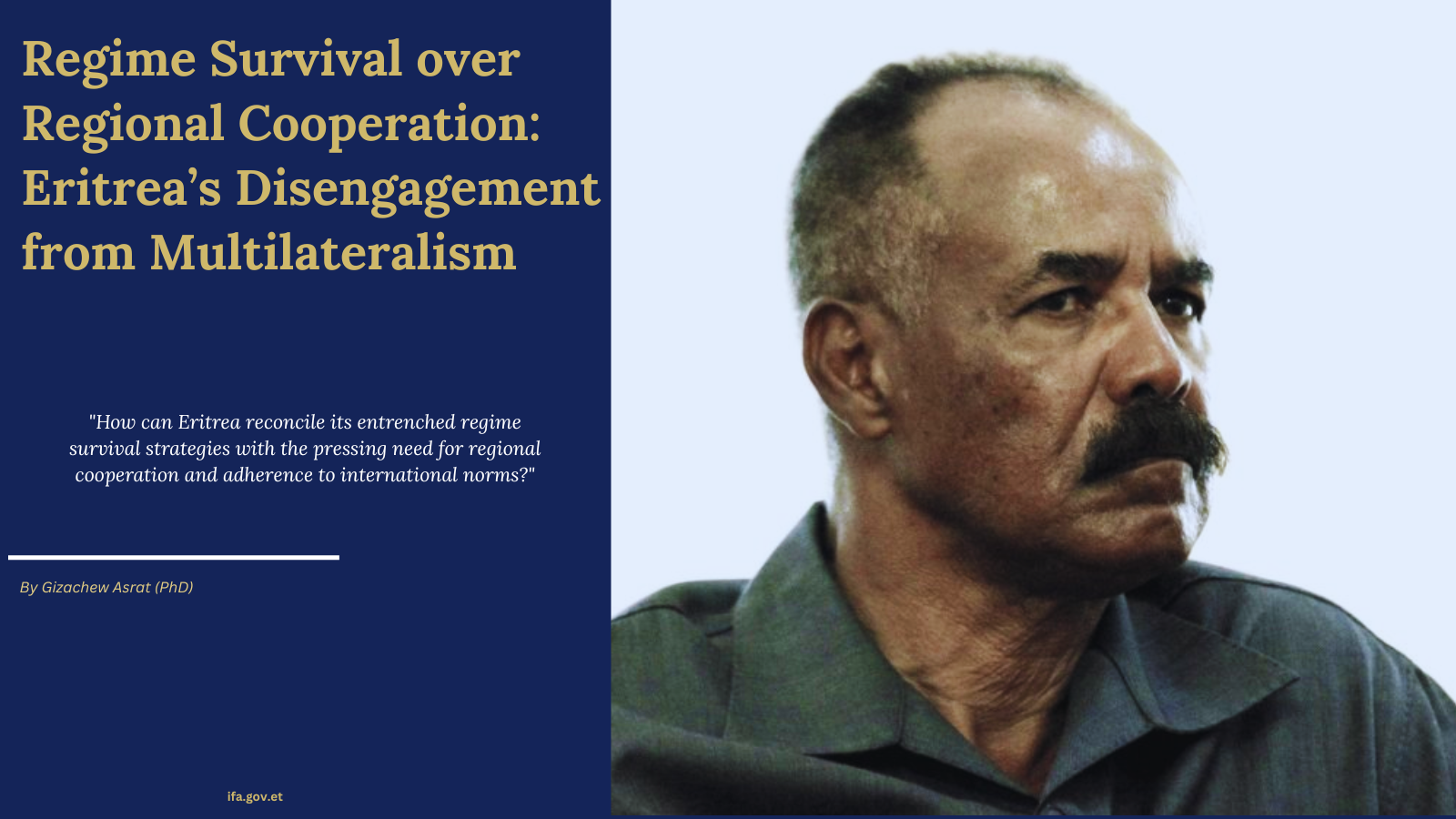
Since achieving de facto independence in 1991, Eritrea has maintained a highly centralised, one‑party political system dominated by President Isaias Afwerki and the People’s Front for Democracy and Justice (PFDJ). The regime operates without meaningful elections, a functioning legislature, or independent civil society oversight, and continues policies of indefinite national service and internal repression documented by the United Nations and human rights organisations. A UN Special Rapporteur has repeatedly reported grave human rights abuses, including arbitrary detention, enforced disappearances, and forced conscription, with no sign of democratic reform over decades of internal and external reporting. As of 2024 an estimated 17 percent of Eritrea’s population had sought asylum abroad, a reflection of persistent repression and limited political freedoms at home that also undermine the country’s standing in international forums. Most of them lived in East Africa. In 2023 2 percent of the country population flees the state.
The Map adopted from UN High Commissioner for Refugees (UNHCR) 2024, cited in Migration Policy Institute, 2025.
Economically, Eritrea remains one of Africa’s most fragile states. Less than six percent of Eritrean land is arable, recurrent droughts and militarised labour policies suppress productivity, and remittances from the diaspora constitute a significant share of GDP amid limited domestic economic diversification. State control extends over roughly 80 percent of GDP, and most Eritreans live in poverty on less than USD 2 per day, with remittances and resource extraction (e.g., the Bisha gold mine) chiefly sustaining the regime and its security apparatus rather than public welfare. These structural economic constraints leave Eritrea with limited financial and administrative capacity for sustained multilateral engagement, encouraging reliance on selective bilateral arrangements that demand less accountability and public transparency.
Eritrea’s pattern of disengagement with multilateral organisations spans decades. After playing a role in early efforts to revitalise the Intergovernmental Authority on Development (IGAD) in the early 1990s, Eritrea abruptly withdrew from IGAD in 2003, citing dissatisfaction with the organisation’s processes and perceived bias, and remained outside the bloc for nearly two decades. Although Asmara rejoined IGAD in June 2023, it never participated meaningfully in its activities and formally withdrew again in December 2025, asserting that membership offered “no discernible strategic benefit” and reflecting deep skepticism toward regional institutional frameworks. In response, IGAD expressed regret and noted Eritrea’s non‑participation even while it attempted conflict mediation and regional cooperation initiatives. This cyclical engagement illustrates that Eritrea’s relationship with regional multilateralism is characterised by absence and withdrawal rather than sustained cooperation.
Eritrea’s interaction with continental and global institutions has been similarly constrained. In 2025, Eritrea sought to end the mandate of the UN Special Rapporteur on its internal human rights situation, submitting a proposal to the UN Human Rights Council to terminate the independent monitoring mechanism. This move marked an unprecedented attempt to weaken accountability mechanisms at the UN level and defensive resistance to scrutiny of its human rights record. Such behaviour underscores Eritrea’s broader reticence to engage in multilateral processes that could expose internal policies to critique or demand compliance with international norms.
Eritrea as a Spoiler in Regional Conflicts: Sudan and Ethiopia
Despite its withdrawal from multilateral frameworks, Eritrea has pursued bilateral and proxy strategies in regional conflicts, notably in Sudan and Ethiopia, where it wields influence through military support and militia engagements rather than institutional cooperation.
In the Sudan conflict, Eritrea has politically and militarily aligned with the Sudanese Armed Forces (SAF), providing training, logistical support, and, according to various reports, even covert deployment of troops to strengthen SAF positions. Eritrean authorities have reportedly facilitated the creation and training of local militias from eastern Sudan including those drawing on eastern tribal networks using camps on Eritrean territory to shape local dynamics in ways favourable to SAF and Eritrean security interests. Observers also point to Eritrea’s role in arms trafficking networks that undermine arms embargoes, and to its strategic diplomacy focused on bilateral ties with Khartoum rather than inclusive, multilateral political solutions. This approach emphasises Asmara’s comfort with bilateral security cooperation over multilateral peace processes in Sudan, as it seeks to manage cross‑border risks and extract strategic advantage in a fragmented regional environment.
Eritrea’s role in the Ethiopian conflict further illustrates its preference for direct military involvement over institutional engagement. Eritrean Defence Forces (EDF) participated alongside Ethiopian federal forces during the law enforcement operation (2020–2022), providing essential manpower that allowed the Ethiopian army to sustain operations and exert control in contested areas. Eritrean troops committed systematic human rights violations, including documented incidences of sexual violence and war crimes actions that continued beyond formal hostilities and contributed to ongoing humanitarian crises in northern Ethiopia. Eritrean forces also reportedly exploited natural and cultural resources in Tigray region, extracting substantial commodities into unregulated markets, in a pattern interpreted as part of a strategic effort to degrade local economic and administrative capacity. These actions reflect Eritrea’s utilitarian engagement in conflict zones, prioritising regime interests and security calculations without accountability to multilateral standards or human rights norms.
Eritrea’s bilateral approach has had enduring consequences for regional stability. In both Sudan and Ethiopia, Eritrea’s military and diplomatic conduct has deepened fragmentation and complicated international efforts aimed at conflict resolution. Its bilateral agreements with Sudanese leadership in 2025, which include security and economic cooperation on projects such as fisheries, mineral refineries, and infrastructure, further solidify ties with SAF while eschewing broader multilateral engagement that could integrate Sudan into regional frameworks. These agreements are pursued outside institutional platforms such as IGAD or African Union (AU) initiatives and signal Eritrea’s strategy of leveraging direct state‑to‑state cooperation to advance its interests.
Economic and Institutional Constraints on Effective Cooperation
Eritrea’s disengagement from multilateralism is reinforced by profound economic and institutional limitations that curtail its capacity to participate effectively in shared governance or collective peacebuilding. The Eritrean economy, constrained by a command structure dominated by state and military interests, struggles with low productivity and widespread poverty; most citizens subsist on limited incomes with minimal social services or economic opportunity. The IMF and other assessments identify remittances as a critical component of the economy, and reports suggest that natural resource ventures such as gold mining are directed more toward regime preservation than public welfare. These economic fragilities reduce the state’s ability to contribute financially or administratively to regional organisations like IGAD or AU programs that require sustained investment and policy alignment.
Such economic constraints intersect with Eritrea’s political culture: an absence of domestic accountability mechanisms, lack of democratic elections, and entrenched authoritarian governance discourage transparency and impede policy reform necessary for constructive participation in multilateral institutions. Without domestic pressure for reform or accountability, the regime has little incentive to align with international norms, instead doubling down on policies that emphasise internal control and bilateral manoeuvring in regional conflicts. This dynamic has contributed to the perception documented by external analysts that Eritrea is an outlier in regional cooperation forums, often acting defensively or disengagedly in contexts where neighbouring states seek collective action on security, economic integration, and political stability.
Eritrea’s disengagement from multilateralism is rooted in a confluence of authoritarian governance, economic fragility, and strategic prioritisation of regime survival through bilateral security and conflict involvement. Its withdrawal from IGAD, resistance to UN human rights mechanisms, and preference for direct engagements in conflicts such as those in Sudan and Ethiopia all exemplify a foreign policy that eschews sustained institutional cooperation in favour of contingent, regime‑centred tactics. This pattern has weakened regional collective responses to shared crises, reduced the efficacy of continental frameworks like the African Union, and complicated international efforts to mitigate human suffering and foster peace. Meaningful change both to Eritrea’s domestic governance and its international engagement would require fundamental reforms that increase transparency, accountability, and integration into cooperative regional mechanisms.
IGAD’s Role Beyond the Criticism
The Horn of Africa states, through the Intergovernmental Authority on Development (IGAD), wielded significant influence over regional affairs. As a key regional organization, IGAD consistently shaped the policy positions of the Organisation of African Unity (OAU) and later the African Union (AU) on Somalia, with its frameworks frequently informing United Nations approaches and strategies in the country. In practice, few stakeholders engaged on political or security matters in the Horn without consulting IGAD and the AU, reflecting IGAD’s status as a central voice in regional diplomacy and conflict management.
IGAD’s leadership extended beyond Somalia to encompass broader peace and security concerns in the region. Notably, the peaceful attainment of South Sudanese independence was largely underpinned by IGAD-led mediation efforts, supported by key member states such as Ethiopia, Kenya, Uganda, and Djibouti. These efforts ultimately contributed to the negotiation and implementation of the 2005 Comprehensive Peace Agreement, which laid the groundwork for South Sudan’s secession. Following South Sudan’s independence, renewed tensions emerged between Khartoum and Juba, particularly over the contested Abyei area. IGAD played a pivotal role in defusing this crisis, facilitating diplomatic engagement between the parties and contributing to discussions on the deployment of peacekeepers. In this context, both Sudan and South Sudan initially advocated for peacekeeping forces drawn from IGAD member states, with Ethiopia identified as a preferred contributor reflecting confidence in the regional organization’s capacity to manage sensitive security arrangements.
Across these engagements from mediating peace processes to shaping continental and international policy IGAD demonstrated its capacity to serve as both a regional convener and peacebroker in the Horn of Africa. Its contributions have been integral to constructing regional consensus, supporting formal peace agreements, and facilitating coordination between African and global actors on issues of peace and security.
IGAD ultimately reflects the commitment of its member states. Unless member states demonstrate genuine political will and undertake meaningful reforms both domestically and at the regional level, IGAD will continue to face significant challenges. After all, it is an institution created, owned, and sustained by the states of the region themselves.
About the author
Gizachew Asrat (PhD), Chief of Staff and Senior Researcher.
Disclaimer:
The content disseminated by the Institute of Foreign Affairs (IFA) – including, but not limited to, publications, public statements, events, media appearances, and digital communications – reflects the views of individual contributors and does not necessarily represent the official positions or policies of the Institute, its partners, or any affiliated governmental or non-governmental entities.
While the IFA endeavors to ensure the accuracy, integrity, and timeliness of the information presented, it makes no representations or warranties, express or implied, regarding the completeness, reliability, or suitability of such content for any purpose. The Institute expressly disclaims any liability for errors or omissions, as well as for any actions taken or decisions made based on the information provided.
The inclusion of external links, references, or third-party resources does not constitute an endorsement by the Institute. Additionally, engagement on social media platforms – including, but not limited to, likes, shares, retweets (RTs), or reposts – shall not be interpreted as an endorsement or validation of the views expressed therein.Readers and audiences are encouraged to exercise critical judgment and seek independent verification when interpreting or relying upon any information disseminated through publications and posts on the Institute’s platforms or representatives.