

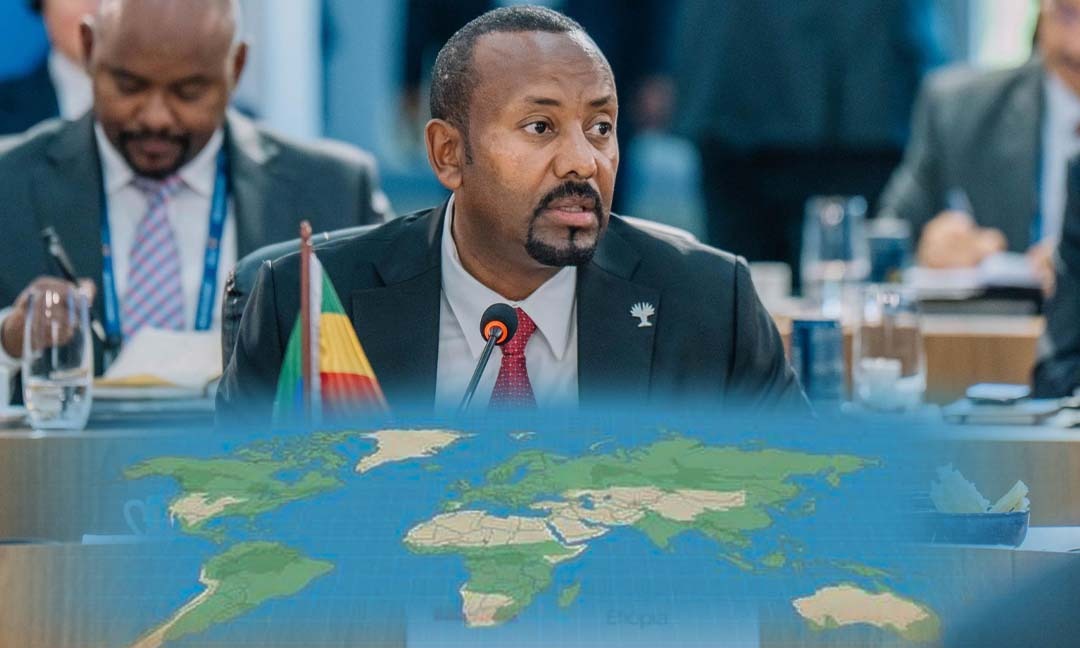
Ethiopia’s foreign policy is undergoing a deliberate recalibration shaped by the acceleration of global multipolarity and intensifying competition between Eastern and Western power blocs. As Africa’s second-most populous country and one of its fastest-growing economies, Ethiopia occupies a structurally important position in the Horn of Africa and the Red Sea hinterland—yet remains constrained by landlocked geography, external debt pressures, and dependence on international capital and trade corridors.
This article argues that Ethiopia’s contemporary diplomacy is best understood as strategic hedging between East and West, rather than bloc alignment or ideological realignment. Addis Ababa is simultaneously deepening engagement with BRICS countries—particularly China and Russia—while reaffirming cooperation with Western-led institutions such as the IMF, World Bank, European Union, and the United States. This dual engagement reflects a rational effort to maximize economic opportunity, preserve policy autonomy, and manage systemic risk in an increasingly fragmented global order.
Ethiopia’s Core National Interests in a Multipolar System
Since Prime Minister Abiy Ahmed assumed office in 2018, Ethiopia’s foreign policy has been anchored in three interrelated pillars: economic diplomacy, regional stability, and strategic autonomy. These priorities align with African Union norms on conflict prevention and integration while remaining compatible with engagement across competing global centers of power. [1]
Ethiopia’s leadership has consistently rejected rigid alignment, instead cultivating diversified partnerships that reduce vulnerability to external shocks. This approach reflects a broader trend among middle powers in the Global South, where hedging—not bandwagoning—has become the dominant survival strategy in an era of great-power rivalry. [2]
Ethiopia’s diplomatic behavior also reinforces its long-standing identity as a contributor to international peace and security. The United Nations has repeatedly recognized Ethiopia’s role in peacekeeping, mediation, and regional stabilization, underscoring its preference for multilateralism over unilateral action.[3]
BRICS Membership and South–South Positioning
Ethiopia’s accession to BRICS in 2024 marked a significant symbolic and strategic milestone. Membership enhances Ethiopia’s access to alternative development finance, political coordination with major emerging economies, and participation in institutions such as the New Development Bank (NDB).[4]
Ethiopia has framed BRICS not as an anti-Western platform but as a complementary avenue for diversification, consistent with its hedging doctrine.[5]
China: Infrastructure, Finance, and Industrialization
China remains Ethiopia’s largest bilateral creditor and a central partner in infrastructure development, particularly in transport, energy, and industrial parks. Flagship projects—including railways, power transmission lines, and manufacturing zones—have been instrumental in Ethiopia’s state-led development model.[6]
At the same time, Ethiopian authorities have sought to recalibrate the relationship by emphasizing debt sustainability, export expansion, and technology transfer rather than unconditional borrowing. [7]
Russia: Diplomatic Signaling and Strategic Autonomy
Ethiopia is rapidly strengthening ties with Russia across energy, defense, and trade, marking a “breakthrough” phase in bilateral relations. Among others, the two countries solidified their commitment to nuclear development in 2019 through a series of high-level agreements between “Rosatom” and the FDRE’s Ministry of Innovation and Technology. This partnership, finalized during the Russia-Africa Summit, established a roadmap for peaceful nuclear energy use and authorized the construction of a collaborative Nuclear Science and Technology Center within Ethiopia. [8]
Bretton Woods Institutions and Economic Stabilization
Despite expanding Eastern ties, Ethiopia has simultaneously deepened engagement with Western-led financial institutions. For the past couple of years, the country has been negotiating a comprehensive IMF program and advanced debt restructuring.
Following the IMF Executive Board’s successful fourth review of Ethiopia’s Extended Credit Facility (ECF), the government has been granted access to approximately US$261 million. This approval reflects the nation’s better-than-expected macroeconomic performance, characterized by robust export growth, enhanced revenue collection, and a cooling of inflationary pressures. The IMF emphasizes that continued commitment to these structural reforms is vital for long-term economic stability and poverty alleviation.[9]
The World Bank has also scaled up financing for social protection, energy access, and economic reform, positioning Ethiopia as a key development partner.[10]
European Union and United States: Diplomacy and High-Level Engagement
Ethiopia has unwaveringly intensified of relations with the EU and the United States, marked by high-level diplomatic visits, resumed development assistance, and renewed security dialogue. EU officials have emphasized Ethiopia’s regional importance and the necessity of engagement over isolation, particularly in the context of Red Sea security and Horn of Africa stability.
In a recent high-level meeting, Ethiopia reaffirmed its commitment to deepening its five-decade strategic partnership with the European Union. Both parties highlighted the importance of their ongoing cooperation in economic development, peace-building, and regional security, while pledging to enhance political dialogue and collaboration on global multilateral issues of mutual interest.[11]
The European Union and Ethiopia have launched the 2024 Annual Action Programme, a €240 million (32.3 billion Birr) initiative designed to accelerate national recovery and sustainable development. This comprehensive agreement focuses on six strategic pillars: stabilizing democratic institutions and transitional justice, restoring essential health services in conflict-affected regions, and providing durable solutions for displaced populations. Furthermore, the partnership aims to modernize the economy by boosting agribusiness competitiveness, enhancing digital skills within the vocational education system, and strengthening the private sector through tax, customs, and capital market reforms. This program marks a significant revitalization of bilateral relations, aligning international support with Ethiopia’s broader economic and social reform agenda.[12]
Building on a diplomatic foundation established over 120 years ago, Ethiopia and the United States maintain one of the longest-standing partnerships in sub-Saharan Africa, characterized by extensive humanitarian and developmental cooperation. Under the current 2022–2027 Country Development Cooperation Strategic Agreement, the U.S. has committed over $2 billion to enhance disaster resilience, promote private sector-led growth, and improve essential service delivery, particularly for women and girls. As the largest bilateral donor to Ethiopia, the U.S. continues to play a pivotal role in strengthening citizen-responsive governance and improving the livelihoods of millions through significant investments in health, education, and food security. [13]
Besides, in a high-level meeting at his office H.E. Dr. Gedion Timothewos, Minister of Foreign Affairs of Ethiopia, received US Deputy Secretary of State Christopher Landau to discuss deepening the long-standing bilateral partnership between their two nations. Commemorating 120 years of diplomatic relations, the officials explored avenues for enhanced cooperation and exchanged perspectives on regional security and other matters of mutual interest.[14]
Ethiopia as a Regional Stabilizer
Contrary to alarmist narratives, Ethiopia continues to function as a regional de-escalator. It remains actively involved in African Union peace initiatives, counter-terrorism cooperation, and UN peace support training, reinforcing its image as an anchor of stability despite internal and external pressures.
Far from destabilizing the region, Ethiopia’s approach could reduce trade bottlenecks, strengthen Horn-Red Sea economic corridors, and promote cooperative infrastructure development
Above all Ethiopia has been an anchor of peace in the Horn of Africa. Despite internal and regional challenges, Ethiopia continues to participate in regional peacekeeping and counter-terrorism efforts, support African Union mediation frameworks, and advocate sovereignty, dialogue, and conflict prevention. [15]
Strategic restraint—even when national interests are strongly implicated—has become a defining feature of Ethiopia’s diplomacy, enhancing its credibility with both Eastern and Western partners.
Conclusion
Ethiopia’s foreign policy is neither drifting eastward nor returning unconditionally to the Western fold. Instead, it represents a calculated exercise in strategic hedging, leveraging BRICS, China, and Russia to diversify partnerships while maintaining indispensable ties with the IMF, World Bank, EU, and the United States.
This balancing act is not ideological but pragmatic—driven by development imperatives, demographic realities, and the pursuit of sovereign decision-making space. As global polarization deepens, Ethiopia’s ability to engage across divides positions it as a critical diplomatic balancer in the Horn of Africa and the wider Red Sea system.
References
- Yalemsew Genetu, “Ethiopia’s Foreign Policy Aspiration under PM Abiy Ahmed: A Brief Overview,” Institute of Foreign Affairs (IFA), November 2024, https://newsite.ifa.gov.et//wp-content/uploads/2024/11/Ethiopias_foreign_policy_aspiration_under_PM_Abiy_Ahmed_A_Brief.pdf.
- Mehtap Kara, “Strategic Hedging of Middle Powers in an Era of Great Power Competition,” ResearchGate, January 2025, https://www.researchgate.net/publication/397653401_Strategic_Hedging_of_Middle_Powers_in_an_Era_of_Great_Power_Competition.
- “UN Praises Ethiopia for Founding Role, Commitment to Global Peace,” Ethiopian News Agency, October 24, 2024, https://www.ena.et/web/eng/w/eng_7594336.
- Wen Wang and Chen Long, “A New Era of ‘Greater BRICS Cooperation’: The Future of the World and China’s Role,” BRICS Journal of Economics 5, no. 4 (December 20, 2024): 37–54, https://doi.org/10.3897/brics-econ.5.e129530.
- Guilherme Barcha Schneider, “Ethiopia and BRICS: From Membership to Strategic Economic Partnership,” Institute of Foreign Affairs, December 15, 2025, https://newsite.ifa.gov.et//2025/12/15/ethiopia-and-brics-from-membership-to-strategic-economic-partnership/.
- Qian Zhou, “China-Ethiopia Trade, Investment, and Opportunities,” China Briefing, March 28, 2025, https://www.china-briefing.com/news/china-ethiopia-trade-investment-opportunities/.
- “Ethiopian Delegation Visits China to Advance Debt Restructuring, Strengthen Economic Cooperation,” Ethiopian News Agency (ENA), September 22, 2025, https://www.ena.et/web/eng/w/eng_7378365.
- “Bilateral Relations,” Embassy of the Russian Federation in the Federal Democratic Republic of Ethiopia, accessed January 29, 2026, https://ethiopia.mid.ru/en/russia_ethiopia_english/bilateral_relations/.
- International Monetary Fund, “IMF Executive Board Completes Fourth Review Under the Extended Credit Facility Arrangement for Ethiopia,” Press Release No. 26/09, January 16, 2026, https://www.imf.org/en/news/articles/2026/01/16/pr-26009-ethiopia-imf-completes-4th-rev-under-ecf-arrangement.
- World Bank, “World Bank Supports Ethiopia’s Efforts to Unleash the Potential of Its Financial Sector,” Press Release, December 19, 2024, https://www.worldbank.org/en/news/press-release/2024/12/19/world-bank-supports-afe-ethiopias-efforts-to-unleash-the-potential-of-its-financial-sector.
- “Ethiopia, EU Sign 240 Mln Euro Annual Action Program,” Ethiopian News Agency (ENA), January 23, 2026, https://www.ena.et/web/eng/w/eng_8203068.
- European Union Delegation to Ethiopia, “European Union and Ethiopia Sign Annual Action Programme 2024, Allocating EUR 240 Million (32.3 Billion Birr),” European External Action Service, January 23, 2026, https://www.eeas.europa.eu/delegations/ethiopia/european-union-and-ethiopia-sign-annual-action-programme-2024-allocating-eur-240-million-323-billion_en.
- “Ethio-USA: 120 Years of Friendship and Economic Cooperation,” Ministry of Finance of the Federal Democratic Republic of Ethiopia, accessed January 29, 2026, https://www.mofed.gov.et/blog/ethio-usa-120-years-of-friendship-and-economic-cooperation/.
- Ministry of Foreign Affairs of Ethiopia, “Foreign Minister Gedion holds talks with US Deputy Secretary of State,” Facebook, January 28, 2026, https://www.facebook.com/MFAEthiopia/posts/1199895515628943.
- United Nations Development Programme (UNDP), “Ethiopian International Peace Support Training Institute,” accessed January 29, 2026, https://www.undp.org/ethiopia/projects/ethiopian-international-peace-support-training-institute.
By Getahun Tsegaye, IFA-associated researcher
Disclaimer:
The content disseminated by the Institute of Foreign Affairs (IFA) – including, but not limited to, publications, public statements, events, media appearances, and digital communications – reflects the views of individual contributors and does not necessarily represent the official positions or policies of the Institute, its partners, or any affiliated governmental or non-governmental entities.
While the IFA endeavors to ensure the accuracy, integrity, and timeliness of the information presented, it makes no representations or warranties, express or implied, regarding the completeness, reliability, or suitability of such content for any purpose. The Institute expressly disclaims any liability for errors or omissions, as well as for any actions taken or decisions made based on the information provided.
The inclusion of external links, references, or third-party resources does not constitute an endorsement by the Institute. Additionally, engagement on social media platforms – including, but not limited to, likes, shares, retweets (RTs), or reposts – shall not be interpreted as an endorsement or validation of the views expressed therein.Readers and audiences are encouraged to exercise critical judgment and seek independent verification when interpreting or relying upon any information disseminated through publications and posts on the Institute’s platforms or representatives.