

- Introduction
Exactly 100 years ago, the Republic of Türkiye established its first Sub-Saharan African embassy in Addis Ababa in 1926, and assigned Ahmet Munir as the inaugural Turkish ambassador to Ethiopia. In response, Ethiopia warmly welcomed the decision of Turkiye, opening its embassy in Ankara in 1933, and appointed Birhane Markos as its first Ethiopian ambassador (Jima, 2021). Since then, the two countries have established consistent relationship without the involvement of a third party, characterized by a unique cooperation. During the Italo-Ethiopian aggression, for instance, Türkiye expressed its solidarity with Ethiopia, opposing Italy’s violent behavior and voicing support for the sovereignty of Ethiopia at the League of Nations (Suadiq, 2025). In a similar vein, these days, Turkiye has also maintained healthy diplomatic relations with Ethiopia even when there national interests diverge. Shared perspectives on regional issues such as the Nile dispute and Ethiopia’s quest for sea access proved Turkish positive sprit pertaining to critical concerns of Ethiopia. Such position enabled Turkiye to successfully mediate the historic Ankara declaration which helped ease tension between Ethiopia and Somalia tension (Yeni Safak, 2026).
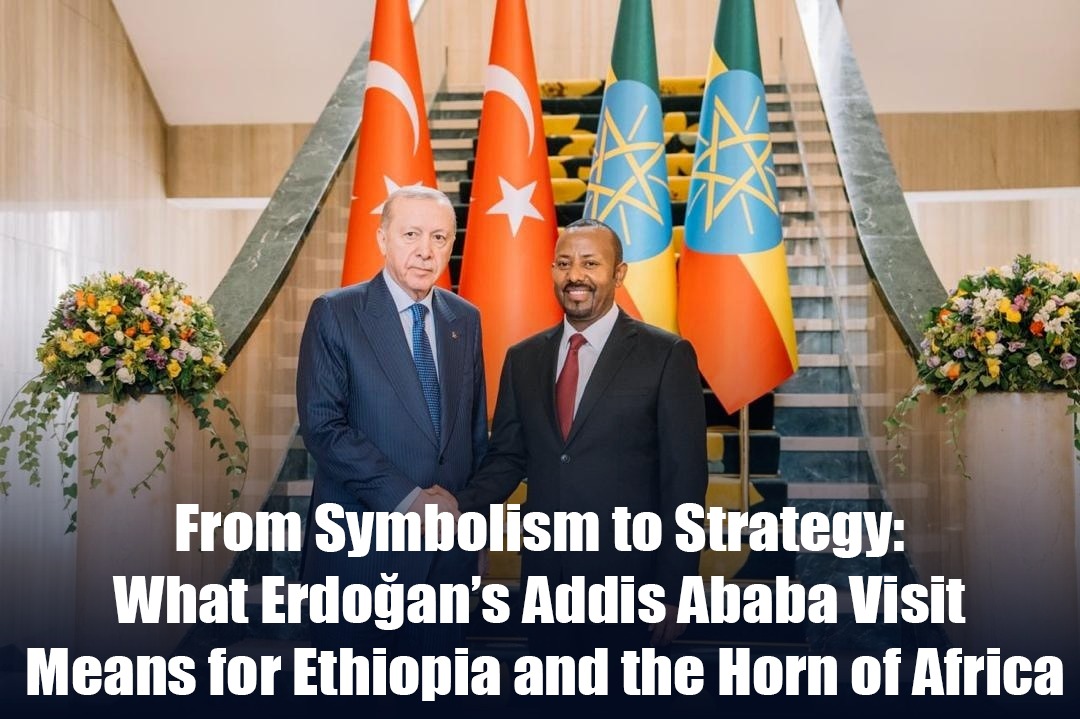
In particular, over the past two decades, Ethio-Turkish relations have evolved into a broad and multifaceted partnership. Their growing engagement has been reinforced by high-level visits conducted by the leaders of the two respective countries. These reciprocal multiple visits highlights the depth and the fruition of their diplomatic ties, commenced half millennia ago (Journal, 2021). Focusing specifically on the latest high level engagement, Turkish President Erdogan visited Ethiopia on 17 February 2026, a historic occasion that coincided with the 100th anniversary of the opening of Turkish embassy in Ethiopia (Jima, 2021). Prime Minister Abiy Ahmed mentioned during a press conference that he initiated the visit of the President when he met with Erdoğan on the sidelines of the G20 meeting in South Africa.
- Strategic Dimensions of Erdogan’s Visit to Ethiopia
President Erdoğan visited Ethiopia in 2015 for the first time. However, after that initial trip, more than a decade passed without another presidential visit. Thus, when Erdoğan eventually returned to Ethiopia after over 10 years, his visit signaled a renewed commitment to deepening bilateral cooperation and re-engaging with Ethiopia. Therefore, the current visit and discussion will have profound outcome in multiple arenas. Diplomatic sources described the discussion between Prime Miniter Abiy and President Erdogan as “constructive and forward-looking,” focusing not only Ethio-Turkish bilateral engagements but also emphasizing shared interests such as regional stability and South–South cooperation (ILKHA, 2026). Pertaining to regional stability, for example, President Erdogan expressed that Türkiye would never want to see new conflict in the Horn of Africa, urging countries in the region to resolve their problems on their own.
During their discussion, Prime Minister Abiy Ahmed and President Erdogan touched a range of strategic dimensions such as strengthening cooperation in trade and investment, access to the sea and anti-terrorism. Hence, while the visit of the president honoring the 100th anniversary of the commencement of Ethio –Turkish diplomatic engagement; it also reaffirms Ethio-Turkish strategic partnership in diversified fields presented hereunder.
- Economic and Trade Cooperation
Expanding economic and trade cooperation is a cornerstone of Ethio-Turkish relations, as Turkiye has emerged as Ethiopia’s second-largest trading partner, next to China. Importantly, following the official visit of President Erdogan, Ethiopia and Turkiye have signed multiple agreements aimed at expanding the already existing economic, trade, and energy cooperation between the two countries. Among others, the two countries agreed to work towards enhancing the trade relation between Ethiopia and Türkiye to be at least $1 billion or more. They also formalized their commitment to Comprehensive Energy Cooperation Framework, signed by Ethiopian Water and Energy Minister, Habtamu Itefa and his counterpart Alparslan Bayraktar, Turkish Energy and Natural Resources (Yeni Safak, 2026).
2.2. Foreign Direct Investment
Türkiye ranks among the leading foreign investors in Ethiopia. Its broader FDI flow in Ethiopia hinged on Ethiopia’s liberal investment policies, cheap labor, and recently the creation of industrial parks. Berk Baran, Ambassador of the Republic of Türkiye to Ethiopia pointed out that starting from 2006 to 2023, there were a total of above 200 Turkish owned foreign direct investment projects in Ethiopia with a capital of more than 10 Billion Ethiopian Birr (Capital News, 2023). In this regard, the current visit of Ethiopia by Erdogan carries significant implications for the flow of Turkish foreign direct investment into the country. While holding a joint press conference with Prime Minister Abiy Ahmed, Erdogan Said, “We are pleased to be the second biggest investor in Ethiopia. It is a source of pride for us that more than 200 Turkish companies, with investments amounting to 2.5 billion dollars, are supporting the employment of approximately 20,000 Ethiopians”.
- The Quest for Access to the Sea
Ethiopia is a landlocked country following the independence of Eritrea since 1993. The loss of its coastal territories constrained Ethiopia’s access to international trade routes which significantly affect its pursuit of strategic autonomy. Ethiopia’s inability to access the Red Sea directly isolated it economically and geographically from the crucial Red Sea region. Its departure from the strategic Red Sea created a maritime vacuum for Ethiopia, making the Land of Origin, Prisoner of Geography. It seems in this context that Prime Minister Abiy Ahmed formally asked Türkiye to support Ethiopia’s quest for sea access. The Prime Minister stressed that sustaining Ethiopia’s rapid economic growth requires resolving structural bottlenecks, particularly in logistics and maritime access. He also underscored that Ethiopia, with a population of over 130 million, has remained landlocked for decades contrary to global norms, describing the condition as historically unjust. In attempting to magnify the value of the sea access, the Prime Minister further noted that Ethiopia’s fastest-growing economy needs maritime access to sustain the momentum. According to him, Ethiopia has been made a prisoner of geography for years, a condition that must be changed with the support of friendly countries such as Turkiye. It is hoped that Türkiye and its partners recognize the injustice pertaining to the landlocked-ness of Ethiopia. As the prime minister urged, it is therefore, imperative to exert diplomatic pressure to secure Ethiopia’s rightful access to the sea.
Conclusion
President Erdogan’s current visit of Ethiopia coincided with the 100th anniversary of the birth of modern Ethio-Turkish diplomatic relations. Hence, it can be framed around commemorating century-old diplomatic ties between the two countries. Yet, its tangible outcomes are rooted in economic and strategic cooperation, enhancing the prospects of trade, investment, and regional security in the Horn of Africa. Indeed, by celebrating 100 years of partnership, both countries demonstrate consistent commitment on mutual respect, collaboration, and forward-looking engagement that will continue to shape their strategic partnership in the future. Ethiopia can benefit from the recent agreements signed with Turkiye, as Turkish experiences in various areas potentially offer a lesson to Ethiopia.
References
Capital News. (2023). Turkiye insight. Available https://capitalethiopia.com/2023
ILKHA (2025). Türkiye and Ethiopia sign landmark economic and energy agreements. Available at https://ilkha.com/english/world/turkiye
Jıma, N. (2021). Turkey and Ethiopia relations: Historical perspective (1920’s to 1991). Cedrus, 9, 473-483.
Journal, K. (2022). Ethiopia’s Relation with the Ottomans: From Hostility to Understanding. Kadim. https://doi.org/10.54462/KADIM.1039019
Suadiq Sufian. (2025). Turkish Mediation Diplomacy: The Ankara Declaration and Its Strategic Implications for Ethiopia. Institute of Foreign Affairs, Policy Brief.
Yeni Safak.(2026). Türkiye and Ethiopia sign energy MoU to develop joint power, renewables projects. Available at https://en.yenisafak.com/turkiye/turkiye
About the author
Suadiq Sufian (Ph.D.), Senior Researcher in Middle East and Asia Pacific Affairs Directorate General at the Institute of Foreign Affairs.
He can be reached at suadiq2008@gmail.com.
Disclaimer:
The content disseminated by the Institute of Foreign Affairs (IFA) – including, but not limited to, publications, public statements, events, media appearances, and digital communications – reflects the views of individual contributors and does not necessarily represent the official positions or policies of the Institute, its partners, or any affiliated governmental or non-governmental entities.
While the IFA endeavors to ensure the accuracy, integrity, and timeliness of the information presented, it makes no representations or warranties, express or implied, regarding the completeness, reliability, or suitability of such content for any purpose. The Institute expressly disclaims any liability for errors or omissions, as well as for any actions taken or decisions made based on the information provided.
The inclusion of external links, references, or third-party resources does not constitute an endorsement by the Institute. Additionally, engagement on social media platforms – including, but not limited to, likes, shares, retweets (RTs), or reposts – shall not be interpreted as an endorsement or validation of the views expressed therein.Readers and audiences are encouraged to exercise critical judgment and seek independent verification when interpreting or relying upon any information disseminated through publications and posts on the Institute’s platforms or representatives.