

I. The Corridor Paradox
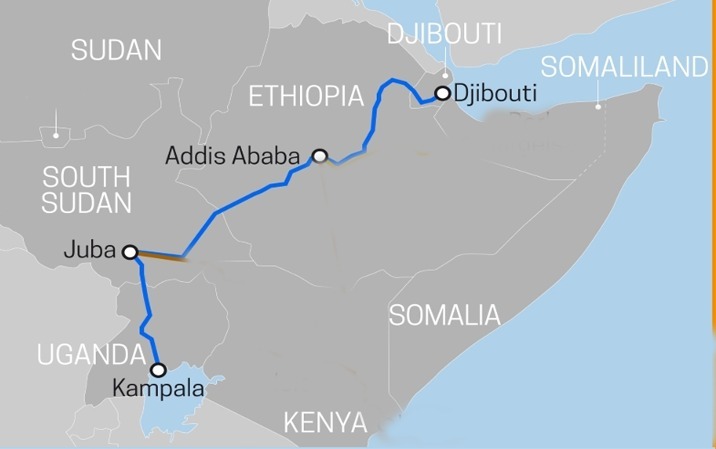
DESSU—the Djibouti–Ethiopia–South Sudan–Uganda Corridor—is a newly formalized multimodal trade and logistics initiative anchored by an intergovernmental agreement establishing the DESSU Corridor Authority, signed in Djibouti on 15 February 2026. Public descriptions present it as a strategic connectivity platform linking Djibouti’s Red Sea port infrastructure to inland markets and logistics nodes across Ethiopia, South Sudan, and Uganda, with a route commonly described as connecting the Port of Djibouti to Addis Ababa, Jimma, Boma, Raad, Kapoeta, Nimule, Gulu, and Kampala. The project is strategically important because it seeks to connect the Horn more directly to the Great Lakes economic space through coordinated transport and logistics systems—not only through physical infrastructure, but through a shared governance framework.
In the Horn of Africa, corridor politics is often narrated through maps, ports, roads, and announcements. The language is usually physical: access, distance, throughput, infrastructure. Yet the region’s harder constraint is increasingly not whether corridors can be imagined or even built, but whether they can be governed. DESSU brings this contradiction into focus. Its strategic significance lies less in its value as a transport project and more in what it represents as an institutional experiment: a test of whether participating actors can build durable rules for cross-border coordination in a politically sensitive regional environment.
This is why DESSU should not be analyzed primarily as a logistics asset. It should be read as a corridor-governance regime in formation. The decisive variable is not the scale of infrastructure ambition or the symbolism of connectivity, but whether the corridor can develop workable arrangements around authority design, customs harmonization, and dispute resolution. In the Horn, where sovereignty concerns and integration imperatives coexist uneasily, these institutional questions determine whether corridor politics produces leverage or deadlock.
II. Why DESSU Matters Beyond the Project Lens
The broader point is not unique to DESSU. Across the region, the political life of corridors has entered a new phase. Earlier debates centered on access: who gets a route, which port matters, what infrastructure is financed, and which external actors support which network. Those questions remain important. But as more corridor initiatives move from declaration to implementation, the strategic bottleneck shifts from construction to coordination. Roads can be built faster than trust. Transport can be announced faster than customs systems can be aligned. Political agreements can be signed faster than administrative systems can operate across jurisdictions. DESSU matters because it reveals this transition from project politics to governance politics.
That alone makes it analysis-worthy. Corridor arrangements in the Horn are not merely commercial tools; they are regional-order mechanisms. They shape trade patterns, redistribute bargaining power, and expose state dependencies on neighboring administrative systems. They also sit at the intersection of sovereignty and functional necessity. States seek strategic control over routes, revenues, and border authority, while the effective operation of a corridor requires standardization, predictability, and some degree of delegated coordination. DESSU therefore carries significance beyond infrastructure planning: it has spillover implications, it sits at a strategic bottleneck, and it may set a precedent for how corridor governance is approached in the Horn.
III. From Corridor as Asset to Corridor as Regime
A project-centered analysis of DESSU risks missing the issue’s core strategic logic. The project lens tends to focus on visible milestones: memoranda, financing signals, construction phases, route promotion, and geopolitical messaging. Those indicators matter, but they often overstate progress. In practice, many corridors underperform because the governance architecture remains unresolved. What appears on paper as connectivity can, at the operational level, become layered friction: duplicate inspections, inconsistent documentation, contested fees, slow clearances, jurisdictional overlap, and ad hoc political intervention when disputes emerge.
This is the central analytical shift DESSU invites. A corridor is not only a physical route linking origin and destination points. It is a regime of coordinated authority. It consists of legal and administrative procedures, compliance standards, revenue arrangements, inspection practices, security protocols, and escalation mechanisms. It is, in effect, a governed chain of decisions. The quality of that chain is what produces corridor performance.
A corridor with modest infrastructure but coherent governance can outperform a better-equipped route trapped in institutional fragmentation. Conversely, a corridor with strong strategic branding but weak operational rules can become a site of recurrent delay, informal extraction, and political mistrust. Infrastructure creates the possibility of integration; governance determines whether that possibility becomes a reliable system.
IV. The Core Governance Question in DESSU: Who Governs What, Where, and Under Which Rules?
Seen this way, the most consequential questions around DESSU are not simply where the corridor runs or what it promises to connect, but who governs what, where, and under which rules. This is where corridor politics becomes statecraft.
A. Authority Design
Authority design is the first test. Corridors cross and connect institutions, not just territory. Ministries, customs agencies, transport regulators, local administrations, security actors, and executive offices often operate with overlapping mandates and uneven incentives. Without clear allocation of operational authority, coordination can become episodic and vulnerable to political shocks. A corridor may then depend less on institutional routines than on intermittent high-level intervention—a pattern that can keep a project alive rhetorically while limiting performance in practice.
Authority design is also where sovereignty concerns become most visible. States are unlikely to cede strategic control over routes tied to revenue, security, or national planning. But corridor operations require some degree of procedural harmonization and institutional predictability that can constrain discretionary action at key nodes. This does not necessarily require surrendering sovereignty. It requires a more difficult move: converting sovereignty into rule-based coordination. The real challenge is not whether sovereignty is preserved in principle, but whether it can be exercised in ways that permit functional cooperation. DESSU’s future, in that sense, depends on whether participating actors can build institutional arrangements that protect state agency while reducing operational arbitrariness.
B. Customs Harmonization
Customs harmonization is the second and perhaps most decisive test because it is where corridor governance becomes tangible. Much of corridor underperformance in the region stems not from the absence of roads but from the accumulation of procedural delays. If documentation is not interoperable, if inspections are duplicated, if risk management systems are inconsistent, or if clearance decisions remain opaque, then infrastructure gains are diluted. Customs harmonization is often described as a technical matter, but in corridor politics it is a strategic one. It determines throughput, cost predictability, and trader confidence. It shapes whether a corridor is viewed as a dependable route or as a politically exposed gamble.
More importantly, customs systems are deeply political. They involve revenue collection, enforcement authority, anti-smuggling concerns, and bureaucratic discretion. Agencies may formally support harmonization while informally resisting changes that reduce gatekeeping power or alter established revenue channels. Digitization and process standardization can improve efficiency, but they also redistribute administrative control. This is why customs reform cannot be treated as an afterthought to infrastructure development. For DESSU, customs harmonization is not simply one implementation component among many; it is the operational core of corridor governance. Without it, the corridor remains a project in name but not a system in practice.
C. Dispute Resolution and Escalation Control
The third governance pillar is dispute resolution. This is frequently underdeveloped in corridor planning, yet it is often what determines resilience. Corridors generate routine disputes: over fees, inspections, delays, liability, security incidents, documentation discrepancies, and the interpretation of agreed procedures. In politically sensitive environments, even minor frictions can escalate quickly if there is no credible mechanism for technical resolution. What begins as an operational disagreement can become a sovereign dispute, especially when corridor issues intersect with broader bilateral tensions.
DESSU’s strategic value will therefore depend in part on whether it can institutionalize dispute management before crises emerge. That means not only identifying who adjudicates disagreements, but also defining escalation ladders, timelines, and technical forums that allow disputes to be contained at the appropriate level. Corridors cannot eliminate friction. Their success depends on whether friction is governed. In the absence of such architecture, every disruption becomes a test of political will, and corridor reliability declines accordingly.
V. Competing Readings of DESSU: Integration Instrument or Symbolic Corridor?
There are, of course, competing ways to read DESSU. The first is an integrationist view that sees the corridor as a practical mechanism for reducing trade costs, improving connectivity, and deepening interdependence. On this reading, corridor development can create shared incentives that gradually discipline political volatility. Even where trust is limited, the mutual gains from improved movement and commerce can sustain cooperation. This logic has real force. Functional arrangements can, under the right conditions, build confidence over time and generate constituencies that favor stability.
A second reading is more skeptical and sovereignty-realist. It views DESSU as vulnerable to the same structural constraints that have limited regional initiatives elsewhere in the Horn: political mistrust, uneven state capacity, mandate overlap, fragmented implementation, and the tendency to privilege announcements over institutional sequencing. From this perspective, corridor projects can become symbolic assets—useful for signaling ambition or attracting external attention—but less effective in changing the underlying governance conditions needed for reliable operation. Here too, the skepticism has empirical grounding. The region has seen ambitious frameworks struggle when administrative systems remain underaligned or politically exposed.
A balanced assessment should resist treating these interpretations as mutually exclusive. Both are plausible; each becomes more accurate under different institutional conditions. DESSU can become a meaningful integration instrument if governance design is front-loaded—if authority is clarified, customs practices are harmonized, and dispute mechanisms are operationalized early. It can also become another underperforming corridor if governance is postponed until after infrastructure milestones or left to ad hoc political management. The strategic question is therefore not whether DESSU is desirable in principle, but under what governance conditions it becomes workable in practice.
VI. DESSU in the Horn’s Larger Corridor Politics: From Access Politics to Rule Politics
This matters beyond DESSU itself because it reflects a wider shift in the Horn’s corridor politics—from access politics to rule politics. For years, regional debates have understandably focused on routes, ports, and physical connectivity. Strategic geography remains central. But geography alone does not govern flows. As corridor density and competition increase, the decisive terrain increasingly becomes regulatory and institutional. Which corridor gains strategic relevance will depend not only on distance and infrastructure quality, but on which route offers the most predictable governance environment: faster clearance, fewer procedural ambiguities, more credible dispute management, and greater insulation from bilateral political shocks.
This is where the Horn’s recurring tension between infrastructure optimism and political fragility becomes acute. Corridors promise integration, but their success depends on political trust, customs coordination, and administrative discipline that cannot be built overnight. Infrastructure can outpace institution-building, creating a mismatch between physical capacity and governance capacity. When that gap widens, expectations rise faster than performance, and political disappointment can harden into strategic mistrust. DESSU should therefore be seen as a stress test not only of transport planning, but of the region’s ability to convert connectivity ambitions into governed interdependence.
Corridor politics, in this sense, is a form of regional order-making. Corridors do not merely move goods; they distribute leverage, shape dependencies, and reorganize border governance. DESSU’s trajectory may therefore influence not just trade flows, but how states in the Horn imagine the relationship between sovereignty and cooperation in future infrastructure-linked arrangements.
VII. The Political Economy of Corridor Governance: Leverage, Revenue, and Administrative Incentives
The political economy dimension reinforces this point. Corridor governance disputes are not simply technical failures; they often reflect rational institutional incentives. Revenue collection, transit fees, licensing systems, inspection powers, and local administrative control all create interests that may favor friction over flow. Streamlining procedures can improve corridor performance while reducing discretionary rents or redistributing authority among agencies. In such settings, formal commitments to harmonization may coexist with informal resistance to implementation.
This is not unique to the Horn, but it is especially consequential in contexts where state institutions are capacity-constrained and politically layered. DESSU’s governance design will need to account for these incentive structures rather than assume administrative alignment. A corridor governance framework that overlooks bureaucratic interests and revenue politics may be formally coherent but operationally weak.
External partners can help close some of these gaps through financing, technical support, and systems development. But here too, the region’s experience suggests the need for pragmatic caution. External support can strengthen corridor governance if it reinforces locally owned sequencing and interoperable standards. It can also fragment governance if parallel priorities, competing technical models, or politically driven timelines encourage institutional patchworks rather than coherent systems. The issue is not whether external involvement is inherently beneficial or harmful. It is whether it aligns with a corridor-governance strategy rooted in local institutional realities rather than in project visibility alone.
VIII. Historical and Regional Lessons: Constraint Mapping, Not Background
DESSU also fits a broader regional pattern in which infrastructure ambition often advances faster than governance harmonization. Across the Horn and adjacent regional integration efforts, a recurring implementation gap has appeared: frameworks are announced, routes are prioritized, and political signaling is strong, but customs/legal coordination, operational sequencing, and dispute-management mechanisms lag behind. The result is not necessarily project failure, but underperformance relative to strategic expectations.
The lesson is not that corridor initiatives are misguided. It is that corridor performance depends on institutional sequencing. Crisis periods tend to reveal whether a corridor is governed by durable rules or sustained by temporary political alignment. DESSU’s long-term significance will therefore hinge on whether it internalizes this lesson early—treating governance architecture as foundational rather than supplementary.
IX. What Will Determine DESSU’s Trajectory? The Real Tests Ahead
DESSU’s importance lies in what it reveals about the next phase of regional statecraft in the Horn. Corridor politics is no longer only about securing routes; it is increasingly about governing interfaces—between institutions, jurisdictions, and competing conceptions of sovereignty and cooperation. This is why the article’s central claim matters: DESSU is less a transport story than a governance story. Its outcomes will shape not just movement, but the credibility of a wider regional proposition—that the Horn can build forms of interdependence that are politically managed rather than perpetually improvised.
The key tests ahead are therefore institutional, not rhetorical:
- Authority clarity: Can operational mandates be clarified before overlapping roles become chronic bottlenecks?
- Customs sequencing: Will customs harmonization be treated as core architecture rather than downstream technical cleanup?
- Dispute institutionalization: Can routine frictions be contained through agreed mechanisms before they escalate into political confrontations?
- Insulation from bilateral volatility: Can corridor operations remain functional during periods of diplomatic strain?
- Administrative capacity and compliance: Do participating institutions have the systems and discipline to implement agreed rules consistently?
- Incentive alignment: Can revenue and bureaucratic incentives be aligned toward throughput and predictability rather than checkpoint control and fragmentation?
These questions do not produce a simple verdict on DESSU. They produce a more useful one. DESSU’s trajectory will depend less on the ambition of infrastructure announcements than on the quality of governance design that follows them. In the Horn of Africa’s evolving corridor politics, the decisive contest may be less about building routes than about building the institutions that make routes usable. If DESSU succeeds in making that shift—from project diplomacy to corridor governance—it could become more than a connectivity initiative. It could become a precedent for how the region manages sovereignty and interdependence in the same strategic space.
By kuchim Sileshe, Assistant researcher at IFA
Disclaimer:
The content disseminated by the Institute of Foreign Affairs (IFA) – including, but not limited to, publications, public statements, events, media appearances, and digital communications – reflects the views of individual contributors and does not necessarily represent the official positions or policies of the Institute, its partners, or any affiliated governmental or non-governmental entities.
While the IFA endeavors to ensure the accuracy, integrity, and timeliness of the information presented, it makes no representations or warranties, express or implied, regarding the completeness, reliability, or suitability of such content for any purpose. The Institute expressly disclaims any liability for errors or omissions, as well as for any actions taken or decisions made based on the information provided.
The inclusion of external links, references, or third-party resources does not constitute an endorsement by the Institute. Additionally, engagement on social media platforms – including, but not limited to, likes, shares, retweets (RTs), or reposts – shall not be interpreted as an endorsement or validation of the views expressed therein.Readers and audiences are encouraged to exercise critical judgment and seek independent verification when interpreting or relying upon any information disseminated through publications and posts on the Institute’s platforms or representatives.