

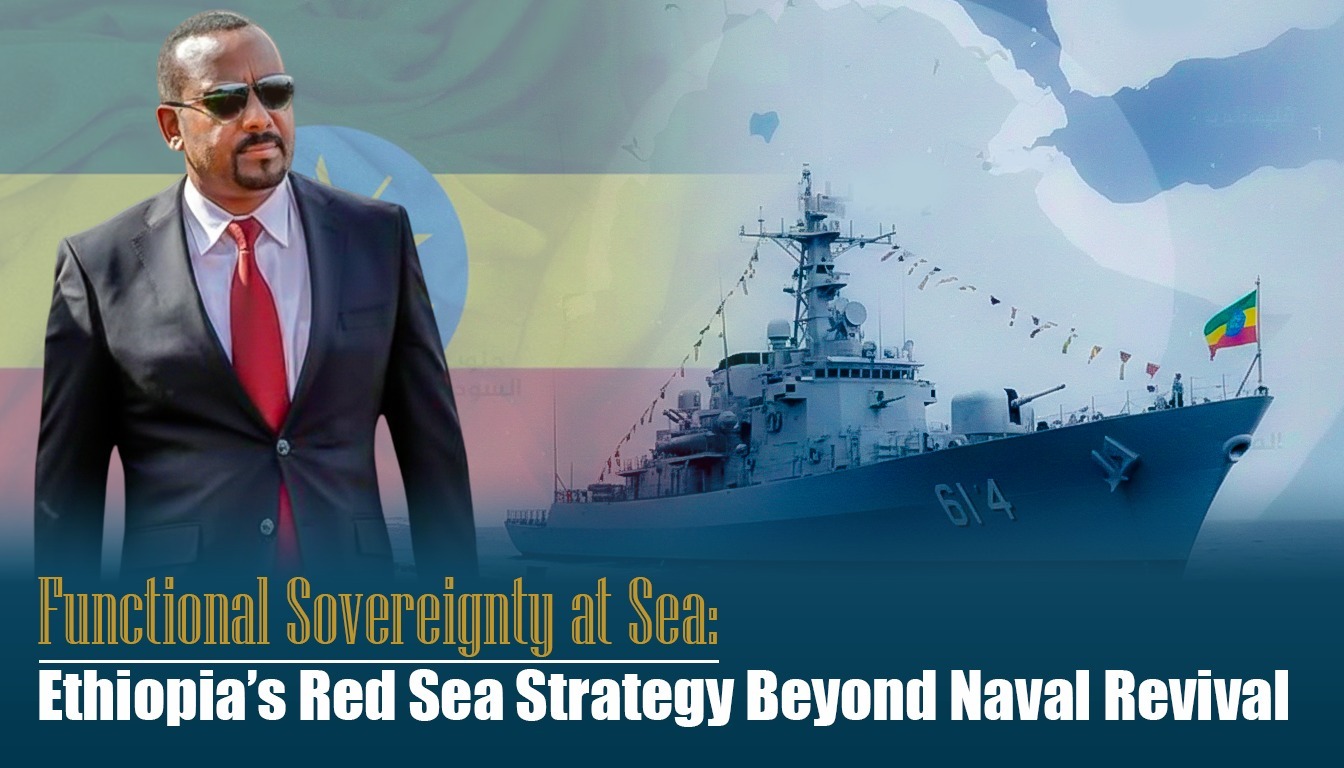
A Debate Framed Too Narrowly
Ethiopia’s renewed emphasis on the Red Sea has triggered a predictable debate. Commentators across the region have framed Addis Ababa’s maritime rhetoric primarily as a naval story: a landlocked state seeking ships, bases, and symbolic return to the sea. Yet this framing narrows a far more consequential strategic question.
The critical issue is not whether Ethiopia seeks to revive a navy. It is whether Ethiopia can secure functional sovereignty in a maritime system upon which its economic survival depends but over which it exercises no territorial control. Naval revival may be one instrument within that effort. It is not the essence of it.
Ethiopia’s Red Sea posture reflects a structural calculation: extreme corridor dependency is a strategic vulnerability, and long-term state capacity cannot rest on a single external gateway. The success or failure of this recalibration will shape not only Ethiopia’s insulation from economic shock but also the future balance between sovereignty norms and functional integration in the Horn of Africa.
From Legal Sovereignty to Functional Sovereignty
For decades, debates in the Horn have revolved around legal sovereignty—territorial integrity, recognition, borders, and non-interference. Ethiopia’s maritime discourse introduces a subtler but equally significant dimension: functional sovereignty.
Legal sovereignty refers to control over territory and internationally recognized jurisdiction. Functional sovereignty refers to the capacity to secure uninterrupted access to strategic lifelines—trade routes, energy imports, insurance stability, customs predictability, and logistics continuity—regardless of territorial status.
The distinction matters. Since the early 1990s, Ethiopia has operated as one of the world’s largest landlocked economies without direct maritime frontage. This reality has not prevented growth or external trade. It has, however, concentrated risk. A dominant share of imports and exports has flowed through a single corridor. During periods of stability, such concentration might not be a problem, however, during periods of volatility, it generates systemic exposure.
When conflict disrupts transit routes, when insurance premiums rise in the Red Sea, when congestion increases at ports, or when diplomatic friction emerges, the economic shock is transmitted rapidly into domestic inflation, fiscal pressure, and private-sector costs. In this context, the maritime question is not symbolic restoration. It is structural vulnerability management.
The Red Sea as a Crowded Strategic Subsystem
The Red Sea itself is not a neutral commercial highway. It is a layered strategic arena shaped by Gulf state investments and competition, global power basing arrangements, ongoing instability in Sudan, Eritrea’s destructive positioning, Djibouti’s dual role as logistics hub and military host, and uneven African maritime governance capacity. Naval assets, commercial shipping lanes, and geopolitical tensions coexist within a narrow corridor.
Any Ethiopian move—whether framed as naval revival, port equity participation, or long-term leasing—inevitably enters this crowded subsystem. In such an environment, fleet size matters less than access guarantees, cost predictability, and diplomatic relations. Functional sovereignty requires stability of arrangements more than projection of force.
Dependency in this context is not only strategic failure, it is a structural risk featuring geography and history. Concentrated dependency produces three interlocking risks. The first is political risk: disagreements between states can translate into logistical friction. The second is security risk: conflict in adjacent territories can disrupt transit reliability. The third is market risk: insurance spikes, rerouting costs, and global price volatility amplify domestic inflation.
From a functional sovereignty perspective, the objective is not autarky. It is rebalancing. Corridor diversification, multimodal infrastructure integration, and transparent long-term access agreements reduce the political premium embedded in trade flows. Maritime presence, in this reading, is less about coercive leverage than about bargaining credibility.
Competing Interpretations: Expansionism or Structural Adaptation?
Ethiopia’s Red Sea posture has generated competing interpretations.
The Expansionist Frame
Critics argue that renewed maritime rhetoric unsettles sovereignty norms, fuels security dilemmas, and risks destabilizing a fragile regional equilibrium. In a region where territorial integrity debates remain sensitive, such concerns resonate. Naval symbolism, they suggest, may amplify mistrust in an already securitized corridor.
The Structural Adaptation Frame
An alternative view holds that Ethiopia’s posture reflects rational adaptation to structural exposure. A large and growing economy cannot indefinitely operate under extreme single corridor concentration. Negotiated maritime access arrangements are common in global trade systems. From this vantage point, Ethiopia is not challenging sovereignty norms but attempting to operate within them more securely.
A Conditional Outcome
Both interpretations contain partial truths. Rhetoric, if poorly calibrated, can trigger anxiety. Yet structural drivers are not imaginary. The decisive variable lies in sequencing and institutional design. Transparent agreements anchored in clear legal frameworks can mitigate destabilizing perceptions. Ambiguity and unilateral signaling risk misinterpretation.
The Economic Logic Beneath the Strategy
The economic rationale underpinning Ethiopia’s Red Sea posture is straightforward. Trade cost volatility transmits directly into growth constraints. Delays in port clearance affect manufacturing inputs. Insurance premiums ripple into consumer prices. Currency pressures amplify logistics shocks. Reducing corridor concentration lowers the systemic risk premium embedded in the economy.
Yet insulation is not costless. Diversification requires parallel infrastructure, diplomatic capital, and time. The trade-off between immediate fiscal burden and long-term vulnerability reduction sits at the core of the policy calculus. Functional sovereignty is therefore not a slogan. It is an economic strategy under geopolitical constraint.
Sovereignty and Integration: A Regional Test
Ethiopia’s maritime discourse also tests a deeper regional tension: sovereignty versus functional integration. The Horn’s order rests on territorial integrity norms. Yet modernization increasingly depends on cross-border corridors and negotiated interdependence. Ethiopia’s approach may become a precedent.
If successful, it could demonstrate that landlocked states can secure diversified access without territorial revisionism. If mismanaged, it could reinforce security dilemma dynamics and external power leverage. The stakes extend beyond national policy to the architecture of regional order itself.
African Institutions and Maritime Governance
African institutions further complicate the equation. The African Union and subregional bodies have articulated maritime frameworks, but operational coordination remains uneven. Normative legitimacy does not automatically translate into enforcement capacity. Embedding maritime arrangements within regional consultation mechanisms could reduce misperception. Overreliance on symbolic endorsement without operational clarity risks hollow reassurance. Functional sovereignty ultimately depends on credible agreements and administrative follow-through, not institutional rhetoric alone.
Beyond Vessels, Toward Systems
Ultimately, the access to the sea debate is less about ships than about systems. Can Ethiopia convert concentrated dependency into negotiated interdependence? Can it do so without destabilizing sovereignty norms or overextending internal capacity? Can regional actors interpret maritime engagement as integration rather than ‘revisionism’?
These questions matter beyond Ethiopia. The Horn of Africa is undergoing contested reordering. Sovereignty, infrastructure, external competition, and state capacity are being renegotiated simultaneously. Ethiopia’s maritime recalibration sits at the intersection of these forces.
The real measure of success will not be vessel count. It will be cost predictability, diversified corridors, transparent agreements, and institutional coherence. If Ethiopia reduces structural exposure while maintaining regional reassurance, its Red Sea strategy could enhance both national resilience and regional stability. If ambition outpaces capacity or diplomacy falters, symbolic escalation could exceed structural insulation.
Functional sovereignty at sea is not about reclaiming lost coastline. It is about insulating state capacity within a crowded maritime order. Ethiopia’s strategy will be judged not by whether it speaks the language of navies, but by whether it masters the grammar of negotiated interdependence in one of the world’s most complex strategic corridors.
By Beminet Alemayehu, Assistant researcher at IFA
Disclaimer:
The content disseminated by the Institute of Foreign Affairs (IFA) – including, but not limited to, publications, public statements, events, media appearances, and digital communications – reflects the views of individual contributors and does not necessarily represent the official positions or policies of the Institute, its partners, or any affiliated governmental or non-governmental entities.
While the IFA endeavors to ensure the accuracy, integrity, and timeliness of the information presented, it makes no representations or warranties, express or implied, regarding the completeness, reliability, or suitability of such content for any purpose. The Institute expressly disclaims any liability for errors or omissions, as well as for any actions taken or decisions made based on the information provided.
The inclusion of external links, references, or third-party resources does not constitute an endorsement by the Institute. Additionally, engagement on social media platforms – including, but not limited to, likes, shares, retweets (RTs), or reposts – shall not be interpreted as an endorsement or validation of the views expressed therein.Readers and audiences are encouraged to exercise critical judgment and seek independent verification when interpreting or relying upon any information disseminated through publications and posts on the Institute’s platforms or representatives.