

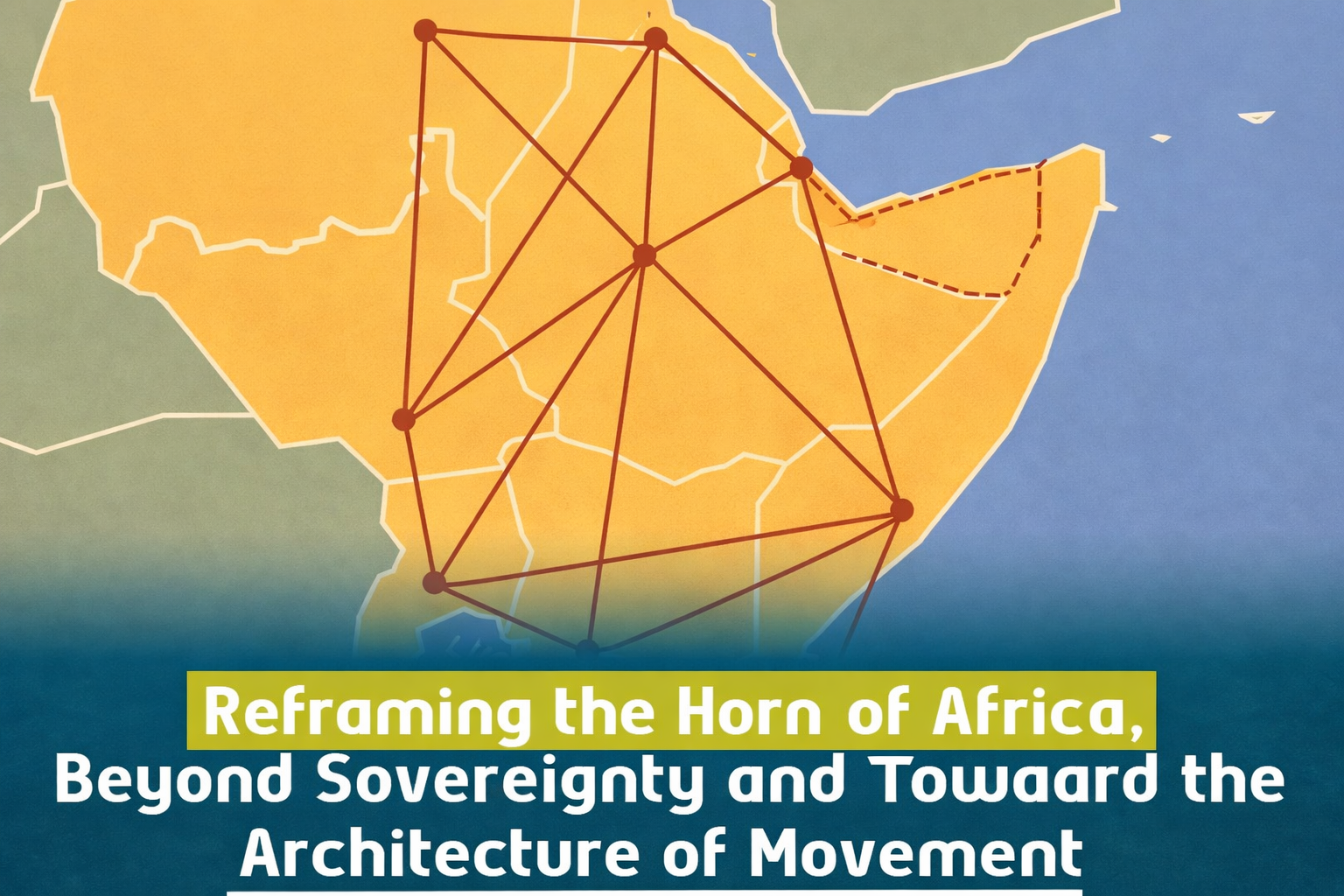
The Horn of Africa is increasingly narrated through a deceptively simple frame. On one side stands Ethiopia, a large landlocked country articulating maritime access as a matter of economic necessity, long-term security, and equitable regional integration. On the other hand, neighboring states and policy communities emphasize the importance of sovereignty, territorial integrity, and adherence to established international norms. At first glance, the debate appears clearly defined: access versus sovereignty, necessity versus legal order.
Yet such a framing, while politically compelling, is analytically insufficient for capturing the deeper transformation underway in the region.
What is emerging in the Horn is not simply a disagreement over maritime access. Rather, it is a broader and more structural contest over the design and governance of connectivity systems: the ports through which trade flows, the corridors that link hinterlands to global markets, the security arrangements that stabilize these routes, and the diplomatic frameworks that legitimize them. In this context, debates framed around sovereignty often serve as the visible expression of a more fundamental negotiation over how movement—of goods, capital, and influence—is organized across the region.
Understanding this shift requires moving beyond narratives of fragility and toward an analytical perspective grounded in international political economy and strategic studies. As widely discussed in global development literature, infrastructure and connectivity increasingly define power in the twenty-first century. States in the Horn are therefore not merely reacting to instability; they are actively shaping the strategic environment to secure resilience, autonomy, and relevance within an interconnected regional order.
Connectivity as Power: The Strategic Geography of the Horn
While connectivity is often presented as a shared regional good, it is not a neutral process. The design, financing, and governance of corridors, ports, and logistical systems inevitably reflect underlying power relations that shape who benefits, who depends, and who sets the terms of access. In this sense, connectivity is not only an economic or technical project, but a political one, where influence is exercised through the structuring of movement itself.
Historically, political competition in the Horn has centered on sovereignty, territorial control, and regime survival. However, the legacy of colonial boundary-making and post-independence state formation has produced a geopolitical landscape in which control over routes and access points often matters as much as control over territory itself.
Key historical agreements illustrate this layered legacy. The 1902 Anglo–Ethiopian Treaty influenced early Nile Basin dynamics, while later arrangements such as the 1929 Anglo–Egyptian and 1959 Egypt–Sudan Nile Waters Agreements shaped patterns of water governance that excluded upstream stakeholders. More recently, the 2000 Algiers Agreement between Ethiopia and Eritrea formally ended armed conflict while leaving broader questions of regional connectivity and cooperation only partially addressed.
Taken together, these developments highlight a persistent reality: the Horn’s political order has long been influenced by access to strategic corridors and shared resources.
Ports such as Massawa, Assab, Berbera, and those in Djibouti function not only as commercial hubs but also as anchors of regional interdependence. Djibouti, in particular, has long played a strategically significant and mutually beneficial role in facilitating Ethiopia’s trade, underscoring how cooperation has historically underpinned regional economic activity. Corridors—rail, road, and logistics networks—serve as the arteries through which economic and political life circulates.
In such an environment, connectivity becomes a central dimension of geopolitical influence. Contemporary global examples reinforce this logic. China’s Belt and Road Initiative and European Union transport corridors illustrate how states and regional blocs invest in infrastructure to expand strategic reach and economic integration. Within the Horn, similar dynamics are increasingly visible as states pursue infrastructure diplomacy to enhance both national development and regional connectivity.
Ethiopia’s Maritime Question and the Politics of Strategic Correction
Ethiopia’s pursuit of diversified maritime access should be understood within this broader structural context. Since Eritrea’s independence in 1993, Ethiopia has relied heavily on external port infrastructure, with the majority of its trade passing through Djibouti. While this arrangement has been stable and mutually beneficial, it has also highlighted the risks associated with high dependency on a single corridor.
Consequently, Ethiopian policy discourse has gradually reframed maritime access as part of a long-term strategy aimed at economic resilience and diversification. This reflects a broader international pattern in which states mitigate structural vulnerabilities through diversified partnerships. Countries such as Kazakhstan and Rwanda, for instance, have pursued multi-corridor strategies to reduce dependency and enhance access to global markets.
In the Horn, Ethiopia’s approach has taken the form of infrastructure development and corridor expansion. The Addis Ababa–Djibouti railway, investments in dry ports such as Modjo, and engagement in regional port discussions—including Berbera and Lamu corridors—illustrate efforts to broaden logistical options while maintaining cooperative ties with existing partners. These initiatives are best understood not as disruptions, but as contributions to a more diversified and resilient regional connectivity system.
At the same time, such developments naturally invite careful consideration from neighboring states. Djibouti continues to play a central and valued role in Ethiopia’s trade architecture, while Somalia and Eritrea view evolving port dynamics through the lens of sovereignty and long-term national planning. These perspectives reflect legitimate interests in ensuring that new arrangements complement, rather than undermine, existing frameworks of cooperation.
The Defensive Logic of the Status Quo
For neighboring countries, Ethiopia’s evolving connectivity strategy raises important considerations regarding the future distribution of economic opportunity and strategic relevance. Djibouti’s logistics sector remains a cornerstone of its national economy. Eritrea’s Red Sea position is closely tied to its security and development outlook. Somalia’s port governance intersects with its federal system and broader state-building efforts.
In this context, Ethiopian leadership has consistently emphasized that maritime access is pursued within a framework of cooperation and regional integration. Prime Minister Abiy Ahmed has repeatedly articulated that access to the sea should serve shared economic interests rather than unilateral advantage. This position has been reflected in multiple diplomatic engagements, including trilateral discussions with President Ismaïl Omar Guelleh of Djibouti and President Hassan Sheikh Mohamud of Somalia in Jijiga, where regional stability, connectivity, and economic cooperation were central themes. Similarly, public statements to the Ethiopian parliament have underscored that engagement with Eritrea regarding ports such as Assab is envisioned within a cooperative, not confrontational, framework.
These engagements highlight a broader reality: Ethiopia, Djibouti, Eritrea, and Somalia are deeply interconnected, and their long-term prosperity is closely tied to the success of regional integration. Historically, however, the Horn has often prioritized rigid interpretations of sovereignty over collective economic frameworks, contributing to fragmentation and, at times, exposure to external proxy dynamics. Given the region’s strategic location along the Red Sea and its proximity to major global trade routes, a shift toward integration offers significant shared benefits, including increased trade, infrastructure development, and political stability.
From this perspective, responses to Ethiopia’s policy are best understood not as opposition, but as efforts to preserve stability and predictability within existing frameworks.
Somalia’s Political Situation and the Control of Circulation
Somalia’s evolving political landscape provides an important illustration of how connectivity intersects with state-building. Since adopting its federal framework in 2012, Somalia has worked to balance authority between the federal government and regional states, with ongoing constitutional discussions reflecting both institutional design and control over key economic assets.
Control over ports, airports, and trade routes has direct implications for fiscal capacity and governance authority. In this regard, Somalia’s internal debates are closely linked to the broader regional question of how connectivity should be organized. Strengthening coordination between federal and regional actors can therefore contribute not only to domestic stability but also to more effective participation in regional integration initiatives.
Similarly, the transition from the African Union Transition Mission in Somalia (ATMIS) to the African Union Support and Stabilization Mission (AUSSOM) reflects the intersection between security and connectivity. Stabilization efforts create the conditions under which infrastructure, trade, and governance systems can function effectively. In this sense, security cooperation is not separate from regional integration; it is a foundational component of it.
The Northern Frontier: Eritrea, Tigray, and the Red Sea
The Horn’s northern corridor further illustrates the interconnection between internal dynamics and regional geopolitics. The 2022 Pretoria Agreement, which formally ended the conflict between the Ethiopian federal government and the Tigray People’s Liberation Front (TPLF), marked a significant step toward peace. Ongoing implementation efforts, including disarmament, demobilization, and reintegration (DDR) processes, are central to consolidating stability.
This stability has implications beyond domestic recovery. Northern Ethiopia’s proximity to Red Sea corridors means that sustained peace supports broader regional connectivity and economic cooperation. Rebuilding trust and restoring functional linkages across borders can therefore contribute to a more integrated and resilient regional system.
Sudan’s War and the Western Strategic Front
The ongoing conflict in Sudan, involving the Sudanese Armed Forces (SAF) and the Rapid Support Forces (RSF) has introduced additional complexity into the Horn’s strategic environment. The war has resulted in significant humanitarian consequences, including displacement and infrastructure destruction, with neighboring countries such as Ethiopia hosting refugees and managing spillover effects.
Ethiopia has consistently supported diplomatic efforts aimed at peaceful resolution, engaging in regional and continental initiatives to encourage dialogue. These efforts reflect an understanding that stability in Sudan is integral to the wider region’s security and connectivity. Coordinated approaches that address both humanitarian and strategic dimensions are therefore essential.
The Red Sea: A Theatre of Strategic Multiplicity
The growing presence of external partnerships further reinforces the need to understand connectivity as a negotiated space in which influence is exercised indirectly, often through infrastructure, financing, and institutional arrangements rather than direct political control
As one of the world’s most vital maritime arteries, the Red Sea corridor has become a magnet for external powers—from global superpowers to assertive middle powers like the UAE, Saudi Arabia, Turkey, and Egypt. Their involvement transcends simple diplomacy, weaving a fluid web of infrastructure deals and security pacts that favor shifting partnerships over rigid, Cold War-style alliances..
For states in the Horn, managing this environment requires strategic balance. Strengthening regional coordination through institutions such as the Intergovernmental Authority on Development and the African Union can help ensure that external engagement aligns with regional priorities. By presenting unified positions and promoting transparent agreements, Horn countries can leverage external partnerships while safeguarding collective interests.
Sovereignty, Securitization, and the Politics of Movement
The Horn’s evolving dynamics point to a broader conceptual insight: sovereignty is increasingly exercised through the capacity to manage movement. Maritime access, corridor development, and security cooperation are therefore not solely legal questions but components of a wider system that shapes economic and political life.
Recognizing this helps shift the conversation away from binary debates and toward a more constructive focus on shared opportunities for integration and development.
Implications for the Horn
A connectivity-centered perspective underscores the importance of cooperative policy approaches. Regional institutions such as IGAD and the African Union are well positioned to facilitate dialogue that links infrastructure development with conflict prevention and economic integration.
Coordinated frameworks for port access, corridor development, and maritime governance can align national strategies with shared regional benefits. Ethiopia’s continued emphasis on dialogue and partnership, combined with the active engagement of neighboring states, can contribute to an inclusive regional order.
Conclusion: A Contest Over the Architecture of Order
The Horn of Africa is undergoing a significant transformation. Rather than a simple contest over sovereignty, the region is navigating a complex process of redefining how connectivity is organized and governed.
In this evolving landscape, ports, corridors, and cooperative frameworks are becoming central to both national development and regional stability. The central challenge is not to choose between sovereignty and access, but to integrate them within a framework that advances mutual benefit.
Ultimately, the region’s future will depend on its ability to move from fragmented competition toward coordinated integration. If managed constructively, the Horn’s strategic geography can serve as a foundation for shared prosperity, strengthening both national resilience and regional stability.
By Yemisirach Fikadu, IFA
Disclaimer:
The content disseminated by the Institute of Foreign Affairs (IFA) – including, but not limited to, publications, public statements, events, media appearances, and digital communications – reflects the views of individual contributors and does not necessarily represent the official positions or policies of the Institute, its partners, or any affiliated governmental or non-governmental entities.
While the IFA endeavors to ensure the accuracy, integrity, and timeliness of the information presented, it makes no representations or warranties, express or implied, regarding the completeness, reliability, or suitability of such content for any purpose. The Institute expressly disclaims any liability for errors or omissions, as well as for any actions taken or decisions made based on the information provided.
The inclusion of external links, references, or third-party resources does not constitute an endorsement by the Institute. Additionally, engagement on social media platforms – including, but not limited to, likes, shares, retweets (RTs), or reposts – shall not be interpreted as an endorsement or validation of the views expressed therein.
Readers and audiences are encouraged to exercise critical judgment and seek independent verification when interpreting or relying upon any information disseminated through publications and posts on the Institute’s platforms or representatives.