

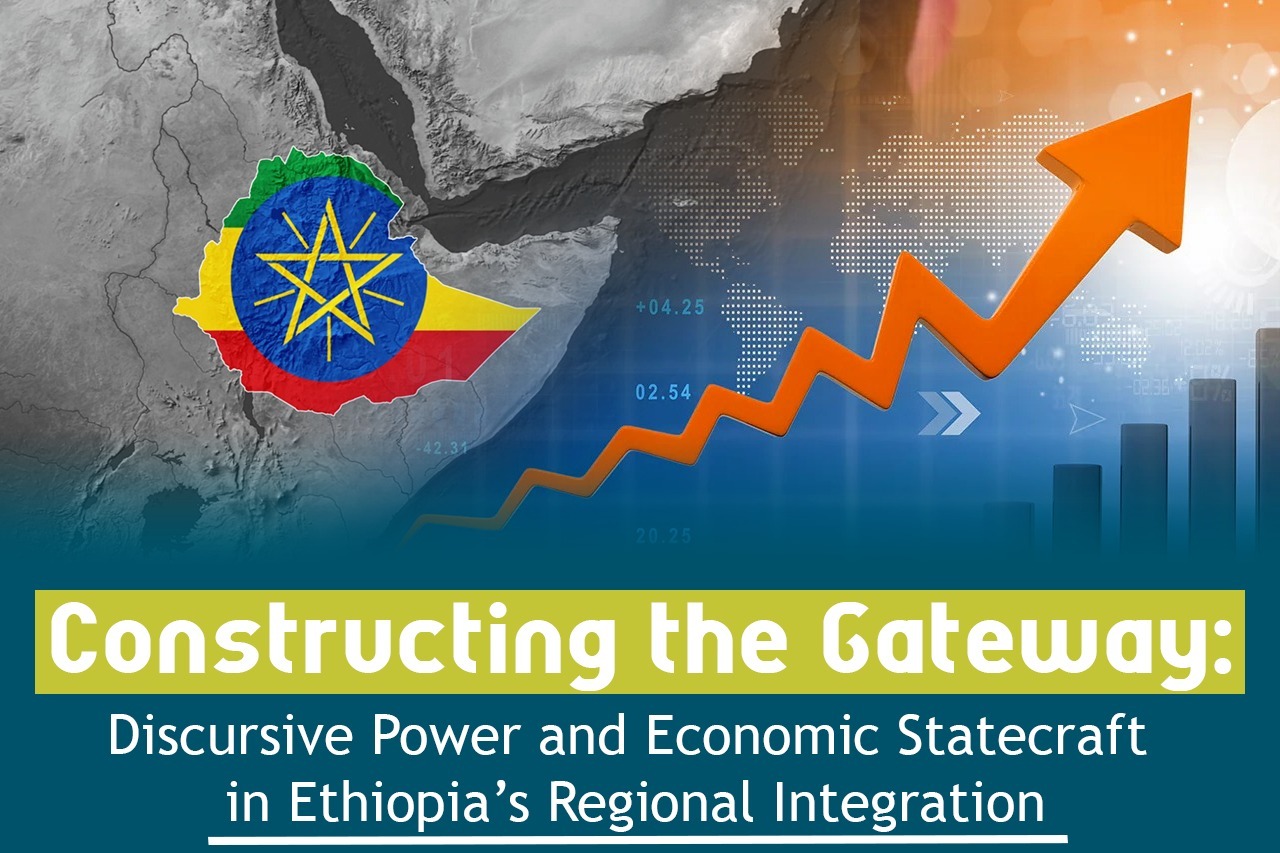
The increasing engagement of Gulf states and Turkey in the Horn of Africa demonstrates that geopolitical influence is exercised not only through material investments but also through the construction of strategic narratives. Drawing on Michel Foucault, this analysis argues that Ethiopia’s repositioning as a regional “gateway” reflects both material transformations and discursive processes that legitimize emerging configurations of power. Contemporary scholarship increasingly supports the view that narratives—such as “regional hub” or “gateway state”—function as instruments of economic statecraft, shaping perceptions of legitimacy, partnership, and strategic relevance (Young, 2021; Lynch, 2020).
This dynamic suggests that geopolitical change in the Horn of Africa must be understood not only through infrastructure expansion and foreign direct investment, but also through the production of meanings that frame and justify these developments.
Historical Narratives and Ethiopia’s Symbolic Capital
The role of narratives in Ethiopia’s state formation has deep historical roots. The victory at the Battle of Adwa was not only a military triumph but also became a powerful global symbol of anti-colonial resistance. Historians emphasize that Adwa’s legacy contributed to Ethiopia’s diplomatic prestige and symbolic authority across Africa and the Global South (Milkias & Metaferia, 2005).
This symbolic capital was later institutionalized when African Union (formerly the OAU) established its headquarters in Addis Ababa. Ethiopia’s hosting role reinforced its image as a diplomatic center and a unifying force in post-colonial Africa (Murithi, 2005). These developments illustrate how narratives of independence and sovereignty have historically complemented material realities in shaping Ethiopia’s regional identity.
Geostrategic Continuity of the Horn of Africa
The Horn of Africa’s importance as a trade and security corridor is well documented. Located near the Red Sea and the Gulf of Aden, the region sits along one of the world’s most critical shipping routes, linking Europe, Asia, and the Middle East. According to World Bank (2024/2025) and IMF reports, these waters normally facilitate roughly 12% to 15% of total global maritime trade, including approximately 30% of global container traffic. Ports such as Berbera Port have historically functioned as key commercial hubs. During the colonial period under British Empire, Berbera was developed as a livestock export center serving Arabian markets (Phillips, 2020). Its continued relevance today reflects the enduring geopolitical significance of infrastructure in the region.
The Horn’s strategic value has also been shaped by military competition. During the Cold War, both the Soviet Union and the United States utilized facilities in the region, a pattern that persists today with multiple foreign military bases (ICG, 2018). This continuity reinforces the idea that geography gains meaning through shifting global power structures.
Gulf States, Turkey, and Economic Statecraft
The growing role of the Gulf Cooperation Council (GCC) countries in the Horn reflects broader transformations in global political economy. As Karen E. Young (2021) notes, Gulf states are increasingly deploying investment as a tool of foreign policy, integrating economic ambitions with security strategies.
The DP World investment in Berbera—valued at approximately $440 million—illustrates how long-term port concessions create enduring economic and geopolitical linkages (Deutsche Welle, 2022). Similarly, investments in Bosaso Port and earlier involvement in Doraleh Container Terminal demonstrate a strategic diversification of maritime assets following disputes with Djibouti (Pilling, 2019).
Beyond economic engagement, Gulf states have expanded their military footprint in the region, partly driven by the Yemen War. Research indicates that the Horn hosts one of the world’s highest concentrations of foreign military bases, reflecting the convergence of security and trade interests (International Crisis Group, 2018).
Turkey has also emerged as a key actor, particularly in Somalia. Through defense cooperation, infrastructure development, and maritime security initiatives, Turkey has strengthened its influence while contributing to capacity-building in Somali institutions (Ozkan, 2020).
Ethiopia, Investment, and Narrative Repositioning
Ethiopia remains a central node in these dynamics. Despite being landlocked since the independence of Eritrea in 1993, it has maintained strategic relevance through regional integration and infrastructure development. The World Bank (2020) highlights Ethiopia’s role as one of Africa’s fastest-growing economies prior to recent shocks, driven partly by large-scale infrastructure investments and regional connectivity projects.
Gulf countries have become major investors in Ethiopia, particularly in logistics, agriculture, and energy sectors (UNCTAD, 2024). These engagements align with broader strategies to secure food supply chains and trade routes, while also reinforcing political partnerships.
At the same time, Ethiopia’s foreign policy—articulated through the concept of Medemer under Abiy Ahmed—emphasizes cooperation, regional integration, and mutual benefit. Analysts interpret this framework as both a policy orientation and a narrative strategy aimed at reframing Ethiopia’s role from a landlocked state to a connective hub (Lefebvre, 2021).
Discourse, Power, and the “Gateway State”
From a Foucauldian perspective, discourse does not merely describe reality—it produces it. The framing of Ethiopia as a “gateway state” reflects a broader discursive formation that legitimizes its evolving role in regional trade and diplomacy.
This narrative aligns with Ethiopia’s participation in peacekeeping missions under the United Nations and the African Union, reinforcing its image as a stabilizing force (UN Peacekeeping, 2023). It also complements infrastructure initiatives linking Ethiopia to ports in Djibouti, Somaliland, and beyond.
Such narratives are not neutral. They shape investment flows, diplomatic alignments, and institutional partnerships. As scholars of international relations note, economic statecraft increasingly relies on the interplay between material capabilities and ideational framing (Blackwill & Harris, 2016).
Conclusion
Ethiopia’s emergence as a “gateway state” is neither purely material nor purely rhetorical. It is the product of an interaction between infrastructure development, foreign investment, and strategic narrative construction. Gulf states and Turkey have leveraged both economic and security tools to expand their influence in the Horn, while Ethiopia has simultaneously sought to reposition itself within this evolving order.
Narratives in the Horn of Africa are not passive reflections but active instruments of power. Ethiopia’s historical legacy—from Adwa to its role in the African Union—provides a foundation upon which contemporary narratives of connectivity and centrality are being constructed. These narratives, when aligned with material investments, enhance Ethiopia’s bargaining power and regional relevance.
Recommendations.
Ethiopia should institutionalize its “gateway” narrative through transparent regional economic frameworks that prioritize mutual benefit and reduce perceptions of asymmetry. Strengthening multilateral engagement—particularly through the African Union and regional blocs—can help anchor its role within cooperative rather than competitive geopolitics. Additionally, balancing foreign investment with domestic capacity-building will be essential to avoid dependency and ensure long-term strategic autonomy. As a final point, policymakers should remain attentive to the discursive dimension of foreign policy, recognizing that how Ethiopia is framed internationally can be as consequential as the material policies it pursues.
References
Blackwill, R. D., & Harris, J. M. (2016). War by other means: Geoeconomics and statecraft. Harvard University Press.
Deutsche Welle. (2023, June 26). Somaliland’s Berbera port: A new gateway to Africa? https://www.dw.com/en/somalilands-berbera-port-a-new-gateway-to-africa/a-60980144
International Crisis Group. (2018). The United Arab Emirates in the Horn of Africa (Africa Report No. 264). https://www.crisisgroup.org/africa/horn-africa/united-arab-emirates-horn-africa
Lefebvre, J. A. (2021). Ethiopia’s foreign policy and regional integration: The transition from Meles Zenawi to Abiy Ahmed. Journal of Eastern African Studies, 15(3), 422–441. https://doi.org/10.1080/17531055.2021.1957458
Lynch, M. (2020). The new Arab order: Power and violence in today’s Middle East. Foreign Affairs, 99(5), 165–177.
Milkias, P., & Metaferia, G. (Eds.). (2005). The Battle of Adwa: Reflections on Ethiopia’s historic victory against European colonialism. Algora Publishing.
Murithi, T. (2005). The African Union’s transition from non-intervention to non-indifference: Charting the continuum of peace operations. African Security Review, 14(1), 35–48. https://doi.org/10.1080/10246029.2005.9627332
Ozkan, M. (2020). Turkey’s involvement in Somalia: Assessment of a state-building partnership. Insight Turkey, 22(4), 113–132.
Phillips, S. (2020). When there was no aid: War and peace in Somaliland. Cornell University Press.
Pilling, D. (2018). The growth delusion: Wealth, poverty, and the well-being of nations. Bloomsbury Publishing. (Note: Original publication is 2018, though 2019 editions exist; 2018 is standard for first citations).
UNCTAD. (2024). World Investment Report 2022: International tax reforms and sustainable investment. United Nations Conference on Trade and Development.
United Nations Peacekeeping. (2023). Troop and police contributors. https://peacekeeping.un.org/en/troop-and-police-contributors
World Bank. (2020). Ethiopia economic update: Poverty and household welfare in Ethiopia, 2011-2016. World Bank Group.
World Bank. (2023). The logistics performance index 2023: Connecting to compete. World Bank Group.
Young, K. E. (2021). The economic statecraft of the Gulf Arab states: Deploying capital in the Global South. I.B. Tauris / Bloomsbury Publishing.
By Hanan Hassen, IFA
Disclaimer:
The content disseminated by the Institute of Foreign Affairs (IFA) – including, but not limited to, publications, public statements, events, media appearances, and digital communications – reflects the views of individual contributors and does not necessarily represent the official positions or policies of the Institute, its partners, or any affiliated governmental or non-governmental entities.
While the IFA endeavors to ensure the accuracy, integrity, and timeliness of the information presented, it makes no representations or warranties, express or implied, regarding the completeness, reliability, or suitability of such content for any purpose. The Institute expressly disclaims any liability for errors or omissions, as well as for any actions taken or decisions made based on the information provided.
The inclusion of external links, references, or third-party resources does not constitute an endorsement by the Institute. Additionally, engagement on social media platforms – including, but not limited to, likes, shares, retweets (RTs), or reposts – shall not be interpreted as an endorsement or validation of the views expressed therein.
Readers and audiences are encouraged to exercise critical judgment and seek independent verification when interpreting or relying upon any information disseminated through publications and posts on the Institute’s platforms or representatives.