

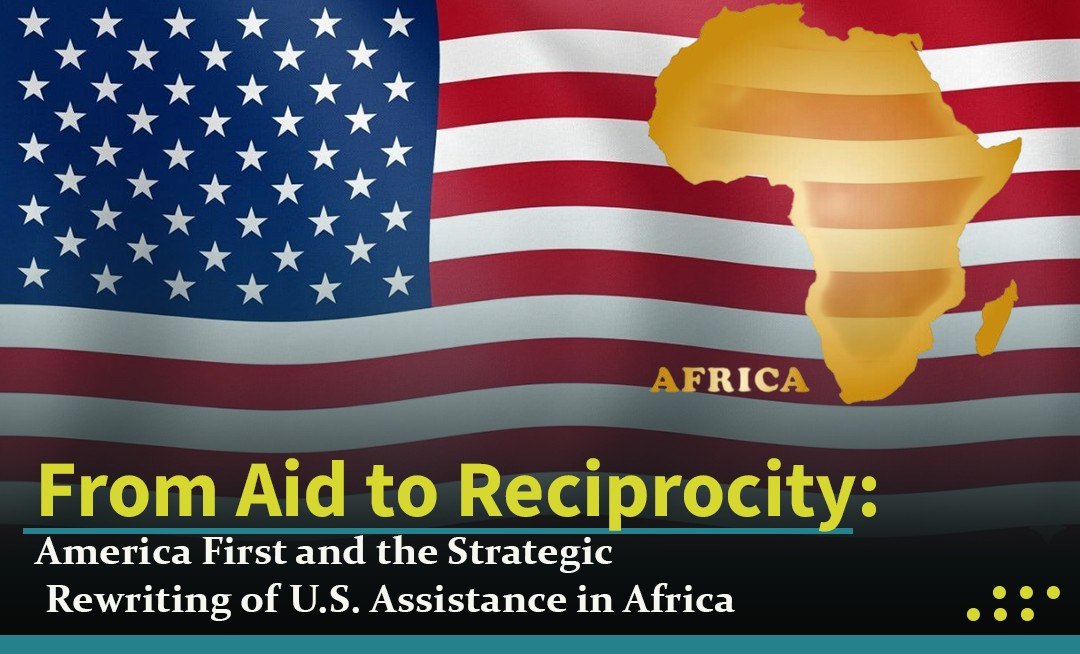
The most important change in U.S. assistance policy toward Africa is not moral decline but strategic reclassification. What is now unfolding under the banner of “America First” is a shift from assistance as a predominantly developmental instrument to assistance as part of a broader architecture of reciprocal advantage. In that architecture, health, minerals, industrial policy, budget discipline, and geopolitical alignment no longer sit in separate policy boxes. They are increasingly negotiated together. Reuters’ reporting on Zambia offers the clearest public example: a proposed U.S. health package was linked to collaboration in the mining sector, while U.S. officials defended the principle that foreign assistance should advance American national interests. That is not simply a controversy over one deal. It is a signal of a larger trend. [1]
Seen this way, the strategic question for African states is no longer whether external powers attach interests to aid. They always have. The real question is how explicit, how transactional, and how integrated those interests have become in a period defined by supply-chain competition, critical minerals politics, and sharper rivalry with China. Ethiopia’s own recent health agreement with Washington does not replicate the Zambian case in form. It contains no public minerals-for-aid clause. But it does reflect the same strategic turn in method: co-financing requirements, audit access, performance conditions, data governance provisions, and support for a policy environment favorable to U.S.-linked pharmaceutical investment. The lesson for Addis Ababa is not to reject engagement with Washington, but to read the new U.S. posture correctly and negotiate accordingly. [1][2]
The strategic turn in U.S. assistance
The intellectual frame for this shift is visible in official U.S. strategy. The White House’s 2025 National Security Strategy states that the United States must expand access to critical minerals and materials in order to secure the inputs necessary for its defense and economy. In parallel, the administration’s Africa messaging has become more direct. In March 2026, the State Department’s “America First in Africa” line stated that the U.S. goal is to ensure that African critical minerals begin “flowing west” to the United States. Those two positions matter when read together. They indicate that Washington increasingly sees Africa less through the older vocabulary of development partnership and more through the harder grammar of strategic value, commercial access, and supply-chain positioning. [3][4]
That wider minerals push is already visible beyond aid agreements. Reuters has reported that the United States is using offtake deals, trading structures, and state-backed financing to redirect African copper, cobalt, and related minerals into U.S.-aligned value chains as it competes with China. In other words, the policy environment around Africa is already organized around securing access, influencing flows, and reducing dependence on rival-controlled processing chains. Once that becomes the governing logic, it is unsurprising that health assistance too begins to be folded into a broader framework of reciprocity. [5][6]
This is why the Zambian case deserves attention beyond Zambia. Reuters reported that the delayed five-year health package, worth more than $1 billion and requiring substantial Zambian co-financing, became controversial because revised drafts included a problematic section, and because U.S. messaging referenced support “in exchange for collaboration in the mining sector and clear business sector reforms.” The same report noted that the draft agreement linked continuation of funding to a related bilateral compact that sources said was tied to mining collaboration. Whether or not every clause survives renegotiation, the strategic meaning is already clear: Washington is willing to use health assistance as leverage within a wider bargaining field that includes resource access, business reform, and long-run alignment. [1]
Zambia is the explicit case; Ethiopia is the institutional case
It would be analytically careless to say Ethiopia’s agreement is identical to Zambia’s. It is not. The publicly available Ethiopia-U.S. health Memorandum of Understanding signed in December 2025 does not condition assistance on mineral access. But that should not lead to the opposite mistake of treating it as a conventional donor agreement. Its logic is highly reciprocal and structured. The MOU requires increased Ethiopian co-investment, allows U.S. access to data and accounts for multiple forms of audit, ties underperformance to reduced future funding, and includes consequences for failure to meet specimen and data-sharing commitments. It also states that the United States plans to support an enabling policy and regulatory environment for U.S. direct foreign investment in local manufacturing and related pharmaceutical innovations. This is not extractive diplomacy in the narrow mining sense. It is strategic assistance embedded in governance, compliance, and industrial positioning. [2]
That difference matters. Zambia shows the blunt edge of the new approach, where strategic interest becomes publicly legible through minerals language. Ethiopia shows the more institutionalized edge, where assistance is routed through state systems but attached to measurable reciprocity, policy leverage, and future commercial footholds. Both belong to the same trend. The point is not that every African country will face minerals-for-medicine bargaining in explicit form. The point is that Washington’s assistance model is being redesigned so that health partnerships, financial obligations, regulatory frameworks, and strategic interests reinforce one another. [1][2][7]
Broader analysis of the administration’s bilateral health agreements supports that reading. Think Global Health reports that twenty-seven such MOUs, mostly with African countries, govern at least $20.1 billion in planned spending between 2026 and 2030, with roughly 37 percent to be funded by recipient governments. CGD likewise notes that these agreements shift funding more directly into country systems while sharply reducing U.S. support over time as partners ramp up domestic spending. That means the emerging model is not one of open-ended patronage. It is a model of compressed transition, burden shifting, oversight, and conditional partnership. [7][8]
What Ethiopia should learn
For Ethiopia, the strategic lesson is not to read the U.S. move primarily as a threat, nor to romanticize it as partnership on older terms. It should be read as a durable change in negotiating style. Washington is signaling that future cooperation will increasingly be justified by reciprocity, measurable burden sharing, strategic utility, and commercial relevance. Ethiopian policy should therefore move on two tracks at once.
The first is interpretive. Addis Ababa should treat health, pharmaceuticals, digital systems, logistics, minerals, and industrial policy as interconnected arenas in dealing with the United States. If Washington is collapsing these domains into a single strategic frame, Ethiopia should avoid negotiating them as isolated technical files. A health MOU is now also a question of data governance, industrial policy, procurement autonomy, and future market structure. [2][4]
The second is institutional. Ethiopia should enter this era with a doctrine of selective reciprocity. That means accepting that great-power competition can create bargaining opportunities, but ensuring that reciprocity serves domestic capability rather than short-term budget relief alone. In practice, that requires at least four habits. First, Ethiopia should insist that any burden-sharing arrangement be matched by credible support for domestic productive capacity, especially pharmaceutical manufacturing, regulatory capability, and public-health logistics. Second, it should negotiate stronger protections on data access, auditing scope, and policy discretion so that transparency does not become open-ended external supervision. Third, it should avoid one-sector bargains by linking U.S. engagement to wider national priorities such as industrial upgrading and technological learning. Fourth, it should preserve diversification by keeping strategic options open with multiple external partners rather than allowing one relationship to define the architecture of critical sectors. Those are not anti-American positions. They are the requirements of competent statecraft in a more transactional international environment. [2][5][8]
Beyond aid, toward negotiated strategic exchange
The deeper implication of “America First in Africa” is that the old donor-recipient vocabulary is losing explanatory power. The emerging pattern is one of negotiated strategic exchange. In that setting, some African states will gain leverage because they possess critical minerals, logistics advantages, large markets, or industrial potential. Others will face much harsher asymmetries. Ethiopia occupies an intermediate but important position: not a premier critical-minerals state on the Zambian or Congolese model, but a major regional actor with demographic weight, geostrategic location, public-health significance, and potential industrial depth. That gives it room to negotiate, but only if it understands that the structure of bargaining has changed. [4][5][6]
The central point, then, is not that humanitarian assistance has suddenly become political. It is that assistance is now being more openly integrated into a wider competitive strategy built around supply chains, domestic burden shifting, regulatory reach, and strategic reciprocity. Zambia reveals the explicit edge of that turn. Ethiopia reveals the managed and institutional edge. The proper Ethiopian response is neither moral outrage nor passive accommodation. It is to build a negotiating framework that converts great-power competition into durable national capability while defending policy autonomy. That is the strategic lesson of the American shift now underway in Africa. [1][2][3]
References
[1] Reuters, “Zambia pushed back on U.S. health funding deal to protect interests, government says,” February 25, 2026. (Reuters)
[2] Memorandum of Understanding between the Government of the United States of America and the Federal Democratic Republic of Ethiopia on Health Cooperation, December 23, 2025.
[3] The White House, National Security Strategy, December 2025.
[4] U.S. Department of State, “America First in Africa,” March 19, 2026. (State Department)
[5] Reuters, “US challenges Chinese control in race for African minerals,” February 9, 2026. (Reuters)
[6] Reuters, “Can Africa win as the West and China scramble for minerals?” February 12, 2026. (Reuters)
[7] Think Global Health, “Tracking the ‘America First’ Bilateral Health Agreements,” March 2026. (Think Global Health)
[8] Center for Global Development, “Rolling Out the Trump Administration’s Global Health Agreements: What Can We Learn from Past Government-to-Government Assistance?” February 13, 2026. (cgdev.org)
By Kena Seyife, IFA
Disclaimer:
The content disseminated by the Institute of Foreign Affairs (IFA) – including, but not limited to, publications, public statements, events, media appearances, and digital communications – reflects the views of individual contributors and does not necessarily represent the official positions or policies of the Institute, its partners, or any affiliated governmental or non-governmental entities.
While the IFA endeavors to ensure the accuracy, integrity, and timeliness of the information presented, it makes no representations or warranties, express or implied, regarding the completeness, reliability, or suitability of such content for any purpose. The Institute expressly disclaims any liability for errors or omissions, as well as for any actions taken or decisions made based on the information provided.
The inclusion of external links, references, or third-party resources does not constitute an endorsement by the Institute. Additionally, engagement on social media platforms – including, but not limited to, likes, shares, retweets (RTs), or reposts – shall not be interpreted as an endorsement or validation of the views expressed therein.
Readers and audiences are encouraged to exercise critical judgment and seek independent verification when interpreting or relying upon any information disseminated through publications and posts on the Institute’s platforms or representatives.