

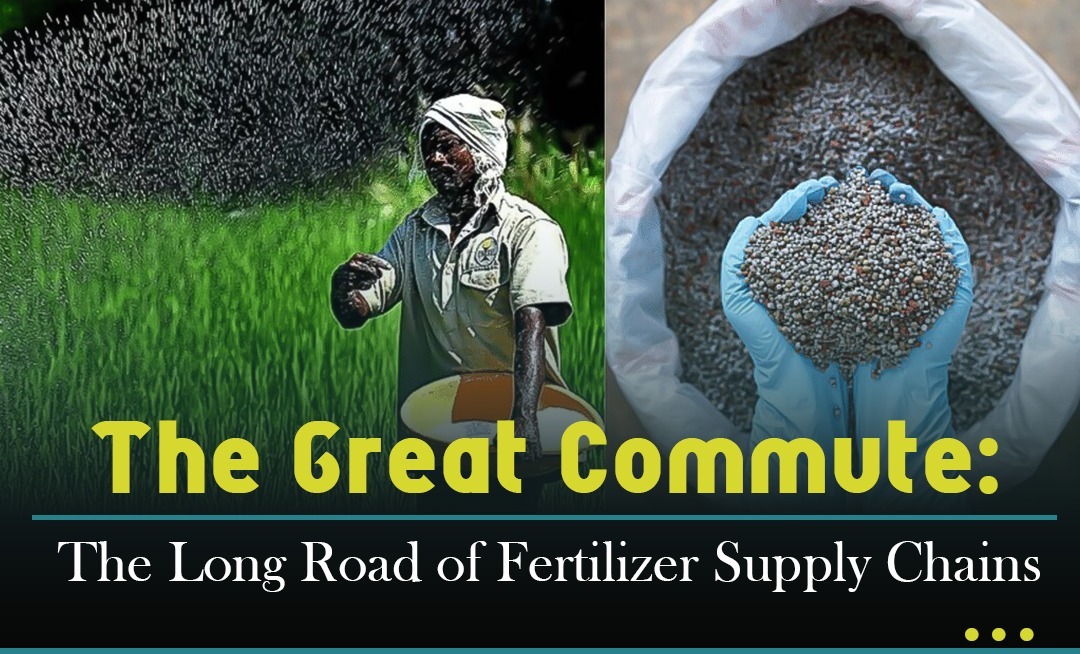
A bag of fertilizer fated for an Ethiopian farmer does not simply travel distance; it moves through layered systems of risk—across oceans, maritime chokepoints, congested ports, extended inland corridors, and tightly governed institutions. At every stage, its movement is shaped not only by logistics but by political economy: depending on who controls access, how decisions are made, and how vulnerability is distributed across the global sphere. In Ethiopia, fertilizer is not just a commodity; it is a governed input embedded in a historically constructed system of state coordination and external dependence.
At first glance, Ethiopia’s fertilizer system appears to be a logistical problem of geography. As a landlocked country, Ethiopia depends almost entirely on the Port of Djibouti for its external trade flows, with estimates suggesting that over 90 percent of imports pass through this corridor (World Bank, 2022). But this framing is incomplete. Fertilizer does not fail in Ethiopia because it moves slowly; it is constrained because its movement is embedded in institutional arrangements that prioritize control over flexibility. Logistics, in this sense, becomes an extension of the structure of system.
This structural dependence becomes particularly visible under conditions of external shock. The escalating conflict in the Middle East has introduced a new layer of risk at the very origin point of Ethiopia’s fertilizer supply chain. The Strait of Hormuz—through which a significant share of global petrochemical exports transit—functions as a systemic chokepoint linking Gulf-based fertilizer production hubs to global markets. Any disruption or perceived threat to its navigability transmits immediate price and supply shocks. Recent tensions have already triggered a sharp increase in global urea prices, with U.S. futures rising by approximately $130 per tonne within days. For Ethiopia, which imports over 90 percent of its nitrogen fertilizer requirements primarily from Gulf states such as Saudi Arabia, the United Arab Emirates, and Iran, this translates directly into higher procurement costs and heightened uncertainty in supply timing.
Ethiopia’s fertilizer use began in the 1960s during the imperial era’s modernization agenda. Early imports were facilitated through donor-supported agricultural programs and pilot interventions, including FAO-supported initiatives that introduced and tested chemical fertilizers such as urea in limited agricultural zones (FAO, 1967; World Bank Agricultural Sector Review, 1973). However, these interventions remained highly selective. Fertilizer access was concentrated in commercial farms, state-supported estates, and demonstration plots, while smallholder farmers—who accounted for the vast majority of rural producers—remained largely excluded due to weak distribution systems, limited credit access, and underdeveloped rural markets. In this early phase, fertilizer functioned less as a national input and more as a tool of targeted modernization within a dualistic agrarian structure.
This structure shifted after the 1974 revolution. Under the Derg regime, agricultural input systems were fully centralized under state control. Institutions such as the Agricultural Inputs Supply Corporation (AISCO) managed importation, pricing, and distribution within a command economy framework. Fertilizer allocation prioritized state farms and producer cooperatives as part of centrally planned production targets (FDRE Agricultural Policy Archives; World Bank, 1992). While this system improved coordination capacity, it also generated inefficiencies typical of command allocation systems: weak responsiveness to localized demand, logistical bottlenecks, and misalignment between supply and agro-ecological needs. From a political economy perspective, fertilizer became a state allocation instrument rather than a market-responsive input, reinforcing centralized control over agricultural production decisions.
Following 1991, the EPRDF government introduced structural reforms under the Agricultural Development-Led Industrialization (ADLI) strategy. Fertilizer markets were formally liberalized, subsidies reduced, and private participation encouraged. However, this liberalization remained partial and reversible. By the early 2000s, fertilizer procurement and distribution had again become highly centralized, dominated by state-linked enterprises and cooperative unions (World Bank, 2007; IFPRI, 2010). Imports increased substantially—from approximately 440,000 tons in 2008 to nearly 900,000 tons by 2012 (Ministry of Agriculture, Ethiopia; World Bank agricultural input data). Yet this increase in volume did not necessarily translate into efficiency gains. In several instances, fertilizer stocks accumulated in public warehouses, while farmers received standardized input packages that did not always reflect local soil conditions or farmer purchasing capacity.
The result is what development economists describe as a hybrid input governance system: neither fully liberalized nor fully centralized, but characterized by state coordination layered over limited market mechanisms. This structure ensures nationwide distribution coverage, but it also reduces flexibility and weakens price and demand responsiveness (World Bank, 2019; IFPRI Policy Briefs).
Today, Ethiopia remains heavily dependent on imported fertilizer, with application rates averaging approximately 15–20 kilograms of nutrients per hectare, significantly below both global and Sub-Saharan African middle-income benchmarks (FAO STAT, 2023; World Bank Development Indicators). This gap is not only technical but structural. It reflects constraints in affordability, credit access, distribution timing, and risk exposure faced by smallholder farmers.
The long physical journey of fertilizer begins far from Ethiopia, in petrochemical hubs across the Arabian Gulf. In ports such as Jubail, Jebel Ali, and Sohar, natural gas is converted into ammonia and urea—the foundational inputs of global fertilizer supply chains. These commodities are then shipped through global maritime networks whose efficiency is increasingly matched by volatility due to energy price fluctuations and geopolitical uncertainty (WTO Trade Statistics Review, 2023).
Vessels pass through the Gulf of Aden and into the Bab el-Mandeb Strait, one of the world’s most strategically sensitive maritime chokepoints. This corridor links the Indian Ocean to the Red Sea and is shaped by overlapping risks including regional instability, piracy threats, and naval militarization. Even minor disruptions here can affect global freight insurance premiums and shipping timelines, transmitting external shocks into Ethiopia’s domestic agricultural cycle.
Yet the Bab el-Mandeb represents only the downstream segment of a longer chain of vulnerability. Upstream, the Strait of Hormuz serves as the primary exit route for fertilizer-producing Gulf economies. Disruptions at Hormuz do not merely delay shipments; they constrain global supply availability itself. This distinction is critical: while instability in the Red Sea corridor affects transit costs and timing, instability at Hormuz affects both price formation and physical supply. The result is a compounded shock structure—origin disruption at Hormuz combined with transit disruption in the Red Sea—that amplifies risk exposure for import-dependent countries such as Ethiopia
Upon arrival at the Port of Djibouti, fertilizer undergoes its most critical transformation. Bulk shipments—often exceeding hundreds of thousands of tons annually—are unloaded, inspected, bagged, and prepared for inland distribution. Ethiopia’s reliance on this port is structurally significant: it handles the overwhelming majority of the country’s external trade flows, making it a critical infrastructural dependency rather than a neutral transit point (World Bank Logistics Performance Index, 2023). Delays or congestion at Djibouti therefore translate into temporal shocks for agricultural production, where planting seasons are fixed and non-negotiable.
These external shocks are occurring at a moment of heightened domestic vulnerability. Agriculture accounts for approximately 35 percent of Ethiopia’s GDP and employs over 70 percent of the population, while fertilizer imports reached roughly $1.2 billion in 2023. At the same time, internal conflicts in regions such as Amhara, Tigray, and Oromia have disrupted distribution corridors, while ongoing subsidy reforms—aimed at reducing public expenditure from 16 billion birr in 2024 to 0.3 percent of GDP by FY2026—are compressing farmer purchasing power. In such a context, even marginal increases in fertilizer prices or delays in delivery can translate into significant reductions in application rates, with direct implications for staple crops including teff, wheat, maize, sorghum, and barley (Ethiopian Business Review, 2026).
From Djibouti, fertilizer moves inland through the Addis Ababa–Djibouti corridor toward Mojo Dry Port, covering approximately 750–900 kilometers. Despite the existence of rail infrastructure, road transport continues to dominate due to flexibility during peak agricultural demand periods. The corridor is characterized by seasonal congestion, fuel price volatility, and administrative bottlenecks—features consistent with what new institutional economics identifies as high transaction-cost logistics environments (North, 1990; World Bank, 2022).
Once inland, the structure of power becomes more explicit. Fertilizer does not circulate through an open market but through a layered administrative system. At the federal level, state-linked enterprises manage international procurement and financing arrangements, often leveraging bulk purchasing to stabilize national supply. At the regional level, agricultural bureaus allocate quotas based on production targets aligned with national food security strategies. At the local level, cooperative unions and primary cooperatives function as gatekeeping institutions, controlling final distribution and often linking access to seasonal credit provided through state-affiliated financial institutions such as the Commercial Bank of Ethiopia.
This creates a vertically integrated input governance system, where access is not determined solely by price but by institutional mediation, administrative eligibility, and credit linkage. While this system ensures broad coverage and prevents market exclusion in theory, it also introduces rigidity. Delays, forecasting errors, or administrative bottlenecks at any level cascade downward through the system, often reaching farmers at suboptimal times in the agricultural cycle.
At the farmer level, fertilizer becomes a calculated risk rather than a guaranteed productivity enhancer. Empirical evidence shows that fertilizer demand in Ethiopia is highly price-sensitive, with studies indicating that a 10 percent increase in fertilizer prices can reduce application rates by 3–5 percent among smallholders (IFPRI, 2018). This reflects broader structural constraints: rain-fed agriculture, limited insurance mechanisms, and volatile output prices all increase the uncertainty of returns.
In this sense, the supply chain does not end at delivery but at decision. Fertilizer may physically reach rural communities, but its economic utilization depends on whether risk conditions allow farmers to apply it.
From a political economy perspective, Ethiopia’s fertilizer system reflects a central tension in developmental state models: the trade-off between coordination capacity and allocative efficiency. The system is highly effective at ensuring physical distribution at scale, but less effective at optimizing timing, affordability, and localized responsiveness. As a result, fertilizer moves efficiently through global systems but becomes constrained at the point of domestic absorption.
Recent developments, however, suggest emerging efforts to structurally reduce this vulnerability. In August 2025, Ethiopia signed a $2.5 billion shareholders’ agreement with Nigeria’s Dangote Group to build a new urea fertilizer production complex in Gode, Ethiopia—which will have an annual capacity of 3 million metric tonnes, matching the capacity of Dangote’s existing facility in Nigeria. The agreement, signed between Ethiopian state-linked procurement agencies and the Dangote Group, aims to secure long-term fertilizer supply at more stable and potentially preferential terms. Beyond its immediate commercial value, the deal carries broader regional significance. By diversifying supply sources away from exclusive dependence on Gulf producers and Hormuz-linked routes, it introduces an African-based supply alternative that is less exposed to Middle Eastern geopolitical volatility. In this sense, the agreement is not only a strategic buffer for Ethiopia but also a potential stabilizing mechanism for the wider Horn of Africa region, where multiple countries share similar import dependencies and logistical constraints. While its full impact will depend on implementation scale and distribution integration, it signals a gradual reconfiguration of fertilizer supply geography—from a globally exposed system toward a more regionally anchored one.
Reference
Food and Agriculture Organization of the United Nations. (1967). FAO agricultural development programs in Ethiopia: Early fertilizer introduction and pilot interventions. FAO.
Food and Agriculture Organization of the United Nations. (2023). FAOSTAT statistical database. https://www.fao.org/faostat/
International Food Policy Research Institute. (2010). Fertilizer policy and supply chain reforms in Ethiopia. IFPRI.
International Food Policy Research Institute. (2018). Smallholder fertilizer demand responsiveness in Sub-Saharan Africa: Evidence from Ethiopia. IFPRI Discussion Paper.
North, D. C. (1990). Institutions, institutional change and economic performance. Cambridge University Press.
Ministry of Agriculture (Ethiopia). (various years). Annual agricultural input supply and fertilizer distribution reports. Government of the Federal Democratic Republic of Ethiopia.
World Bank. (1992). Ethiopia: Agricultural sector review. World Bank.
World Bank. (2007). Ethiopia: Agriculture and rural development sector study. World Bank.
World Bank. (2019). Ethiopia economic update: The changing structure of the economy. World Bank Group.
World Bank. (2022). Ethiopia transport and logistics diagnostic report: Corridor efficiency and trade dependency analysis. World Bank Group.
World Bank. (2023). Logistics performance index (LPI) report. World Bank. https://lpi.worldbank.org/
World Bank. (2023). World development indicators. World Bank. https://data.worldbank.org/
World Trade Organization. (2023). World trade statistical review 2023. WTO. https://www.wto.org/
Federal Democratic Republic of Ethiopia. (n.d.). Agricultural Development-Led Industrialization (ADLI) strategy documents. Government of Ethiopia policy archives.
By Dinaol Ibraahim, IFA
Disclaimer:
The content disseminated by the Institute of Foreign Affairs (IFA) – including, but not limited to, publications, public statements, events, media appearances, and digital communications – reflects the views of individual contributors and does not necessarily represent the official positions or policies of the Institute, its partners, or any affiliated governmental or non-governmental entities.
While the IFA endeavors to ensure the accuracy, integrity, and timeliness of the information presented, it makes no representations or warranties, express or implied, regarding the completeness, reliability, or suitability of such content for any purpose. The Institute expressly disclaims any liability for errors or omissions, as well as for any actions taken or decisions made based on the information provided.
The inclusion of external links, references, or third-party resources does not constitute an endorsement by the Institute. Additionally, engagement on social media platforms – including, but not limited to, likes, shares, retweets (RTs), or reposts – shall not be interpreted as an endorsement or validation of the views expressed therein.
Readers and audiences are encouraged to exercise critical judgment and seek independent verification when interpreting or relying upon any information disseminated through publications and posts on the Institute’s platforms or representatives.