

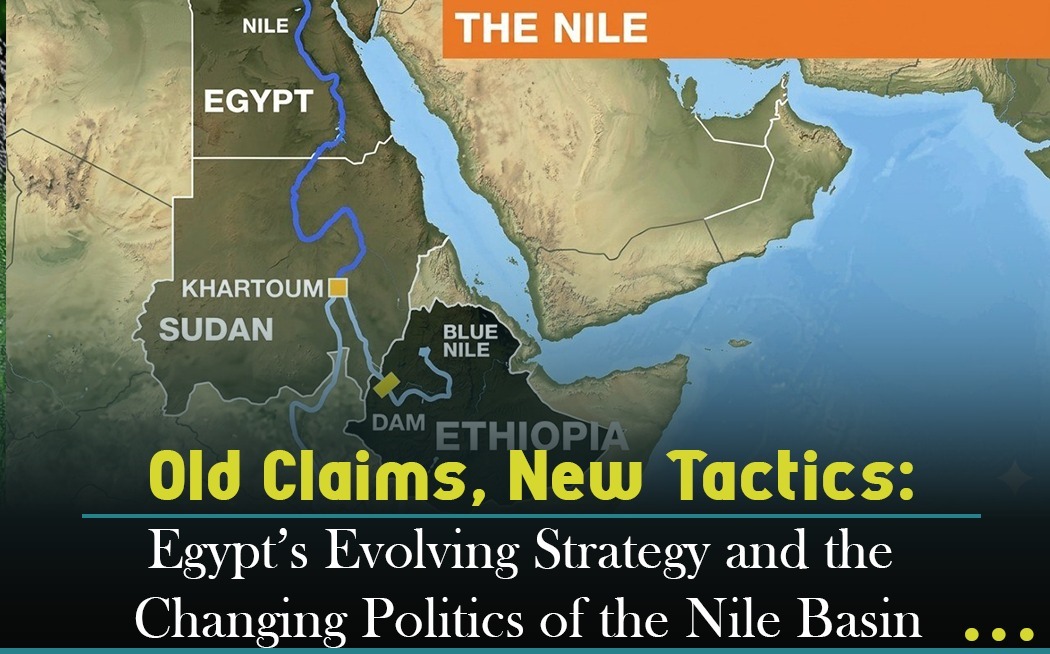
At first glance, the contemporary politics of the Nile Basin appears to be undergoing transformation, new agreements, emerging partnerships, and shifting diplomatic alignments suggest a departure from the rigid hierarchies of the past. Yet, beneath this veneer of change lies a deeper continuity: the persistence of asymmetrical claims rooted in colonial-era arrangements, now repackaged through modern instruments of influence. Nowhere is this contradiction more evident than in Egypt’s evolving engagement with upstream states, particularly Uganda and Kenya, at a time when the basin is ostensibly transitioning toward a more equitable legal and institutional order under the Cooperative Framework Agreement (CFA).
This tension, between an emerging multilateral regime grounded in equitable utilization and an older paradigm of hydro-hegemony, is not merely diplomatic. It reflects a broader struggle over sovereignty, development, and the redefinition of rights over one of Africa’s most strategic transboundary resources: the Abbay (Blue Nile) River.
Historical Legacies and the Question of Legitimacy
Any meaningful analysis of contemporary Nile politics must begin with its historical architecture. The 1929 Anglo-Egyptian Treaty and the 1959 Egypt–Sudan Agreement institutionalized a regime of exclusion, granting Egypt and Sudan near-total control over Nile waters while systematically marginalizing upstream states—most notably Ethiopia, which contributes approximately 85% of the Nile’s total flow through the Abbay River.
These agreements were neither inclusive nor representative. They reflected the geopolitical priorities of colonial powers rather than the hydrological realities of the basin. Yet, Egypt’s long-standing diplomatic posture has been anchored in these arrangements, often framed as “historic rights”—a term that, upon closer inspection, reveals more about power than about law.
Ethiopia, by contrast, has consistently rejected this framework, advancing instead the principle of equitable and reasonable utilization, as codified in the 1997 UN Convention on the Law of the Non-Navigational Uses of International Watercourses. This principle aligns closely with Ethiopia’s interpretation of limited territorial sovereignty, a doctrine that affirms a state’s right to utilize transboundary resources within its territory, provided such use does not cause significant harm to others.
Prime Minister Abiy Ahmed has repeatedly articulated this position in both domestic and international forums. As he noted in a parliamentary address:
“The Nile is not a gift to one nation; it is a shared resource. Ethiopia does not seek to harm downstream countries, but neither can it accept a system that denies its people the right to development.”
This framing is critical. It situated Ethiopia’s hydraulic development not as a unilateral assertion of power, but as a corrective to historical exclusion—a rebalancing of rights in line with contemporary international norms.
The GERD and the Reconfiguration of Power
The Grand Ethiopian Renaissance Dam (GERD), inaugurated in September 2025, represents the materialization of this normative shift. More than a hydroelectric project, the GERD embodies a reconfiguration of hydro-political power in the basin.
Financed almost entirely through domestic resources—estimated at $4–5 billion—the dam stands as a symbol of sovereign development and Pan-African self-reliance. It also challenges the structural foundations of hydro-hegemony, which historically relied on three pillars: material power (control over water infrastructure), bargaining power (diplomatic leverage), and ideational power (dominant narratives of legitimacy).
By constructing the GERD, Ethiopia has effectively altered all three. Materially, it now possesses significant upstream storage and regulation capacity. Diplomatically, it has rallied support from multiple basin states through the CFA. Ideationally, it has reframed the discourse from “water security” as control to “water security” as shared development.
PM Abiy Ahmed encapsulated this shift succinctly: “We are not building a dam to withhold water, but to generate energy—energy that will power not only Ethiopia, but the region. Cooperation is not a choice; it is a necessity.”
Egypt’s Strategic Adaptation: From Hegemony to “Micro-Interventionism”
Faced with this changing landscape, Egypt appears to be recalibrating its strategy. Unable to prevent the completion of the GERD, Cairo has increasingly turned to what may be described as “micro-interventionism”, a strategy centered on small-scale, high-visibility projects in upstream states.
The recent commitments to Uganda, including pledges to finance water infrastructure through the Nile Development Fund, exemplify this approach. Similarly, the proposed $100 million package for Kenya, targeting feasibility studies, groundwater development, and rainwater harvesting, reflects a broader pattern of development diplomacy.
On paper, these initiatives are framed in the language of “win-win cooperation” and adherence to the principle of “no significant harm.” Yet, their strategic function appears more complex.
First, they operate as instruments of diplomatic signaling, allowing Egypt to project engagement and leadership in the basin. Second, they serve as tools of alignment management, seeking to dissuade upstream states from fully committing to the CFA framework. Third, they reflect an attempt to reconstruct influence in a context where traditional mechanisms of control are no longer viable.
Conceptually, this strategy aligns with broader patterns of development diplomacy and soft power projection observed among middle powers. Rather than relying on large-scale infrastructure dominance, it emphasizes targeted investments designed to build political goodwill and maintain influence. In this sense, Egypt’s recalibration reflects adaptation to shifting geopolitical realities rather than simple decline.
Commitments Without Capacity: The Political Economy Constraint
Perhaps most revealing is the gap between Egypt’s external commitments and its internal economic realities. Since early 2026, Egypt has faced significant financial strain: Suez Canal revenues have reportedly declined by nearly 60% due to regional instability, inflation has surged to approximately 13%, and energy shortages have necessitated rationing measures.
At the same time, Cairo remains heavily reliant on external financial support, including IMF programs and assistance from Gulf states and the European Union.
In this context, the proliferation of foreign infrastructure pledges raises critical questions about sustainability. Many of the announced projects in Uganda and Kenya remain in the feasibility or proposal stage, with limited evidence of large-scale capital disbursement.
This has led to a growing perception—particularly in Addis Ababa—that these agreements function less as development initiatives and more as “diplomatic IOUs”: commitments designed to generate political goodwill without immediate material follow-through.
From a realist perspective, this reflects a classic case of overextension, where a state attempts to maintain influence beyond its economic capacity, relying on symbolic gestures rather than structural investments.
The CFA and the Emergence of a New Legal Order
In contrast to bilateral arrangements, the Cooperative Framework Agreement represents a multilateral effort to institutionalize equitable governance in the Nile Basin. Ratified by Ethiopia, Uganda, Rwanda, Tanzania, Burundi, and South Sudan, the CFA establishes a Nile River Basin Commission aimed at managing the river as a shared resource.
Crucially, the CFA rejects the notion of historical veto power, instead emphasizing collective decision-making and mutual benefit.
Egypt’s reluctance to join this framework underscores the central tension in contemporary Nile politics. While Cairo advocates for inclusivity in principle, its continued reliance on bilateral engagements suggests a preference for arrangements that preserve asymmetrical advantages.
From Ethiopia’s perspective, this divergence is not merely procedural—it is normative. It reflects historical continuity and security, the other prioritizing equitable redistribution and shared governance.
Sudan and the Fluid Middle Ground
Sudan occupies a pivotal yet evolving position in Nile Basin politics. Geographically situated between Ethiopia and Egypt, it functions as both a downstream and intermediary actor, with interests that do not fully align with either side. The GERD presents a combination of opportunities—such as improved flood management and more regulated water flows—as well as coordination challenges related to dam operations and water governance.
At the same time, Sudan’s domestic transitions in recent years have influenced the consistency and continuity of its external engagement on Nile-related issues. This has contributed to a more adaptive and context-dependent policy posture, shaping how it engages with basin-wide initiatives. As a result, Sudan remains an important interlocutor in regional discussions, with its positioning carrying significant implications for the direction of future cooperation in the basin.
Hydro-Hegemony Revisited: A System in Transition
Applying the lens of hydro-hegemony theory, the Nile Basin appears to be transitioning from a hegemonic order to a more pluralistic configuration.
Egypt’s traditional dominance—anchored in downstream control and international alliances—is being challenged by upstream assertiveness and institutional innovation. Ethiopia’s rise as a “hydro-power” state, coupled with its role as a regional energy hub, is reshaping the balance of power.
Yet, this transition remains incomplete. Egypt retains significant diplomatic capital, particularly in global forums, and continues to securitize the Nile issue in its domestic discourse. Sudan, meanwhile, occupies a fluid position, influenced by internal instability and shifting alliances.
The result is a precarious equilibrium, a system in which no single actor can impose its will, yet collective agreement remains elusive.
Beyond Water: Energy, Integration, and the Future of the Basin
Perhaps the most consequential shift, however, lies in the changing nature of what is at stake. The Nile is no longer solely a question of water allocation; it is increasingly about energy, infrastructure, and regional integration.
Ethiopia’s “Mega-Development Model”—centered on large-scale projects like the GERD and cross-border electricity exports—offers a vision of interdependence that extends beyond hydropolitics. By supplying affordable electricity to countries such as Kenya and Djibouti, Ethiopia is positioning itself as a provider of regional public goods.
This stands in contrast to Egypt’s more fragmented approach, which, while effective in building relationships, lacks the structural depth to reshape regional systems. The implications are profound. As basin states prioritize industrialization and economic growth, the demand for energy—and the value of integrated infrastructure—will likely eclipse traditional concerns over volumetric water control.
Conclusion: Toward a Cooperative Future
The evolving politics of the Nile Basin reflects both continuity and change. Egypt’s shift toward micro-interventionism demonstrates adaptability, yet it also reveals the limits of a strategy rooted in legacy claims and constrained resources. Ethiopia’s rise, anchored in the principles of equitable utilization and limited territorial sovereignty, signals a broader transformation in how transboundary resources are governed.
Yet, the path forward remains uncertain. For all parties, the central challenge is to move beyond zero-sum thinking and embrace a genuinely cooperative framework. As PM Abiy Ahmed has emphasized: “If we choose cooperation, the Nile can be a source of prosperity for all. If we choose conflict, it will benefit none.”
Policy Recommendations
- Institutional Consolidation of the CFA: Accelerate the operationalization of the Nile Basin Commission to provide a credible multilateral platform for dispute resolution and resource management.
- Confidence-Building Measures: Establish transparent data-sharing mechanisms, particularly regarding dam operations and water flows, to reduce mistrust.
- Economic Integration Initiatives: Expand regional energy grids and joint infrastructure projects to create interdependencies that incentivize cooperation.
- Reframing the Narrative: Shift from securitized discourse to development-oriented dialogue, emphasizing shared benefits rather than perceived threats.
- Inclusive Diplomacy: Encourage Egypt and Sudan to engage constructively with the CFA framework, recognizing that long-term water security is best achieved through cooperation, not control.
The Nile Basin stands at a decisive juncture. The erosion of colonial-era hierarchies offers an opportunity to construct a more just and sustainable order—one in which sovereignty is not a barrier to cooperation, but its foundation.
By Bemnet Alemayehu, IFA
Disclaimer:
The content disseminated by the Institute of Foreign Affairs (IFA) – including, but not limited to, publications, public statements, events, media appearances, and digital communications – reflects the views of individual contributors and does not necessarily represent the official positions or policies of the Institute, its partners, or any affiliated governmental or non-governmental entities.
While the IFA endeavors to ensure the accuracy, integrity, and timeliness of the information presented, it makes no representations or warranties, express or implied, regarding the completeness, reliability, or suitability of such content for any purpose. The Institute expressly disclaims any liability for errors or omissions, as well as for any actions taken or decisions made based on the information provided.
The inclusion of external links, references, or third-party resources does not constitute an endorsement by the Institute. Additionally, engagement on social media platforms – including, but not limited to, likes, shares, retweets (RTs), or reposts – shall not be interpreted as an endorsement or validation of the views expressed therein.
Readers and audiences are encouraged to exercise critical judgment and seek independent verification when interpreting or relying upon any information disseminated through publications and posts on the Institute’s platforms or representatives.