

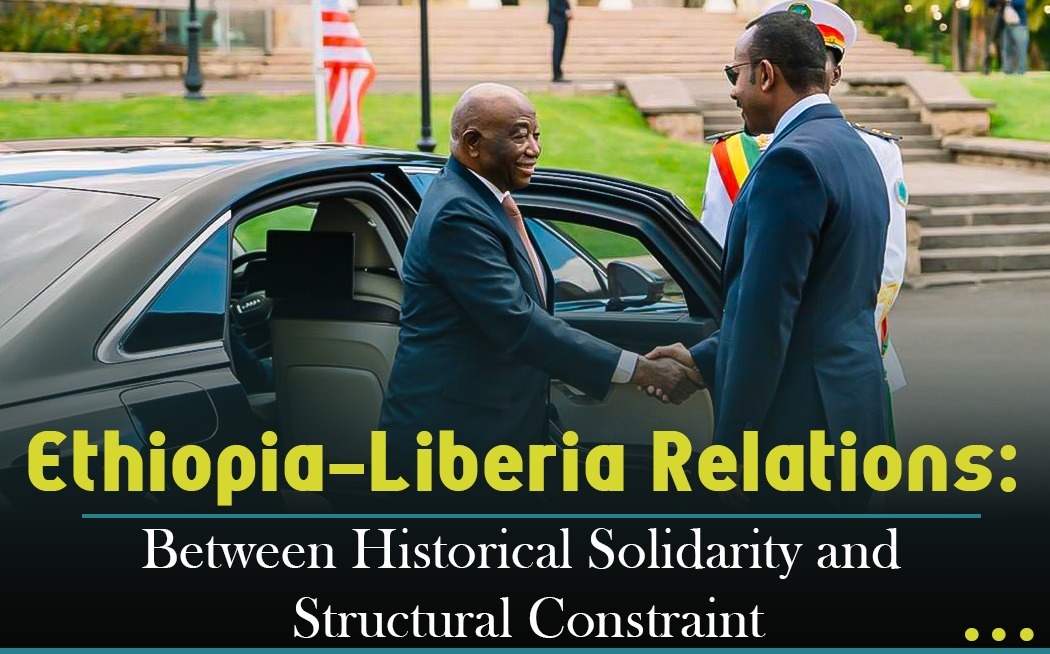
Diplomatic engagements often reveal as much through their form as through their substance. The official visit of Joseph Nyuma Boakai to Addis Ababa on 13 April 2026—where he held bilateral talks with Abiy Ahmed Ali—served not only to reaffirm long-standing ties, but also to highlight how historical solidarity continues to inform contemporary cooperation. The signing of Memoranda of Understanding (MOUs) in areas such as peacekeeping, agriculture, and capacity building points to a shared intention to translate enduring goodwill into practical collaboration.
The setting of the visit carries its own significance. Addis Ababa, as the seat of the African Union and a center of continental diplomacy, provides an institutional backdrop that reinforces Ethiopia’s role in facilitating dialogue and policy exchange. Within this context, the engagement reflects a complementary dynamic: Ethiopia contributes its experience in development and institutional capacity, while Liberia brings perspectives shaped by post-conflict recovery and reform.
Taken together, the visit underscores more than a continuation of shared historical narratives rooted in anti-colonial resistance. It illustrates an evolving partnership in which common heritage supports forward-looking cooperation, shaped by differing yet mutually reinforcing national experiences.
Historical Solidarity as Diplomatic Currency
The Ethiopia–Liberia relationship is often framed through a narrative of exceptionalism within Africa’s colonial history. Liberia, founded in 1847, and Ethiopia, which preserved its sovereignty through pivotal moments such as the Battle of Adwa, represent two distinct yet convergent trajectories of African autonomy. Both countries became early symbols of resistance and statehood in a continent largely defined by colonial subjugation.
This shared status was not merely symbolic. It translated into early diplomatic engagement and mutual recognition within emerging global governance frameworks, particularly as founding members of the United Nations in 1945. In this context, Ethiopia and Liberia were not peripheral actors but norm entrepreneurs, advocating sovereignty, territorial integrity, and decolonization.
The convergence deepened with the formation of the Organization of African Unity (OAU) in Addis Ababa in 1963. Leaders such as Emperor Haile Selassie I and William Tubman institutionalized Pan-Africanism as both ideology and diplomatic practice. The principles they advanced—non-interference, sovereign equality, and anti-colonial solidarity—continue to shape African interstate relations, now carried forward by the African Union.
Yet, to interpret this historical alignment as a direct foundation for contemporary strategic partnership risks analytical overreach. Solidarity, in this case, operates less as a material driver of integration and more as a diplomatic language—one that legitimizes cooperation without necessarily restructuring underlying economic or geopolitical realities.
From Symbolism to Selective Engagement
Perhaps most revealing is how this historical solidarity has manifested in practice. Ethiopia’s role in Liberia’s post-conflict stabilization illustrates both the strengths and limits of this relationship. During Liberia’s civil wars (1989–2003), Ethiopia contributed troops under the United Nations Mission in Liberia framework, reinforcing its broader identity as a leading African peacekeeping state.
This engagement reflects a pattern: solidarity translates effectively into multilateral cooperation, particularly in peace and security. However, bilateral economic integration remains comparatively shallow. Trade volumes between Ethiopia and Liberia are minimal, and there is limited evidence of sustained investment flows or joint infrastructure development.
This divergence underscores a critical distinction. While historical solidarity facilitates political alignment and diplomatic goodwill, it does not automatically generate the material conditions necessary for deep integration. Instead, it often obscures asymmetries—rendering them politically manageable but structurally persistent.
Structural Constraints and Divergent Political Economies
To understand these limitations, one should move beyond narrative and examine structural realities. Ethiopia’s geopolitical condition as a landlocked state fundamentally shapes its strategic priorities. Its economic trajectory is anchored in securing access to maritime corridors, investing in logistics infrastructure, and managing dependencies on transit states such as Djibouti.
Liberia, by contrast, occupies a markedly different position within the global system. Rather than relying on territorial control of trade routes, it exerts influence through institutional mechanisms—most notably its status as one of the world’s largest maritime registries. This “flag-of-convenience” model integrates Liberia into global shipping networks, not through geography but through regulatory governance.
These contrasting positions create a paradox. While both states are embedded in global trade systems, they engage them through fundamentally different modalities—Ethiopia through physical infrastructure and territorial access, Liberia through institutional and legal frameworks. The result is a structural misalignment that limits the scope for deep bilateral integration.
Equally consequential is the broader architecture of global trade, which privileges established corridors and entrenched logistics networks. Unlike regional partnerships such as the Ethiopia–Djibouti corridor—where infrastructure investment creates tangible interdependence—Ethiopia–Liberia relations lack a comparable material foundation.
Agriculture as a Zone of Convergence
Yet, structural constraints do not eliminate the possibility of meaningful cooperation; they reshape its terrain. Agriculture emerges as the most viable domain of convergence, precisely because it is less constrained by geography and more amenable to policy transfer and institutional learning.
Liberia’s agricultural sector, which contributes roughly a quarter to a third of GDP and employs a majority of the population, remains characterized by low productivity and significant post-harvest losses. Ethiopia, in contrast, has undertaken extensive agricultural reforms over the past two decades, expanding extension services, increasing fertilizer use, and investing in agro-industrial parks.
This divergence creates a complementary dynamic. Ethiopia’s experience in scaling smallholder productivity and building extension systems offers a model that can be adapted—though not uncritically—to Liberia’s context. The MOUs signed during the April 2026 visit reflect this recognition, emphasizing cooperation in agriculture, livestock development, and capacity building.
In this sense, solidarity becomes operational. It facilitates the transfer of knowledge, the adaptation of policy frameworks, and the development of institutional capacity. Unlike infrastructure-heavy cooperation, which requires significant capital and geographic alignment, agricultural collaboration is scalable and flexible.
Human Capital and Institutional Exchange
Beyond agriculture, the expansion of Technical and Vocational Education and Training (TVET) systems represents another avenue for engagement. Ethiopia’s experience in rapidly scaling vocational education aligns with Liberia’s need to develop a skilled workforce in the post-conflict period.
Such cooperation falls within what may be termed “low-friction domains”—areas where institutional exchange is not heavily constrained by capital requirements or geographic barriers. These include education, public administration, and governance reform.
More innovatively, Liberia’s maritime expertise offers Ethiopia an indirect pathway into global shipping governance. While this does not resolve Ethiopia’s dependence on external ports, it provides opportunities for capacity building in maritime regulation and logistics management. In an era where global trade is increasingly governed by complex regulatory regimes, such knowledge is not insignificant.
Comparative Lessons: When Solidarity Becomes Structure
A comparative perspective further clarifies the limits of Ethiopia–Liberia relations. Partnerships such as the Ethiopia–Djibouti corridor or the LAPSSET initiative demonstrate how political alignment can be transformed into structural interdependence through infrastructure investment.
Similarly, outside Africa, relationships such as India–Kenya illustrate how postcolonial solidarity evolves into robust economic partnerships when supported by trade complementarities and capital flows.
The absence of such material underpinnings in Ethiopia–Liberia relations explains why their cooperation remains selective rather than comprehensive. Solidarity, in itself, is insufficient. It must be coupled with infrastructure, investment, and institutional integration to produce transformative outcomes.
Domestic Drivers and Strategic Calculations
Domestic political considerations further shape the trajectory of this relationship. For Ethiopia, projecting its development model internationally serves both diplomatic and ideological purposes. It reinforces its identity as a leader in African development discourse while creating opportunities for soft power projection.
For Liberia, engagement with Ethiopia offers access to policy experience and technical expertise that can support post-conflict reconstruction and economic transformation despite some asymmetries.
These asymmetries do not preclude cooperation, but they do define its parameters. The relationship is less a partnership of equals in economic terms than a collaboration shaped by differentiated capacities and needs.
Conclusion: Toward a Pragmatic Partnership Model
Overall, Ethiopia–Liberia relations illustrate the dual nature of postcolonial solidarity in contemporary Africa. On one hand, it serves as a bridge—facilitating diplomatic engagement, legitimizing cooperation, and sustaining political goodwill. On the other, it functions as a veil, obscuring the structural constraints that limit deeper integration.
The April 2026 visit and the accompanying MOUs signal an attempt to move beyond symbolism toward more concrete forms of collaboration. Yet, the success of this effort will depend on whether both states can align their cooperation with areas of genuine structural complementarity.
Policy Recommendations:
- Prioritize Sector-Specific Integration: Focus on agriculture, education, and institutional exchange where cooperation is both feasible and impactful.
- Develop Joint Implementation Mechanisms: Move beyond MOUs to establish monitoring frameworks that ensure continuity and accountability.
- Leverage Multilateral Platforms: Utilize the African Union and UN systems to scale bilateral initiatives into broader regional programs.
- Explore Indirect Strategic Linkages: Expand cooperation in maritime governance and logistics training, leveraging Liberia’s institutional strengths.
- Encourage Private Sector Engagement: Facilitate business-to-business linkages to complement state-led initiatives and create sustainable economic ties.
Ethiopia–Liberia relations are best understood not as an unrealized strategic alliance but as a selective partnership ecosystem—one shaped by history, constrained by structure, and activated through pragmatic, sector-specific engagement. The challenge, and opportunity, lies in transforming solidarity from a rhetorical resource into a functional instrument of African-led development.
References
African Union. (2002). Constitutive Act of the African Union. Addis Ababa: AU.
Clapham, C. (2017). The Horn of Africa: State formation and decay. Oxford University Press.
Ethiopian News Agency. (2017). Ethiopia, Liberia agree to work together in multiple areas. Ethiopian News Agency.
Ethiopian News Agency. (2024). Liberia desires to learn from Ethiopia’s development experiences. Ethiopian News Agency.
Economic Community of West African States. (2020). Regional maritime strategy and security framework. Abuja: ECOWAS.
United Nations. (2003). UN Mission in Liberia (UNMIL): Background and achievements. New York: UN.
World Bank. (2021). Liberia economic update: Leveraging the blue economy. Washington, DC: World Bank.
Yohannes, O. (1991). African diplomacy and the OAU: Ethiopia’s role in African unity. Addis Ababa University Press.
By Kuchim Silesh , IFA
Disclaimer:
The content disseminated by the Institute of Foreign Affairs (IFA) – including, but not limited to, publications, public statements, events, media appearances, and digital communications – reflects the views of individual contributors and does not necessarily represent the official positions or policies of the Institute, its partners, or any affiliated governmental or non-governmental entities.
While the IFA endeavors to ensure the accuracy, integrity, and timeliness of the information presented, it makes no representations or warranties, express or implied, regarding the completeness, reliability, or suitability of such content for any purpose. The Institute expressly disclaims any liability for errors or omissions, as well as for any actions taken or decisions made based on the information provided.
The inclusion of external links, references, or third-party resources does not constitute an endorsement by the Institute. Additionally, engagement on social media platforms – including, but not limited to, likes, shares, retweets (RTs), or reposts – shall not be interpreted as an endorsement or validation of the views expressed therein.
Readers and audiences are encouraged to exercise critical judgment and seek independent verification when interpreting or relying upon any information disseminated through publications and posts on the Institute’s platforms or representatives.