

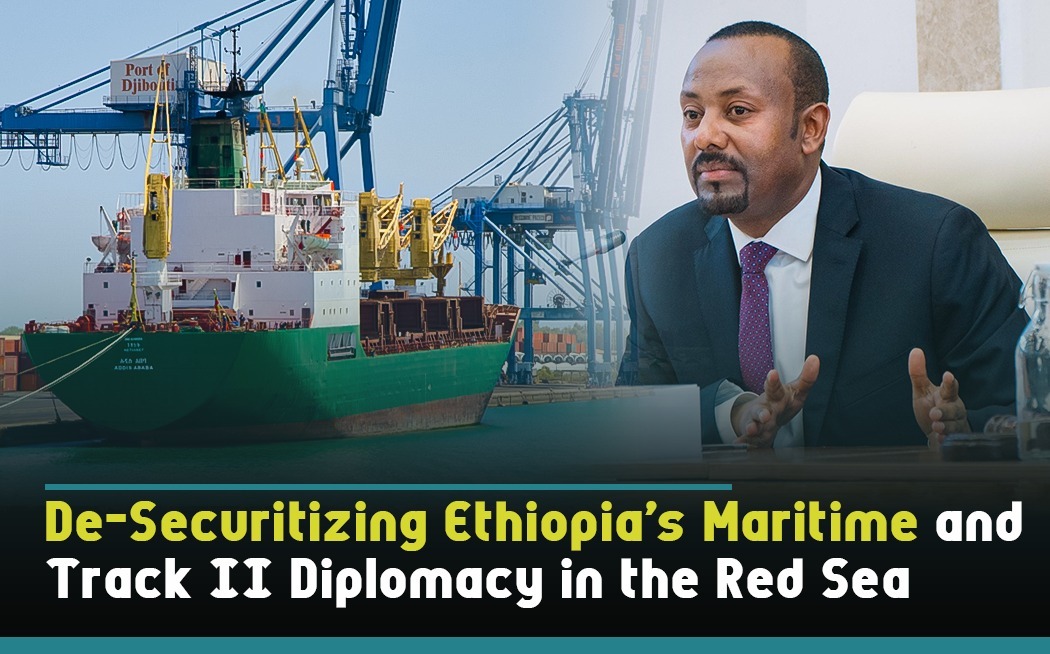
Executive Summary
Ethiopia’s strategic pivot toward “Functional Sovereignty” in the Red Sea—seeking operational control of maritime corridors rather than territorial acquisition—faces serious regional contestation. Neighbors, especially Somalia and Egypt, often interpret Ethiopia’s posture as irredentist, generating “zero-sum” logic over “ownership vs. function.” This brief argues that Track II Diplomacy is essential for de-securitizing Ethiopia’s maritime ambition: it can reduce mistrust, clarify intentions, socialize legal narratives aligned with the law of the sea, and convert perceived threats into shared interests—thereby supporting long-term regional stability.
2. Problem Statement
For too long, the planning of international relations has leaned almost exclusively on official formalism—a world of high-stakes summits conducted under the unforgiving glare of public scrutiny and the stifling weight of protocol [13][16]. While these “Track I” negotiations are essential for finalizing legal agreements, their inherent rigidity frequently leads to strategic deadlocks [5] [7]. This is particularly evident in the Horn of Africa, where national pride and deeply entrenched “red lines” are so sensitive that even a minor public concession can be framed as a political betrayal [4][2]. In such an environment, formal leaders are often paralyzed, unable to explore compromise without risking their domestic legitimacy. [13][18]
Because the diplomatic attention is perpetually fixed on the official stage, the potential of “Track II” diplomacy—the quiet, informal dialogues led by scholars, community elders and seasoned retired diplomats—has been systematically overlooked [13][17]. For decades, these unofficial channels have been marginalized as “side projects” or purely academic exercises, deemed to lack the authority required to influence hard power [16] [3]. By sidelining these experts, regional actors forfeit a vital opportunity to build the human trust and technical consensus that is impossible to achieve in a high-pressure government environment [12][14]. Track II diplomacy works and potentially preferred this utilize how the integration of informal channels into the heart of regional diplomatic strategy can serve as a transformative catalyst for stability. Track II offers a safe, low-stakes arena where “outside-the-box” solutions can be stress-tested without the fear of immediate political fallout [13] [14]. Ultimately, this study seeks to uncover those creative pathways to peace and cooperation that traditional statecraft, acting in isolation, is currently unable to reach.
3. The Solution: Track II Diplomacy as a Strategic Enabler
Track II Diplomacy—informal, non-governmental dialogue among academics, former officials, business actors, and civil society—can close the perception gap that formal Track I channels struggle to address. It offers a low-stakes setting in which parties can explore narratives, test shared assumptions, and build practical cooperation without immediately triggering sovereignty-sensitive bargaining.
Track II can operationalize de-securitization through five mechanisms:
- Narrative De-escalation. Convene structured dialogues that consistently explain “functional sovereignty” as logistics-focused operational governance (trade facilitation, transit security, and corridor resilience), replacing geopolitical language of “annexation” with interdependence-oriented framing. [6][7] [15][
- Legal Socialization (UNCLOS alignment). Use workshops and expert symposia to socialize interpretations of international maritime law—particularly the rights and protections relevant to landlocked states and maritime access—so Ethiopia’s approach is understood as consistent with legal norms rather than exceptionalism. [3][8]
- Building Commercial Entanglement. Engage business and investment constituencies to co-design corridor-related economic models (e.g., joint ventures, shared equity, revenue-sharing, and interoperable logistics). When commercial benefits are perceived as real and distributed, the political logic of threat declines. [6][9]
- Informal Security Dialogue. Facilitate private exchanges on maritime risk assessment and security coordination (piracy, smuggling, maritime-terror vulnerabilities, and disruption contingencies) to build trust around shared protection of trade lifelines rather than contested control of territory. [6][10]
- Early Warning and De-confliction. Establish Track II “horizon scanning” and conflict-prevention channels to identify emerging friction points—then explore non-binding mitigation options before issues reach official escalation thresholds. [11][12] [18][
Track II is not a substitute for state diplomacy, but it can change the conditions under which state diplomacy becomes politically feasible—by reducing misinterpretation, normalizing legal narratives, and expanding incentives for cooperation. [6][7]
4. Operationalizing Track II for Maritime Stability
To translate Track II from concept into capability, Ethiopia should implement a sequenced, regionally inclusive program.
- Fund credible conveners and protect neutrality. Provide sustained funding and strategic autonomy to independent research institutions (including regional academic and policy centers) to convene Track II sessions regularly and maintain perceived impartiality. [1][12]
- Commission a rigorous legal-economic narrative. Support scholarly work that clearly links “functional sovereignty” to international maritime legal principles (especially UNCLOS-consistent interpretations) and demonstrates quantifiable economic dividends for transit communities and coastal states. [3][8]
- Adopt broad multi-stakeholder engagement. Ensure participation extends beyond elite security circles to include civil society, academia, and private-sector stakeholders across the Horn and Red Sea littorals—so that legitimacy is built through public-facing credibility and shared economic expectations. [6][9]
- Use Track II outputs to build formal maritime governance pathways. Once trust and shared narratives develop, Ethiopia should leverage Track II-produced consensus to advocate inclusive, formally institutionalized corridor governance arrangements (e.g., multilateral management frameworks, joint mechanisms for disruption response, and transparent coordination of security responsibilities). [2][11]
Expected outcomes (medium term): reduced sovereignty-motivated reflexes; improved interpretation of Ethiopia’s posture; increased buy-in for legal-economic models; and earlier detection of disputes before they become Track I crises. [6][10]
5. Conclusion
Track II Diplomacy should be treated as a vital pillar of Ethiopia’s “functional sovereignty” strategy—not merely a supporting activity. By deliberately fostering dialogue, clarifying intentions, socializing legally grounded narratives, and building tangible mutual interests, Track II can de-escalate tensions and cultivate the trust required to convert perceived threats into shared opportunities. Ethiopia’s aspiration to become a regional convener and market maker depends on its ability to bridge the interpretive gap between maritime operational ambitions and enduring regional anxieties—precisely the niche Track II is designed to address.
References
[1] Cascão, A. E. (2014) ‘Geopolitics of the Nile Basin: Implications for regional security’, Mediterranean Politics, 19(2), pp. 237–254.
[2] Clapham, C. (2017) The Horn of Africa: State Formation and Decay. London: Hurst & Company.
[3] Davidson, W. D. and Montville, J. V. (1981) ‘Foreign policy according to Freud’, Foreign Policy, (45), pp. 145–157.
[4] De Waal, A. (2015) The Real Politics of the Horn of Africa: Money, War and the Business of Power. Cambridge: Polity Press.
[5] De Waal, A. (2019) The Red Sea arena: Debating regional power and political marketplace. World Peace Foundation.
[6] Diamond, L. and McDonald, J. W. (1996) Multi-Track Diplomacy: A Systems Approach to Peace. West Hartford: Kumarian Press.
[7] Fearon, J. D. (1994) ‘Domestic political audiences and the escalation of international disputes’, American Political Science Review, 88(3), pp. 577–592.
[8] International Crisis Group (2024) Ethiopia’s Somaliland deal: A gamble for sea access (Africa Report No. 317).
[9] Jones, P. (2015) Track two diplomacy: Theory and practice. Routledge.
[10] Kelman, H. C. (2005) ‘Interactive problem solving in the Israeli-Palestinian case’, in R. J. Fisher (ed.) Paving the Way. Syracuse: Syracuse University Press.
[11] Mehari, T. M. (2024) Ethiopia’s quest for a port: Sovereignty, security, and regional stability. Al Jazeera Centre for Studies.
[12] Montville, J. V. (1991) ‘Track Two Diplomacy: The Arrow and the Olive Branch’, In V. Volkan et al. (eds.) The Psychodynamics of International Relationships. Lexington: Lexington Books.
[13] Putnam, R. D. (1988) ‘Diplomacy and domestic politics: The logic of two-level games’, International Organization, 42(3), pp. 427–460.
[14] Saunders, H. H. (1991) The Other Walls: The Arab-Israeli Peace Process in a Global Perspective. Princeton: Princeton University Press.
[15] Soliman, S. (2019) ‘Mediation and bias in international conflict resolution: Lessons from the Nile dispute’, International Negotiation, 24(1), pp. 89–112.
[16] United Nations (1982) United Nations Convention on the Law of the Sea (UNCLOS).
[17] Vasciannie, S. (2021) Landlocked and geographically disadvantaged states in the International Law of the Sea. Oxford: Oxford University Press.
[18] World Bank (2023) The Horn of Africa initiative: Overcoming landlockedness through regional corridors. Washington, D.C.: World Bank Publications.
About the author
Yitina Gebre (Ph.D.), Researcher at the Multilateral Affairs Department, Institute of Foreign Affairs
Disclaimer:
The content disseminated by the Institute of Foreign Affairs (IFA) – including, but not limited to, publications, public statements, events, media appearances, and digital communications – reflects the views of individual contributors and does not necessarily represent the official positions or policies of the Institute, its partners, or any affiliated governmental or non-governmental entities.
While the IFA endeavors to ensure the accuracy, integrity, and timeliness of the information presented, it makes no representations or warranties, express or implied, regarding the completeness, reliability, or suitability of such content for any purpose. The Institute expressly disclaims any liability for errors or omissions, as well as for any actions taken or decisions made based on the information provided.
The inclusion of external links, references, or third-party resources does not constitute an endorsement by the Institute. Additionally, engagement on social media platforms – including, but not limited to, likes, shares, retweets (RTs), or reposts – shall not be interpreted as an endorsement or validation of the views expressed therein.
Readers and audiences are encouraged to exercise critical judgment and seek independent verification when interpreting or relying upon any information disseminated through publications and posts on the Institute’s platforms or representatives.