

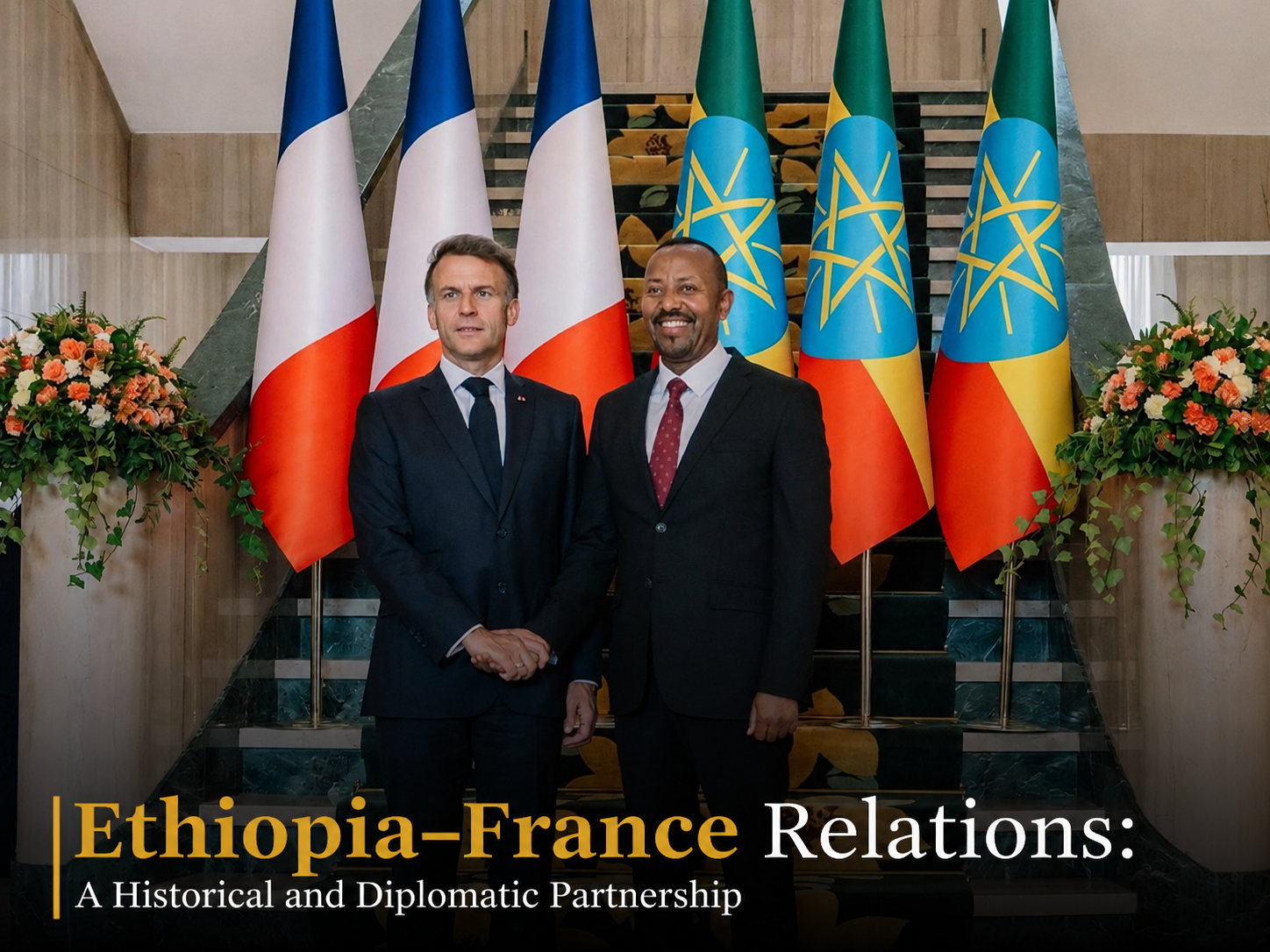
Prime Minister Abiy Ahmed’s engagement with French President Emmanuel Macron in both Nairobi and Addis Ababa in May 2026 reflects more than a routine diplomatic exchange. It signals the consolidation of a broader strategic realignment in Ethiopia–France relations within an evolving international order increasingly shaped by Africa’s geopolitical agency, green industrial transformation, and multipolar competition.
During President Macron’s third official visit to Ethiopia, Prime Minister Abiy emphasized the growing depth of bilateral relations, stating: “France’s friendship with our nation speaks for itself… the ties that bind Ethiopia and France only grow stronger.” The statement captured the emerging political logic underpinning contemporary Ethio–French relations: a transition from historically symbolic cooperation toward a multidimensional strategic partnership grounded in energy transition, infrastructure modernization, regional security, and diplomatic coordination.
The visit followed the Africa Forward Summit held in Nairobi, co-hosted by Kenya and France, where Prime Minister Abiy articulated Ethiopia’s vision of green industrialization and sustainable development as central pillars of Africa’s future economic transformation. The summit itself represented an important geopolitical moment. France sought to reposition its engagement with Africa away from the historical legacy of Françafrique and toward what President Macron described as a partnership based on sovereign equality, co-investment, and innovation-driven cooperation.
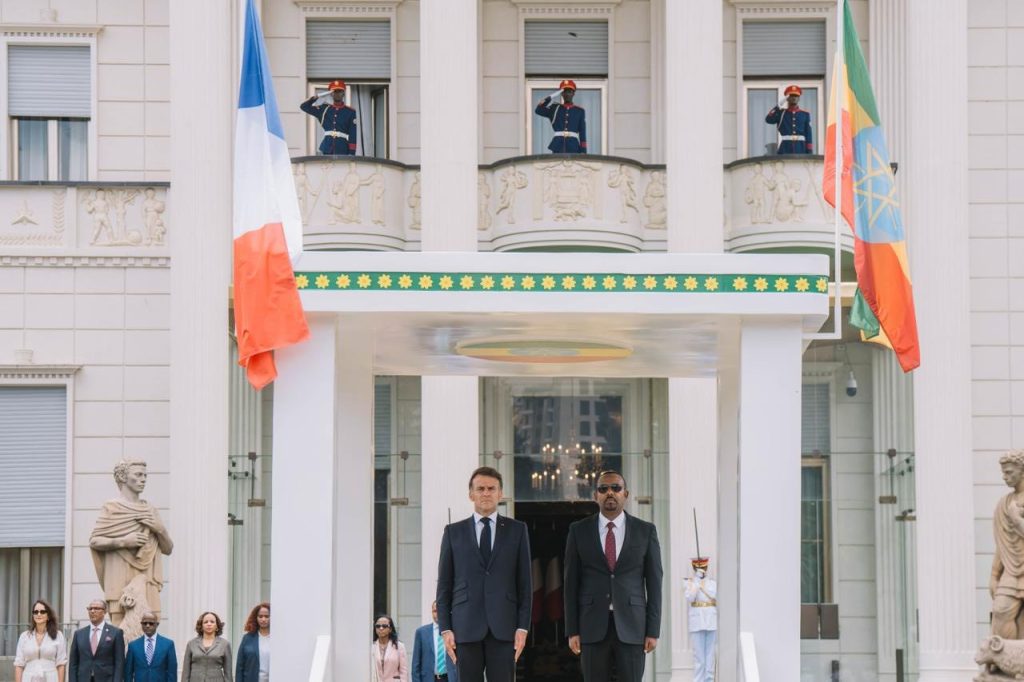
For Ethiopia, however, the significance of these developments extends beyond bilateral diplomacy. Under Prime Minister Abiy Ahmed’s leadership, Ethiopia’s foreign policy has increasingly pursued strategic diversification, economic diplomacy, regional integration, and infrastructure-centered statecraft. Ethiopia’s engagement with France therefore reflects Addis Ababa’s broader effort to position itself as a continental anchor state capable of linking African priorities with emerging global partnerships.
Historical Foundations of Ethio–French Relations
The relationship between Ethiopia and France remains one of Africa’s oldest enduring diplomatic partnerships with a European state. Formal diplomatic engagement dates back to 1843, when King Sahle Selassie of Shoa signed the Treaty of Friendship and Commerce with King Louis-Philippe of France. The agreement represented one of the earliest European recognitions of Ethiopian sovereignty during an era of expanding colonial competition.
Relations deepened significantly following Ethiopia’s victory against Italy at the Battle of Adwa in 1896, an event that reshaped anti-colonial consciousness across Africa and the Global South. France subsequently strengthened its political and diplomatic engagement with Ethiopia through the 1897 Treaty of Friendship signed with Emperor Menelik II. The establishment of one of the first permanent European diplomatic missions in Addis Ababa further institutionalized the relationship and symbolized growing mutual confidence.
One of the most transformative dimensions of the partnership emerged through infrastructure cooperation. The Franco–Ethiopian Railway linking Addis Ababa to Djibouti, constructed between 1897 and 1917, fundamentally altered Ethiopia’s integration into global commerce and facilitated the rise of Dire Dawa as a major economic center. Beyond transportation, the railway represented an early model of modernization-oriented diplomacy between Ethiopia and Europe.
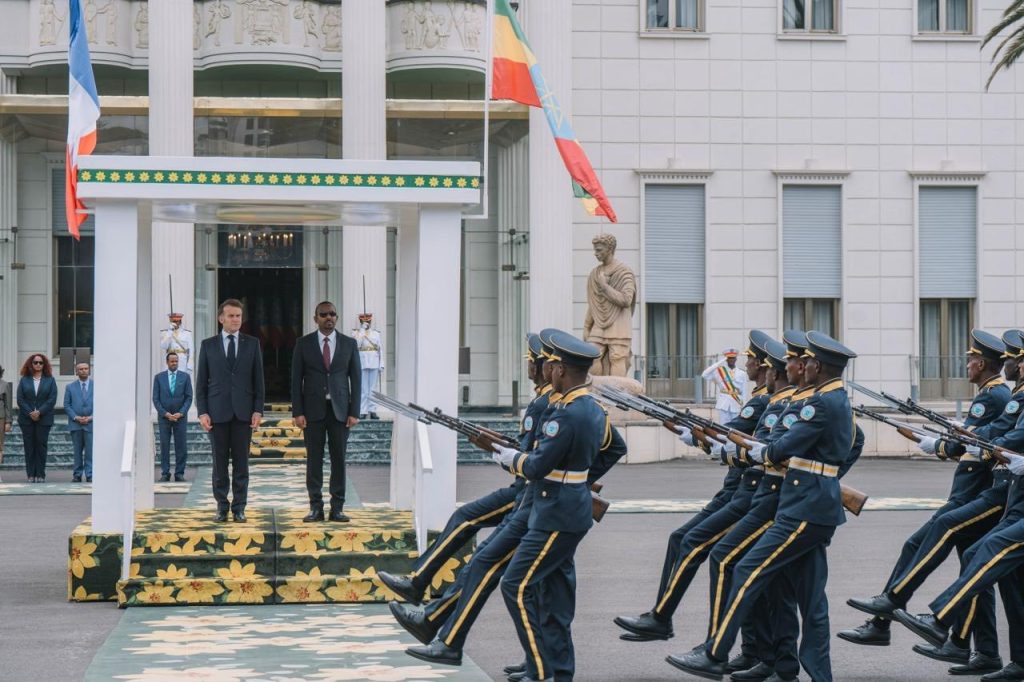
Educational and cultural collaboration likewise became central components of the relationship. Institutions such as the Alliance Ethio-Française and Lycée Guébré-Mariam fostered academic exchange, language education, and cultural diplomacy. French archaeological and restoration initiatives at Lalibela, alongside scholarly cooperation through the French Center for Ethiopian Studies (CFEE), further deepened intellectual and historical engagement.
Despite Ethiopia’s major political transformations throughout the twentieth century—from the imperial era to the Derg period and the federal republican order—relations with France remained relatively stable. France supported Ethiopia’s admission to the League of Nations in 1923 and maintained long-term diplomatic engagement across successive governments. Over time, cooperation expanded into aviation, infrastructure, renewable energy, and economic modernization.
Ethiopia’s Foreign Policy Reorientation Under Prime Minister Abiy Ahmed
Since 2018, Ethiopia’s foreign policy under Prime Minister Abiy Ahmed has increasingly emphasized strategic pragmatism, economic transformation, regional connectivity, and diplomatic diversification. Addis Ababa has sought to reposition itself not merely as a recipient of external engagement, but as an active geopolitical actor shaping continental and international agendas.
This approach has been visible in Ethiopia’s engagement with the Gulf states, China, the European Union, Türkiye, Italy, Russia, and increasingly France. Rather than aligning exclusively within traditional geopolitical blocs, Ethiopia has pursued issue-based partnerships centered on infrastructure development, investment, energy transition, logistics, and peace diplomacy.
Prime Minister Abiy’s remarks at the Africa Forward Summit in Nairobi reflected this broader strategic vision. He emphasized Ethiopia’s growing contribution to Africa’s green industrialization and energy transition agenda, positioning the country as a driver of sustainable development on the continent. His intervention aligned closely with Ethiopia’s domestic development trajectory, including investments in renewable energy, industrial parks, electric mobility, digital transformation, and climate resilience.
This foreign policy orientation is also linked to Ethiopia’s aspiration to strengthen its role as the diplomatic and political center of Africa. As host of the African Union, the United Nations Economic Commission for Africa, and numerous multilateral institutions, Ethiopia increasingly seeks to connect continental diplomacy with emerging global economic and technological transitions.
Prime Minister Abiy previously emphasized Ethiopia’s role as a bridge between Africa and the wider world during the Italy–Africa Summit earlier in 2026, arguing that Ethiopia is “connecting Africa to the world.” The growing engagement with France must therefore be understood within this larger effort to position Ethiopia as a strategic hub linking African priorities with global economic and geopolitical processes.
Macron’s African Recalibration and the Post-Françafrique Debate
President Macron’s engagement with Africa has unfolded amid a broader crisis in France’s traditional influence across the continent. French military withdrawals from the Sahel, anti-French protests in West Africa, and the rise of alternative geopolitical actors such as China, Russia, Türkiye, and Gulf states have accelerated debates over the decline of Françafrique.
The decision to organize the Africa Forward Summit in Nairobi—outside the traditional Francophone sphere—carried significant symbolic and strategic meaning. Macron explicitly framed the summit as part of a transition away from historical spheres of influence toward a model based on investment, innovation, and sovereign partnership.
The summit’s messaging emphasized equal partnership, multilateral cooperation, youth innovation, and green industrialization. French and African stakeholders announced major investment commitments targeting clean energy, technology, agriculture, and infrastructure.
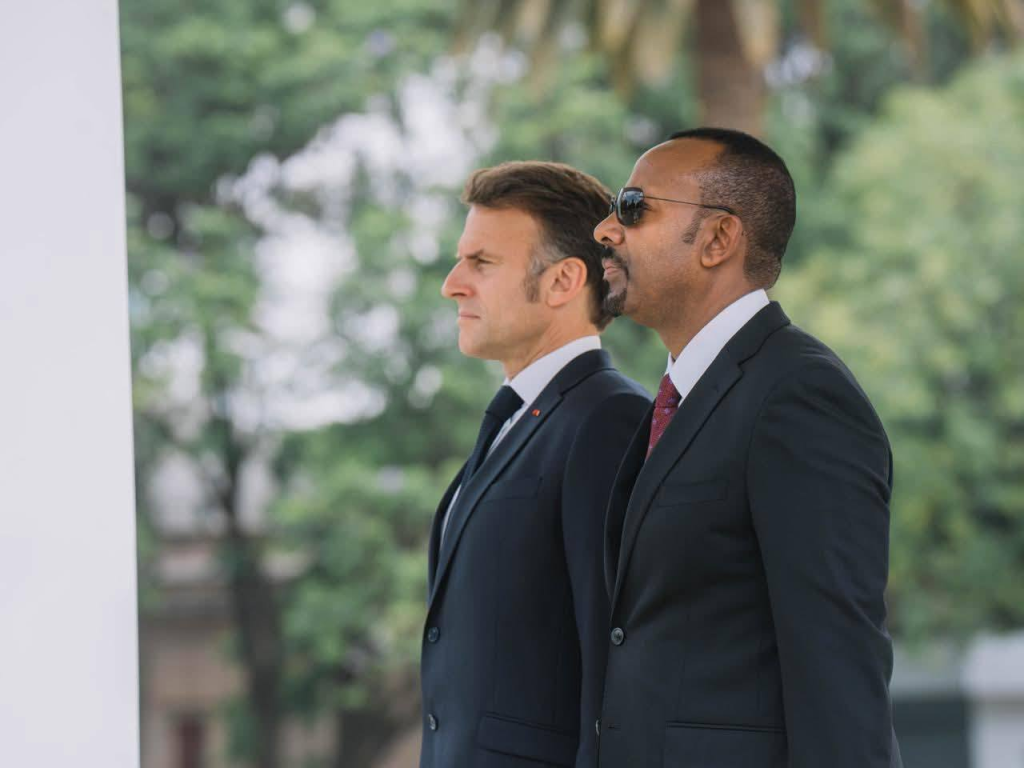
At the same time, reactions to Macron’s interventions during the summit revealed continuing sensitivities surrounding France’s historical role in Africa. Public debates surrounding Macron’s conduct at the Nairobi forum demonstrated the persistence of skepticism regarding whether France’s new rhetoric fully departs from earlier paternalistic approaches.
These tensions highlight a broader structural reality: contemporary Africa–Europe relations are increasingly shaped by African demands for sovereign equality, strategic autonomy, and mutually beneficial cooperation. African states are no longer passive participants in global diplomacy; they are actively redefining the terms of international engagement.
In this context, Ethiopia’s approach appears particularly significant. Addis Ababa’s engagement with France has not been framed through dependency, but through negotiated strategic convergence on infrastructure, renewable energy, regional stability, and multilateral diplomacy.
Strategic and Economic Dimensions of Macron’s Visit to Ethiopia
President Macron’s May 2026 visit to Addis Ababa produced concrete economic and strategic outcomes. Prime Minister Abiy announced that both leaders presided over the exchange of key bilateral agreements, including a €54.6 million loan agreement supporting Ethiopia’s Renewable, Integrated, Sustainable Energy and Digitalization Program, alongside a new framework and roadmap for a 150MW geothermal Public-Private Partnership initiative.
These agreements are strategically important for several reasons.
First, they reinforce Ethiopia’s long-term ambition to become a continental leader in renewable energy production and green industrialization. Ethiopia’s investments in hydroelectricity, geothermal power, and sustainable infrastructure align with broader African and global climate transition agendas.
Second, the agreements reflect France’s growing interest in partnering with strategically positioned African states capable of facilitating regional economic transformation. Ethiopia’s large population, expanding infrastructure networks, diplomatic centrality, and energy potential make it an increasingly attractive partner within Europe’s evolving Africa strategy.
Third, the focus on digitalization and sustainable energy reflects a broader shift in international development cooperation away from traditional aid paradigms toward technology-centered and investment-oriented partnerships.
The growing defense and security dimension of Ethio–French relations is equally notable. In recent years, France has increased cooperation with Ethiopia on military training, regional security dialogue, and maritime issues. This reflects broader European recognition that stability in the Horn of Africa remains essential for Red Sea security, counterterrorism coordination, migration management, and global trade routes.
Ethiopia as an Anchor State in the Horn of Africa
The strengthening of Ethio–French relations also carries important regional implications. Ethiopia remains central to the political and security architecture of the Horn of Africa due to its demographic scale, military capacity, diplomatic influence, and geographic position.
Despite internal and regional challenges over recent years, Ethiopia continues to play a critical role in peace diplomacy, regional mediation, and continental security initiatives. Its strategic location near the Red Sea and the Gulf of Aden gives it enduring geopolitical importance within evolving global maritime competition.
Under Prime Minister Abiy Ahmed, Ethiopia’s foreign policy increasingly seeks to position the country as a stabilizing anchor state capable of supporting regional integration and collective security. Addis Ababa’s engagement with neighboring states, Gulf powers, Europe, and multilateral institutions reflects an effort to preserve strategic relevance amid intensifying geopolitical competition in the Horn.
France’s growing engagement with Ethiopia therefore reflects broader international recognition that regional stability in the Horn of Africa cannot be addressed without Ethiopia’s participation and leadership.
The Africa Forward Summit similarly underscored the rising international importance of African-led solutions to global challenges. UN Secretary-General António Guterres emphasized in Nairobi that “Africa is not waiting. Africa is moving. Africa is leading.” This sentiment closely aligns with Ethiopia’s contemporary diplomatic messaging emphasizing African agency, strategic autonomy, and sovereign development pathways.
Conclusion
The contemporary phase of Ethiopia–France relations reflects the convergence of historical continuity and geopolitical transformation. What began in the nineteenth century as a diplomatic and commercial relationship has evolved into a multidimensional strategic partnership shaped by energy transition, infrastructure modernization, regional security, and Africa’s expanding global agency.
President Macron’s 2026 visit to Ethiopia and Prime Minister Abiy Ahmed’s engagement at the Africa Forward Summit together illustrate broader shifts in Africa–Europe relations. Traditional hierarchies are increasingly being challenged by African demands for equal partnership, investment-driven cooperation, and strategic respect.
For Ethiopia, the relationship with France forms part of a larger foreign policy doctrine centered on economic diplomacy, regional integration, green industrialization, and geopolitical diversification. Addis Ababa increasingly seeks to position itself not merely as a participant in continental affairs, but as a central anchor state shaping the future political and economic architecture of the Horn of Africa and the wider continent.
As Africa’s geopolitical relevance continues to expand amid global realignments, Ethiopia–France relations are likely to assume growing strategic importance—not only for bilateral interests, but also for the evolving configuration of Africa–Europe cooperation in the twenty-first century.
By Beminet Alemayehu, IFA
Disclaimer:
The content disseminated by the Institute of Foreign Affairs (IFA) – including, but not limited to, publications, public statements, events, media appearances, and digital communications – reflects the views of individual contributors and does not necessarily represent the official positions or policies of the Institute, its partners, or any affiliated governmental or non-governmental entities.
While the IFA endeavors to ensure the accuracy, integrity, and timeliness of the information presented, it makes no representations or warranties, express or implied, regarding the completeness, reliability, or suitability of such content for any purpose. The Institute expressly disclaims any liability for errors or omissions, as well as for any actions taken or decisions made based on the information provided.
The inclusion of external links, references, or third-party resources does not constitute an endorsement by the Institute. Additionally, engagement on social media platforms – including, but not limited to, likes, shares, retweets (RTs), or reposts – shall not be interpreted as an endorsement or validation of the views expressed therein.
Readers and audiences are encouraged to exercise critical judgment and seek independent verification when interpreting or relying upon any information disseminated through publications and posts on the Institute’s platforms or representatives.