

By: Haimanot Eshetu (phD)
Over the past two decades, Africa has often been a passive observer in the Group of Twenty (G20) discussions, lacking a consistent and unified voice in shaping critical global economic policies. South Africa, as an emerging economy and a founding member of BRICS, has been the sole African nation with permanent G20 membership, representing the continent’s interests. However, this singular representation has often been insufficient to address the diverse and multifaceted concerns of the entire continent. The landmark decision in 2023 to grant the African Union (AU) permanent membership in the G20 has reignited hopes that Africa can now advocate more effectively for its genuine interests. This inclusion aims to provide the continent with a more robust platform to influence global economic agendas and contribute to decision-making processes that shape the world’s economic future.
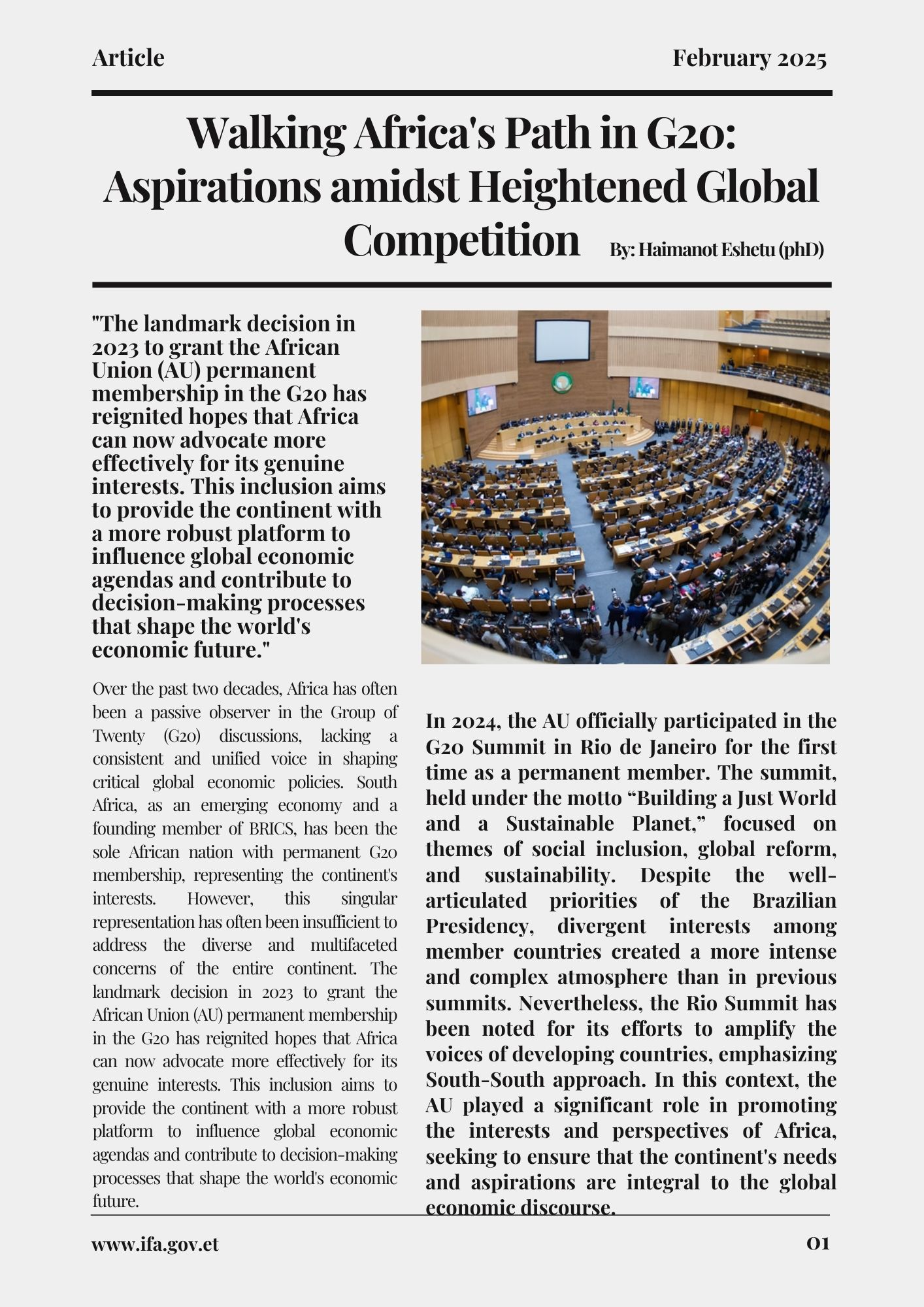
In 2024, the AU officially participated in the G20 Summit in Rio de Janeiro for the first time as a permanent member. The summit, held under the motto “Building a Just World and a Sustainable Planet,” focused on themes of social inclusion, global reform, and sustainability. Despite the well-articulated priorities of the Brazilian Presidency, divergent interests among member countries created a more intense and complex atmosphere than in previous summits. Nevertheless, the Rio Summit has been noted for its efforts to amplify the voices of developing countries, emphasizing South-South approach. In this context, the AU played a significant role in promoting the interests and perspectives of Africa, seeking to ensure that the continent’s needs and aspirations are integral to the global economic discourse.
The G20, comprising 19 major developed and developing economies along with the European Union, accounts for approximately 85% of global GDP, 80% of international trade, and two-thirds of the world’s population[1]. This forum has emerged as a pivotal platform for global governance, significantly shaping the world economy and largely replacing the once dominant G7[2]. The group’s mission includes coordinating growth policies to bolster international financial stability while amplifying the voice of emerging economies whose size and strategic importance impact the globalized economy. Supporting this mission, the Leader’s Declaration from the recent G20 summit in Rio de Janeiro emphasized “a collective responsibility for the effective stewardship of the global economy, fostering conditions for sustainable, resilient, and inclusive growth, while committing to support developing countries in responding to global crises and challenges and achieving sustainable development goals.”[3]
Beyond its original economic focus, the G20’s agenda has expanded to include pressing global issues such as climate change, international health, and sustainable development—areas where member countries often have conflicting interests. Actions by some global power member nations have led to accusations that the G20 is being utilized to advance their security interests rather than the collective good. Initially praised for its role in coordinating the international response to the 2008 global financial crisis, the G20 has since faced challenges due to internal dissension and differing priorities among its members. This discord has undermined the group’s consensus-driven approach, particularly on security-related matters involving major powers, raising questions about its effectiveness in addressing complex global issues.[4]
As emerging economies continue to develop and South-South cooperation strengthens—especially with the significant influence of the BRICS bloc—the G20 risks evolving into a forum for dialogue rather than decisive action. Geopolitical tensions and shifting power dynamics have increasingly stiffened discussions within the G20, resulting in non-consensus outcomes that hinder progress on previously established agreements, such as the Paris Agreement on climate finance. To navigate these challenges, the African Union (AU) must find common ground among its member nations to advocate for multilateral cooperation within this complex forum.
Divergent Interests in the G20: Insights from Brazil’s Presidency
Under the motto “Building a Just World and a Sustainable Planet,” G20 leaders during Brazil’s presidency focused on three main priorities: social inclusion and the fight against hunger and poverty, reform of global governance institutions, and sustainable development and energy transition. However, the forum encountered significant challenges due to geopolitical tensions and the diverse, sometimes unpredictable, interests of its member countries.
One notable divergence in Brazil’s agenda was Argentina’s opposition to references to gender equality, women’s rights, a tax for billionaires, and the 2030 Agenda for Sustainable Development.[5] This divergence raises critical questions about why neighboring countries with seemingly mutual interests differ sharply in their priorities, particularly when a unified front could enhance their influence in the evolving global dynamics. Beyond ideological differences, Brazil and Argentina’s contrasting approaches to climate change solutions further illustrate this division. A cooperative stance could enhance their collective influence on the international stage.
This situation suggests that some emerging countries align themselves with competing global powers, serving those interests rather than regional ones. For example, Argentina’s recent decision to withdraw from the COP29 conference in Azerbaijan, citing opposition to social inclusion and climate change initiatives discussed at the Rio Summit, indicates that President Javier Milei may be echoing U.S. interests. This alignment coincides with Donald Trump’s return to U.S. leadership, raising uncertainties about America’s commitment to multilateral agreements like the Paris Climate Accords. Furthermore, leaders sympathetic to Trump, such as Milei, may feel emboldened to undermine global cooperation on critical issues like climate change and gender equality.
Conversely, Brazil’s approach reflects a commitment to BRICS and broader South-South cooperation, though its western alliance’s remain essential. Notably, amidst the summit’s controversies, the Global South’s voice was more pronounced than ever. The AU’s participation as a permanent member for the first time might underscores this shift, highlighting the increasing influence of developing nations in global governance.
Overall, Donald Trump’s reelection casts a shadow over the G20 forum and the future of multilateral cooperation. This development may erode global trust in U.S. leadership, prompting other powers, particularly China, to position themselves as stable partners committed to fostering multilateral cooperation. In this context, regional powers like Brazil may seek to expand their leadership roles in specific areas such as food security, where they can make meaningful contributions to global governance.[6] Given the diverse interests of G20 member countries, participants at the summit expressed concerns that opportunities for broad agreements would continue to diminish. This highlights the necessity for the African Union (AU) to maintain a unified African position amidst divergent global interests.
Achieving a Unified African Position within the G20
The Common African Position (CAP) represents a framework through which the AU advocates for Africa’s interests on the international stage. CAP emphasizes a range of prioritized topics, including structural economic transformation and inclusive growth, science, technology and innovation, and environmental sustainability.[7] These priorities must be championed by the AU Commission in close consultation with its member states.
In complex global forums like the G20, where competing interests are prevalent and relationships are intricate, it is essential to strategically position Africa’s agenda to achieve the continent’s aspirations for sustainable development. By maintaining a cohesive stance, the AU can effectively negotiate and advocate for the collective interests of African nations, ensuring that their developmental needs are adequately addressed in G20 discussions.
Key strategies to strengthen Africa’s position within the G20
The following insights aim to bolster a unified African position within the G20, enhancing the continent’s ability to advocate for sustainable development:
- Understanding Geopolitical Dynamics: Africa’s development models must adapt to current geopolitical shifts, addressing emerging issues while leveraging past experiences. A nuanced understanding will enhance Africa’s ability to prioritize concerns and negotiate effectively.
- Coordination: Criticism of AU member states often centers on a lack of cooperation and ownership of the CAP plan. Enhancing Africa’s ability to present a unified voice requires momentum within the AU system, emphasizing Pan-African solidarity through inclusive, participatory processes.
- Initiatives: Developing frameworks like Ethiopia’s proposed strategy for a common African position in G20 discussions will facilitate unified agendas, securing development partnerships.
- South Africa’s Presidency: South Africa’s leadership provides a crucial opportunity for the AU to articulate African priorities within the G20, supported by South-South cooperation initiatives. Particularly the upcoming 2025 South Africa G20 Summit will give an opportunity to promote Africa’s common position.
By implementing these strategies, Africa can enhance its role in global governance, ensuring that its interests are well-represented and its developmental goals are effectively pursued within the G20 framework.
[1] https://www.exteriores.gob.es/en/PoliticaExterior/Paginas/G20OCDE.aspx
[2] https://www.gisreportsonline.com/r/g20-brazil/
[3] https://www.g20.utoronto.ca/2024/241118-declaration.html
[4] https://www.gisreportsonline.com/r/g20-brazil/
[5] https://www.atlanticcouncil.org/blogs/new-atlanticist/how-brazil-mexico-and-argentina-approached-this-years-g20/
[6] https://www.belfercenter.org/research-analysis/g20-summit-2024-how-world-reacting-trump
[7] https://au.int/sites/default/files/documents/32848-doc-common_african_position.pdf
About the Author
Haimanot Eshetu (phD), senior Researcher at the Institute of Foreign Affairs (IFA).
Disclaimer:- The opinions stated in this article solely Belong to the author and do not reflect the views or Positions of the IFA