

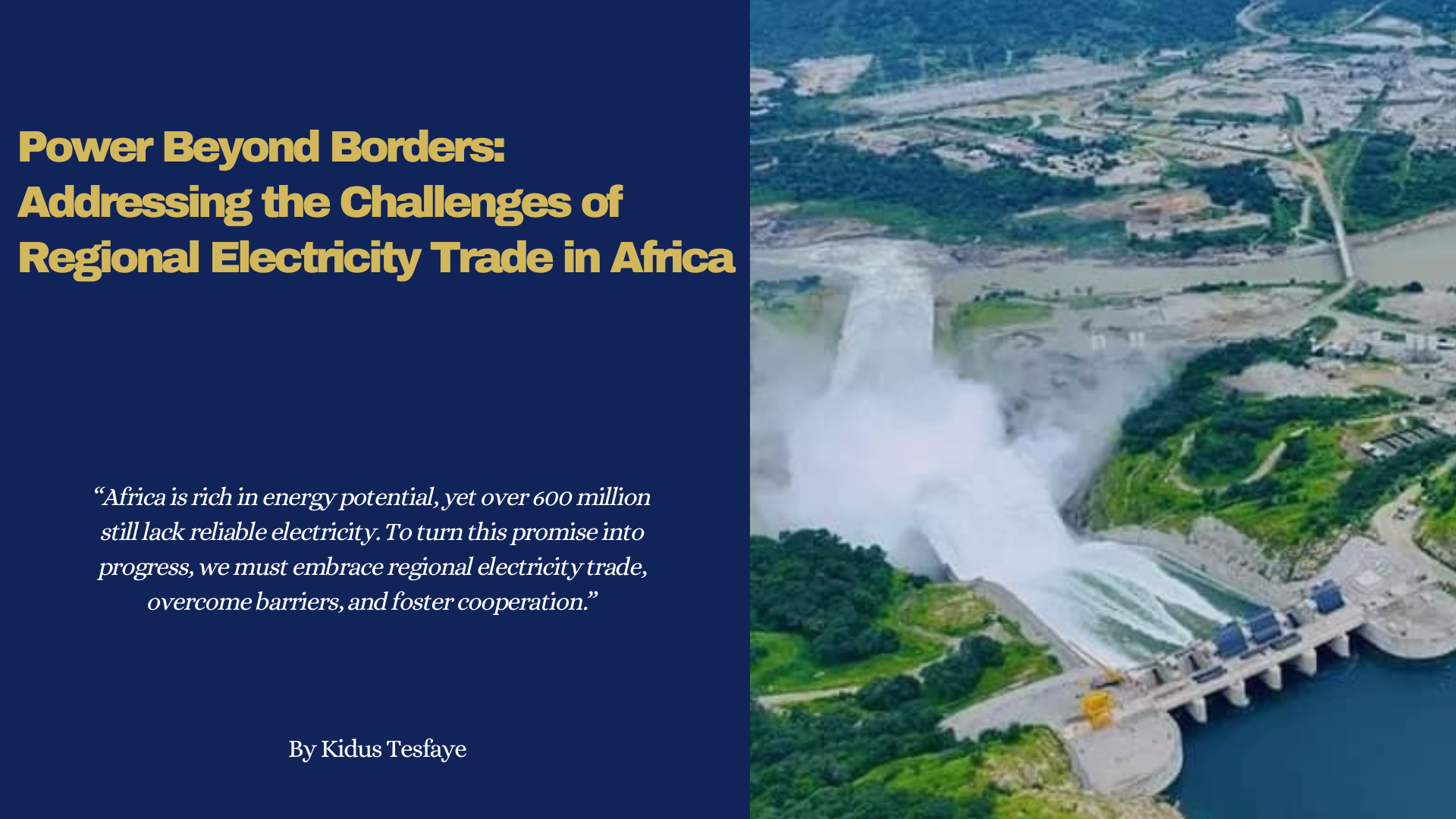
Africa is a continent overflowing with energy promise. From the thunderous rivers ideal for hydropower to the boundless, sun-bathed plains primed for solar generation; from vast geothermal seams to untapped natural gas reserves – this is a land rich in resources. Yet, more than 600 million Africans live without access to reliable electricity.[1] Nearly half the continent remains in the dark – not due to a shortage of potential, but a crisis of coordination, infrastructure, and political will.
This paradox isn’t new. It speaks to a deeper structural failure: one not rooted in scarcity, but in disconnection. And while Africa is gradually moving toward regional integration – with initiatives such as the African Continental Free Trade Area (AfCFTA), the Programme for Infrastructure Development in Africa (PIDA), and the emergence of regional power pools – progress remains uneven. The idea of electricity trade, once considered a long-term aspiration, is now an urgent necessity. It offers the promise of shared infrastructure, economic growth, and regional harmony. But to unlock its full value, Africa must overcome a number of entrenched challenges.
Electricity trade – the simple but powerful concept of exchanging power across borders – offers immediate and long-term advantages. It enhances reliability, drives down costs through economies of scale, and allows countries to optimize their energy mix. A nation rich in hydropower, such as Ethiopia or the Democratic Republic of the Congo, can export surplus electricity to neighbors facing seasonal deficits. Others, blessed with abundant solar radiation, can invest in battery storage and contribute to a region-wide grid. Through coordinated energy trade, countries can share loads, reduce dependence on emergency generators, and build long-term system resilience.
The Ethiopia–Kenya interconnector stands as a promising example of what is possible. Now operational, it enables the export of hydroelectric power from Ethiopia to Kenya, making real the idea of shared prosperity through infrastructure. Yet even this success underlines a broader truth: regional integration can only work when countries first address internal challenges. A nation that cannot effectively manage its own energy resources – whether through proper infrastructure maintenance, financial sustainability, or institutional strength – cannot be a reliable partner in a cross-border energy system. Strong, stable national frameworks are the foundation for any meaningful regional cooperation.
Still, the path forward is fraught with obstacles. Across much of the continent, the infrastructure required to support cross-border electricity trade simply doesn’t exist or is too weak to be effective. Many interconnectors remain incomplete, underbuilt, or technically obsolete. This is not simply a matter of engineering – it reflects decades of underinvestment and the enduring tendency of governments to prioritize national projects over regional ones. Sovereign interests, while legitimate, often delay or derail projects that could benefit entire regions.
Compounding the issue is regulatory fragmentation. Energy policies, tariff structures, subsidy regimes, and technical standards differ widely from one country to another. Without harmonized rules, electricity trade becomes a bureaucratic puzzle – complicated, costly, and unpredictable. Even where there is political agreement on the value of trade, national energy security often takes precedence over regional cooperation, leading to policy choices that inhibit rather than enable integration.[2]
Underlying all of this is a profound trust deficit. Electricity trade, by nature, demands trust: trust that power will be delivered as promised, that payments will be made on time, and that contracts will be honored across political cycles. Yet many African countries still contend with political instability, governance challenges, and unresolved historical tensions. In such an environment, even the most promising energy agreements can be frozen by shifting alliances or a change in leadership.
There is also the enduring problem of finance. Building power pools and interconnectors requires billions of dollars in long-term investment. Although institutions such as the African Development Bank and the World Bank have stepped in to fill some of the gap, many countries continue to struggle to attract the kind of patient, low-risk capital that such projects demand. New financing approaches are urgently needed – particularly those that integrate private sector resources, sovereign wealth, and diaspora capital.[3] Ethiopia’s experience with the Grand Ethiopian Renaissance Dam (GERD) is instructive. While its attempt to mobilize diaspora funding fell short of expectations, it remains a powerful example of innovative financing that could inspire similar efforts for regional infrastructure.
All of this points to a clear conclusion: Africa’s development partners, alongside its regional institutions, must treat electricity trade as a strategic imperative. But more importantly, African governments must lead. The momentum for integration must be driven not by donors or external agencies, but by national leaders willing to place regional energy cooperation at the heart of their economic strategies and commit the necessary political and financial capital to see it through.
This means working toward harmonized policies – uniform tariff structures, technical standards, and dispute resolution mechanisms that can ease transactions and build trust. It means investing in infrastructure that is not just physically strong but digitally smart: smart grids, real-time monitoring systems, and transparent data management that make the entire ecosystem more efficient and accountable. It means cultivating a new kind of diplomacy – “power diplomacy” – where African states deploy technical and political envoys to negotiate electricity deals with the same seriousness given to trade or security. These energy diplomats must align national priorities with regional goals and resolve disputes before they become crises.
Africa must also strengthen the very institutions it has already created. Power pools such as the Eastern Africa Power Pool (EAPP) and the Southern African Power Pool (SAPP) need greater autonomy and more resources. These bodies must evolve from coordination platforms into operational market actors – managing auctions, enforcing contracts, and setting performance benchmarks across borders.
The stakes could not be higher. Electricity is not merely a technical concern. It is the foundation for everything that modern life requires – industry, digital innovation, education, healthcare. Without it, development is stalled. With it, the continent’s vast potential can finally be realized. Agenda 2063, the African Union’s vision for a prosperous, integrated, and self-reliant Africa, depends fundamentally on the success of regional electricity trade.[4]
This is not a theory. It is a developmental imperative. Africa’s energy abundance should be a shared inheritance – not a source of division. If we treat electricity cooperation as a moral and civic responsibility, we can turn our diversity of energy resources into a common strength. We can light homes, power factories, and build a continent where no one is left behind.
The moment to act is not in a year or a decade. It is now.
[1] United Nations Office of the Special Adviser on Africa, Decoding Africa’s Energy Journey: Three Key Numbers, January 27, 2025, https://www.un.org/osaa/news/decoding-africas-energy-journey.
[2] Harsh V. Pant and Aarshi Tirkey, Energy Nationalism and Global Energy Security, Observer Research Foundation, May 27, 2022, https://www.orfonline.org/research/energy-nationalism-and-global-energy-security
[3] African Development Bank. Annual Development Effectiveness Review 2023: Powering Inclusive Growth in Africa. Abidjan: AfDB, 2023. https://www.afdb.org/en/documents/annual-development-effectiveness-review-2023
[4] African Union Commission. 2015. Agenda 2063: The Africa We Want. Addis Ababa: African Union. https://au.int/en/agenda2063
About the Author
Kidus Tesfaye is a PhD candidate at Addis Ababa University with a multidisciplinary understanding of sustainable development, including infrastructure, water systems, and public services. His work explores the intersections of regional cooperation and youth empowerment, with a strong focus on how technical systems like energy and water contribute to inclusive and resilient growth in Africa.
Disclaimer:
The content disseminated by the Institute of Foreign Affairs (IFA) – including, but not limited to, publications, public statements, events, media appearances, and digital communications – reflects the views of individual contributors and does not necessarily represent the official positions or policies of the Institute, its partners, or any affiliated governmental or non-governmental entities.
While the IFA endeavors to ensure the accuracy, integrity, and timeliness of the information presented, it makes no representations or warranties, express or implied, regarding the completeness, reliability, or suitability of such content for any purpose. The Institute expressly disclaims any liability for errors or omissions, as well as for any actions taken or decisions made based on the information provided.
The inclusion of external links, references, or third-party resources does not constitute an endorsement by the Institute. Additionally, engagement on social media platforms – including, but not limited to, likes, shares, retweets (RTs), or reposts – shall not be interpreted as an endorsement or validation of the views expressed therein.
Readers and audiences are encouraged to exercise critical judgment and seek independent verification when interpreting or relying upon any information disseminated through publications and posts on the Institute’s platforms or representatives.