

Introduction
The post–Cold War era marked a turning point in global geopolitics, signaling the decline of a U.S. dominated unipolar order and the gradual rise of a fluid, interconnected, multipolar world. This shift dissolved old ideological divisions and ushered in rapid globalization with intensified flows of capital, technology, people, and ideas across borders. For Ethiopia, a country long attentive to regional and global geopolitics, this transformation brings both significant challenges and remarkable opportunities. Special Economic Zones (SEZs) are legally defined, geographically demarcated areas operating under special regulatory and fiscal regimes designed to boost investment and exports. They often function almost as separate enclaves within the national economy, facilitating controlled connectivity with global markets. As Megan Maruschke notes, “Zones are understood as spaces that enable flows of goods, capital, and people while simultaneously shielding the rest of the national economy from this connectivity”.(Megan, M. 2017). Although SEZs offer autonomy, they also demand oversight since the primary goal of creating SEZ is to create a trickledown effect on the overall economy of the country in various ways. As Laurent Gayer discusses in broader critiques of globalization’s boundaries, citizens often seek the benefits of globalization while expecting protection from its adverse effects highlighting the state’s vital role in regulating these economic “portals” (Gayer, L. 2010)
Since the early 2000s, Ethiopia has witnessed a global shift marked by the rise of new power centers such as the BRICS nations, China’s economic ascent, and evolving trade dynamics post the global financial crisis. Diplomacy has adapted to this new era, evolving from traditional statecraft into economic and multilateral engagement. To harness these trends, Ethiopia has reoriented its foreign policy toward economic diplomacy placing trade, investment, and development cooperation at the center. Within this framework, SEZs play an instrumental role: designed to industrialize the country, boost exports, and channel foreign direct investment into linkages with global value chains. Anchored by development strategies like the Homegrown Economic Reform Agenda (HGER) and Foreign Affairs and National Security Policy and Strategy (FANSPS), SEZs actively bridge domestic development goals with global engagement. By integrating SEZs into national planning, the Ethiopian government seeks to attract foreign investors, promote technology transfer, and expand regional trade partnerships. These zones also empower diplomats to act as economic promoters engaging with investors, fostering transnational business networks, and ensuring the advantages of global linkages reach local communities.
SEZs are more than economic instruments they are strategic tools in Ethiopia’s foreign policy toolkit. By serving as controlled gateways to global markets, they help balance national sovereignty with globalization’s demands, advancing domestic development while integrating Ethiopia into the global economy.
Ethiopian Diplomacy from Security to Prosperity: A New Approach to Economic Diplomacy
Ethiopia is undergoing a profound transformation in how it positions itself on the world stage. Historically, our foreign policy was dominated by security concerns, ideological alignment, and regional stability. Today, however, the country is charting a fresh path that places sustainable economic development and global integration at the core of its diplomatic efforts. One of which is the shift to economic diplomacy and it is important to understand the notion, i.e, Economic diplomacy. The renowned scholar Robert Gilpin framed economic diplomacy within the broader lens of international political economy, highlighting how states use political influence to shape economic outcomes and vice versa. In essence, it’s about harmonizing commercial and political strategies to advance a nation’s prosperity and security. (Gilpin, R. 1987). In Ethiopia’s case, this means, promoting exports and attracting foreign investment, fostering technology exchange and industry partnerships, strengthening regional cooperation to maximize economic benefits across the Horn of Africa. From the above background it is normal to ask what is changing? Historically our diplomacy was driven by military, ideological, or regional security agendas. It was reactive or crisis-driven foreign policy, therefore our diplomatic missions focus was mostly on bilateral political affairs. The new approach is economy focused and centered on trade, investment and development. It is characterized by proactive global engagement through active conversation with business and corporations about mutual economic opportunities that is facilitated by the diplomatic missions.
Furthermore, the National Security Policy and Strategy (FANSPS) adopted in 2002, expanded the mandate of the Foreign Affairs Ministry to include economic outreach. The Homegrown Economic Reform Agenda (HGER) launched in 2019, sets the tone for economic liberalization and integration with global markets. To operationalize this new strategy, Ethiopia has restructured its institutions to support economic diplomacy, in this case the Ministry of Foreign Affairs now aligning its economic diplomacy efforts with trade, investment promotion and the diplomatic personnel are also trained as development and investment envoys responsible for attracting quality foreign investment and strengthening trade ties. In order to ensure holistic policy implementation, there is interagency coordination mechanism with bodies like the Ethiopian Investment Commission, Civil Service, and National Bank working in unison toward shared economic development goals.
The foregoing confirms that Ethiopia is now engaging not just politically, but economically with countries across Asia, Europe, Africa, and the Americas, hence diversification of partnerships matters a lot as it obviously increases FDI and trade flows. This shift not only enables Ethiopia to tap into global value chains, attract foreign investment, but also create jobs for the increasing number of its young workforce by way of harnessing the demographic dividend. It is important to emphasize on stronger regional integration which can be realized by prioritizing collaborative infrastructure and trade initiatives, in this case, Ethiopia is strengthening its role in African economic frameworks as evidenced by its mega projects for example the the construction of the hydropower (GERD) is an important milestone in strengthening regional collaborations in the energy sector and railways and roads connecting the neighboring countries and accelerating cross border economic transactions and strengthening people to people relations.
Ethiopia’s diplomatic recalibration from traditional geopolitics to a development-centered approach signals a mature understanding of modern international relations. By embedding economic diplomacy into its foreign policy infrastructure, Ethiopia is positioning itself not just as a regional political actor, but as a competitive and attractive destination in the global economy.
The Realities of Economic Diplomacy in Ethiopia
For much of its modern history, Ethiopia’s foreign policy was shaped by a security first approach, guided by an “outside-in” paradigm. This framework emphasized external threats such as regional instability and foreign interference as the primary sources of national insecurity.
However, this perspective began to shift in the early 2000s with the publication of the Foreign Affairs and National Security Policy and Strategy (FANSPS) in 2002. For the first time, Ethiopia officially recognized internal vulnerabilities such as poverty, underdevelopment, and governance challenges as more pressing and immediate threats to national security. FANSPS marked a significant turning point, reframing development not merely as a goal, but as the central pillar of national security and foreign policy, particularly in the context of the volatile Horn of Africa.
This transformation redefined the role of Ethiopia’s diplomacy no longer confined to preserving peace and managing crises rather the diplomacy to become a tool to attract investment, tourism, trade, and economic cooperation. The year 2018 witness Leadership and Policy Shifts in Ethiopia. This strategic redirection aligns with what scholars like Frank Hermann and James M. Doeser describe as “leader-driven foreign policy change”, where key individuals, particularly political leaders, catalyze and drive major shifts in foreign policy priorities and practices (Doeser, 2013; Hermann & Hagan, 2005). In Ethiopia’s case, this leadership role became especially pronounced after 2018 and under the new leadership, the country embraced a series of bold political and economic reforms, most notably the “Medemer” ideology emphasizing unity, synergy, and alignment between government goals and citizens’ interests. The other major milestone is the Homegrown Economic Reform Agenda (HGER) placing economic growth, job creation, and macroeconomic stability at the core of national development.
From Traditional to Economic Diplomacy
The shift to economic diplomacy is not simply a matter of policy but it is a national imperative. Recognizing the critical need to grow the economy, create jobs, and integrate into global markets, the government has prioritized reforms that strengthen diplomatic institutions and reorient their missions. Today, Ethiopian diplomats are no longer limited to conventional political negotiations. They are also tasked with attracting foreign direct investment (FDI), promoting tourism and cultural diplomacy, mobilizing development finance and linking domestic industries to global value chains. To support this expanded mission, Ethiopia has restructured the Ministry of Foreign Affairs (MoFA) and other key institutions. Diplomats are being trained and deployed as economic envoys, development facilitators, and investment ambassadors, signaling a clear departure from the traditional role of state representation. However, this shift demands coordinated action across government sectors and MoFA works closely with strategic partners such as Ethiopian Investment Commission (EIC), Ministry of Planning and Development, National Bank of Ethiopia, Ministry of Finance and others. Together, these institutions aim to position Ethiopia as investor friendly economy with vast opportunities in manufacturing, infrastructure, agriculture, energy, and technology.
If implemented effectively, Ethiopia’s approach to economic diplomacy could serve as a continental model for growth-oriented foreign policy with the potential of transforming the country into a hub of regional prosperity by 2030.
Special Economic Zones (SEZs) as Tools of Economic Diplomacy
Special Economic Zones (SEZs) are not a new idea they’ve been used around the world since the 1970s, especially in Africa, in hopes of replicating the “Asian miracle.” For Ethiopia, they’ve now become key instruments in economic diplomacy. Before examining their functions, it is important to create understanding about SEZ. SEZs are legally defined enclaves, operating with special administrative and fiscal frameworks separate from broader national systems. They act as “portals” to the global economy as they facilitate trade, investment, and movements while maintaining overall national sovereignty. As Megan Maruschke explains, SEZs are “spaces that enable flows of goods, capital, and people” (Megan M., 2017).
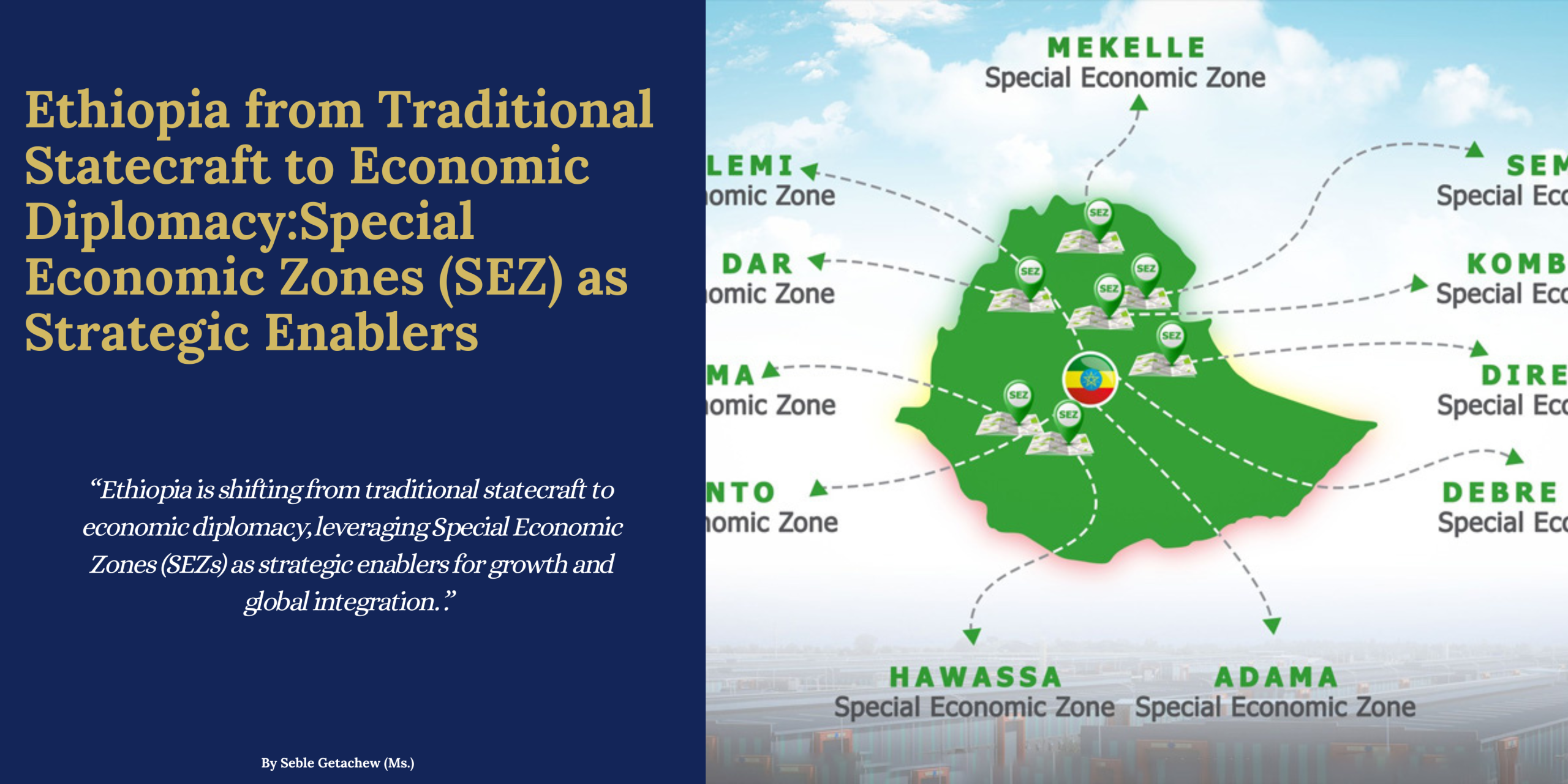
Ethiopia’s goal in establishing SEZs is clear and the purpose is to stimulate a trickledown effect across the economy, creating jobs, encouraging exports, and building industrial capacity. While they enjoy a degree of autonomy, SEZs require thoughtful oversight to ensure global integration benefits the broader society. Comparing SEZs in global and Ethiopian contexts, as of 2019, UNCTAD reported over 5,000 SEZs worldwide, used by about 75% of developing economies and nearly all transition economies to drive early industrialization phases. Ethiopia is no exception. Guided by Proclamation No. 1322/2024, the country has upgraded 10 industrial zones into SEZs aimed at attracting FDI, spurring job creation, and boosting trade. Today, Ethiopia hosts 16 SEZs, home to more than 300 companies. A 2024 UNCTAD survey of 50 global SEZs revealed that 88% of them target SDG 9, i.e., industry, innovation, and infrastructure. Significantly, the Hawassa SEZ is recognized for its strong adherence to environmental, social, and governance (ESG) standards and inclusive growth initiatives. Such contextualization of SEZs leads us to ask why it matters for diplomacy? Aligning SEZ with development goals SEZs contribute to Ethiopia’s Ten-Year Development Plan (2021–2030) “Pathway to Prosperity”, which targets doubling per-capita income, reducing poverty, and sustaining 13% annual GDP growth. Collaboration propels the success of SEZ therefore it is necessary to create institutional coordination among relevant bodies, such as, Ethiopian Investment Board & EIC for policy guidance, National Bank of Ethiopia for financial support and others for operational alignment. Coming to actions at the international level, Ethiopian diplomats are now critical promoters of SEZs by actively engaging multinational firms, showcasing investment opportunities, and facilitating trade and partnerships.
Ethiopia’s SEZ strategy is more than an economic policy it is a diplomatic tool. These zones are integral tools for achieving development goals through increased FDI, industrial diversification, and global value chain integration. With strong institutional backing and diplomatic engagement, Ethiopia positions itself to unlock sustained growth by 2030 and serve as a model of economic diplomacy in Africa.
Recommendation
Ethiopia’s economic diplomacy agenda requires a clear, focused, and institutionally coordinated approach. First and foremost, it is essential to provide specialized training for diplomats in areas such as public diplomacy, trade negotiations, investment promotion, and economic policy. These skillsets are no longer optional they are prerequisites for effectively representing Ethiopia in today’s globally competitive environment.
Institutionalizing economic diplomacy across all embassies and missions should be prioritized. Every diplomatic post should serve not only as a political liaison but also as an active economic outpost engaged in attracting investment, forging commercial ties, and supporting trade and technology transfer.
The Ethiopian diaspora represents an untapped engine for development. To harness this potential, Ethiopia must offer investment incentives, simplify procedures, and strengthen consular services to support diaspora engagement in trade, tourism, and entrepreneurship.
Equally important is positioning Ethiopia as a strategic gateway to East Africa and doing so requires not only infrastructure and logistics development, but also smart public diplomacy strategies that effectively communicate Ethiopia’s value proposition to targeted international partners. Moreover, Ethiopia should deepen its participation in the African Continental Free Trade Area (AfCFTA) and related cross-border infrastructure initiatives. By investing in regional manufacturing hubs and joint logistics ventures, Ethiopia can increase its economic influence across the Horn of Africa.
Finally, aligning foreign and economic policy priorities through structured collaboration among institutions including the Ministry of Foreign Affairs, the Ministry of Trade and Regional Integration, the Ethiopian Investment Commission, and others will improve implementation, performance tracking, and strategic impact.
Conclusion
Ethiopia’s transition from traditional diplomacy to economic diplomacy reflects a thoughtful recalibration of its foreign policy priorities. Recognizing that economic prosperity is essential to national security and international relevance, the country is pursuing a pragmatic, development-oriented diplomatic strategy.
Special Economic Zones (SEZs) stand at the heart of this transformation. As platforms for attracting foreign investment, promoting exports, and integrating into global value chains, SEZs serve as both policy instruments and symbols of Ethiopia’s global economic ambition.
With the right institutional frameworks, strategic partnerships, and diplomatic outreach, Ethiopia is well positioned to emerge not only as a regional political actor but also as a competitive economic force on the African continent.
References:
ALN. (2024). Ethiopia’s New SEZ Proclamation: Unlocking Investment Opportunities. Retrieved from https://aln.africa/
Baranay, B. (2009). Economic Diplomacy in the Globalised World. [Journal/Publisher if available].
DAG Ethiopia. (2016). Growth and Transformation Plan II (GTP II). Retrieved from http://dagethiopia.org/new/images/DAG_DOCS/GTP2_English_Translation_Final_June_21_2016.pdf
Doeser, F. (2013). Leader-driven foreign-policy change: Denmark and the Persian Gulf War. International Political Science Review, 34(5), 582-597. https://doi.org/10.1177/0192512112473027 (Original work published 2013)
Ethiopian Ministry of Foreign Affairs. (2002). Foreign Affairs and National Security Policy and Strategy (FANSPS). Addis Ababa.
Geyer, L (2010). Portals of Globalization, in: W. Eberhard and C.Lübke (eds.), The Plurality of Europe: Identities and Spaces, Leipzig 2010, pp. 509–520.
Gilpin, R. (1987). The political economy of international relations. Princeton University Press, P.76
Hermann, C. F. (1990). Changing course: When governments choose to redirect foreign policy. International Studies Quarterly, 34(1), 3–21.
Ministry of Planning and Development. (2021). Ethiopia 2030: The Pathway to Prosperity – Ten Years Perspective Development Plan (2021 – 2030) HGER: https://www.mofed.gov.et/media/homegrown_economic_reform_agenda-_a_pathway_to_prosperity_
Megan Maruschke, (2017). Portals of Globalization: Repositioning Mumbai’s Ports and Zones (1833–2014).
Okano-Heijmans, M. (2011). Conceptualizing economic diplomacy: The crossroads of international relations, economics, IPE and diplomatic studies. The Hague Journal of Diplomacy, 6(1), 7–36.
Saner, R., & Yiu, L. (2003). International economic diplomacy: Mutations in post-modern times. Discussion Papers in Diplomacy, Netherlands Institute of International Relations ‘Clingendael’.
UNCTAD. (2019). World Investment Report: Special Economic Zones. United Nations Conference on Trade and Development.
About the Author
Seble Getachew is an Associate Researcher at the Institute of Foreign Affairs (IFA). She is a dedicated advocate for women’s empowerment and continuous personal growth. Seble has over 18 years of experience working in the UN Offices, Field Services and similar International organizations in Africa, South-East Asia and the Gulf. With her experience working in a post-conflict environment, she has deep understanding of protection of civilians including policy research and administration. Seble has an abundance of multicultural expertise and a passion for diversity. She did her post graduate studies in Global Studies with a emphasis on Peace and Security in Africa from the Leipzig University and International Relations and Development from ISS, the Hague along with Bachelor’s degree in Political Science and International Relations from Addis Ababa University. Seble has been serving the IFA since August 2024 as volunteer in the capacity of Partnership Officer and Researcher in the Multilateral Affairs Research Directorate.
Disclaimer:
The content disseminated by the Institute of Foreign Affairs (IFA) – including, but not limited to, publications, public statements, events, media appearances, and digital communications – reflects the views of individual contributors and does not necessarily represent the official positions or policies of the Institute, its partners, or any affiliated governmental or non-governmental entities.
While the IFA endeavors to ensure the accuracy, integrity, and timeliness of the information presented, it makes no representations or warranties, express or implied, regarding the completeness, reliability, or suitability of such content for any purpose. The Institute expressly disclaims any liability for errors or omissions, as well as for any actions taken or decisions made based on the information provided.
The inclusion of external links, references, or third-party resources does not constitute an endorsement by the Institute. Additionally, engagement on social media platforms – including, but not limited to, likes, shares, retweets (RTs), or reposts – shall not be interpreted as an endorsement or validation of the views expressed therein.
Readers and audiences are encouraged to exercise critical judgment and seek independent verification when interpreting or relying upon any information disseminated through publications and posts on the Institute’s platforms or representatives.