

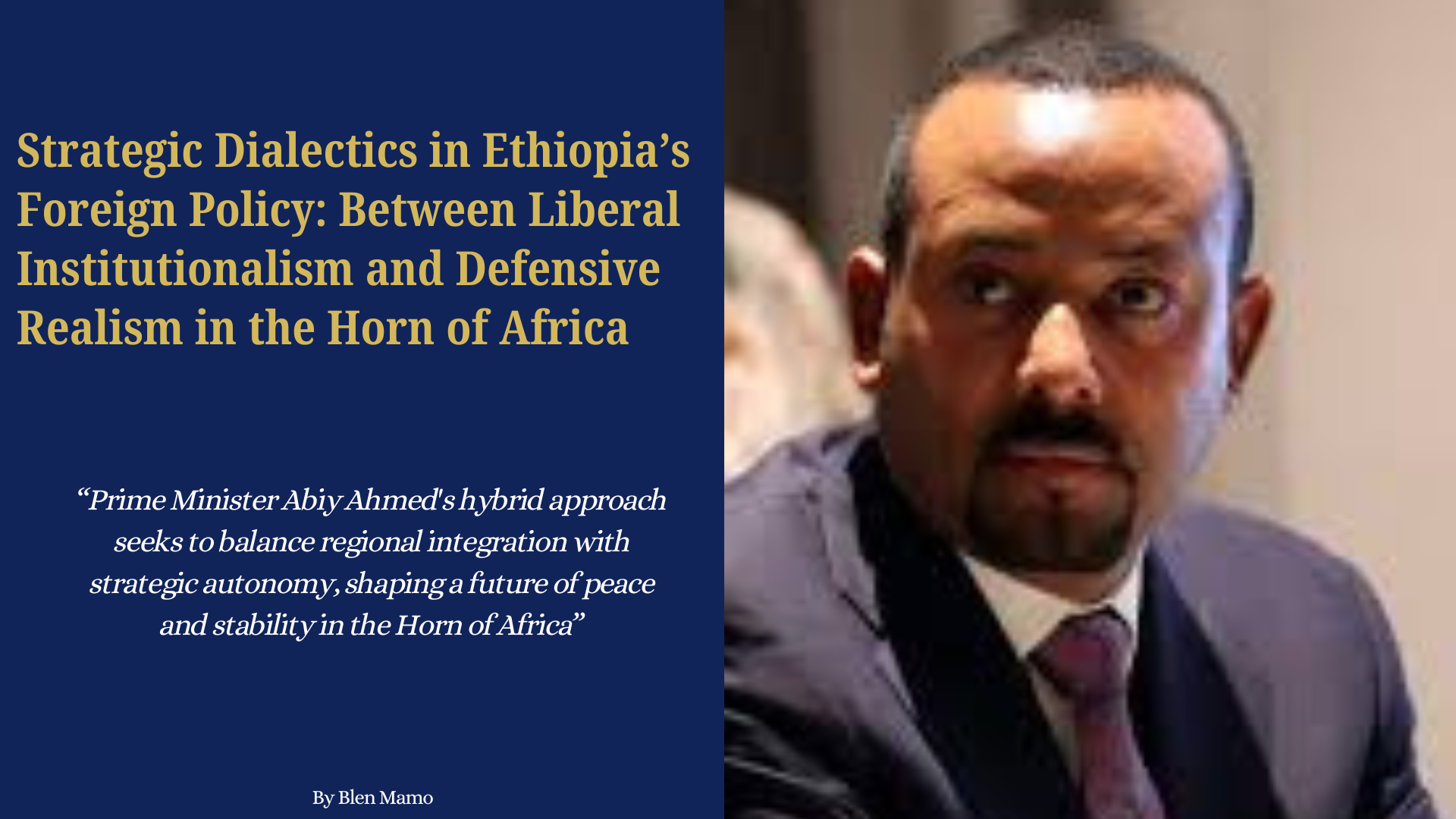
Ethiopia’s contemporary foreign policy reflects a dynamic interplay between two influential paradigms: liberal institutionalism and defensive realism. On one side is the liberal institutionalist orientation, emphasizing regional integration, cooperative engagement, and multilateralism as instruments to achieve national and regional security. On the other is a seasoned cohort within the foreign policy establishment, grounded in defensive realism, which – while not rejecting integration – prioritizes national security and strategic autonomy in response to the Horn of Africa’s complex and often volatile realities. This dialectic shapes Ethiopia’s strategic posture and significantly influences its positioning in both regional and global affairs.
Liberal institutionalism, as theorized by Robert Keohane and Joseph Nye (Keohane, 1984; Keohane & Nye, 1977), posits that international cooperation is feasible within an anarchic global system, provided that states build interdependence and robust international institutions. It emphasizes norms, shared values, and multilateralism as mechanisms to reduce conflict and promote stability. In the Ethiopian context, this manifests through a policy of regionalism – emphasizing shared ethnic and cultural heritage – and pursuing economic interdependence, institutional cooperation, and diplomacy as means of fostering regional stability and development. The current administration promotes consensus-building and collaborative frameworks as the foundation for Ethiopia’s engagement in the Horn.
This vision treats diplomacy and regionalism as tools for shared prosperity. Ethiopia has worked to deepen bilateral and multilateral ties with its neighbors, grounded in the belief that shared interests and collective political will can overcome historical divisions. Regional connectivity and institutional cooperation proceed in tandem, reflecting a commitment to transform a historically competitive landscape into one characterized by mutual benefit.
At the heart of this outlook lies the conviction that shared development goals – such as enhanced trade, energy integration, infrastructure, and inclusive growth – can mitigate rivalries and contribute to a sustainable security architecture. Proponents argue that such interconnectedness enhances both Ethiopia’s security and long-term regional stability.
However, this liberal institutionalist approach contrasts with the realist school of thought rooted in the principles of defensive realism, as articulated by Kenneth Waltz (1979) and Stephen Walt (1987). From this perspective, survival in an anarchic and volatile regional environment depends on strategic autonomy, credible deterrence, and prudent power use. Cooperation is desirable – but only once sovereignty is secured and the balance of power maintained.
Ethiopia’s realist tradition, shaped by its history of conflict, territorial threats, and regime instability in neighboring states, supports regional engagement when aligned with core strategic interests. In this framework, credible security is not the outcome of cooperation but its essential precondition.
The Horn states’ persistent fragility, the vulnerability of adjacent maritime corridors, and the unpredictability of neighboring regimes necessitate a cautious foreign policy. While realists may support regional integration, they insist its success relies on strong national defense capabilities and concurrent political reforms. Ethiopia’s own democratic progress cannot fully bear fruit in a region dominated by autocratic regimes that rely on repression and austerity.
Ongoing conflicts and unresolved disputes further undermine regional stability, reinforcing the need for conflict resolution and credible deterrence through hard power. Only through synchronized reforms, effective conflict management, and strategic resolve to ensure monopoly on violence can genuine security cooperation and integration be realized (Glaser, 2010).
This outlook is informed by Ethiopia’s past: the border war with Eritrea (1998–2000), military engagement in Somalia, persistent security threats from Sudan, and recurrent regional tensions. These events have shaped a strategic culture of self-reliance, vigilance, and preparedness – requiring a balance between engagement and deterrence.
Yet realism has not been monolithic across Ethiopian administrations. At times, it has veered toward over-securitization, overshadowing diplomatic flexibility. Under Mengistu Hailemariam’s Derg regime, realism adopted a Machiavellian tone – marked by zero-sum assumptions, militarization, and strategic alliances driven by expediency. Regional diplomacy was sidelined in favor of ideological confrontation and coercive deterrence, which – though preserving sovereignty – entrenched Ethiopia in hostilities and weakened international legitimacy.
The EPRDF under Meles Zenawi also leaned on a form of radical defensive realism. Though more policy-oriented, Meles-era foreign policy prioritized survival through strategic dominance. Interventions in Somalia and a firm stance on Eritrea reflected an emphasis on preemptive engagement and asymmetric deterrence. While these strategies yielded geopolitical leverage, they also fostered perceptions of Ethiopia as a regional hegemon reluctant to adhere to collective norms.
Critics argue that such radical realism undercut opportunities for sustainable regionalism by elevating hard power over trust-building. Paranoia, militarization, and hyper-caution fed a culture of suspicion toward cooperation, framing it as a threat rather than an opportunity. At times, national interest became conflated with regime preservation, blurring the line between legitimate deterrence and isolationism.
In contrast, Prime Minister Abiy Ahmed’s administration has sought to recalibrate this legacy through a hybrid approach that balances defensive realism with liberal institutionalism. The prime minister’s doctrine embeds deterrence within a broader regionalist framework – where mutual economic dependencies, infrastructural connectivity, and partnerships act as force multipliers for security.
This hybrid posture has allowed for greater diplomatic creativity. Outreach to former adversaries, investment in multilateralism, and emphasis on economic corridors mark a departure from over-securitization. Yet, the administration maintains a realist edge through military modernization and strategic deterrence, ensuring cooperation is backed by capacity.
Still, the model’s effectiveness depends on overcoming entrenched realist orthodoxy within Ethiopia’s strategic community. Historical suspicion toward liberalism and memories of past conflicts continue to influence key actors. Ongoing instability in Sudan, Somalia, and elsewhere also tempts reversions to unilateral, security-first policies.
While the administration emphasizes reconciliation and institutionalized cooperation – as seen in the 2018 peace with Eritrea – realists argue diplomacy must rest on strength and readiness. Setbacks or hostile responses from neighbors reinforce their emphasis on strategic resilience.
This dualism is evident in key policy arenas. On the Nile waters, liberal institutionalists call for multilateralism and equitable frameworks. Realists insist on guarantees that protect sovereignty and strategic interests, citing recurring patterns of encroachment and strategic suffocation by Egypt.
Crises in Sudan and Somalia also reveal the divide. Liberals favor international mediation and stronger regional forums; realists prioritize defense capabilities and strategic alliances, often through discreet engagements that manage volatility.
The Red Sea access issue encapsulates this strategic divergence. Abiy’s leadership promotes shared infrastructure and cross-border investment – hallmarks of liberal regionalism. Traditional policymakers, however, stress that these must be pursued from a position of strength, especially amid unpredictable regional dynamics. From their view, cooperation depends not just on technical coordination but also systemic political reform across the region.
The 2023 Memorandum of Understanding (MoU) with Somaliland illustrates the challenge of balancing outreach with defense. The MoU aimed to secure maritime access and diversify trade routes – aligning with liberal goals of integration. However, regional reactions nearly mounting to the threat of war revealed sensitivities and confirmed the need for diplomatic engagement to be backed by credible defense. For realists, the episode confirmed the necessity of military capability and domestic reform to support foreign policy ambitions.
Recognizing this, Abiy launched sweeping military reforms in 2018 to modernize Ethiopia’s defense institutions and ensure operational readiness. His leadership reflects a deliberate balancing act: advancing integration and economic cooperation while reinforcing deterrence.
Abiy’s strategic vision harmonizes the liberal and realist strands within Ethiopia’s foreign policy. He envisions a regionalism where cooperation and multilateralism thrive – supported by a capable security apparatus to safeguard national interests. Such balance remains vital as Ethiopia faces assertive neighbors and regional conflict.
This plurality of perspectives has fostered a foreign policy architecture that is adaptive and balanced. Liberal institutionalism offers a vision of cooperation and prosperity; realism provides a grounding in sovereignty and strategic restraint. Neither paradigm suffices alone. Excessive assertiveness risks isolation, while pure idealism may fail to protect vital interests. Ethiopia must therefore continue to pursue a calibrated strategy – addressing immediate security imperatives while gradually constructing the foundations for sustainable regional cohesion.
As the strategic landscape evolves, policymakers must continue seeking a pragmatic synthesis. By combining realism’s resilience with liberalism’s cooperative ethos, Ethiopia can forge a durable foreign policy – one that leverages national capabilities while advancing a vision of peace and shared progress.
Ultimately, Ethiopia’s foreign policy will be shaped by domestic consensus and regional dynamics. Its direction will influence not only its national trajectory but also the broader future of peace and integration in the Horn of Africa.
References
Glaser, C. L. (2010). Rational Theory of International Politics. Princeton University Press.
Keohane, R. O. (1984). After Hegemony: Cooperation and Discord in the World Political Economy. Princeton University Press.
Keohane, R. O., & Nye, J. S. (1977). Power and Interdependence: World Politics in Transition. Little, Brown.
Walt, S. M. (1987). The Origins of Alliances. Cornell University Press.
Waltz, K. N. (1979). Theory of International Politics. Addison-Wesley.
About the Autho
Blen M. Diriba is a Research Associate at the Institute for Foreign Affairs (IFA) and the Executive Director of Horn Review, an independent research and publication think – tank dedicated to political, security, and diplomatic affairs in the Horn of Africa. She is also the Executive Producer of the Strategic Dialogue podcast series, a collaborative initiative between Horn Review and the IFA. In parallel, she serves as a chief editor at the Pulse of Africa Media. Blen has also contributed to regional and international forums through her research and engagements with multilateral institutions and diplomatic networks. She holds an LL.B. in Law and an MSc in International Security and Global Governance from the University of London.
She may be reached at blen.mamo@yahoo.com.
Disclaimer:
The content disseminated by the Institute of Foreign Affairs (IFA) – including, but not limited to, publications, public statements, events, media appearances, and digital communications – reflects the views of individual contributors and does not necessarily represent the official positions or policies of the Institute, its partners, or any affiliated governmental or non-governmental entities.
While the IFA endeavors to ensure the accuracy, integrity, and timeliness of the information presented, it makes no representations or warranties, express or implied, regarding the completeness, reliability, or suitability of such content for any purpose. The Institute expressly disclaims any liability for errors or omissions, as well as for any actions taken or decisions made based on the information provided.
The inclusion of external links, references, or third-party resources does not constitute an endorsement by the Institute. Additionally, engagement on social media platforms – including, but not limited to, likes, shares, retweets (RTs), or reposts – shall not be interpreted as an endorsement or validation of the views expressed therein.
Readers and audiences are encouraged to exercise critical judgment and seek independent verification when interpreting or relying upon any information disseminated through publications and posts on the Institute’s platforms or representatives.