

Executive Summary
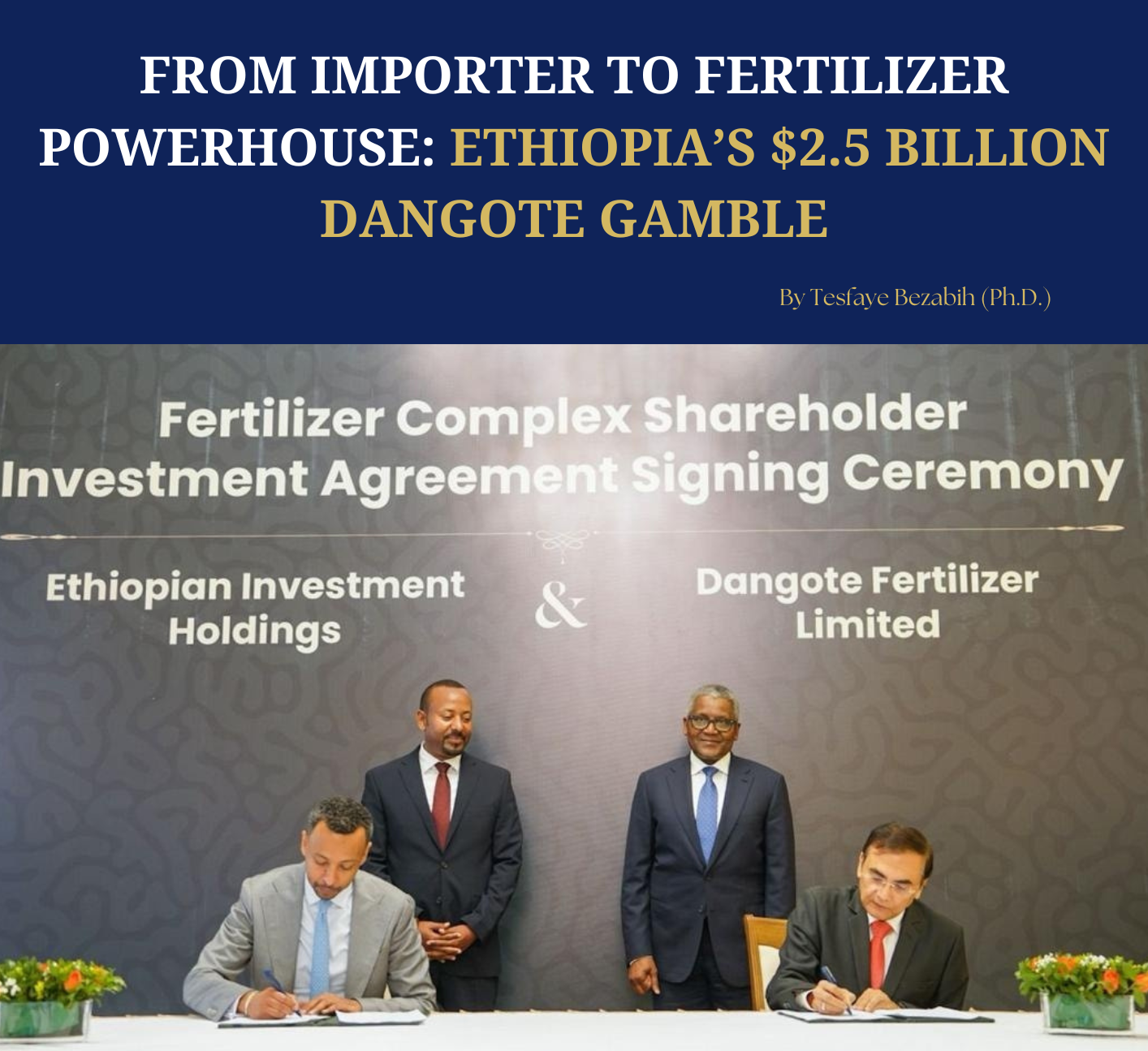
Ethiopia is the second-most populous country in Africa, and agriculture is significantly relied upon by the country as it produces more than a third of the GDP. The sector has been facing fertilizer shortages, reliance on imports, and global price increases even though there have been aggressive moves to modernize. On August 28, 2025 the Government of Ethiopia and the Dangote Group, the largest industrial conglomerate in Africa, signed a $2.5 billion pact to build a fertilizer plant in the Somali region. The plant will be generating 3 million tons per year and it will be linked by pipeline directly with Calub and Hilala natural gas fields. Dangote will own 60 percent with Ethiopian Investment Holdings (EIH) owning 40 percent. The investment will revolutionize Ethiopia into one of the largest producers of fertilizers in the world and will promote the agenda of food sovereignty. Nevertheless, transformative potential of the project is accompanied by the governance, environmental, and geopolitical risks that should be handled with great caution in terms of policy.
Background and Context
Fertilizer Ethiopia has long been a net importer of fertilizer, with most of its industry depending on imported urea to supply its agricultural-led economy. This reliance has caused pressure on the foreign exchange reserves and government subsidies of the country that now are exposed to international price- shocks and supply chain crises. In August 2025, Ethiopia agreed with Nigeria’s Dangote Group on building a urea fertilizer plant in Gode region of Somali Region in a contract amounting to 2.5 billion dollars. Dangote will own 60 percent where the Ethiopian government, through the Ethiopian Investment Holdings own 40 percent. It is projected that the plant, in close proximity to natural gas deposits will yield 3 million metric tons of predominantly urea-based fertilisers per year, which is multiple times that of the present domestic usage, which could potentially make Ethiopia a domestic exporter of the product, rather than an importer. It is scheduled to be completed in 40 months and feedstock supplied by natural gas will come in the form of a contract with the GCL Gas group of China. It is supposed to create thousands of building jobs and long term industrial employment. Such an investment does not only make domestic production of fertilizers and food security stronger, but also the overall industrialization agenda of Ethiopia, the foreign direct investment environment and fiscal sustainability of this country by alleviating spending on subsidies.
Strategic Significance
The Dangote fertilizer project enhances food sovereignty in Ethiopia since it will increase domestic production of fertilizers thereby lessening imports. This plays a direct role in the national food security strategy of Prime Minister Abiy Ahmed and it helps to give the smallholder farmers a more stable input prices, which in turn increases agricultural productivity and resilience. The agricultural sector of Ethiopia is at greater risk of global market shocks and supply chain disruptions because obtaining a steady stream of fertilizers will help the country to safeguard its agricultural sector. The project has a great potential of transformations in economic terms. It is projected to save about 1 billion dollars a year in foreign exchange by reducing the cost of imports as well as boosting industrial production by producing as well as energy-related sectors. Access to affordable fertilizers can boost the rural population in enhanced crop production, higher family income, as well as exports of some major commodities like wheat, maize coffee, and oil seeds. This brings about diversification of the economy as well as rural expansion. Regionally, the plant positions Ethiopia as a key fertilizer hub in the Horn of Africa and the COMESA markets. This increased production power gives Ethiopia a lead in the regional food security sector, which gives it an upper hand in the process of influencing East Africa agricultural and trade dynamics. Being a stable partner to its neighbors, Ethiopia will increase its control over the regional trade relationships, as well as strengthen its geopolitical position in the Horn of Africa..
Policy Recommendations
To ensure that the Dangote fertilizer project is maximized, Ethiopia ought to tighten governance and regulation through the establishment of special Fertilizer Market Regulatory Authority to oversee the prices, competition and quality. It will be necessary to ensure that the ownership share held by Ethiopian Investment Holdings becomes accountable to the people in order to ensure that the smallholder farmers are justly accounted to. The national agricultural policy must also incorporate the availability of fertilizers by undertaking measures like soil mapping, extension services, crop diversification and providing subsidies to smallholders as opposed to the large commercial players. Meanwhile, economic, environmental, and regional goals should be given the first priority in the country. National fertilizer blending plants can tailor-made products to the different soils of Ethiopia; foreign exchange saved by cutting imports could be invested in irrigation, mechanization, and storage. The implementation of green production criteria, such as energy consumption, monitoring of emissions, and eventual shift to green ammonia through renewable energy will make it greener. Lastly, it is necessary that Ethiopia should also capitalize on its increased production capacity by becoming a fertilizer exporter to the IGAD and COMESA states, and sign bilateral trade agreements to ensure stable local markets as well as to bolster its geopolitical power.
References
Ethiopia signs $2.5 billion fertilizer investment deal with Dangote Group to bolster food security. (2025, August 28). Fanabc. Retrieved from https://www.fanamc.com/english/ethiopia-signs-2-5-billion-fertilizer-deal-with-dangote-group-to-bolster-food-security/(Welcome to Fana Media Corporation S.C)
Dangote, Ethiopia ink $2.5bn deal for world’s largest fertiliser plant. (2025, August 28). Punch Nigeria. Retrieved from https://punchng.com/aliko-dangote-ethiopia-ink-2-5bn-deal-for-worlds-largest-fertiliser-plant/(Punch Newspapers)
Nigeria’s Dangote and Ethiopia to build $2.5 billion fertiliser plant. (2025, August 28). Reuters. Retrieved from https://www.reuters.com/world/africa/nigerias-dangote-ethiopia-build-25-billion-fertiliser-plant-2025-08-28/(Reuters)
Dangote Group to build $3 billion fertiliser plant in Ethiopia. (2025, July 9). Kilimo News. Retrieved from https://kilimonews.co.ke/agriculture-investment/dangote-group-to-build-3-billion-fertilizer-plant-in-ethiopia/(Kilimo News)
Dangote Group signs US$3B deal for fertilizer plant in Gode, Ethiopia. (2025, July 9). Milling Middle East & Africa. Retrieved from https://millingmea.com/dangote-group-signs-us3b-deal-for-fertilizer-plant-in-gode-ethiopia/(Milling Middle East & Africa)
Aliko Dangote’s Ethiopia Fertilizer Plant: A Catalyst for Africa’s Agricultural Self-Sufficiency and Industrialization. (2025, August 28). African Investment. Retrieved from https://www.ainvest.com/news/aliko-dangote-ethiopia-fertilizer-plant-catalyst-africa-agricultural-sufficiency-industrialization-2508/(AInvest)
Dangote, Ethiopia Agree Ownership of $2.5 Billion Urea Plant. (2025, August 28). Bloomberg. Retrieved from https://www.bloomberg.com/news/articles/2025-08-28/dangote-ethiopia-agree-ownership-of-2-5-billion-urea-plant(Bloomberg.com)
Why Dangote Chose Gode: Ethiopia’s $2.5B Fertilizer Gamble. (2025, August 28). Addis Insight. Retrieved from https://www.addisinsight.net/2025/08/28/why-dangote-chose-gode-ethiopias-2-5b-fertilizer-gamble/(Addis Insight)
Dangote Group launches $3 billion fertilizer investment in Ethiopia to address regional food security. (2025, July 9). Africa Sustainability Matters. Retrieved from https://africasustainabilitymatters.com/dangote-group-launches-3-billion-fertilizer-investment-in-ethiopia-to-address-regional-food-security/(Africa Sustainability Matters)
Ethiopia says China’s POLY-GCL to start gas drilling by July. (2015, April 16). GCL Group. Retrieved from https://www.gcl-power.com/en/about/newdetail/5207.html(gcl-power.com)
About the Autho
Dr . Tesfaye Bezabih is a lead researcher at the Institute of Foreign Affairs. He got his Ph.D. in Journalism and Mass Communication from Assam University through the Indian Cultural Council Relations African Scheme scholarship program. Formerly he was an Assistant Professor of Journalism and communication at Wollo University. He has been also serving as an External examiner and Guest Lecturer at AAU. He has published several empirical and policy research papers in the area of media and communication, Foreign policy, climate diplomacy, public diplomacy and much more. His Ph.D. dissertation has also won the 2017 Open Society Research Grant. He currently works as a Foreign policy Researcher at the Europe and America Research Directorate at the Institute of Foreign Affairs (IFA) and Director General of Knowledge Management at the Training unit at IFA. Professionally he has been participating in several government and Non-government duties and accomplished fundamental achievements.
You can reach him at
tbezabih@gmail.com or tesfaye.b.gezahagne@ifa.gov.et
x:@TesfayeBezabih3, Linkedin: https://www.linkedin.com/in/tesfaye-bezabih-phd-042726113?utm_source=share&utm_campaign=share_via&utm_content=profile&utm_medium=android_app
Disclaimer:
The content disseminated by the Institute of Foreign Affairs (IFA) – including, but not limited to, publications, public statements, events, media appearances, and digital communications – reflects the views of individual contributors and does not necessarily represent the official positions or policies of the Institute, its partners, or any affiliated governmental or non-governmental entities.
While the IFA endeavors to ensure the accuracy, integrity, and timeliness of the information presented, it makes no representations or warranties, express or implied, regarding the completeness, reliability, or suitability of such content for any purpose. The Institute expressly disclaims any liability for errors or omissions, as well as for any actions taken or decisions made based on the information provided.
The inclusion of external links, references, or third-party resources does not constitute an endorsement by the Institute. Additionally, engagement on social media platforms – including, but not limited to, likes, shares, retweets (RTs), or reposts – shall not be interpreted as an endorsement or validation of the views expressed therein.
Readers and audiences are encouraged to exercise critical judgment and seek independent verification when interpreting or relying upon any information disseminated through publications and posts on the Institute’s platforms or representatives.