

Introduction
Ethiopia shares longstanding socio-cultural and geographical ties with the Arab world, rooted in centuries-old economic and religious diplomacy. Ethiopia has strived to maintain strategic balanced relations with each Middle Eastern country, even amid challenging times. For instance, when it was pressurized to take side during the Gulf Crisis, anchored in its traditional foreign policy orientation of neutrality and non-interference, Ethiopia managed the pressure by resorting to strategic equilibrium. It threated the rival blocs – the Saudi-led group and Qatar, equally.
Indeed, despite deep ties, Ethiopia’s relationship with the Arab world has been characterized by underlying tensions and ambivalence, characterized by a pattern that can be depicted as “zigzag diplomacy”.
A recent compelling illustration of this pattern is the Arab world’s position on the Grand Ethiopian Renaissance Dam (GERD) dispute. Regional organizations such as the Gulf Cooperation Council (GCC) and the League of Arab States have consistently aligned with the concern of Egypt and Sudan, claiming that the water security of these countries is also Arab’s water security. While challenging such positions, Ethiopia has often demonstrated commitment and perseverance from the inception to the inauguration of its largest dam –GERD Project.
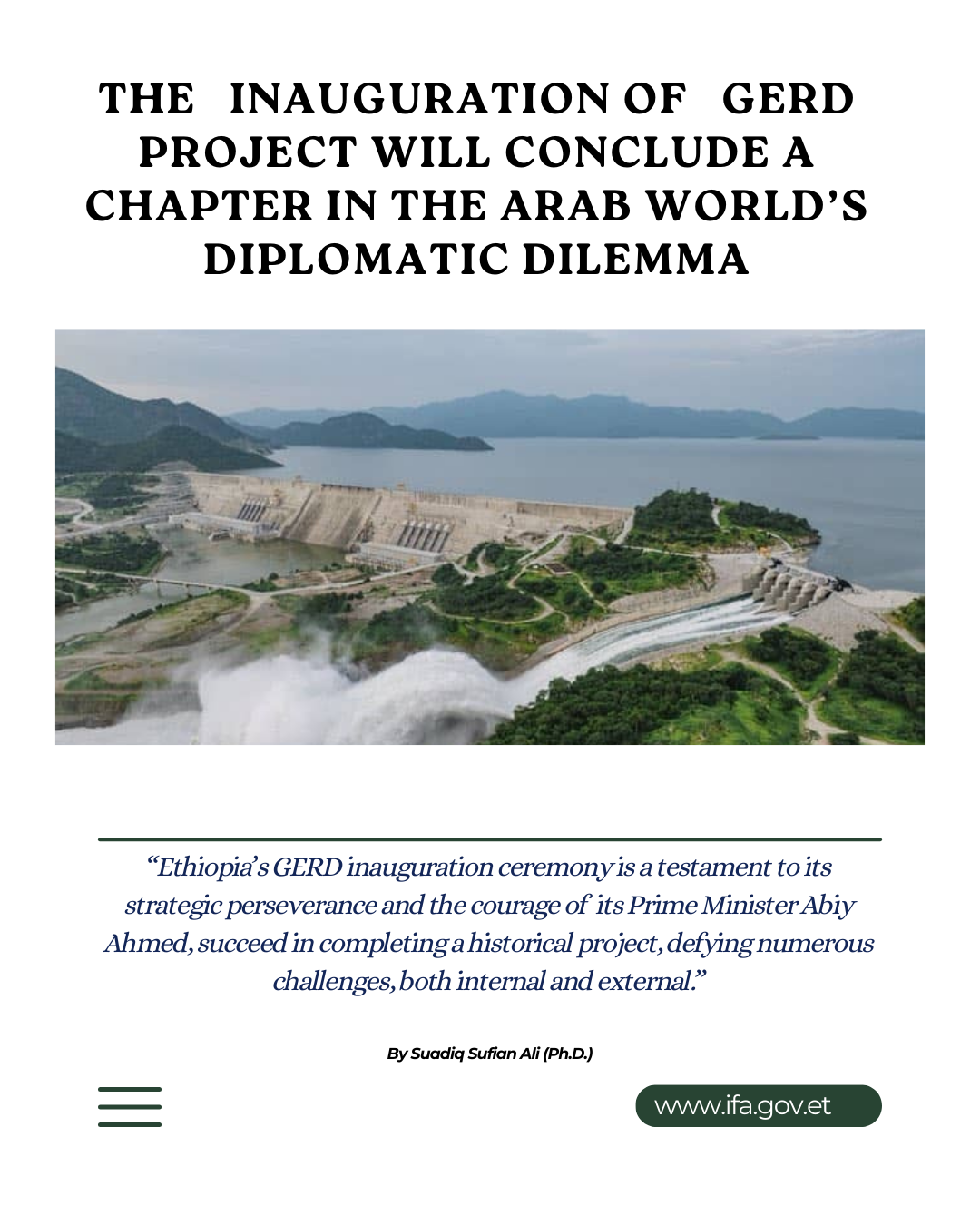
Ethiopia’s GERD inauguration ceremony marked its strategic perseverance and the courage of its Prime Minister, defying numerous challenges, both internal and external. As it is known, the Prime Minister of Ethiopia officially extended formal invitations to Egypt, Sudan, and other Nile riparian countries to join the celebration. His invitation signaled that Ethiopia’s completion of GERD is not a threat but a shared opportunity, benefiting both Upper and Lower riparian countries. Notwithstanding, the Egyptian Foreign Ministry rejected this friendly invitation, replying his country would not join the inauguration ceremony, citing the absence of a binding legal agreement governing the dam’s operation. Indeed, this justification lacks credibility, since the demand for a binding agreement is not a prerequisite for attending a ceremony, as epitomized by the lesson of Egypt itself. Notably, when Egypt inaugurated its Aswan High Dam in 1971, there was no any binding agreement with upstream Nile Basin countries. In this perspective, Egypt’s insistence on a binding agreement reflects a clear double standard.
The inauguration of GERD is not merely a hydropower achievement designed to enhance electricity coverage in the country. It represents profound transformative geopolitical and paradigm shift across the region. Among others, it is a symbol of Ethiopia’s quest for strategic autonomy – envisioned, financed, and constructed entirely through domestic efforts. Hence, its inauguration reflects a decisive departure from Ethiopia’s historical marginalization in the hydro-politics of the Nile, heralding a new era of strategic autonomy.
Against this background, this policy brief illuminates the implications of inaugurating the GERD Project while arguing the ceremony will challenge Egypt’s Hydro-hegemony and conclude the diplomatic dilemma of the Arab World in the years to come.
The End of Egypt’s Historical Dominance over the Nile River
Egypt has claimed historical rights to dominate the Nile River exclusively. Hence, the completion and inauguration of the GERD project challenges this historical foundation. Despite Herodotus, the famed Greek historian, once described Egypt as “the gift of the Nile” and acknowledged the river’s vital role in sustaining Ancient Egyptian civilization, in parallel, we Ethiopians say, “Nile is the gift of Ethiopia” as our country contributes approximately 85% of the Nile River’s total water volume. Yet over time, Egypt has stretched the observation of Herodotus into a political doctrine and downgraded Ethiopia’s reality – positioning itself not merely as a beneficiary, but as the de-facto owner of the Nile. This posture has persisted till these days though its contribution to the Nile River is insignificant close to null.
Ironically, Egypt’s claim to exclusive rights over the Nile is rooted in colonial- era treaties particularly the 1929 and 1959 agreements which were crafted without the consent of upstream countries. Being an independent state throughout its history, Ethiopia, however, has never recognized these colonial arrangements. Instead, it has often called for equitable utilization of the Nile River despite Egypt’s nonstop-able conspiracy to deny Ethiopians’ legitimate quest for development using their own natural resource – Nile River.
It should be noted that the inauguration of the GERD demonstrates a historic juncture for Egypt – challenging its entrenched narrative and decades of hydro-political hegemony. In other words, Egypt faces a significant challenge against its favorite statuesque, enjoying for years unilaterally and illegally. It is unfortunate; such unilateral and illegal exploitation of the Nile River poses a diplomatic dilemma for the Arab World, as demonstrated by the GERD dispute.
Arab World’s Diplomatic Dilemma on the GERD Dispute
Almost it becomes a tradition that Egypt repeatedly claimed the GERD will have repercussions on the country, and it has done so without hesitating or trying to downplay the issue. In response, Ethiopia attempts to clarify the situation so that the leaders of the Arab World do not buy Egyptians’ non-stoppable agenda. Seemingly, through time, the Arab World has grappled with a diplomatic dilemma pertaining to the GERD dispute. At the bilateral level meetings, many countries of the Arab World have acknowledged Ethiopia’s legitimate concerns over the hydro-politics of the Nile River. And, they made clear that Ethiopia’s quest for development using its own water resource can be neither ignored nor denied. Yet, in multilateral forums such as the Arab League or GCC, these same states have tended to align with Egypt’s position. For example, the Arab League has repeatedly sided with Egypt and Sudan. The most recent one could be observed in its 164th session. Siding with Egypt and Sudan, the League urged a legally binding agreement on the filling and operation of the GERD, showing its unwavering commitment to support the position of the down-stream countries.
Ethiopia firmly rejected the position of the League in its earlier response, underscoring that “The Arab League had better exert its time and resources to solve its own problems and leave African matters to Africans, as the Nile belongs to Africans.” By framing the GERD as an African issue, Ethiopia not only challenged external interference but also reinforced a narrative of continental sovereignty.
At the heart of the matter, the inauguration of the GERD significantly erased Egypt’s concerns regarding the dam’s filling process since completion of the project closed the case – the issue of filling the dam. However, Egypt’s apprehensions did not end with the completion of the filling. More recently, it has called for a binding agreement on the dam’s operation, signaling a shift in focus from filling to long-term management. Indeed, with Ethiopia having successfully completed the filling phase, Egypt’s initial fears have largely subsided. Consequently, the Arab world’s dilemma may also be resolved – unless, like Egypt, the Arab world also recalibrates its position to emphasize the operational phase of the dam.
Conclusion and Policy Recommendation
The inauguration of the GERD stands as a powerful symbol of national self-reliance and strategic autonomy. Constructed entirely through domestic effort – without bowing to colonial-era agreements and in defiance of sustained pressure from the Arab world, GERD reflects Ethiopia’s diplomatic agility and strategic patience. This principled approach should guide the formulation of any post-GERD strategy, particularly during the operation of the dam.
Following the inauguration, it is hoped that the Arab world’s diplomatic dilemma will soon be resolved. Moving forward, diplomacy must remain the cornerstone of Ethiopia’s regional engagement, especially with the Arab world, as it provides a viable means to correct the impact of Zigzag diplomacy. Above all, Ethiopia’s perseverance and courage demonstrated throughout the GERD dispute should be replicated in Ethiopia’s pursuit of sovereign access to the sea.
About the author
Suadiq Sufian (Ph.D.) is a senior researcher at the Middle East Affairs Department in the Institute of Foreign Affairs.
Disclaimer:
The content disseminated by the Institute of Foreign Affairs (IFA) – including, but not limited to, publications, public statements, events, media appearances, and digital communications – reflects the views of individual contributors and does not necessarily represent the official positions or policies of the Institute, its partners, or any affiliated governmental or non-governmental entities.
While the IFA endeavors to ensure the accuracy, integrity, and timeliness of the information presented, it makes no representations or warranties, express or implied, regarding the completeness, reliability, or suitability of such content for any purpose. The Institute expressly disclaims any liability for errors or omissions, as well as for any actions taken or decisions made based on the information provided.
The inclusion of external links, references, or third-party resources does not constitute an endorsement by the Institute. Additionally, engagement on social media platforms – including, but not limited to, likes, shares, retweets (RTs), or reposts – shall not be interpreted as an endorsement or validation of the views expressed therein.
Readers and audiences are encouraged to exercise critical judgment and seek independent verification when interpreting or relying upon any information disseminated through publications and posts on the Institute’s platforms or representatives.