

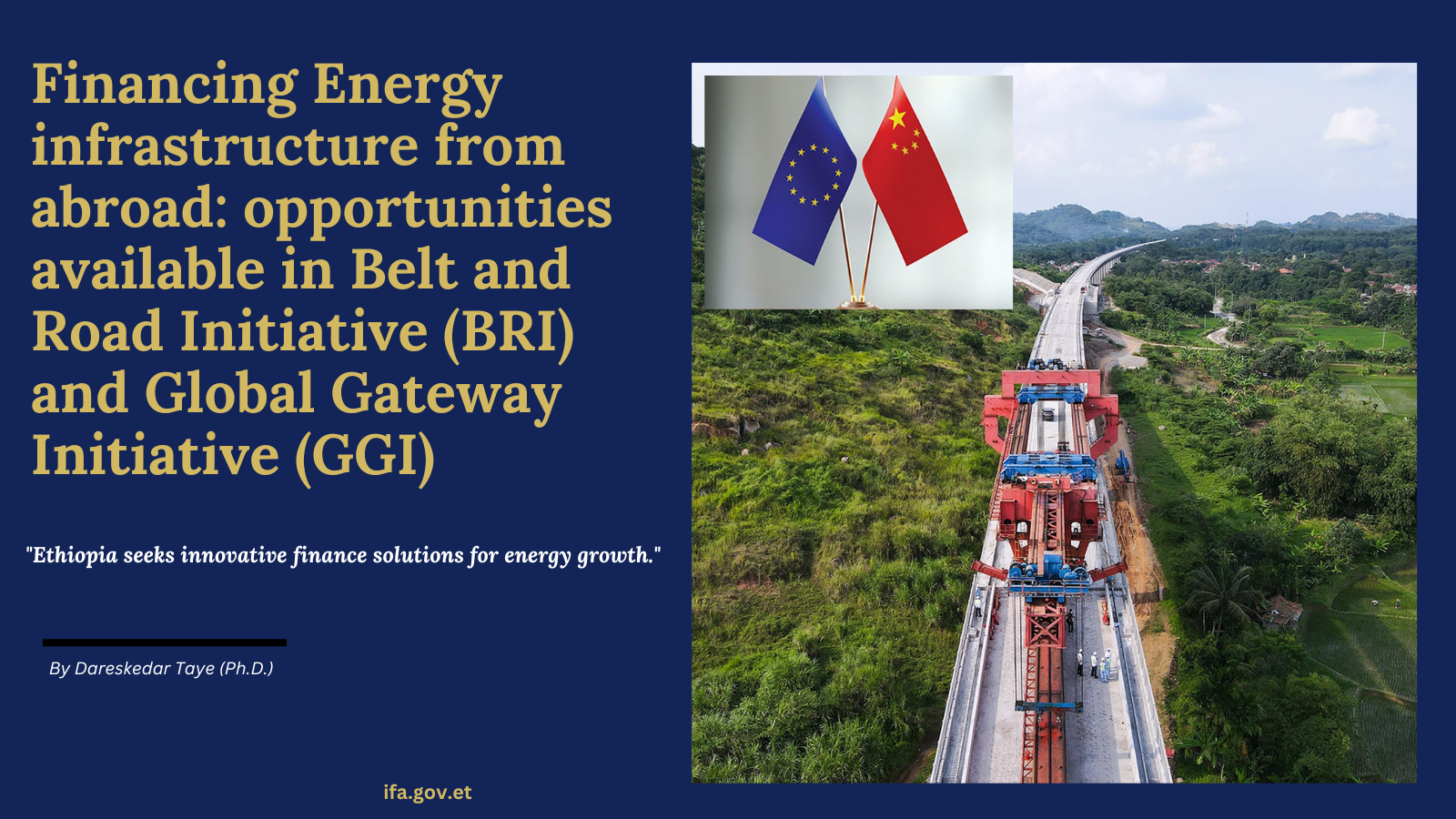
An apparent mismatch between energy need and the capacity to invest in energy production is requiring Ethiopia to look into alternative finances available from Europe and China. The rapid rise of population accompanied by rapid urbanization and economic growth, Ethiopia needs a rapid growth in energy production proportional to its economy, which by itself hinges on the financial capability of the state. The key hindrances of Ethiopia from producing adequate energy include:
- Financial gap: according to UNECA data, Africa needs $170 billion annually to satisfy its infrastructure need, one of which being electric grid installation. Ethiopia also share the same challenge and lacks adequate finance to exploit all its potentials.
- Technological gap: generating energy either from water, wind, sunlight, nuclear, or fossil fuel required technological endowment. In the past two decades, in fact, Ethiopia has been tapping into the technology of hydropower dam construction and power generation. But diversifying energy sources and improving the pace of the rate of growth in technological endowment is still a challenge to Ethiopia.
- Other challenges: though finance and technology are important ingredients, issues related to policy coordination and dealing with instability and maladministration are also critical factors in limiting the nation from investing in energy production and distribution.
The external financial opportunities made available by China and the European Union are worth mentioning here in order to analyze their role in filling the financial gap Ethiopia is now experiencing.
Belt and Road Initiative (BRI)
BRI was initiated with the aim to connect Chinese economy with the Eurasia landmass and trans-oceanic maritime space all over the world. Africa also benefitted from BRI though the primary targets of Chinese investment through BRI were Europe and Asia. China financed the construction of the Djibouti-Addis Ababa railway line as well as other projects in Kenya and Nigeria. The promise to finance more projects finally halted after the COVID pandemic, which marked the beginning of the decline in the flow of infrastructure finance from China into Africa.
In the post-COVID era, China announced another package of infrastructure finance to Africa. Xi Jinping made it clear on September 5, 2024 at the FOCAC summit that “the Chinese government will provide RMB 360 billion [$50 billion] of financial support through the next three years.”[1] From out of the total sum of finance, RMB 210 billion will be distributed under a credit line; RMB 80 billion will be an assistance fund for Africa in different forms and at least RMB 70 billion an investment fund for Chinese companies in Africa.
The key challenge in tapping into the Chinese finance include, first, the beneficiary nation has to adhere to the policy imperatives of China. Embracing ‘one China’ policy is the primary policy expectation if any state aspires to get finance. The second challenge may happen as a result of the source of finance, which is the Chinese state. This implies to the necessity of conducting state-to-state negotiation with little or no space for the private financing enterprises. Third, the issue of debt management is another critical factor in shaping the future of financial interaction between Ethiopia and China. Much of the money gained from China since the beginning of BRI through commercial loan arrangement are either matured or are beyond the capacity of Ethiopia to pay back the accumulated debt. This necessitates the prolonged negotiation for debt restructuring, which tarnish future efforts to request more finance for new projects.
Global Gateway Initiative (GGI)
European Union has a tradition of introducing new budgetary programs, called a Multiannual Indicative Program (MIP), every seven years. For the period 2021 to 2027, EU has allocated €300 billion for a program called Global Gateway Initiative. It is largely an infrastructure development program intended to be invested in countries close to Europe geographically or in terms of interest. Half of the money, which is €150 billion, was promised to disburse to infrastructure developments in Africa. The focus of GGI support and investment include infrastructure projects like high speed road and railway line, energy transition, and digital connectivity. It seems that EU stood behind Africa’s interest to connect African capitals through modern infrastructure. The problem, however, is the value attached to the Initiative, which is beyond the reach of most African nations. EU associated the GGI with democracy, good governance, equal partnership, green and clean energy, and security partnership. To benefit from GGI, African nations should have to align themselves with the values set out by EU.
The implementation of the GGI is not free from limitations however. Although a lot has been promised at the inception of the Initiative, like to support more than nine trans-boundary road and railway projects to connect East and West Africa and North and South Africa, there is no significant progress in a matter of five years. The other challenge is the lack of transparency from the side of EU either for its priority lists for the beneficiary project or for the project to be financed by GGI. From the limited investments under the umbrella of GGI in Africa, one can see that the interest of EU goes more to energy transition, whereas connecting African capitals is a top priority for Africa, as clearly stipulated in Agenda 2063 vision of AU. Integrating GGI with the values set by EU is also another challenge for Africa since they are largely beyond reach.
Way forward
Strengthening domestic capacity: the reliable source of finance for any nation is its own economy. The same is also true for Ethiopia. As it has been observed in the construction of the Grand Ethiopian Renaissance Dam by domestic capacity, soliciting fund from within reduces dependency from other nations and reduces the challenges of finance related preconditions. Hence, Ethiopia has to envisage boosting its domestic capability to amass huge finance for energy production.
Neighborly collaboration for energy: Collaborating with different nations to access finance from foreign sources provides better chance than for a single nation requested for it. The collaboration of Ethiopia and its neighbors for energy production and energy distribution may attract alternative creditors as the beneficiaries are going to be different countries and the risk is also shared among the beneficiaries.
Encouraging the participation of the private sector: The participation of the private sector in energy production and energy distribution reduces financial stress from the state because the private sector enters into the energy market having its own finance. The private sector may also establish partnership with European and Chinese creditors directly without the involvement of the state. This helps to overpass the debt restructuring challenge that Ethiopia is passing through right now.
[1] Xi Jinping, Joining Hands to Advance Modernization and Build a Community with a Shared Future, Keynote Address by H.E. Xi Jinping, The Forum on China-Africa Cooperation, Beijing, September 5, 2024, https://english.www.gov.cn/news/202409/05/content_WS66d964bdc6d0868f4e8eaa07.html
About the author
Dareskedar Taye, PhD, Lead Researcher and Europe & America Affairs Director General at the Institute of Foreign Affairs
Disclaimer:
The content disseminated by the Institute of Foreign Affairs (IFA)—including, but not limited to, publications, public statements, events, media appearances, and digital communications—reflects the views of individual contributors and does not necessarily represent the official positions or policies of the Institute, its partners, or any affiliated governmental or non-governmental entities.
While the IFA endeavors to ensure the accuracy, integrity, and timeliness of the information presented, it makes no representations or warranties, express or implied, regarding the completeness, reliability, or suitability of such content for any purpose. The Institute expressly disclaims any liability for errors or omissions, as well as for any actions taken or decisions made based on the information provided.
The inclusion of external links, references, or third-party resources does not constitute an endorsement by the Institute. Additionally, engagement on social media platforms – including, but not limited to, likes, shares, retweets (RTs), or reposts – shall not be interpreted as an endorsement or validation of the views expressed therein.
Readers and audiences are encouraged to exercise critical judgment and seek independent verification when interpreting or relying upon any information disseminated through publications and posts on the Institute’s platforms or representatives.