

Introduction
Neoliberal dogma has molded global economic governance since the end of the Second World War, focusing on market liberalisation, deregulation, fiscal austerity, and investor confidence. These concepts have increased financialisation and profit maximisation while weakening resilience, widening inequality, and marginalizing climate and social objectives.[1] When the 1997-98 financial crisis exposed Asia’s vulnerabilities in the global financial system, the Finance Ministers and Central Bank Governors of the most industrialized and developing economies convened an informal forum to discuss ways to improve international economic and financial stability. These deliberations culminated in a 1999 summit of finance ministers and central bank governors in Berlin, Germany.[2] Then, during the global financial crisis of 2007-2009, this forum evolved into the Leaders’ Summit, a two-day gathering of presidents and prime ministers aimed at solving the world’s economic problems. Since 2011, the G20 summit has become an annual event.[3]
This year, the leaders of the G20 gathered in Johannesburg for the historic first Summit on the African Continent under the South African Presidency, from 22 to 23 November 2025. They addressed major global challenges under the themes of solidarity, equality, and sustainability, which mark a watershed movement for Africa as it aims to strengthen its position in global governance and achieve development goals shared by the Global South. As Ethiopia was one of the invited participants, this commentary examines how it has benefited from the 2025 G20 Summit in South Africa, from both the Summit participation and Side Diplomacy.
First, Ethiopia benefited from an advantage of the G20’s diverse agenda, which embeds justice and sustainability in crisis coordination: The G20 became the major forum for coordinating these policies among the world’s top nations, solidifying its role as the primary platform for crisis response and macroeconomic cooperation. The G20, which was initially intended as a forum for discussing international economic and financial concerns, has expanded its agenda to include other global challenges, such as climate change, global health, AI governance, and digital transformation. Therefore, Ethiopia utilized the 2025 G20 Summit to claim that future G20 responses may incorporate equality, debt sustainability, social protection, and ecological thresholds into their design. For Ethiopia, meeting these standards at the G20 Summit would shift crisis management from reactive stabilization to proactive, distributive resilience, benefiting Ethiopia’s current national agenda and continental aspirations, and increasing global demand.
Second, Ethiopia benefited from the G20’s inclusiveness and pragmatism. The current G20 members are Argentina, Australia, Brazil, Canada, China, France, Germany, India, Indonesia, Italy, Japan, the Republic of Korea, Mexico, Russia, Saudi Arabia, South Africa, Turkey, the United Kingdom, the United States, the European Union, and the African Union (inducted in 2023). The African Union’s admittance as a permanent member of the G20 in 2023 marks a significant step toward strengthening African voices in the world’s top platform for economic cooperation. As a result, there are now 21 members in total, comprising 19 nations and two international organizations, with Spain serving as a permanent guest. This establishes the G20 as a platform for the world’s top economies, which meet regularly to discuss the most serious challenges confronting the global economy. They together account for around 85% of global GDP, more than 75% of global commerce, and almost two-thirds of the world’s population.[4] The G20 Summit also raises the status of Middle Power nations that are carving out a significant role in an increasingly divided globe. As a result, Ethiopia benefited from the G20’s unique ability to bring together a broad set of countries, both established and developing, representing various regions and economic systems. This inclusion helps Ethiopia to take a more thorough and balanced approach to solving global concerns. This is also consistent with Ethiopia’s pragmatist connection with G20 members, which emphasizes practical solutions to real-world issues, results-driven initiatives, and cooperation above ideology or big gestures. Ethiopia is therefore given a non-binding promise by the G20 to undertake policies that support global stability and prosperity, grounded in its inclusiveness and pragmatism.
Thirdly, Ethiopia leveraged the informality of the G20 Summit to assert its national agenda. The G20’s casual nature encourages leaders to have open, adaptable conversations. Ethiopia used the platform to express its national objectives and priorities more freely and constructively because there are no formal treaties or strict procedures in place. For Ethiopia, the G20 Summit of 2025 provided an opportunity to disseminate knowledge and recommendations developed by highlighting the country’s four main global priorities: digitization, energy transformation, debt alleviation, and climate action.
Regarding debt, Ethiopia urged the G20 to make sure that debt relief results in significant investments, emphasizing that relief must directly empower individuals by transforming financial space into actual investments in resilient infrastructure, healthcare, and education. By characterizing the hazards of this century as social and ecological, such as climate change, insecure employment, and growing inequality, Ethiopia claimed that this expands the definition of stability to encompass human and planetary security. On climate, Ethiopia highlighted its Green Legacy achievement, which included planting 48 billion seedlings, rebuilding soils and watersheds, and indicating that ecological regeneration must be the world’s next big investment frontier, underscoring the need for environmental restoration as a global investment priority. On energy, Ethiopia presented the Grand Ethiopian Renaissance Dam (GERD) as a symbol of Africa’s rising ambitions, as well as Ethiopia’s expansion into solar, wind, geothermal, and nuclear energy, to create a continent-wide power grid that accelerates industrialization while moving toward net-zero emissions. Ethiopia’s dedication to renewable energy was also highlighted, with the GERD embodying the continent’s goals for sustainability, underscoring the country’s aim for a linked African energy network that draws on diverse sources and strives for net-zero emissions. On the digital front, Ethiopia announced significant advancements, including telecommunications liberalization and the expansion of digital finance, aiming to establish a national digital public infrastructure that integrates identity, payment, and data platforms to serve Ethiopia’s citizens effectively by 2030. This positioned Ethiopia’s artificial intelligence as a key instrument for addressing local and global concerns such as drought forecasting and health diagnostics. All of them enable Ethiopia to engage with and legitimize coalitions pursuing structural change, leveraging the G20’s exposure to generate traction for progressive breakthroughs that often emerge outside official decision-making frameworks.
Fourthly, the G20 Summit ensured Ethiopia’s commitment to global goals. The United Nations SDGs have been repeatedly highlighted in G20 announcements, notably in poverty reduction, education, gender equality, and climate action. Ethiopia has officially joined the Global Alliance against Hunger and Poverty, becoming one of the nations on the renowned board of champions at the G20 Summit. Ethiopia’s voluntary participation in the Global Alliance against Hunger and Poverty is a significant step forward in the country’s long-term struggle against poverty and food insecurity. This strategic decision underscores Ethiopia’s steadfast commitment to achieving its ambitious development goals and to contributing to global efforts to eradicate hunger and poverty by 2030. As a member of this Global Alliance, Ethiopia has renewed its commitment to tackling hunger and poverty via a variety of strategic national programs. These policies are crucial to Ethiopia’s broader commitment to achieving the SDGs 1, 2, and 10, which aim to reduce disparities. This collaboration aligns Ethiopia with a worldwide movement of nations, institutions, and organizations, all striving toward a shared vision of sustainable, inclusive, and equitable development.[5] This is supported by Prime Minister Abiy Ahmed’s statement at the G20 Summit 2025 in South Africa, in which he said, “Ethiopia’s journey towards inclusive growth is unfolding,” underscoring Ethiopia’s ongoing path toward inclusive growth. The premier also mentioned the concept of “Medemer,” a philosophy that emphasizes unity and collaborative progress, as a guiding principle for the nation’s development. It is ensured that Ethiopia is forging ahead, urging that “Let us count not only GDP but also the capacity of societies to adapt and thrive,” reiterating Ethiopia’s willingness to participate in this shared global journey based on Medemer principles.
Fifthly, Ethiopia ably achieved Side Diplomacy from the G20 Summit. Side diplomacy is a set of informal but high-impact conversations between state or international organization leaders that take place on the margins of multilateral conferences or diplomatic summits, in the form of tea break diplomacy (exchanges), corridor diplomacy (collider conversations), handshake diplomacy, brief structured pull-sides, and spontaneous consultations[6]. This side diplomacy (informal discussions) has provided state leaders with flexible opportunities to clarify sensitive issues, misinformation, build trust, negotiate follow-up agendas, and secure political alignment within a short time with several key state leaders in the absence of significant formal diplomatic scrutiny or rigidity. Leveraging a cost-effective, flexible approach and time-sensitive side diplomacy, Ethiopia addressed to the global key leaders its positions on the current global rivalry, regional turmoil, contested narratives, and rampant misinformation about its quest for access to the Sea.
To be clearer, at the margin of the G20 summit, Ethiopia used side diplomacy effectively to address misunderstandings and clarify its critical national priorities. One of the areas where Ethiopia leveraged informal exchanges was the sensitive topic of its quest for peaceful access to the sea. Ethiopia’s quest for Sea access is currently a topic of diplomatic issue in the Horn of Africa, accompanied by speculation, misinformation, and a range of propaganda. Ethiopia leveraged the G20 Summit to clarify its position on access to the Sea to key leaders, emphasizing Ethiopia’s commitment to pursuing it exclusively through peaceful negotiations, mutual benefit, and respect for regional sovereignty. Leveraging side diplomacy, Ethiopia was able to communicate its positions to more than 20 state leaders and representatives of international organizations from Africa, the Middle East, Europe, and Asia. Ethiopia mitigated the risk of misinformation shaping international responses.
Ethiopia also used side diplomacy to inform global leaders of its critical issues in ways formal speeches could not. For instance, in addition to the address at a formal meeting, Ethiopia used tea breaks and corridor diplomacy to highlight the urgency of fair and timely debt restructuring and to explain how existing delays impede social investment and long-term stability. Moreover, Ethiopia addressed its partners on its planned digital transformation, the need to scale up climate financing, and the strategic importance of renewable energy projects.
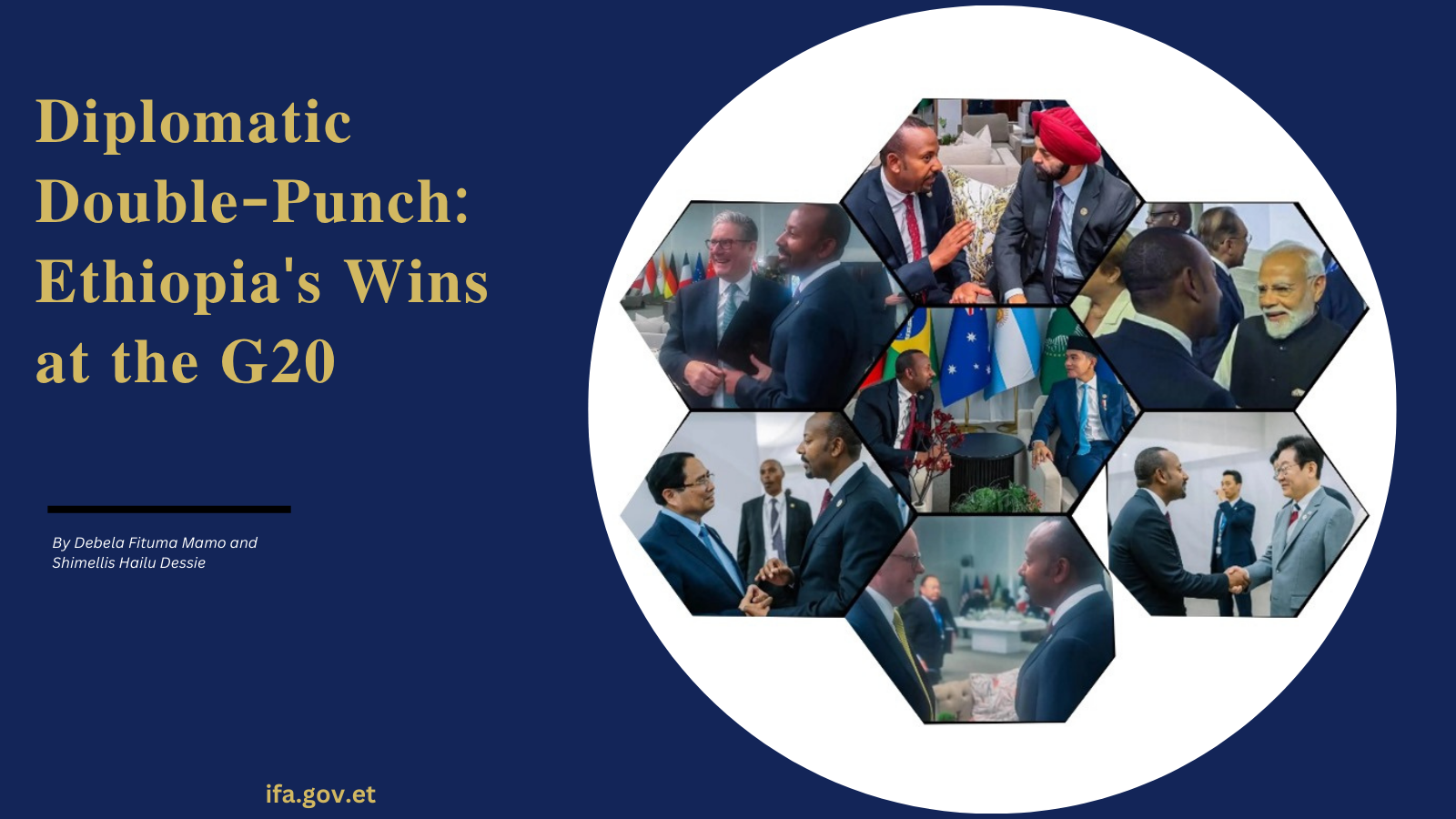
Furthermore, side diplomacy is always used by states to set schedules and agendas for future discussions with traditional and new partners. Through his brief but focused interactions with leaders from various corners of the World, Prime Minister Abiy Ahmed initiated strengthened bilateral and mini-lateral collaborations on a range of issues. Through short-term formal conversations with the German Chancellor, the Netherlands Prime Minister, the Italian Prime Minister, the Turkish President, the South African President, and the UN Secretary-General, Ethiopia laid the groundwork for future engagements on a range of issues. Also, Ethiopia held in-depth conversations with the Managing Director of the International Monetary Fund (IMF), the World Bank Director General, and the new Director General of the African Development Bank (AfDB).
Conclusion
The G20 summit is designed to serve as a platform for developing cooperative policies and giving emerging economies a voice alongside the world’s largest economies. The 2025 G20 Summit, as the first historic summit on African soil, was essential in shaping the world’s collective future, and decisions made in Johannesburg have global impacts across sectors. Ethiopia’s participation in the 2025 G20 summit marked a noteworthy diplomatic triumph. By employing both track I and side diplomacy, Ethiopia promoted its national priorities, addressed regional sensitivities, countered misinformation, secured future cooperation, and strengthened financial and political ties with a range of actors. In the contemporary global system where narratives, alliances, and decisions shift quickly, side diplomacy is an indispensable diplomatic tool. Ethiopia’s experience at the 2025 G20 Summit illustrated how a country can increase its influence, protect its interests, and shape global conversations through deliberate, skillful, and proactive use of both track I and side diplomacy.
[1] Sarah Anderson, Fernanda Balata, Iago Montalvão Campos, Bruno de Conti, Reyanna James, Marianna Leite, Shikwane Warren Makoga, María Emilia Mamberti, Tatenda Mzezewa, Marco Antonio Rocha, and Clara Saliba. (2025). The G20 at a crossroads: An independent assessment of the G20’s impact, and lessons for an equitable economic future. The G20 at a crossroads: An independent assessment of the G20’s impact, and lessons for an equitable economic future
[2] N. K. Purohit and Shailesh Mathur. (2024). Role of G20 in a Changing World in “A Decade of Shaping the Future: Global Harmony, Co-operation, and G20.”
[3]World Economic Forum. (2025). What is the G20 and why does it matter? https://www.weforum.org/stories/2025/11/g20-summit-what-you-need-to-know/
[4]G20- Background Brief (2023). https://www.g20.in/content/dam/gtwenty/gtwenty_new/about_g20/G20_Background_Brief.pdf
[5]The Ethiopian Herald. (2025). Ethiopia joined the Global Alliance to combat hunger, poverty: A significant step towards sustainable development. https://globalallianceagainsthungerandpoverty.org/wp-content/uploads/2025/02/the-ethiopia-herald.pdf
[6] Naylor, Tristen. (2020). “All That’s Lost: The Hollowing of Summit Diplomacy in a Socially Distanced World.” Hague Journal of Diplomacy 15. https://eprints.lse.ac.uk/107494/1/HJD_15.4_Naylor_Copyedited.pdf
About the authors
Mr. Debela Fituma Mamo is a researcher in the Institute of Foreign Affairs’ Middle East and Asia-Pacific Affairs Department. He is reachable at debela.f.mamo@ifa.gov.et
Shimellis Hailu is a researcher at the Department of America and Europe, Institute of Foreign Affairs (IFA), and a PhD candidate in Political Science at Addis Ababa University. His research interests focus on Ethiopia’s foreign policy in relation to the dynamics of great power competition, evolving geopolitics, and surfacing new diplomacy.
Disclaimer:
The content disseminated by the Institute of Foreign Affairs (IFA) – including, but not limited to, publications, public statements, events, media appearances, and digital communications – reflects the views of individual contributors and does not necessarily represent the official positions or policies of the Institute, its partners, or any affiliated governmental or non-governmental entities.
While the IFA endeavors to ensure the accuracy, integrity, and timeliness of the information presented, it makes no representations or warranties, express or implied, regarding the completeness, reliability, or suitability of such content for any purpose. The Institute expressly disclaims any liability for errors or omissions, as well as for any actions taken or decisions made based on the information provided.
The inclusion of external links, references, or third-party resources does not constitute an endorsement by the Institute. Additionally, engagement on social media platforms – including, but not limited to, likes, shares, retweets (RTs), or reposts – shall not be interpreted as an endorsement or validation of the views expressed therein.Readers and audiences are encouraged to exercise critical judgment and seek independent verification when interpreting or relying upon any information disseminated through publications and posts on the Institute’s platforms or representatives.