

1 Conceptualizing Ethiopia’s Strategic Autonomy in the Red Sea
Ethiopia ‘s conception of strategic autonomy in the Red Sea Region is clearly and boldly indicated in Prime Minister Abiy’s recent parliamentary speech in 2025. He stated, “Raising the question of access to the sea is no longer a taboo … Nor could Ethiopia remain in geographic prison….” Of course, the Prime Minister reminded the presence of the generic version of this notion and the need to reorient Ethiopia’s strategy to the Red Sea Region in his book entitled “Medemer”. He also underlined Ethiopia’s pursuit of direct access to the Sea is not a tactical engagement which has happened by accident; rather it has been strategically designed to overcome the labyrinth geopolitical challenges in the Red Sea Region. This reflects Ethiopia’s transition from a strategy of adaptable survival in the Red Sea region to, at the very least, a form of ideational autonomy—allowing it to question existing maritime arrangements and negotiate for mutual benefits in the Red Sea governance. This can be evidenced by three important subsequent developments. Firstly, the agenda of accessing to the sea which has been a taboo for the last three decades in the hitherto regime is now a public agenda following the 2018 political transition in Ethiopia. Accordingly, exchanges of ideas and knowledge production on Ethiopia’s access to the sea among the public, scholars and politicians have become day to day activities. Secondly, Ethiopian government through its foreign diplomatic engagement has started negotiation with littoral states and other non-regional actors on how to get access to the sea. Thirdly, Ethiopia has reestablished naval institution under the ministry of defense. In this regard, Ethiopia’s naval diplomacy and port agreements in 2024, rebuilding naval capabilities and active involvement in multilateral organizations are indicators of transition from strategic survival towards autonomy
- Diplomatic Pathways to Access to Naval power
2.1 Securitization of the Red Sea: Agenda Framing and Mobilization
Cognizant of the looming threats in the Red Sea region, the Ethiopian government has securitized the region since 2018. In this regard, three key securitization measures have been taken by the government. First, Prime Minister Abiy Ahmed has delivered a series of speeches in parliament highlighting the strategic importance of the Red Sea, associated threats, and the need for maritime diplomacy to secure access to the sea. Second, the issue has been extensively articulated by key securitizing actors, including the Office of the Prime Minister, the Ministry of Foreign Affairs, and the Ministry of Defense. Third, the government has taken extraordinary steps such as engaging in naval port diplomacy and undertaking institutional rebuilding. While Ethiopia has not yet achieved full naval autonomy, it has attained a notable degree of institutional and ideational autonomy. To this effect, Ethiopian government has initiated diplomatic talks with the neighboring coastal states such as Djibouti, Somalia, Somaliland, Kenya and Eritrea to negotiate on port access for both commercial and military purposes. Below are some of the diplomatic efforts that underscore Ethiopia’s pursuit of naval access in the Red Sea.
2.2 Ethiopia-Somaliland Memorandum of Understanding (MOU)
The first Ethiopian diplomatic move to get access to naval power was exclusively linked with the Ethiopia and Somaliland Memorandum of Understanding (MoU) signed in Addis Ababa on January 1, 2024. Although the full content of the MoU was not disclosed, the publicly communicated agreement provides a 20 km (12 miles) coastline access to Ethiopia for both naval and commercial uses over a period of 50 years. However, the agreement makes Ethiopian access conditional upon its political recognition of Somaliland’s statehood. Beyond the port fee, Somaliland was promised to have a share from the profitable Ethiopian Air Lines. Ethiopia’s diplomatic leverage as the political center of Africa and the seat of the African Union appears to be one of the key factors that motivated Somaliland to sign the deal. The respect of the colonial boundary outlined in the African Union Charter remains a major challenge for the independence of Somaliland. As a result, approaching Ethiopia has been considered by Somaliland as a pathway for achieving formal independence. Additionally, among others, a scholar such as Farah argues that Ethiopia’s military strength and its potential to deter any forceful reunification with Somalia was another driving factor behind Somaliland’s decision to enter into the MoU.
Although Ethiopia’s pursuit of access to a naval base presents considerable challenges, its political leverage as the center of African diplomacy and its status as a military heavyweight in the Horn of Africa could support its efforts to achieve negotiating autonomy for a naval presence. To this effect, soft power diplomacy through maintaining the principle of neutrality on the Somalia politics and by acting as a reliable security partner to both Somalia and Somaliland, Ethiopia can achieve its presence as a naval power in the Red Sea region. In other words, striking a balance between the interests of Somaliland and Somalia might thrive Ethiopia to advance its strategic naval autonomy in the Red Sea.
2.3 The Ankara Declaration
The Ankara declaration is the upshot of the Ethio-Somaliland MoU. The way the MoU was signed and communicated caused frustration on the neighboring Somalia. The government of Somalia denounced the MoU as a “clear violation of Somalia’s sovereignty, unity, and territorial integrity”. It also unequivocally declared the MoU ‘null and void’ and expressed its readiness to defend its sovereignty. Additionally, the Somali government went so far as to threaten the expulsion of Ethiopian troops from the African Union Mission in Somalia (AMISOM) and to ban Ethiopia’s participation in the new African Union Support and Stabilization Mission in Somalia (AUSSOM). Furthermore, the government of Somalia requested diplomatic support from regional countries like Egypt, Eritrea and Türkiye. Similarly, regional organizations like the African Union (AU), Arab League and Organization of Islamic Cooperation (OIC) offered solidarity to Somalia. Both statements from Ethiopian rival states and regional organizations stressed the need to respect the sovereignty and territorial integrity of Somalia, and its implication for regional peace and security.
The mounting tension between Ethiopia and Somalia as a result of the MoU was averted by the Ankara declaration. The agreement signed on December 11, 2024, at Ankara through the mediation of Türkiye. Based on the Ankara declaration, Ethiopia recognized the territorial integrity and sovereignty of Somalia while Somalia acknowledges Ethiopia’s interest to get access to the sea through lease and contract under the Sovereignty of the Federal Government of Somalia. Both Ethiopia and Somalia agreed on the continuation of Türkiye as mediator for the implementation of the accord. Overall, the Ankara Declaration achieved a delicate balance between Somalia’s territorial integrity and Ethiopia’s access to the sea. It ensured a win-win outcome, giving the sea access agenda broader international recognition and greater significance than the previous MoU. Therefore, it is plausible to argue that Ethiopia demonstrated remarkable ideational autonomy—from setting regional agenda to securing Türkiye as the guarantor for the implementation of the agreement.
3 Rebuilding Institutional Capability
For the last three decades, the EPRDF government suppressed the agenda of access to the sea, as it was widely held responsible for Ethiopia’s landlocked status. However, this simmering public concern re-emerged during the 2005 political contest, in which the opposition—particularly the Coalition for Unity and Democracy—openly supported the issue. The EPRDF government dismissed this stance as warmongering. After the election, the issue of sea access remained an undercurrent in Ethiopian politics. Following the 2018 political transition, the agenda once again resurfaced in public discourse. Currently, the Ethiopian government is leveraging the issue of sea access as a strategic tool in regional geopolitics, with broader ideational influence. Ethiopia now appears to be setting the agenda of access to the sea, rather than merely responding to it. Regional actors are increasingly reacting to Ethiopia’s initiatives, as evidenced by the responses to the Ethio–Somaliland port deal and the Ankara Declaration of 2024. This marks a shift in Ethiopia’s foreign policy—from a subservient geopolitical posture centered on strategic survival to one characterized by ideational autonomy.
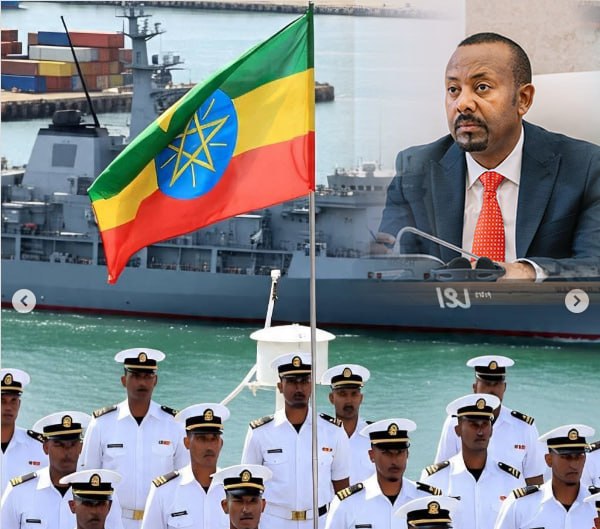
Among other factors, the growing number of military bases in the Red Sea region, the expanding economy and human population, the increasing competition and influence of Gulf countries in the Horn region, the rise of maritime terrorism in the Red Sea and Gulf of Aden, Ethiopia’s heavy dependence on the region for foreign trade, and its exclusion from the Red Sea Council were key drivers behind the securitization of the Red Sea and the subsequent establishment of the Ethiopian Navy under the Ministry of Defense in 2019. The Navy was initially launched with a single commander and gradually expanded with the recruitment of additional military personnel. It began with a simple structure, consisting of one head and two deputies overseeing logistics and training. Currently, the navy has started practical operations in protecting the Great Ethiopian Renaissance Dam (GERD) and involved in rescue operations in times of flooding at different parts of the country.
To enhance the institutional and human capacity of the Navy, the government has begun constructing the Navy’s headquarters in Addis Ababa. Currently, the Navy operates within the Ground Forces headquarters. The completion of the new building complex is expected to significantly strengthen the institutional capacity of the Ethiopian Navy. To address the shortage of skilled personnel, the government has also established a naval academy for Ethiopian cadets. In addition, many Navy personnel have received short- and long-term training in various countries with which Ethiopia has established defense partnerships.
4.4 Multilateral Engagement as Autonomy Multiplier
In line with the decision of the 46th Ordinary Session of the Intergovernmental Authority on Development (IGAD), the Committee of Ambassadors from IGAD established the Red Sea and Gulf of Aden Task Force (RGATF) on April 4, 2019. The primary objective behind the establishment of the Task Force was to develop a common position and strategy to address the growing challenges and opportunities in the Red Sea and Gulf of Aden region. Notably, the Red Sea Council (RSC) had been established a year earlier, with membership limited exclusively to littoral states of the Red Sea. As a result, countries such as Ethiopia, Kenya, and South Sudan were excluded. IGAD member states that bordering the Red Sea was granted dual membership on both platforms. IGAD’s Task Force has twenty-one members, three representatives from each member states including Djibouti, Ethiopia, Kenya, Somalia, South Sudan, Sudan, and Uganda. The task force convened on a quarterly basis and co-chaired by IGAD’s special envoy for the Red Sea and Gulf of Aden Task force, Ambassador Mohamed Ali Guyo. Ethiopia was prosing and pushing for the establishment of RGATF–the ideational power –at least for three strategic reasons. First, to counter its exclusion from the RSC, Red Sea littorality was the sole criterion for membership. Second, to mobilize non-littoral IGAD members as a counter-bloc in shaping Red Sea security governance. And third, to address the emerging geopolitical dynamics in the Red Sea and Gulf of Aden region, particularly in light of the increasing frequency and scale of RSC military drills.
4. Conclusion
Ethiopia’s pursuit of naval power signifies a fundamental shift from reactive survival to proactive strategic autonomy, moving sea access towards the center of its national security agenda. Through the reconstruction of its navy and high-level diplomacy—exemplified by the evolution from the controversial Somaliland MoU to the more balanced Ankara Declaration—Ethiopia has successfully secured “negotiating autonomy” within the Red Sea region. To ensure this ambition and long-term stability, Ethiopia should now prioritize two key actions: securing maritime access through legally binding international frameworks to mitigate regional sensitivities, and launching confidence-building measures with neighboring coastal states. By integrating joint maritime security and port co-management into its strategy, Ethiopia can transform its naval aspirations into a framework for cooperative regional governance.
About the author
Mohammed Seid (PhD), Senior Researchers of the Middle East and Asia Pasfic Affairs Department at the Institute of Foreign Affairs (IFA)
Disclaimer:
The content disseminated by the Institute of Foreign Affairs (IFA) – including, but not limited to, publications, public statements, events, media appearances, and digital communications – reflects the views of individual contributors and does not necessarily represent the official positions or policies of the Institute, its partners, or any affiliated governmental or non-governmental entities.
While the IFA endeavors to ensure the accuracy, integrity, and timeliness of the information presented, it makes no representations or warranties, express or implied, regarding the completeness, reliability, or suitability of such content for any purpose. The Institute expressly disclaims any liability for errors or omissions, as well as for any actions taken or decisions made based on the information provided.
The inclusion of external links, references, or third-party resources does not constitute an endorsement by the Institute. Additionally, engagement on social media platforms – including, but not limited to, likes, shares, retweets (RTs), or reposts – shall not be interpreted as an endorsement or validation of the views expressed therein.
Readers and audiences are encouraged to exercise critical judgment and seek independent verification when interpreting or relying upon any information disseminated through publications and posts on the Institute’s platforms or representatives.