

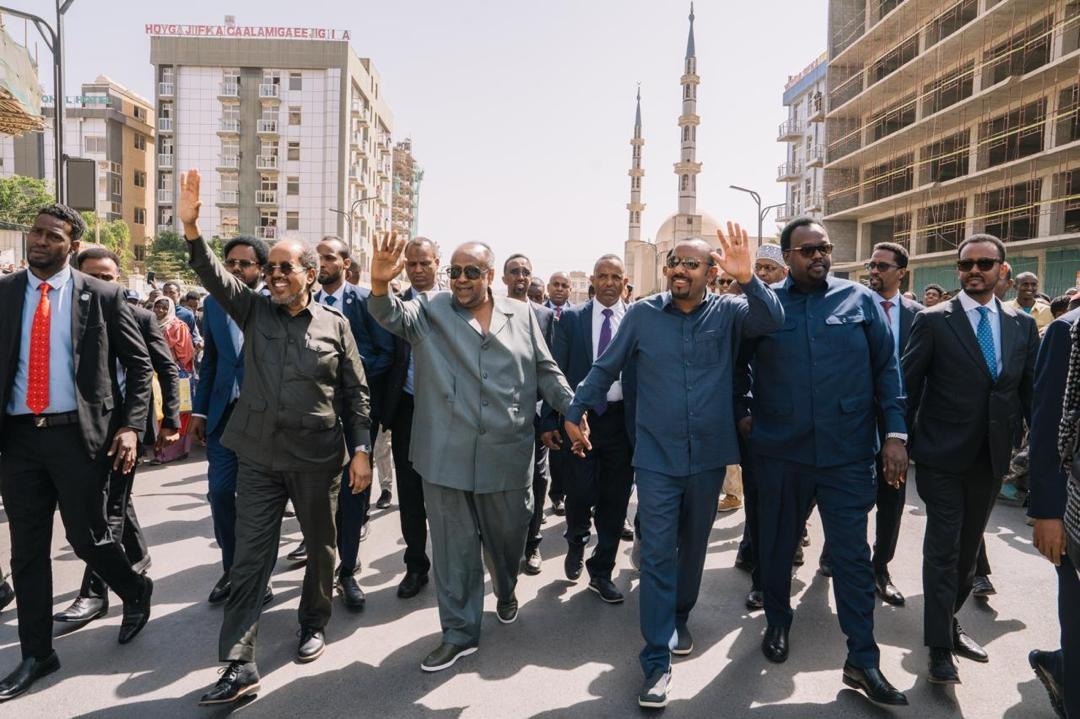
The arrival of President Hassan Sheikh Mohamud of Somalia and President Ismaïl Omar Guelleh of Djibouti in Ethiopia, marked by high-level engagements in Jigjiga, signals a deliberate recalibration of trilateral relations in the Horn of Africa. Beyond ceremonial diplomacy, these engagements reflect a pragmatic convergence shaped by shared security concerns, economic interdependence, and a mutual interest in managing regional risks within a rapidly evolving regional order.
Prime Minister H.E. Abiy Ahmed’s reception of the Somali and Djiboutian leaders in Jigjiga, rather than Addis Ababa, carries strategic significance. It underscores Ethiopia’s intent to anchor regional diplomacy in border and peripheral regions that are central to cross-border connectivity, security management, and economic integration. This approach reflects a broader effort to institutionalize trilateral dialogue as a strategic mechanism for managing regional influence and aligning security and development priorities among the three states.
The timing and substance of these engagements further amplify their importance. The trilateral meetings coincided with the official inauguration of the Aysha-II Wind Power Project, a flagship investment in Ethiopia’s renewable energy agenda located in the Somali Region. With an annual generation capacity of 467 GWh, Aysha-II strengthens Ethiopia’s energy security while providing the scalable and reliable power infrastructure required to support industrialization and technological development. Its strategic location on the Aysha plains, one of East Africa’s most significant wind corridors and in close proximity to neighboring borders, positions Ethiopia as a potential regional hub for cross-border energy trade.
The convergence of high-level political dialogue and strategic infrastructure delivery illustrates Ethiopia’s development-driven diplomacy in practice. Rather than separating foreign policy from domestic development, Addis Ababa is increasingly integrating the two, using large-scale infrastructure projects to reinforce regional interdependence and shared economic interests. The Aysha-II project exemplifies this approach by translating Ethiopia’s natural endowments into assets that can support regional energy cooperation and long-term stability.
This strategy was further reinforced by the inauguration of the Shabelle (Shabeely) Resort in Jigjiga, a development initiative that complements hard infrastructure investments with soft economic and social connectivity. The Shabelle Resort symbolizes Ethiopia’s effort to transform Jigjiga and the Somali Region into emerging hubs for cross-border commerce, services, and people-to-people interaction. Inaugurating the resort alongside trilateral political engagements signals a deliberate linkage between diplomacy, investment confidence, and regional economic integration.
Together, the Aysha-II Wind Power Project and the Shabelle Resort reflect a dual-track strategy that combines energy security and industrial capacity with service-sector development and soft power projection. This approach strengthens the trilateral framework by embedding political cooperation within tangible economic outcomes, reinforcing the credibility and durability of regional engagement.
The broader regional context further explains the strategic logic behind this trilateral alignment. The Horn of Africa remains in a period of structural transition characterized by persistent security threats, fragile state institutions, and intensified competition over trade corridors and infrastructure. In this environment, Ethiopia, Somalia, and Djibouti increasingly recognize that unilateral approaches are insufficient. Sustained coordination offers a more effective means of addressing transnational security challenges, safeguarding transport and logistics routes, and facilitating economic growth.
Underlying this partnership is a carefully managed power asymmetry. Ethiopia engages from a position of demographic scale, economic capacity, and diplomatic reach, seeking to preserve regional stability while maintaining leverage across security and economic domains. Somalia and Djibouti, while sovereign actors, operate within more constrained strategic environments shaped by security vulnerabilities and dependence on regional connectivity. This asymmetry structures the partnership by creating opportunities for Ethiopian influence while imposing limits on the autonomy of its partners. Importantly, however, it does not preclude genuine cooperation or shared strategic interests.
The emphasis on continuity through repeated high-level engagements, formal protocol, and joint participation in development initiatives reflects a shift from episodic diplomacy toward a more routinized and institutionalized trilateral framework. This evolution builds on earlier diplomatic normalization efforts undertaken in early 2025, when the three countries recommitted to structured cooperation following periods of limited coordination. Subsequent joint statements and engagements emphasizing trust-building, security coordination, and economic integration indicate a deliberate move toward operational collaboration in areas such as border management, counterterrorism coordination, and infrastructure connectivity.
Taken together, these developments demonstrate that Ethiopia’s trilateral engagement with Somalia and Djibouti is neither reactive nor symbolic. It is strategically calibrated to cultivate reliable regional partners that contribute to Ethiopia’s security depth while advancing shared development objectives. For Somalia and Djibouti, alignment with Ethiopia offers tangible short- and medium-term stability dividends, while requiring careful navigation to preserve strategic autonomy and avoid excessive dependence.
More broadly, the combination of political dialogue, energy infrastructure, and investment-oriented development initiatives reflects Ethiopia’s vision of a Horn of Africa in which regional challenges are addressed collectively rather than through reliance on external actors. By institutionalizing trilateral cooperation and anchoring it in concrete economic outcomes, Addis Ababa seeks to secure critical infrastructure access, reinforce regional security frameworks, and consolidate its role as a central actor shaping stability and development across the Horn.
In this sense, Ethiopia–Somalia–Djibouti relations are not merely improving; they are being strategically redefined. The implications extend beyond Addis Ababa, Mogadishu, and Djibouti City, offering a model of regionally anchored cooperation that integrates security, economic, and diplomatic objectives. Whether this trilateral framework proves durable or transitional will play a significant role in shaping the Horn of Africa’s strategic balance and regional stability in the years ahead.
By Bemnet Fikre @IFA
Disclaimer:
The content disseminated by the Institute of Foreign Affairs (IFA) – including, but not limited to, publications, public statements, events, media appearances, and digital communications – reflects the views of individual contributors and does not necessarily represent the official positions or policies of the Institute, its partners, or any affiliated governmental or non-governmental entities.
While the IFA endeavors to ensure the accuracy, integrity, and timeliness of the information presented, it makes no representations or warranties, express or implied, regarding the completeness, reliability, or suitability of such content for any purpose. The Institute expressly disclaims any liability for errors or omissions, as well as for any actions taken or decisions made based on the information provided.
The inclusion of external links, references, or third-party resources does not constitute an endorsement by the Institute. Additionally, engagement on social media platforms – including, but not limited to, likes, shares, retweets (RTs), or reposts – shall not be interpreted as an endorsement or validation of the views expressed therein.Readers and audiences are encouraged to exercise critical judgment and seek independent verification when interpreting or relying upon any information disseminated through publications and posts on the Institute’s platforms or representatives.