

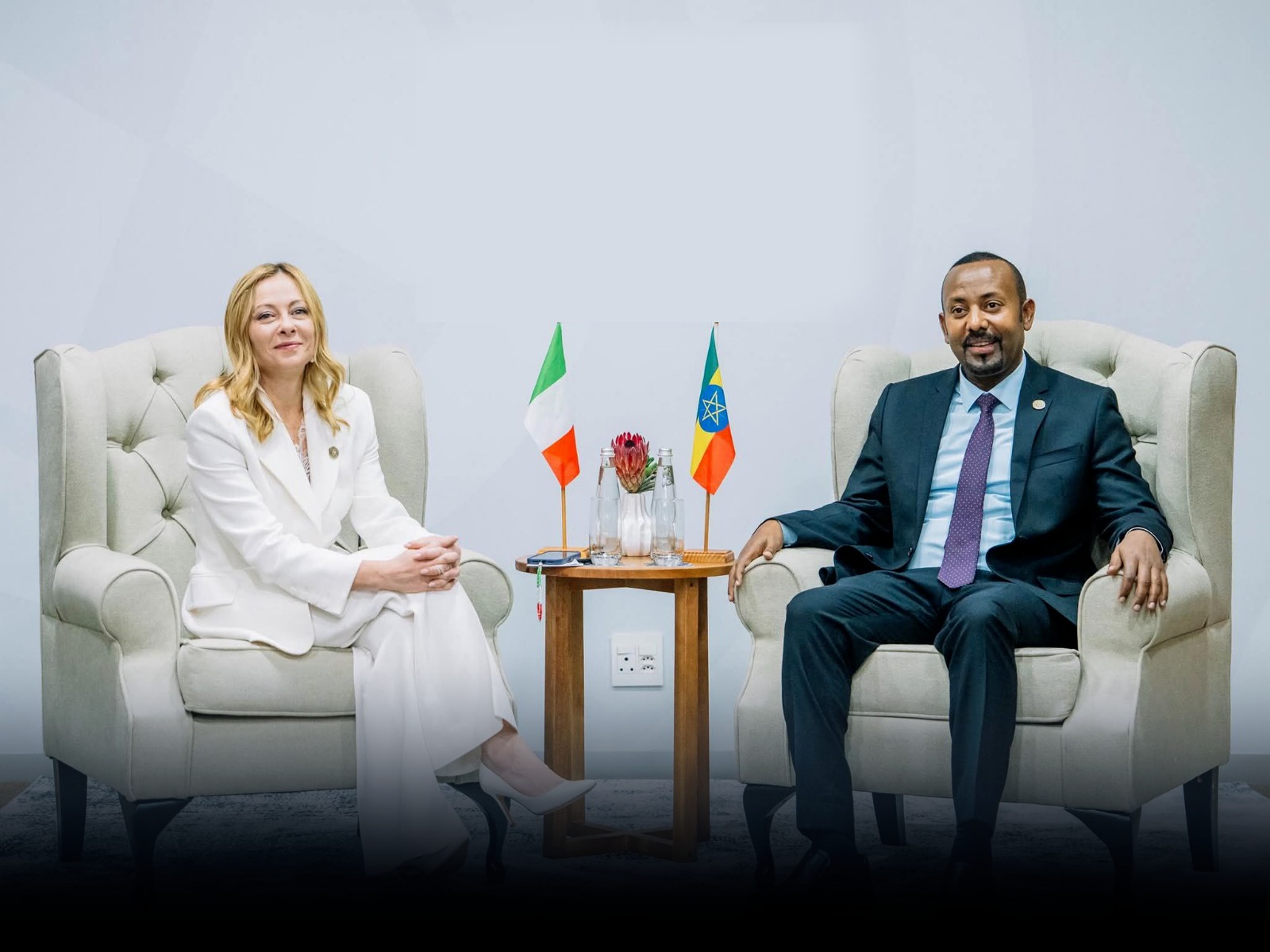
As announced by President of the Council of Ministers Giorgia Meloni during her beginning-of-year press conference, Italy will hold the second Italia-Africa Summit at the level of Heads of State and Government in Addis Ababa, Ethiopia, on 13 February. Such commitment on the Italian side confirms its political will to strengthening strategic relations with the African continent and the consolidation of the objectives set by the Mattei Plan for Africa, which was launched in Rome in January 2024. This two-yearly event will be held in Africa for the first time and will take place in conjunction with the African Union Summit, on the eve of the African Union Heads of State and Government Assembly. President Meloni, as guest of honour, will deliver an address to the opening plenary session of the Assembly. Two years on from its official presentation, this initiative represents a new milestone in Italy’s commitment to fostering structured political and economic partnerships with African nations. It aims to strengthen cooperation on sustainable development, infrastructure, energy, education and training, healthcare and agriculture, in line with the strategic pillars of the Mattei Plan. The summit will also provide an opportunity to review the progress made by the Plan, whose aim is to foster Italy’s presence on the continent through system-wide missions, political dialogue and joint projects including the identification of operational priorities for the coming years.
Africa to the forefront:
In light of bringing Africa back to the political agenda, the launch of the Mattei Plan is critically crucial at least for three reasons. Initially, the Plan has received a very warm recognition by several key African and European actors, with 21 African Heads of State and Government attending in addition to Foreign Ministers and top representatives of the European Union namely Ursula von der Leyen, World Bank, IMF, OECD and several others attending the summit in Rome. Dialogue and partnership are key targets to the success of the Plan, avoiding a top-down approach driven by the old donor-beneficiary paradigm. As proposed by the Italian government, the Mattei Plan was designed in collaboration with the EU and with other actors like the US to attract public and private investments in big African programmes like the Comprehensive Africa Agricultural Development Programme, the Programme for Infrastructure Development in Africa, and the African Continental Free Trade Area. Second, Italy claims to foster the creation of new funding mechanisms under such a scheme. Two mechanisms are planned. Italy could boost the role of CDP (Cassa Depositi e Prestiti- Deposit and Loan Fund) as the Italian development bank to crowd in private sector investments more structurally, following the successful model experienced in other countries (the AFD in France, the KfW in Germany, the Femo in the Netherlands). Also, the government of Meloni could facilitate the setting up of multilateral funds within multilateral development banks (MDBs), notably the African Development Bank (AfDB) in partnership with the United Arab Emirates, or other on-going negotiations at the level of the G7. If such efforts succeed, the new 200-million-dollar agreement signed by CDP and the European Bank for Reconstruction and Development – which is increasing its presence and financial portfolio in Africa. Third, the Mattei Plan will map the most strategic projects and initiatives that Italy has already in place in Africa which is essential to avoid duplications and identify those areas and countries where it is possible to scale up successful partnerships or build new ones. Such targets include, for instance, fostering strong synergies with other European projects like the EFSD+ (European Fund for Sustainable Development with 135 billion euro public and private funding), the Global Gateway or the Green Climate Fund.
The Mattei projects
The first two objectives of the Mattei Plan: improved governance and the creation of effective partnership are foundational reforms designed to support the Plan’s core objective which are scheduled for implementation between 2024 and 2028, with the possibility of a four-year extension. Pilot projects began in 2024 in Morocco, Algeria, Tunisia, Egypt, Ethiopia, Kenya, Côte d’Ivoire, Congo, and Mozambique. In 2025, additional projects were launched in Angola, Ghana, Mauritania, Tanzania, and Senegal. Recently, Italy is engaged in negotiations with Congo, Kenya, Libya, Egypt, Eritrea, Ethiopia and Côte d’Ivoire to develop further initiatives, particularly in the sectors of agriculture and health. The Plan basically subsumes five core pillars: education and training, agriculture, health, energy, and water including infrastructure development. In some cases, its projects are transferring technology, supporting sustainable energy production, extending food sovereignty, adding value to local supply chain, improving internet access for populations and enabling African start-ups to harness the potential of AI. The Plan also includes debt conversion initiatives for the lowest-income countries, transforming debt into sustainable development projects.
Migration
The Mattei Plan could at first glance be interpreted as a form of compensation for migration externalization. The prime minister herself has repeatedly stated that the goal of the Plan is to “grant the right not to emigrate.” Such a policy framing it this way serves her politically, as migration remains a highly sensitive issue for her domestic base which in turn allows her to engage with Africa governments under the banner of migration reduction. So far, despite being a political propaganda, for some critiques none of the Plan’s pillars or any of its current projects are centred on migration. Plus, aside from Tunisia, Egypt, and Côte d’Ivoire which are indeed important origin and transit countries, the rest of the Mattei Plan’s partner countries have not significantly contributed to the migration flows arriving in Italy between 2017 and 2023. It has remained quite difficult to establish a clear quid pro quo aimed at reducing migratory pressure, particularly as both Tunisia and Egypt have historically been longstanding cooperation partners of Italy. In practice, many critiques contend that Meloni has deliberately crafted the Mattei Plan to be devoid of direct references to migration a topic that Italy has failed to address it through the EU Asylum Pact and the Rome Process.
Extraction of Energy
Leveraging the Mattei Plan to increase revenues may be tempting given the positive impact of the Italian hydrocarbon company, ENI (Ente Nazionale Idrocarburi- National Hydrocarbons Board), on Italy’s public finances. Nevertheless, doing so would contradict the Plan’s stated non-predatory principles. As a matter of fact, there appears to be some geographical overlap between ENI’s operation and the Mattei Plan. So far, the ENI has identified eight priority countries in Africa, six of which are also included in the Mattei Plan. The mother country already maintains long-standing cooperation with four of the fourteen Mattei partner countries where a potential overlap of interests between ENI and the Plan may arise whose resources are limited in scale. For instance, in 2023, Italy imported 8% of its oil needs from all 14 countries involved in the Mattei Plan with Algeria alone accounting for 4.1% of Italy’s export share and 41.5% of the total African export. Indeed, in 2025, ENI announced €26 billion in investments in Egypt, Libya and Algeria which is just one of ENI’s many investments commitments that in turn exceeds the total Mattei Plan budget by more than four times. In reality, the disbursement of Mattei Plan funds is subject to strict conditionalities. So far, three billion euros are sourced from Italy’s Climate Fund, which is tied to CDP’s stringent environmental goals whose criteria effectively prohibit the use of these funds for hydrocarbon extraction. Of course, they align with the EU’s New Generation Free Trade Agreement standards, indirectly supporting a potential Free Trade Agreement between Africa and the EU.
Lobito corridor
These days, critical raw materials have rapidly become the new extractive frontier. As part of the Mattei plan, the Lobito rail corridor aims to connect Angola, the Democratic Republic of Congo, and Zambia to facilitate the export of critical raw materials which also targets to diversify its use to promote regional development. Beyond generic promises of “development” and “jobs,” however, there is no concrete plan to add value to local economies through the corridor. Regional fragmentation in technical standards, customs regimes, and procedures makes diversification impossible, as seamless two-way logistics are also essential. As per its design, the railway will primarily serve to export critical raw materials.
Low-Cost Labour for Export
Last, it is argued by proponents of the Mattei Plan, projects appear to avoid extractivist dynamics as most of the European projects seem to engage in extraction industries such as mining. So far, there are two agricultural projects in Algeria and Kenya aimed at realizing food security as well as boosting food exports to the global market. There are some Italian companies working in such an area with quite concerns and reservations of the opponents questioning the viability and relevance of such projects who strongly claim that these could ultimately lead to the exploitation of the local population for Italian benefit.
Conclusion
So far, the Mattei Plan seems to bring Africa back as a top priority of Italy’s foreign policy. In fact, due to many political claims, the continent has been absent for too many years in Italy’s foreign policy priorities which has also affected the portion of resources allocated to the continent. Though energy, security and addressing the root causes of migration have been seen as the main political driver of this initiative, the Mattei Plan has the potential to strengthen Italy’s development and international partnership cooperation policy ten years after the approval of Law 125/2014. So far, Africa needs a way out to boost up international cooperation and partnership. The usual experience is clear. The ex- British colonies in Africa are still dependent on British cooperation frameworks like the Common Wealth Group initiatives as members of the Anglophone African nations while most of the Francophone African nations are tied to using the CFA as their national currency making Paris the ultimate decision maker in determining the functioning of the state and government apparatus consequently. Here, it is worth mentioning to not forget the Lusophone/Portuguese and Spanish speaking African nations in terms of examining their structural dependency in policy framing and decision making with respect to their ex- European colonial powers. These days, although Italy had few colonies to mention- Eritrea, Libya and Somalia with a brief period of its invasion of Ethiopia for five years, it had not as such stretched its colonial legacies in terms of influencing or dictating policies to its ex-colonies as opposed to the old colonial counter parts; namely, the UK and France. This has made recently Italy a viable option for many African nations. Through its comprehensive Mattei plan, as discussed above, Italy now is ready to engage in a multi-sectoral and policy oriented projects in the continent of Africa. Along with the coming AU summit to be held on February 13th 2026 in Addis Ababa, Ethiopia, the Italian- African cooperation summit will also be held side by side aiming at implementing such policy frameworks to foster bilateral and mutual cooperation and partnership between the African continent and Italy in multifaceted areas of development concerns and projects.
Recommendations
While becoming one source of economic gains for Africa and one of the major economies in the EU Zone, Italy has opened up another gate way as an alternative for African nations to seek investment than aid and a potential for knowledge and technology transfer including a reasonable partnership for the extraction and export of the continent’s natural resource on fair and just terms. As we all see, the Chinese, the Emirates, Russians, Turkiye and similar other powers are approaching the continent in a manner that some of their moves quite seem a sort of political and economic scramble for the continent. The Horn of Africa is a typical example in such a case. The strategic positioning and the resource factor has been attracting a number of state actors to come and invest in the sub-region via extractive investment along with activities such as building ports and military bases in small states like Djibouti. Ethiopia, being the anchor state in the Horn region, is never immune from such geo-political rivalry and contentions. As an older partner and having a long historical connection with Italy, Ethiopia needs to devise its foreign policy orientation and coordinate all efforts to gain from the benefits of Italian cooperation schemes and projects for the following critical reasons. First, Ethiopia remains Italy’s major trading partner and economic destination for investment and aid far better than many of the EU Zone nations. In fact, in Ethiopia, a number of worth mentioning companies like SALINI are operating in areas of construction engineering and real estate development; among others. Second, the Mattei plan itself has put Ethiopia among the list of around 9 strategic African nations for further Italian investment in extraction industry which Ethiopia has been working (since the reform period of 2018) to boost up economic welfare and realize national prosperity for the future. The advocated slogan these days for Africa has become investment than aid. Third, as a headquarters of the AU (African Union) and as one of the initiators of ‘African solution for African problem’, it is logical for Ethiopia to coordinate African efforts and work on realizing cooperation with Italy as an alternative partner to achieve continental goals of development and security in general. Fourth, cooperation with Italy would pave the way for further strengthening similar policy initiatives with other nations within the EU framework which offers Africa in general and Ethiopia specifically the opportunities for future development cooperation and investment with continental Europe.
References
https://www.eni.com/en-IT/home.htm
https:international-partnership.ec.europa.eu/funding-and-technical-assistance/funding-instruments/european-fund-sustainable-development-plus-en
About the author
Tariku Abreha is a researcher at the America and Europe Research Affairs Directorate of the Institute of Foreign Affairs.
Disclaimer:
The content disseminated by the Institute of Foreign Affairs (IFA) – including, but not limited to, publications, public statements, events, media appearances, and digital communications – reflects the views of individual contributors and does not necessarily represent the official positions or policies of the Institute, its partners, or any affiliated governmental or non-governmental entities.
While the IFA endeavors to ensure the accuracy, integrity, and timeliness of the information presented, it makes no representations or warranties, express or implied, regarding the completeness, reliability, or suitability of such content for any purpose. The Institute expressly disclaims any liability for errors or omissions, as well as for any actions taken or decisions made based on the information provided.
The inclusion of external links, references, or third-party resources does not constitute an endorsement by the Institute. Additionally, engagement on social media platforms – including, but not limited to, likes, shares, retweets (RTs), or reposts – shall not be interpreted as an endorsement or validation of the views expressed therein.Readers and audiences are encouraged to exercise critical judgment and seek independent verification when interpreting or relying upon any information disseminated through publications and posts on the Institute’s platforms or representatives.