

Executive Summary
Ethiopia, often celebrated as the ‘Cradle of Mankind’ and known by its national brand ‘Land of Origins’, has a profound history of independence. Ethiopia’s historical legacy, particularly during the time when many African nations were under colonial rule, has positioned it as an important advocate for a unified African agenda in multilateral fora. It has embarked on a transformative diplomatic journey in African diplomacy since the inception of the OAU in 1963, its transition to the AU in 2001, and to-date. Addis Ababa, seat of the AU headquarters, serves as the political and diplomatic heart of Africa. The city is currently undergoing a transformation, reasserting its status as the diplomatic capital of the continent while welcoming African head of states for the 39th Ordinary Session of the AU Summit. This policy paper pays a glance look at Ethiopia’s diplomatic odyssey within the AU and unclose its strategic positioning thereof in a vantage point of time, highlighting the country’s enduring commitment, evolutionary role, strategic positioning to the birth of the OAU and all the way through the AU.
Historical Context and Background
Ethiopia, known as the ‘Cradle of Humanity’ due to the emergence of early human ancestors, has endowed with a rich history and a unique cultural tapestry that span over millennia. It stands out as the only African country that was never subjected to colonization. Preserving its independence and sovereignty in the face of colonial powers, Ethiopia defied their mighty ambitions that was declared and formalized through the Berlin Conference in 1885 as the “Scramble for Africa” doctrine. Ethiopia’s historical legacy departed from its victory over the Italian fascist force at the battle of Adwa in 1896 has inspired Africans and the black people elsewhere for a deep sense of nationalism and pride, making Ethiopia the beacon of hope for Pan-Africanism and anti-colonial struggles. Ethiopia’s diplomatic antiquity, principles and approaches that it live by is shaped by this remarkable history of defiance.
The spirit of Adwa not only marked Ethiopia’s symbolic importance for Pan-Africanism movements but also injected black people all over the world a stamina to struggle for freedom and equality. Most importantly, the victory of Adwa changed the course of world history. Then after, Ethiopia has continued to show an utmost diligence supporting the liberation struggles of many African nations, and voiced for the equality of black people at multilateral arena. A case in point, Ethiopia, being the sole black nation member of the League of Nations since the early 1920s, has consistently advocated for the right of all black and oppressed people, and championed the equality of all humanity, regardless of differences. Being an emblem of continental and global Pan-Africanism movements, Ethiopia has played uncontested role in the establishment of the Organization of African Unity (OAU) in 1963. When the OAU transitioned to AU in 2001, Ethiopia once again exhibited its unwavering position to retain the headquarters in Addis Ababa. In a nutshell, to fully capture Ethiopia’s strategic positioning in the AU, one must start with delving deep into the historical context of OAU’s establishment, and the price paid by Emperor Hailesellasie, Ethiopia’s seasoned diplomats, and fellow African forefathers.
Ethiopia’s Strategic Positioning as Center of African Diplomacy
As the center of African diplomacy, Ethiopia’s strategic positioning in the AU has seen multifaceted showcases in a vantage point of time, irrespective of internal regime changes. These include: the astounding role played by Ethiopia during the establishment of the OAU, Addis Ababa as permanent headquarters of the AU, hosting AU’s major annual Summits, leadership role and active participation, and tangible contributions to AU’s common agenda. In the paragraphs to follow, the testaments for Ethiopia’s strategic roles in the AU are highlighted:
In the establishment of the OAU in 1963, Ethiopia played a prime role, particularly in bridging the ideological divide between the Monrovia and Casablanca groups, outweighing African unity than the ideologies held by either of the factions. Through consistent lobbying efforts, Emperor Haileselassie and his seasoned diplomats of Ethiopia eventually triumphed Africa’s solidarity, realizing the foundation of the OAU and Addis Ababa as the permanent seat of the organization’s headquarters. In asserting itself as African diplomacy hub, Ethiopia has leveraged its history of independence, unwavering stand and advocacy for the equality of black people, commitment to collective security, symbolic significance for Pan-Africanism, and practical support for the liberation struggles of African nations. The foundation of the OAU marked a significant moment in African unity and solidarity whereby Ethiopia spearheaded the institutionalization of the fragmented movements of African nations, reaffirming its genuine commitment to Pan-Africanism and Africa’s self-reliance ambition. In a more nuanced manner, the OAU was aimed to promote unity among African nations, free Africa from colonial and apartheid rules, strengthen development cooperation among member states and with the world, and reinforce sovereignty and territorial integrity of member states. When the OAU was evolved to the AU in 2001, Ethiopia, once again, continued to play a central role to retain the AU headquarters in Addis Ababa. Ethiopia’s historical legacy in African nations struggle for freedom, and the unwavering commitment of its leaders to propagate African common agenda at the global stage have been recited to solidify Ethiopia as the epicenter of African diplomacy. Since the 1963’s founding conference of the OAU, Ethiopia has successfully hosted the organization’s major annual summits in Addis Ababa, and this time, AU’s 39th Ordinary Session is commenced, ensuring seamless coordination, security, and logistics. This testifies the unreserved support of Ethiopia, as the prime venue of continental diplomacy, for African leaders to discuss continental agendas, decision-making processes, and shape policies and strategies that help charting the shared future of the people. As the home of the AU, Addis Ababa embraces a number of multilateral organizations, resident Ambassadors and diplomats, so that it continued to be a melting pot for diplomatic, policy and security discussions, putting Ethiopia in close proximity to these daily affairs, and the agendas of the AU.
Ethiopia has maintained a central, albeit evolving, leadership role and active participation in the AU, and its predecessor, the OAU, including the specialized agencies therein. Since 1963, Ethiopia has assumed the Chairmanship position of the AU five times, and the Secretary General position one time. In over six decades span of the AU, Ethiopia’s contribution has been immense on some critical issues, such as peace and security, mediation, climate change, regional integration and economic development. First, since the 1950s, Ethiopia has been a top troop-contributing country to both UN and AU peacekeeping missions. The country’s stabilizing role in the most fragile Horn of Africa region, particularly in conflict-ridden areas of South Sudan and Somalia, demonstrates Ethiopia’s dedication to regional stability, and depicts its military prowess among African nations and the international community. Needless to mention, Ethiopia, thus far, has successfully accomplished its fair share in more than eleven peacekeeping missions both in Africa and elsewhere. In a similar note, Ethiopia became a member of the African Union Peace and Security Council (AUPSC), in 2025. Second, Ethiopia has positioned itself as a mediator in several regional conflicts, leveraging its influence in regional diplomacy and historical legacy in AU-led peacekeeping missions as neutral power. One of the most notable examples of Ethiopia’s mediation efforts is its post-2018 involvement in the South Sudan peace process. Ethiopia played a key role in brokering peace agreements between the conflicting parties, demonstrating its commitment to regional stability. Additionally, Ethiopia has facilitated dialogue in the ongoing tensions between Sudan and South Sudan as well as the warring parties of Sudan, showcasing its ability to act as a neutral arbiter. Ethiopia’s commitment to peace and stability, thus, is a testament for its strategic position in the AU peace and security initiatives, and its sustained active involvement in mediation efforts across the continent. Third, Ethiopia’s engagement with the AU also extends to sustainable economic development and regional integration efforts. The AU’s Agenda 2063 outlines a vision for Africa’s development, emphasizing economic integration and cooperation. Ethiopia has actively participated in initiatives aligned with this agenda, positioning itself as a regional economic and renewable energy powerhouse for a prosperous and integrated Africa. To this end, Ethiopia has been investing on projects that serve to realize economic collaboration among African nations, such as free trade industry zones, infrastructure connectivity, green development, and climate change initiatives. The African Continental Free Trade Area (AfCFTA), launched in 2021, represents a significant opportunity for Africa, promoting intra-African trade and reduce barriers to interstate commerce. Ethiopia’s participation in AfCFTA underscores its commitment to regional economic integration and open up new avenues for trade partnerships among African nations.
Apart from setting regional integration as its foreign policy goal in post-2018, Ethiopia has gone miles in connecting Horn of African countries and beyond, leveraging its renewable energy export, cross-country railway and road infrastructures, and most of all upgrading the capacity of its Airlines to support continental integration. As infrastructure development is a critical component of Ethiopia’s economic strategy, the country has prioritized investments in transportation, green energy, and digital infrastructure, augmenting connectivity within the region. By showcasing its infrastructure projects at the AU forums, Ethiopia is strategically positioning itself as an engine for regional integration. The Grand Ethiopian Renaissance Dam (GERD) is a prime example of Ethiopia’s commitment to infrastructure development. The dam is not only a significant energy project for Ethiopia but also has implications for Africa’s strategic autonomy, and water management and energy security in the Nile Basin countries. Ethiopia has engaged in the AU-led critical discussions surrounding the GERD, and showed its commitment to solving the GERD contestation under the auspices of the AU that relies on “African Solutions to African Problems” doctrine. This determination attest not only Ethiopia’s due diligence for reasonable and equitable utilization of the Nile for shared development of riparian countries but also its firm belief that Africans can solve their problems by their own. In a similar note, it has to be recalled that Ethiopia is the mastermind of the currently functioning doctrine of the AU, “African Solutions to African Problems”. This concept is fundamentally based on the words of Emperor Haileselassie’s speech made at the inaugural conference of the OAU in 1963, “A few years ago, African problems were decided by non-Africans outside Africa. Today, this conference has created an opportunity for Africans to decide their own affairs.” By the same token, Ethiopia actively represents African interests on the global stage, such as UN Climate Change Conferences, advocating for a unified African voice. It was once negotiating with big economies on climate financing for African countries, contending that African countries are affected the most by climate change, while contributing little to no to the crisis. Similarly, PM Abiy Ahmed’s Green Legacy Initiative has been recognized by the AU as a model for climate change mitigation. Eventually, Ethiopia won the bid in 2026 to host COP32 in 2027, highlighting its role in the global arena.
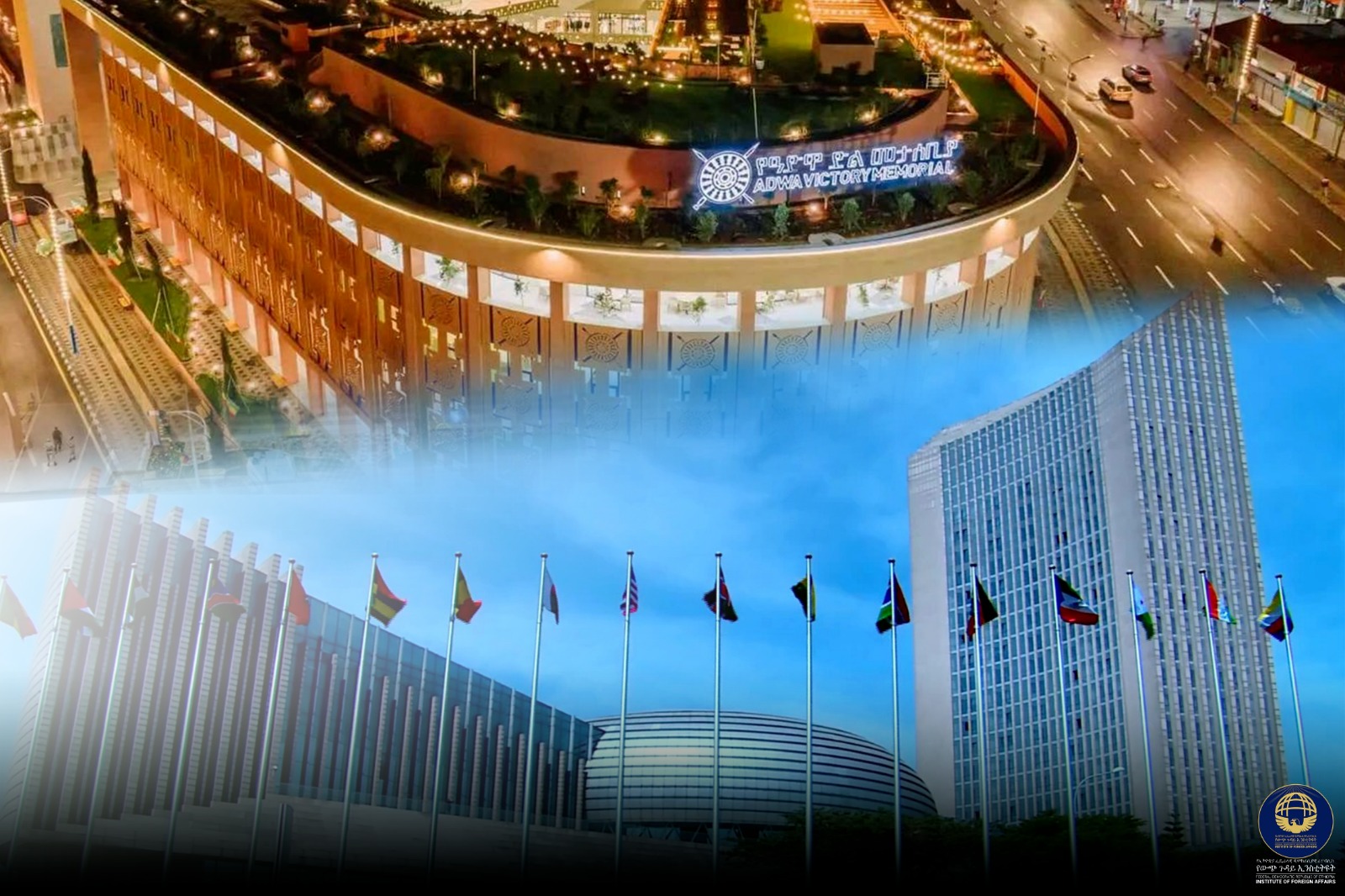
Most importantly, in post-2018, Ethiopia has reinvigorated its strategic positioning to re-affirm Addis Ababa as permanent center of African diplomacy and seat of the AU. The incumbent government’s effort to renovate the continent’s diplomacy capital, Addis Ababa, signifies Ethiopia’s diligence to transform the city’s ecology in a manner conducive for the diplomatic community- resident Ambassadors, diplomats, and staffs of international organizations. To address the longstanding resentments of fellow Africans at the standard of Addis Ababa, the city being the seat of the AU headquarters, the Ethiopian government and the city administration have put much effort to alter Addis Ababa’s portfolio. Now, the witnesses of many Africans testify that Addis Ababa is flourishing to be the pride of Africans, creating a welcoming environment for African leaders who convene for the AU annual Summits. Addis Ababa has seen astounding projects on corridorization, river-side development, urban tourism sites and parks, state-of-the art convention centers, restaurants reflecting a variety of African pigments and cuisines, digital infrastructure, and most of all the Adwa victory memorial park standing bold at its center, witnessing the price paid by Ethiopian forefathers, symbolizing Ethiopia as emblem of Pan-Africanism and African solidarity.
Conclusion and Recommendations
In a vantage point of time, Ethiopia’s strategic positioning for and within the AU has been portrayed by its unwavering stand on African unity, symbol of Pan-Africanism, tangible support for the liberation struggles of African nations, uncontested leadership role in founding the OAU, continued effort to sustain the AU headquarters in Addis Ababa, leading troop contribution to the AU peacekeeping missions, active involvement in mediation efforts, and commitment to sustainable economic development and regional integration agendas. In return, though Ethiopia was able to uplift its diplomatic stature and influence on the continent, this does not equate to what the country has paid for African liberation struggles, unity, and independence. As a key player in regional and continental affairs, thus, Ethiopia can reclaim for a better leadership position in the AU structure. As the AU continues to evolve, Ethiopia’s commitment to Pan-Africanism and collective action will be essential in addressing the challenges facing the continent. By leveraging its historical role in the AU, Ethiopia can not only strengthen its own diplomatic stature but also contributes to the shared vision of a unified and prosperous Africa. Ethiopia’s diplomatic odyssey, its historical legacy in igniting Pan-Africanism and anti-colonialism movements, and its consistent advocacy for African common interests in the world arena, if properly communicated through diplomatic channels, will enable the country to reemerge as a significant player on the continental stage. To this end, first, Ethiopia should reclaim its leadership role in the AU’s top political structure; meanwhile, it should strive balancing its internal political narrative with a long-term, coherent diplomatic doctrine focused on continental solidarity. Second, the Ethiopian government and its foreign ministry should work to increase the visibility of Ethiopia’s seasoned diplomats in the top political structure of the AU and the agencies underneath. Third, the Ethiopian government should look for a mechanism and framework in the AU that would support and settle Ethiopia’s top strategic interests, particularly the quest for sovereign access to the Red Sea.
About the author
Anteneh Getachew (PhD), A senior Researcher at the Middle East and Asia and Pacific Affairs department at the Institute of Foreign Affairs (IFA).
Disclaimer:
The content disseminated by the Institute of Foreign Affairs (IFA) – including, but not limited to, publications, public statements, events, media appearances, and digital communications – reflects the views of individual contributors and does not necessarily represent the official positions or policies of the Institute, its partners, or any affiliated governmental or non-governmental entities.
While the IFA endeavors to ensure the accuracy, integrity, and timeliness of the information presented, it makes no representations or warranties, express or implied, regarding the completeness, reliability, or suitability of such content for any purpose. The Institute expressly disclaims any liability for errors or omissions, as well as for any actions taken or decisions made based on the information provided.
The inclusion of external links, references, or third-party resources does not constitute an endorsement by the Institute. Additionally, engagement on social media platforms – including, but not limited to, likes, shares, retweets (RTs), or reposts – shall not be interpreted as an endorsement or validation of the views expressed therein.Readers and audiences are encouraged to exercise critical judgment and seek independent verification when interpreting or relying upon any information disseminated through publications and posts on the Institute’s platforms or representatives.