

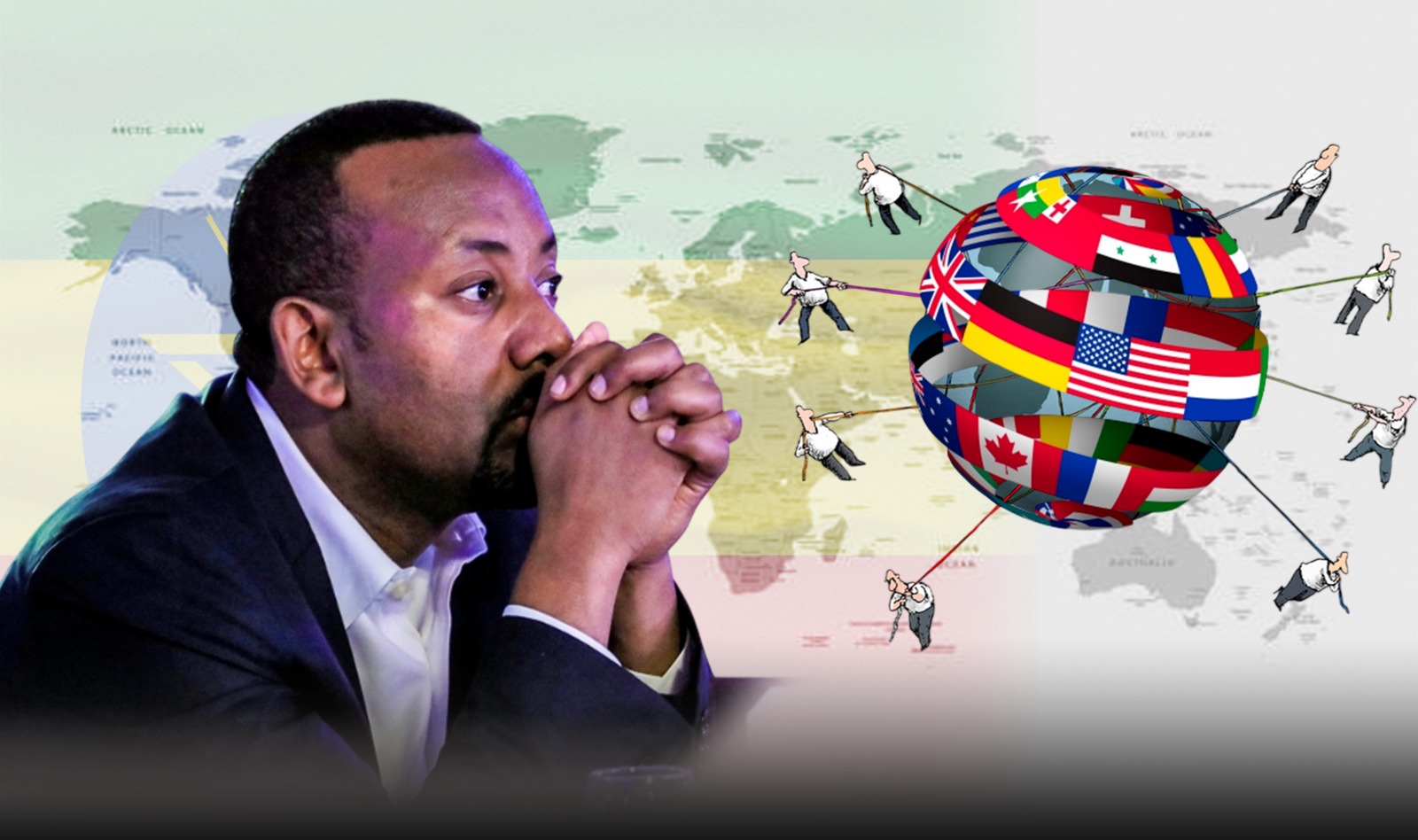
The Crisis of the Neoliberal World Order, the Rise of Competitive Geopolitics, and its Implications for Ethiopia
Introduction
The neoliberal world order that emerged after World War II and consolidated under U.S. led unipolarity in the 1990s is undergoing a deep structural crisis. This polycrisis stems from the internal fragmentation of Western core values and from intensifying external challenges from non-Western actors. These led to a global system change from a rule-based neoliberal world order to a competitive, volatile, and transactional world system. This policy brief observed that contemporary global politics is centered on four sources of geopolitical competition: technological power, control of strategic trade routes and coastlines, control of critical resources, and evolving security competition. These geopolitical developments have a direct bearing on Ethiopia, which necessitated it to systematically navigate the increasing geopolitical competition, global volatility, and transactional engagement. The purpose of this policy brief is therefore to examine the challenges of the neoliberal world order and the core sources of contemporary geopolitical competition, in order to infer their implications for Ethiopia.
Internal Challenges
Brexit: the United Kingdom’s withdrawal from EU membership exposed deep tensions among globalization, sovereignty, and regional integration. It challenged the neoliberal structural foundations, economic interdependence, and supranational governance, which its proponents considered irreversible. Beyond its economic effects, Brexit weakened Europeans’ collective geopolitical weight, complicated transatlantic cohesion, and legitimized nationalist narratives across Europe. More broadly, Brexit undermined confidence in neoliberal institutional stability and integration by signaling the possibility of political fragility and reversibility (Mudde, 2019).
The Erosion of Transatlantic Cohesion and Collective Leadership: Brexit and the United States’ retreat from multilateral leadership and funding through unilateral and transactional foreign policy approaches, undermined trust among transatlantic allies and weakened institutions that depended on sustained Western commitment. These gradually born divergent threat perceptions, burden-sharing disputes, and domestic political polarization which have reduced Western states’ cohesions for collective action (Patrick, 2017). These transactional policies undermined the political and social cohesion of Western allies, a central leadership value within the neoliberal world order.
The Rise of Right-Wing Politics: The rise of right-wing nationalist and populist political groups across the Western world has significantly challenged neoliberal values both domestically and globally. These political movements reversed neoliberal core values such as the free movement of people, open markets, and multilateral governance in favor of sovereignty, protectionism, and transactional foreign policy approaches. Statism has emerged at the expense of neoliberal global leadership values of responsibility to protect, democratization, human rights, and rule-based governance. These right-wing-induced political polarization and democratic backsliding have diminished the West’s ability to convincingly promote neoliberal values worldwide (Nye, 2021). These Western domestic political changes significantly weakened the core values of the neoliberal world order.
The Decline of the Role of Multilateralism: Multilateral institutions were central pillars of the neoliberal world order. Internally, however, they have been weakened by declining political support, funding constraints, selective compliance, and politicization. In particular, the USA’s retreat from global responsibilities, withdrawal from international agreements, and reduction in funding to multilateral organizations under Trump’s America First policy have led to the fragmentation and decline of multilateral organizations’ roles in global governance. The USA retreat represents the core internal challenge to the neoliberal world order and its instrument, multilateralism.
External Challenges
The Rise of Non-Western Powers: The first indispensable external challenge to the neoliberal world order is the rise of emerging powers from Asia, particularly China. China emerged as an alternative power to the Western-dominated neoliberal order by introducing its own economic model, technological advancements (Huawei, BYD, and CATL), state-led development policy, and an alternative monetary system that often operated outside Western regulatory and financial systems (Hillman, 2023). For instance, by 2023 China accounted for nearly one-fifth of global GDP in purchasing power parity terms; had become the largest trading partner for more than 120 countries, and had established swap lines with more than 40 central banks, thereby enabling trade settlement in local currencies rather than U.S. dollars which significantly challenged Western leverage over global trade networks (IMF, 2023; People’s Bank of China, 2-23; World Bank, 2024). This monetary policy, in particular, reduced transaction costs and gradually weakened the dollar’s dominance in global financial governance, a core value of the neoliberal world order.
The establishment of Alternative Power Blocs: The formation of alternative power blocs such as BRICS, Asian Infrastructure Investment Bank (AIIB), and New Development Bank (NDB), further challenged the neoliberal financial governance system. The new alternative blocs share interests in either reforming or bypassing Western-dominated neoliberal global institutions. For example, BRICS, as an alternative institution, emphasized establishing cross-border settlement mechanisms, digital financial infrastructure, and alternative payment systems to address the challenges posed by dollar dominance. It chased de-dollarization to reduce the effects of U.S. monetary policy. Similarly, the NDB and AIIB have provided development finance with fewer conditionalities. Therefore, the BRICS, NDB, and AIIB alternative global financial strategies, which use local currencies through swap and other exchange mechanisms, have challenged dollar dominance and the stringent conditions imposed by neoliberal financial institutions. These measures fragmented and weakened the foundation of the neoliberal financial order.
Revisionist States: Since the onset of the neoliberal world order, states like Russia, North Korea, and Iran ideologically stand as opposed to neoliberalism and continuously employ revisionist foreign policy. Despite Western sustained sanctions and diplomatic isolation, these states have persisted and established alternative trade routes, regional partnerships, and de-dollarization financial arrangements, which are now supported by other non-Western actors (both states and non-state actors). For instance, since the onset of the Russia-Ukraine war, Russia has reoriented its trade partnerships toward Asia and conducted trades in yuan and Rubles (Tooze, 2024). Signed bilateral currency swap and non-Western payment systems, which demonstrate how revisionist states’ resilience is finally helping them to be able to mobilize the axis of de-dollarization (Drezner, 2022). Due to this, sanctions, which are the central enforcement tool of the neoliberal world order, have become less effective.
Militarization of Global Commons: The militarization of global commons (maritime trade routes, airspaces, cyberspaces, and outer space) is the other challenge of the neoliberal world order. Global commons are the lifeline of the global economy and are expected to be non-militarized and strictly regulated. However, it is currently militarized by both States and non-state actors. Middle-power states are emerged as key producers and exporters of advanced weapons such as drones, which significantly lowers the threshold for precision-strike capabilities (Gilli & Gilli, 2023). Drone technology further empowered non-state actors, enabling them to militarize the Red Sea, the Gulf of Aden, and the eastern Mediterranean coasts. They have used drones, naval mines, and anti-ship missiles to target commercial shipping, which has shifted critical maritime routes into insecure zones. These new developments blurred the boundaries between civilians and combatants and between conventional and irregular warfare, thereby complicating neoliberal legal frameworks governing maritime routes and exclusive economic zones (Biddle & Friedman, 2020). The easy accessibility of these new weapons has empowered a wider array of competing actors, thereby fragmenting the normative foundations of the neoliberal world order.
Value Competition and the Erosion of Western Soft Power: The neoliberal world order currently faces a legitimacy crisis stemming from alternative conceptions of development, governance, and sovereignty. Countries from the Global South have begun to assertively pursue pragmatic, interest-based engagement that challenges neoliberal orthodoxy. Survey data from the Pew Research Center (2023) indicated declining confidence in Western leadership and growing perceptions of double standards in the application of neoliberal values, whereas Chinese narratives of sovereignty, non-interference, and state-led development aligned with developing countries’ policy ambitions for autonomy from Western dictates.
Sources of Contemporary Geopolitical Competitions
Technological Power: The quest for technological power and digital sovereignty is central to contemporary geopolitical competition. Greater powers are currently competing to hold advanced semiconductors, cyber capabilities, Artificial Intelligence (AI), digital infrastructure, and space systems (Farrel & Newman, 2019). For example, the USA and China are competing for control of advanced technology, shifting the essence of technology from commerce to national security and to sources of geopolitical competition.
Control of Maritime Trade Routes: The second source of geopolitical competition is control over maritime chokepoints. Maritime control has re-emerged as a core driver of geopolitical competition in the global political arena. For instance, the disruption of the Red Sea maritime trade route since 2023 has demonstrated how insecurity in a single corridor can have global economic consequences and signaled the importance of port investment, overseas bases, and naval investment for national security (Kaplan, 2023).
Control of Critical Resources: Energy security remains a central driver of geopolitical competition. However, the global energy transition has heightened the importance of critical minerals and rare-earth elements, such as lithium, nickel, cobalt, and neodymium, as sources of geopolitical competition. These resources are essential for renewable energy technologies, semiconductors, advanced weapon systems, and electric vehicles. Thus, control of critical resources emerged as a yardstick of power in contemporary geopolitical competition.
Security competition: The world is entering a new form of security competition, characterized by drones, cyber operations, loitering munitions, and autonomous systems, which have lowered the cost of distribution and blurred the boundary between war and peace. For instance, the Hamas-Israel war, the Ukraine-Russia War, the Sudan Conflicts, and conflicts in Yemen signified how infrastructure, commerce, and civilian spaces have been militarized. Alliances are highly fluid, and security partnerships remain transactional (Fawcett, 2016).
Implications for Ethiopia
The polycrisis in the neoliberal world order has significant implications for Ethiopia’s foreign policy. The following are the major implications and policy options for Ethiopia.
- First, the erosion of the essence of multilateralism necessitates Ethiopia’s rethinking of its foreign policy, as reliance on multilateral norms is no longer sufficient; diversified partnerships and self-reliance are necessary.
- Second, control of maritime trade chokepoints and coastline is central to contemporary geopolitical competition. As the saying goes, “You can find your sets when the world is shocked.” Ethiopia must develop a strategy for securing maritime access.
- Third, technological power is central to contemporary geopolitical competition and technological advancement is no longer a luxury. Therefore, Ethiopia should accelerate and broaden its investment in technology and innovation to overcome technological marginalization and cybersecurity threats.
- Fourth, to traverse contemporary rivalries, Ethiopia must systematically and comprehensively leverage its geostrategic and resource potentials.
- Fifth, internal resilience, consensus, and governance capacity are the indispensable foundation of effective foreign policy. Therefore, Ethiopia should strengthen its national foreign policy consensus and its capacity for resilience.
To conclude, the neoliberal world order, which has consolidated since the 1990s, has faced twin challenges: Internally, Brexit, the rise of right-wing politics, the decline of multilateralism, and the erosion of transatlantic cohesion, while externally, the rise of new economic power and the resilience of revisionist actors resulted in a global polycrisis. The simultaneity of internal and external challenges created a competitive, volatile, and transactional global order. The fate of Ethiopia’s foreign policy amid these rivalries is determined by the clarity of its national interests, diversification of partnerships, investment in technology, and strong internal resilience capacity.
References
Biddle, S., & Friedman, J. A. (2020). The use of armed force by non-state actors. Journal of Strategic Studies, 43(1), 1–28.
Farrell, H., & Newman, A. (2019). Weaponized interdependence: How global economic networks shape state coercion. International Security, 44(1), 42–79.
Fawcett, L. (2016). International relations of the Middle East. Oxford University Press.
Gilli, A., & Gilli, M. (2023). Military drones and the future of warfare. Security Studies, 32(2).
IMF. (2023). World Economic Outlook.
Kaplan, R. D. (2023). The Tragic Mind. Yale University Press.
Mudde, C. (2019). The far right today. Polity Press.
Nye, J. S. (2021). Power and interdependence in the information age. Foreign Affairs, 100(6).
Patrick, S. (2017). Trump and world order: The return of self-help. Foreign Affairs, 96(2), 52–57.
People’s Bank of China. (2023). Annual Report.
Pew Research Center. (2023). Global Attitudes Survey.
Segal, A. (2024). China’s innovation system under pressure. Foreign Affairs, 103(1).
Tooze, A. (2024). Chartbook on War and the Global Economy.
World Bank. (2024). World Development Indicators.
About the author
Shimellis Hailu is a researcher at the Department of America and Europe, Institute of Foreign Affairs (IFA), and a PhD candidate in Political Science at Addis Ababa University. His research interests focus on Ethiopia’s foreign policy in relation to the dynamics of great power competition, evolving geopolitics, and surfacing new diplomacy.
Disclaimer:
The content disseminated by the Institute of Foreign Affairs (IFA) – including, but not limited to, publications, public statements, events, media appearances, and digital communications – reflects the views of individual contributors and does not necessarily represent the official positions or policies of the Institute, its partners, or any affiliated governmental or non-governmental entities.
While the IFA endeavors to ensure the accuracy, integrity, and timeliness of the information presented, it makes no representations or warranties, express or implied, regarding the completeness, reliability, or suitability of such content for any purpose. The Institute expressly disclaims any liability for errors or omissions, as well as for any actions taken or decisions made based on the information provided.
The inclusion of external links, references, or third-party resources does not constitute an endorsement by the Institute. Additionally, engagement on social media platforms – including, but not limited to, likes, shares, retweets (RTs), or reposts – shall not be interpreted as an endorsement or validation of the views expressed therein.Readers and audiences are encouraged to exercise critical judgment and seek independent verification when interpreting or relying upon any information disseminated through publications and posts on the Institute’s platforms or representatives.