

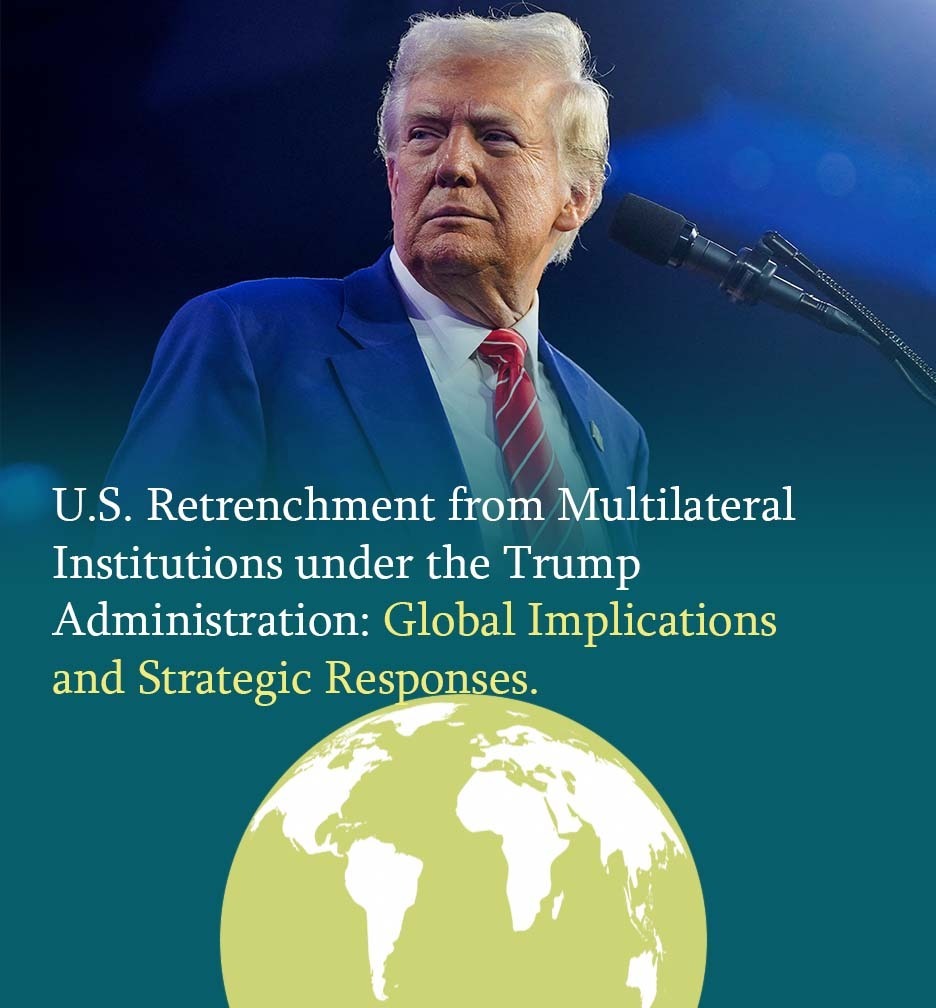
Thirty-one U.N. organizations are among the 66 international organizations that the United States has declared it is leaving because they “no longer serve American interests.”.[1] President Trump declared that the United States would leave 66 international organizations that were found to be harmful, inefficient, and wasteful by the Trump Administration.
The Trump Administration has determined that these institutions are either a threat to our country’s sovereignty, freedoms, and general prosperity, redundant in their scope, mismanaged, unnecessary, wasteful, poorly run, or controlled by actors pursuing their own agendas at odds with our own. President Trump is unambiguous: sending the American people’s blood, sweat, and treasure to these institutions with little to nothing in return is no longer acceptable. The days of billions of dollars in taxpayer money flowing to foreign interests at the expense of our people are over.[2]
The United States’ withdrawal a year ago from conventional international structures—such as the Paris Agreement, the World Health Organization, the United Nations Human Rights Council, and the World Trade Organization—highlights the wider geopolitical ramifications of Trump’s multilateralism strategy. This development puts into question the long-standing liberal order led by the United States and makes it more difficult to address global crises that need for strong and well-coordinated multilateral responses, such as Economic Inequality, Migration, Climate change, and Trans boundary health issues.[3]
From the beginning, President Trump’s budget requests to Congress during his first term aimed to reduce funding for key global health multilaterals, including the World Health Organization (WHO) and the Global Fund. Specifically, Trump suggested cutting U.S. financing for its assessed contribution to the WHO byhalf in each of his four budget requests.[4]
D. Trump issued an order within hours after taking office to suspend foreign development aid payments for 90 days in order to examine its “effectiveness and alignment with U.S. foreign policy”.[5] Trump’s ‘America First’ policy has marked a sharp break from tradition, emphasizing national sovereignty over collective commitments. In his 2018 address to the United Nations, Trump underscored this shift:
“Each of us here today is the emissary of a distinct culture, a rich history, and a people bound together by ties of memory, tradition, and the values that make our homelands like nowhere else on Earth. That is why America will always choose independence and cooperation over global governance, control, and domination. I honor the right of every nation in this room to pursue its own customs, beliefs, and traditions. The United States will not tell you how to live or work or worship. We only ask that you honor our sovereignty in return”[6]
This policy brief examines how the Trump administration’s ‘America First’ stance has affected multilateralism—specifically in the areas of U.S. foreign aid, the WHO, and climate change globally.
A more fractured global order was a result of the first Trump administration’s selective multilateralism, which prioritized American interests over international collaboration. This was demonstrated by the administration’s restructuring of development frameworks, undermining of international institutions, and disengagement from multilateral agreements. Trump has shown a practical approach to global governance by maintaining conditional support for certain multilateral institutions when they match with U.S. geopolitical interests, notwithstanding his general cynicism of multilateralism.[7]
Because of D. Trump’s decisions, millions of individuals in low and middle income nations face significant health risks. Indeed, the United States government has been the leading donor to global health for decades, making health one of the primary sectors of international development across numerous administrations and congresses, providing major financial aid, technical expertise, and personnel.[8]
The Possibility Impacts and implications of withdrawals
External funding is the leading health financing source in Africa[9].This suggests that the majority of the money needed to pay for healthcare in African nations comes from outside sources. Given that the United States is the largest donor to the World Health Organization, their recent decision to leave the organization necessitates evaluating its impact on healthcare funding in Africa.[10] Since the majority of these programs are financed or subsidized by U.S., its departure from the WHO might have the impact of stopping the tuberculosis program, increasing HIV/AIDS infections, maternal and child mortality and stopping the malaria vaccination program in Africa.[11]
One direct implication of this surge is household financing.[12] Individuals and households will now bear a substantial portion of the financial burden of healthcare, as is already the case. Due to insufficient or inadequate funding for the programs and treatments, other interventions that are fully or partially funded by U.S. funding may also suffer from this.[13]
Impact on core programs of 31 UN-affiliated bodies:- such as The UN Framework Convention on Climate Change (UNFCCC); The Office of the Special Representative of the secretary-general for Children in Armed Conflict; The Office of the Special Representative of the Secretary-General on Sexual Violence in Conflict; UN Population Fund (UNFPA): Major UN agency on population, reproductive health, and demographics; The International Union for Conservation of Nature (IUCN); UN Conference on Trade and Development (UNCTAD); UN Human Settlements Program (UN-Habitat);The Permanent Forum on People of African Descent.
It would weaken global co-operation:- A cut in financing might result in program discontinuity and putmore programs at risk.[14] For a long period of time multilateral organizations were largely reliant on American backing fund. Developing countries risk major ramifications as a result of President Donald Trump’s suspension of U.S. funding for those organizations, which might undermine their efforts to manage existing challenges.
Effects on the integration of vulnerable groups and refugees: Ethiopia is the third largest refugee hosting country in Africa. There are more than 930,000 refugees and asylum seekers residing in Ethiopia. A majority of the displaced people originate from South Sudan, Somalia and Eritrea (as of July 2023).[15] The funding restriction has had a significant impact on organizations that assist refugees and those in vulnerable situations. Programs providing vital services including healthcare, legal aid, and integration initiatives have been compelled to reduce their scope or cease operations completely.[16]
Effects on Shift:- Trump’s conditional multilateralism could undermine trust in US development financing commitments and endangered a number of aid programs globally. In addition, a more transactional U.S. approach could encourage developing nations to seek reliable partnerships that offer consistent support without burdensome conditions. The withdrawal of U.S. aid has allowed China to win some points in the narrative battle as a more reliable aid partner but this doesn’t mean China is replacing the U.S. per se.
Recommendations for future direction
Any organizations that are dependent on other countries or institutions are expected to suffer when such support is withdrawn. Therefore:-
- Launch and strengthen, if any at all, national resilience mechanisms to ” to ensure that essential services can withstand the sudden loss of multilateral support.
- States should prioritize budgetary absorption by transitioning to self-funding models for critical sectors like healthcare previously sustained by foreign aid.
- Governments should diversify strategic partnerships and actively seek internal or alternative international funding sources to reduce over-reliance on a single donor and establish a more stable, diversified financial base.
- As the United States is the largest donor to the World Health Organization, the organizations are expected to adopt a strategy of seeking support from other partner countries and international organizations to make up for the shortfall.
Blustein, P. (2019). Schism: China, America, and the Fracturing of the Global Trading System. Brookings Institution Press.
Cheng, S. (2020). China’s Belt and Road Initiative: A New Global Economic Order?. Asian Economic Policy Review, 15(1), 19-36.
Ferid Belhaj (2024) The New Trump Administration: Selective Multilateralism and the New South’s Challenge for Global Relevance https://www.policycenter.ma/publications/new-trump-administration-selective-multilateralism-and-new-souths-challenge-global
Michael Igoe, (2017) Trump’s “America First” budget proposes a historic reduction of U.S. engagement in global development efforts. https://www.devex.com/news/what-trump-s-budget-request-says-about-us-aid-90342
Rigby J, Renshaw J. Trump team considers demanding WHO reform, including American in charge. Reuters. February 6, 2025, https://www.reuters.com/world/trump-team-considers-demanding-who-reforms-including-american-charge-2025-02-06/).
Ruducha J, Mann C, Singh NS, Gemebo TD, Tessema NS, Baschieri A, et al. How Ethiopia achieved millennium development goal 4 through multi sectorial interventions: a countdown to 2015 case study. Lancet Glob Health. 2017.
Stiglitz, J. E. (2019). Globalization and Its Discontents Revisited: Anti-Globalization in the Era of Trump. W.W. Norton & Company
Williams Robert, IBA US Correspondent (2025) Trump against the rest of the world
https://www.ibanet.org/trump-against-the-rest-of-the-world
BBC (2025) Experts warn of threat to global health as US freezes overseas aid
February 2025 https://www.bbc.com/news/articles/cx2q13113wwo
Center on Global Energy policy, https://www.energypolicy.columbia.edu/energy-and-climate-issues-during-the- trump-administrations-first-100-days/
Congressional Research Service. Withdrawal from the World Health Organization: legal basis and implications. June 5, 2020 (https://crsreports.congress.gov/product/pdf/LSB/LSB10489).
UNHCR, the UN Refugee Agency (2023)
[1] Devex Newswire: Trump dumps and defunds over 60 international orgs. https://www.devex.com/news/devex-newswire-trump-dumps-and-defunds-over-60-international-orgs-111647
[2] Press statement January 07/2026 by the US department of the state. https://www.state.gov/releases/office-of-the-spokesperson/2026/01/withdrawal-from-wasteful-ineffective-or-harmful-international-organizations
[3] UN regrets US exit from global cooperation on health, climate change agreement
https://news.un.org/en/story/2025/01/1159211
[4] Trump’s “America First” budget proposes a historic reduction of U.S. engagement in global development efforts.
https://www.devex.com/news/what-trump-s-budget-request-says-about-us-aid-90342
[5] AFP, Trump administration says it’s cutting 90% of USAID foreign aid contracts
https://apnews.com/article/trump-usaid-foreign-aid-cuts-6292f48f8d4025bed0bf5c3e9d623c16
[6] The New Trump Administration: Selective Multilateralism and the New South’s Challenge for Global Relevance
challenge-global
[7] The New Trump Administration: Selective Multilateralism and the New South’s Challenge for Global Relevance
ttps://www.policycenter.ma/publications/new-trump-administration-selective-multilateralism-and-new-souths-
challenge-global
[8] Global Health policy, https://www.kff.org/global-health-policy/issue-brief/the-trump-administrations-foreign-aid-
freeze-and-global- health-the-biggest-gaps-left-on-the-donor-landscape/
[9] T.O. Sokunbi, E.O. Akinbi The cost of the reemergence of monkey pox: An overview of health financing in Africa Health Policy OPEN, 7 (2024), Article 100132, 10.1016/J.HPOPEN.2024.100132 View PDF View article View in Scopus Google Scholar
[10] Implications of U.S. withdrawal from the World Health Organization on health financing in Africa
https://doi.org/10.1016/j.hpopen.2025.100142 Received 21 March 2025; Received in revised form 18 April 2025; Accepted 29 April 2025 Health Policy OPEN. Available online 8 May 2025
[11] Nigeria Health Watch. Reimagining Health Financing in Africa: Navigating the Aftermath of the U.S. WHO Withdrawal Retrieved February 13, 2025, from https://articles.nigeriahealthwatch.com/reimagining-health-financing-in-africa-navigating-the-aftermath-of-the-u-s-who-withdrawal/; 2025.
[12] T.O. Sokunbi, E.O. Akinbi The cost of the reemergence of monkey pox: An overview of health financing in
Africa Health Policy OPEN, 7 (2024), Article 100132, 10.1016/J.HPOPEN.2024.100132
View PDF View article View in Scopus Google Scholar
[13] Implications of U.S. withdrawal from the World Health Organization on health financing in Africa
https://doi.org/10.1016/j.hpopen.2025.100142 Received 21 March 2025; Received in revised form 18 April 2025; Accepted 29 April 2025 Health Policy OPEN. Available online 8 May 2025
[14] https://www.downtoearth.org.in/africa/america-first-usaid-budget-cuts-could-hit-ethiopia-hard
[15] UNHCR, The UN Refugee Agency (2023)
[16] The impact has been devastating’: how US Aid freeze sent shockwaves through Ethiopia
https://www.theguardian.com/global-development/ng-interactive/2025/feb/21/the-impact-has-been-
devastating-how-us aid-freeze-sent-shockwaves-through-Ethiopia
About the author
Addis Alemahu is a researcher in the Institution of Foreign Affairs, specializing in the Multilateral Governmental and Non-Governmental Affairs department. He holds an MA in Journalism and Communication.
His work focuses on:
- Migration and Refugee Issues
- Peacekeeping and Military Issues
- Socioeconomic Issues
He has authored numerous research articles, including:
- France’s Military Strategy Revision Plan in Africa and its Implications: Future Challenges & Opportunities for Africa
- Saudi Arabia’s Vision 2030 and Its Regional Implications
- Trajectories and Geopolitical Implications of the Gulf-Horn Interaction
- Militarization and Commercialization of Ports in the Horn of Africa
For inquiries, you can contact him at addisalemahu@yahoo.com.
Disclaimer:
The content disseminated by the Institute of Foreign Affairs (IFA) – including, but not limited to, publications, public statements, events, media appearances, and digital communications – reflects the views of individual contributors and does not necessarily represent the official positions or policies of the Institute, its partners, or any affiliated governmental or non-governmental entities.
While the IFA endeavors to ensure the accuracy, integrity, and timeliness of the information presented, it makes no representations or warranties, express or implied, regarding the completeness, reliability, or suitability of such content for any purpose. The Institute expressly disclaims any liability for errors or omissions, as well as for any actions taken or decisions made based on the information provided.
The inclusion of external links, references, or third-party resources does not constitute an endorsement by the Institute. Additionally, engagement on social media platforms – including, but not limited to, likes, shares, retweets (RTs), or reposts – shall not be interpreted as an endorsement or validation of the views expressed therein.Readers and audiences are encouraged to exercise critical judgment and seek independent verification when interpreting or relying upon any information disseminated through publications and posts on the Institute’s platforms or representatives.