

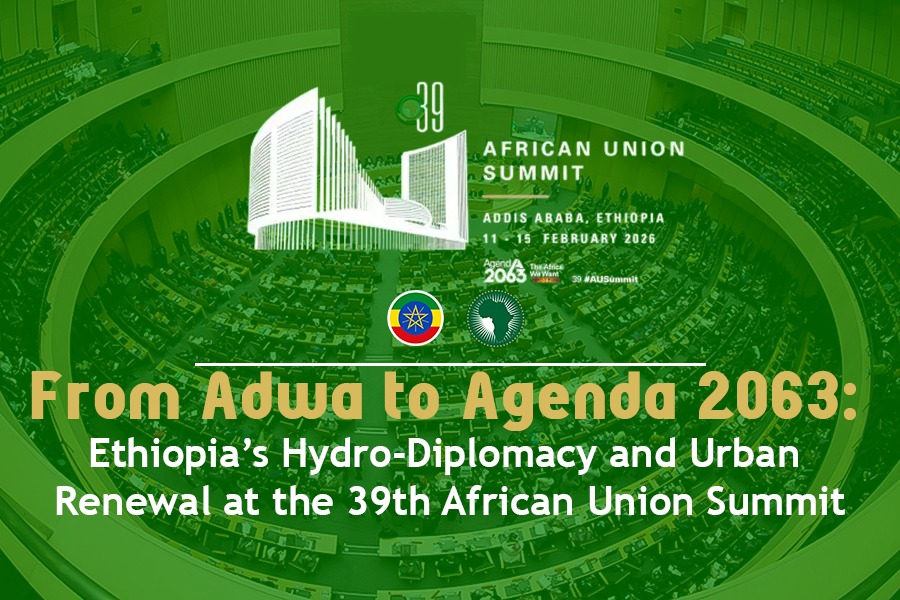
The 39th annual summit of the African Union, held from February 11 to 15, 2026, in Addis Ababa, has captured the attention of both the African leaders and invited international leaders. Undertaken in a critical time of unfolding global security and institutional challenges, the 2026 summit was held under the title of “Assuring Sustainable Water Availability and Safe Sanitation Systems to Achieve the Goals of Agenda 2063.” This agenda allowed Ethiopia to showcase its initiatives and deal with the challenges it faces locally with continental leadership. This policy brief contends that Ethiopia’s historic role, deep embedded in the victory of Adwa that inspired Pan-Africanism and its current government’s Medemer philosophy, would help its effort to redefine Africa’s hydro-politics and urban sanitation. Thus far, leveraging the Grand Ethiopian Renaissance Dam (GERD) and the “Clean Ethiopia” initiative, Ethiopia serves as a “Model for Urban Renewal” and the “Voice of Developmental Water” for the entire continent.
I. From Adwa to Pan-Africanism
Ethiopia’s leadership in the 2026 AU Summit has been well illustrated in the remarks made by Prime Minister Abiy Ahmed on the 14th of February 2026. The prime minister described Ethiopia as “ the origin of mankind, where deep history proves resilience and bold ambition for the African future converge.” Ethiopia’s multidimensional roles for African Unity are not merely a matter of host-nation protocol; it is a manifestation of its historical identity as the “Mother of Africa.” Furthermore, many speeches delivered by foreign ministers during the 48th Ordinary Session of the African Union on February 11, 2026—as well as those by heads of state on February 14 and 15—reinforced these historic imperatives. They specifically highlighted the 1896 Victory of Adwa, noting its role in laying the foundation for the global Pan-African movement and igniting African resistance against colonialism and all forms of exploitation.
The Ethiopian victory at the Battle of Adwa in 1896 inspired the Pan-Africanist movements in the Americas and the Caribbean. Notably, the intellectual frameworks spearheaded by figures such as W.E.B. Du Bois and Marcus Garvey were profoundly influenced by Ethiopia’s successful resistance against Italian colonial aggression.2 For Du Bois, Ethiopia was a symbol of the “enduring Black soul,” while Garvey’s vision of “Africa for the Africans” was anchored in the prestige of the Ethiopian Empire. These legacies and connections of the Ethiopian past to Pan-Africanism and independence often lend Addis Ababa the moral authority to host the annual summits of the African Union. Against such a backdrop, the current 39th AU Summit was held in Addis Ababa, focusing on water and sanitation, reflecting the struggle for water security and economic sovereignty as a modern continuation of the Adwa spirit: a movement from political independence to developmental self-reliance. During the summit, Ethiopia has presented its experience in urban renovation and sanitation and hygiene, as well as concerns on the water usage and management frameworks.
II. Hydro-Diplomacy
The 2026 AU theme, which focused on “Sustainable Water Availability,” was a thematic issue that is central to Ethiopia, a “Water Tower of Africa.”3 several of the statements and arguments made and promoted publicly by the Ethiopian authorities and scholars align with the AU concerns, Agenda 2063, and the imperative of redefining the continental narrative on water from one of conflict to that of shared prosperity. The Grand Ethiopian Renaissance Dam (GERD) is the primary vehicle for this shift. Under the Prosperity Party’s leadership, Ethiopia has framed the GERD as a “developmental asset” rather than a security threat. This approach advocates for the “right to development,” ensuring that upstream nations can utilize their natural resources to lift their populations out of poverty.4 By integrating water management with energy production and regional trade, Ethiopia is leading the continent toward the goals of Agenda 2063. The GERD serves as a practical application of “Developmental Water,” in which shared river basins become engines of industrialization rather than catalysts for war.5
III. Sustainable Environment and the Clean Ethiopia Movement
In alignment with the AU’s focus on “Safe Sanitation Systems,” the Ethiopian government has spearheaded domestic initiatives that serve as “living laboratories” for African urban centers. The Tsedat Ethiopia (Clean Ethiopia) movement, launched by Prime Minister Abiy Ahmed in April 2024, has moved beyond a simple campaign to become a core part of urban governance.6
By early 2026, the results of this movement are visible in the radical transformation of Addis Ababa, with the launching and implementation of different innovative infrastructures. An example in this regard is the “Bole Corridor” and similar developments in Arat Kilo and Kazanchis that have replaced substandard sanitation with modern, integrated blocks. The Bole Corridor alone features over 1,200 restrooms, demonstrating how local funding can solve chronic urban challenges.7. Second, the Green Legacy program, which focused on massive reforestation and climate resilience, addresses the “Climate Shocks” highlighted in the AU 2026 agenda. It aligns with the vision of an “Africa 2065” characterized by environmental sustainability and food security.8 Related to the above, and thirdly, we have witnessed a major policy shift in Ethiopia. This refers to the 2025 initiative targeting plastic pollution and air quality ensures that cleanliness is institutionalized through permanent city maintenance departments and “Polluter Pays” laws.9
IV. The Medemer as an Engine
The link between compatibility of Ethiopian local achievements with continental goals is found in the philosophy of Medemer (synergy). This idea emphasizes the gathering of fragmented efforts into a unified force for progress. In the context of the AU 39th Summit, Medemer provides the framework for strengthening the national fiber through initiatives like “Clean Ethiopia” to project strength abroad. Secondly, Ethiopia pursues a policy of regional integration, which views the neighboring states as partners in a “Water-Energy-Food (WEF) Nexus.
V. Recommendations
Ethiopia should leverage the unfolding potential of the 39th AU Summit to create concrete policy outputs. It is recommended that the following tasks be delivered, as they represent continental imperatives that contribute to Africa’s long-term goals.
As demonstrated during the summit, Ethiopia’s urban renewal and development initiatives drew significant interest. Ethiopia should now propose exporting this model under a ‘Clean Africa Corridor Development’ banner, sharing its technical expertise in sanitation planning, financing, and implementation with the rest of the continent.
Considering the alignment of the African level agenda with the current and strategic concerns of Ethiopia over water rights, it should work on codifying the water rights, including by leading the endorsement of the 2063 African water vision, in a way that contributes to making sure that global water laws reflect the needs of the developing and upstream countries.
There is a need for Ethiopia to advocate its model of private sector integration in the urban renewal, hygiene, and sanitation endeavors. It should promote and sell its experience of the Private Sector Integration model applied in the Addis Ababa corridor development program, where it was the live experience that public toilets are managed as “micro-businesses” and that this enabled both ensuring the maintenance and creation of jobs. This could be replicated for the cities across Africa
Notes
- Historical Foundations of Ethiopian Diplomacy,” IFA Policy Journal 12, no. 1 (2024): 45-50.
- W.E.B. Du Bois, The World and Africa (New York: International Publishers, 1947); Marcus Garvey, The Philosophy and Opinions of Marcus Garvey (New York: Universal Publishing House, 1923).
- 2026 African Union Summit Theme Document,” AU Commission, Addis Ababa, 2026, p. 1.
- AU 2026 Agendas: Alignment with National Interest,” Ethiopian Ministry of Foreign Affairs Briefing Document, 2026, Screenshot 5.
- Summary of Continental Impacts: Role of 2026 AU Agenda,” AU Strategic Planning Paper, 2026, Screenshot 2.
- Clean Ethiopia (Tsedat Ethiopia) Movement Launch Report,” Office of the Prime Minister, April 2024, Screenshot 3.
- Addis Ababa Corridor Development Progress Report,” City Government of Addis Ababa, January 2026, Screenshot 3.
- Green Legacy and the WEF Nexus: A Path to 2065,” Ministry of Planning and Development, 2025.
- Policy Shift: Urban Governance and Pollution Control,” Government of Ethiopia Legislative Review, 2025, Screenshot 4.
About the author
Miftah Mohammed Kemal, Researcher at the African Affairs Director General, The Institute of Foreign Affairs, PhD Candidate of International Politics at the University of South Africa
Disclaimer:
The content disseminated by the Institute of Foreign Affairs (IFA) – including, but not limited to, publications, public statements, events, media appearances, and digital communications – reflects the views of individual contributors and does not necessarily represent the official positions or policies of the Institute, its partners, or any affiliated governmental or non-governmental entities.
While the IFA endeavors to ensure the accuracy, integrity, and timeliness of the information presented, it makes no representations or warranties, express or implied, regarding the completeness, reliability, or suitability of such content for any purpose. The Institute expressly disclaims any liability for errors or omissions, as well as for any actions taken or decisions made based on the information provided.
The inclusion of external links, references, or third-party resources does not constitute an endorsement by the Institute. Additionally, engagement on social media platforms – including, but not limited to, likes, shares, retweets (RTs), or reposts – shall not be interpreted as an endorsement or validation of the views expressed therein.Readers and audiences are encouraged to exercise critical judgment and seek independent verification when interpreting or relying upon any information disseminated through publications and posts on the Institute’s platforms or representatives.