

A Small State with Disproportionate Impact
Eritrea is frequently described as isolated, economically constrained, and diplomatically marginal. Yet its influence is woven through nearly every major geopolitical conflict in the Horn of Africa. From Ethiopia’s internal conflicts to Sudan’s protracted war and Somalia’s persistent instability, Asmara’s role—direct or indirect—has repeatedly surfaced at moments of regional stress.
This pattern presents a strategic puzzle. How does a state with limited economic weight and modest demographic size exercise such persistent regional impact? Why does Eritrea appear consistently aligned with fault lines rather than stability and integration platforms?
The prevailing explanations are insufficient. One camp attributes Eritrea’s posture to ideological rigidity and personalized rule. Another portrays it as a reactive actor navigating an unforgiving neighborhood. Both capture elements of reality. Neither explains the coherence of Eritrea’s regional behavior over time. A sharper diagnosis is required.
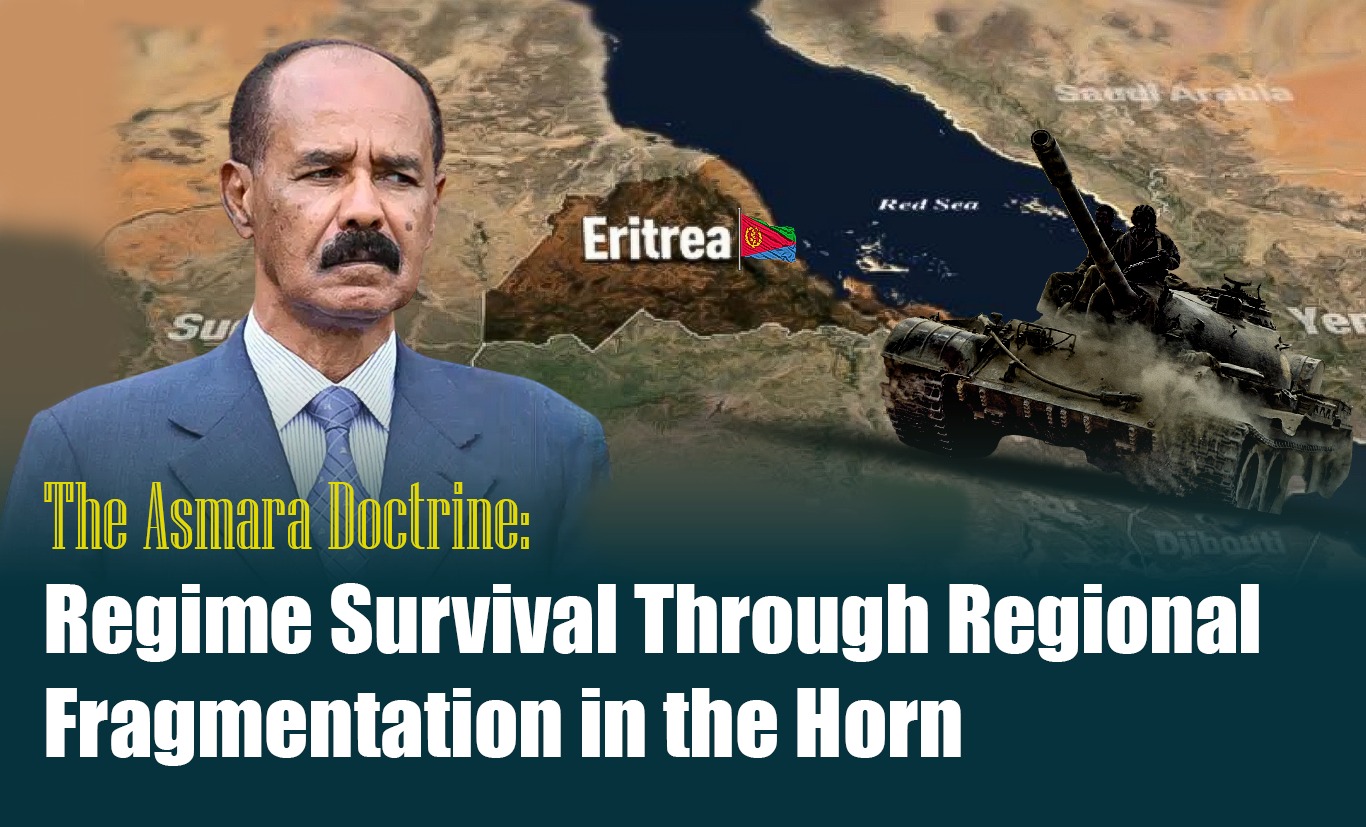
Eritrea’s external conduct reflects a deliberate survival doctrine in which regional fragmentation serves as strategic depth. The consolidation of strong, confident, institutionally coherent neighboring states introduces long-term risks to a tightly controlled domestic order. Fragmentation, by contrast, diffuses pressure and preserves maneuver space. This is the Asmara Doctrine: regime survival through managed regional fragmentation.
From Liberation Movement to Securitized State
Eritrea’s foreign policy cannot be separated from its internal formation. The state emerged from a decades-long liberation struggle defined by discipline, hierarchy, and strategic patience. The transition from insurgency to sovereignty did not dissolve these traits; it institutionalized them.
National service became more than a defense policy. It evolved into a mechanism of political consolidation and social control. Political pluralism was indefinitely deferred in favor of unity under threat. The experience of existential conflict—first during liberation, then in the 1998–2000 border war with Ethiopia—embedded siege mentality into statecraft.
The prolonged “no-war-no-peace” period that followed reinforced this orientation. Border militarization and diplomatic isolation hardened threat perceptions. Sanctions deepened the conviction that vulnerability invited coercion. Over time, securitization became permanent rather than exceptional. Under such conditions, foreign policy ceased to be an arena for economic growth or cooperative expansion. It became an extension of regime preservation. The question, therefore, is not whether Eritrea is defensive? It is why its defensive posture repeatedly manifests as regional disruption.
The Core Logic: Survival Over Integration
Small states in volatile regions often pursue one of three strategic pathways: alignment with stronger powers, institutional integration, or hedging among rivals. Eritrea has experimented with each. Yet beneath tactical shifts lies a consistent organizing principle.
For Asmara, the most significant threat is not territorial invasion. It is structural encirclement by consolidated neighboring states capable of projecting economic, political, or ideological influence inward. A confident Ethiopia pursuing reformist leadership, a unified Sudan embedded in external alliances, or a stabilized Somalia anchored in international security frameworks each present distinct risks.
In this calculus, fragmentation offers insulation. Divided or internally preoccupied neighbors lack the capacity to coordinate sustained pressure or export governance models. Fluidity in the regional environment enhances the relative value of Eritrea’s centralized command structure and military discipline. This does not imply a desire for chaos. Rather, it reflects preference for a strategic landscape in which no single neighboring state accumulates overwhelming coherence or leverage. Regional integration—particularly when tied to institutional harmonization, economic transparency, or political conditionality—can expose internal vulnerabilities. Fragmentation, by contrast, preserves autonomy.
Ethiopia: Tactical Alignment, Structural Suspicion
The 2018 rapprochement between Eritrea and Ethiopia was hailed as a transformative breakthrough. Diplomatic relations were restored, borders symbolically reopened, and optimism surged across the region. Yet the normalization was thinly institutionalized.
Economic interdependence did not expand meaningfully. Border demarcation remained sensitive. Trust was tactical rather than structural. The subsequent conflict in northern Ethiopia demonstrated how rapidly alignment could shift toward security coordination.
For Eritrea, cooperation during Ethiopia’s internal crisis reflected immediate threat convergence. However, a re-centralized and economically dynamic Ethiopia with regional leadership ambitions introduces long-term strategic risk. A neighbor capable of projecting influence through infrastructure, diplomacy, and economic networks alters the balance of insulation. Thus, Eritrea’s posture toward Ethiopia oscillates between collaboration and guarded distance. It is neither unconditional partnership nor entrenched hostility. It is calibration. The objective is not domination but prevention of configurations that compress Eritrea’s maneuver space.
Sudan and Somalia: Hedging in Fluid Arenas
Sudan’s protracted war has reshaped power alignments along Eritrea’s western frontier. Refugee flows, cross-border trade disruptions, and Red Sea security dynamics intersect directly with Eritrean interests. In this environment, Asmara’s approach has emphasized cautious engagement rather than deep institutional entanglement.
A consolidated Sudan aligned firmly with external actors could recalibrate strategic balances. Prolonged fragmentation, while costly in humanitarian terms, sustains a buffer of uncertainty that limits coordinated regional pressure. In Somalia, Eritrea has engaged through bilateral security cooperation rather than highly institutionalized multilateral frameworks. Military training initiatives and quiet coordination reinforce leverage without binding Asmara to externally driven security architectures. Across these arenas, the pattern persists: influence through fluidity, distance from institutional entanglement.
Fragmentation as Strategic Depth
The uncomfortable implication of this analysis is that fragmentation is not merely an unfortunate byproduct of regional instability. It can function as a strategic asset. In highly institutionalized regional systems, power is exercised through rules, transparency, and interdependence. In fragmented systems, power accrues to actors capable of rapid tactical shifts and disciplined mobilization. Eritrea’s centralized governance model thrives in the latter environment.
This dynamic does not require overt destabilization. It operates through selective alignment, calibrated engagement, and willingness to exploit asymmetries. By preventing the emergence of overwhelmingly coherent neighboring blocs, Eritrea sustains relative leverage. From a regional integration perspective, this posture appears obstructive. From a survival perspective, it is rational.
Implications for Regional Order
If regime survival through fragmentation remains the guiding principle, the implications for the Horn are profound. First, security transitions will remain fragile. Efforts to consolidate post-conflict settlements in Ethiopia or Sudan may encounter recalibrations that preserve Eritrea’s maneuver space. Second, multilateral institutions face silent constraints. Organizations seeking consensus-driven integration depend on baseline convergence among member states. A key actor operating from insulation logic complicates harmonization. Third, infrastructure-led integration—corridors, ports, energy grids—requires political confidence. Fragmentation erodes the trust necessary for durable interdependence. Fourth, external powers navigating Red Sea competition must account for Eritrea’s asymmetric influence. Engagement strategies that ignore Asmara risk misreading regional dynamics. None of this renders integration impossible. It does, however, highlight structural tension between survival-driven statecraft and collective stabilization.
What could alter the Asmara Doctrine?
First, internal succession dynamics could reshape threat perceptions. Leadership transition often recalibrates strategic priorities, though continuity is equally plausible.
Second, credible, regionally owned security guarantees could reduce perceived encirclement. Such guarantees would need to respect sovereignty and avoid intrusive conditionality. Third, economic integration structured to enhance rather than undermine regime stability might gradually shift incentives. Integration perceived as exposure will be resisted; integration framed as insulation-enhancing may gain traction. Absent such changes, the structural calculus persists.
Conclusion: A System Under Negotiation
The Horn of Africa is undergoing contested reordering. Sovereignty, integration, and external competition intersect across shifting arenas. Within this landscape, Eritrea occupies a paradoxical role: materially limited yet strategically consequential. Understanding Eritrea as survival-driven rather than irrational clarifies regional tensions. Fragmentation is not merely accidental. It can be instrumental. For policymakers and regional architects, the challenge is not simply to condemn disruption but to redesign incentives. Stability must cease to appear threatening to those who equate openness with vulnerability. Whether the Horn can move toward negotiated interdependence without triggering survival reflexes in one of its most militarized states remains uncertain. The Asmara Doctrine endures because it aligns internal regime logic with external maneuver. The region’s broader transition will depend on whether that alignment can be recalibrated—or whether fragmentation continues to serve as strategic depth in a system still struggling to consolidate coherence.
By IFA Staff writer
Disclaimer:
The content disseminated by the Institute of Foreign Affairs (IFA) – including, but not limited to, publications, public statements, events, media appearances, and digital communications – reflects the views of individual contributors and does not necessarily represent the official positions or policies of the Institute, its partners, or any affiliated governmental or non-governmental entities.
While the IFA endeavors to ensure the accuracy, integrity, and timeliness of the information presented, it makes no representations or warranties, express or implied, regarding the completeness, reliability, or suitability of such content for any purpose. The Institute expressly disclaims any liability for errors or omissions, as well as for any actions taken or decisions made based on the information provided.
The inclusion of external links, references, or third-party resources does not constitute an endorsement by the Institute. Additionally, engagement on social media platforms – including, but not limited to, likes, shares, retweets (RTs), or reposts – shall not be interpreted as an endorsement or validation of the views expressed therein.Readers and audiences are encouraged to exercise critical judgment and seek independent verification when interpreting or relying upon any information disseminated through publications and posts on the Institute’s platforms or representatives.