

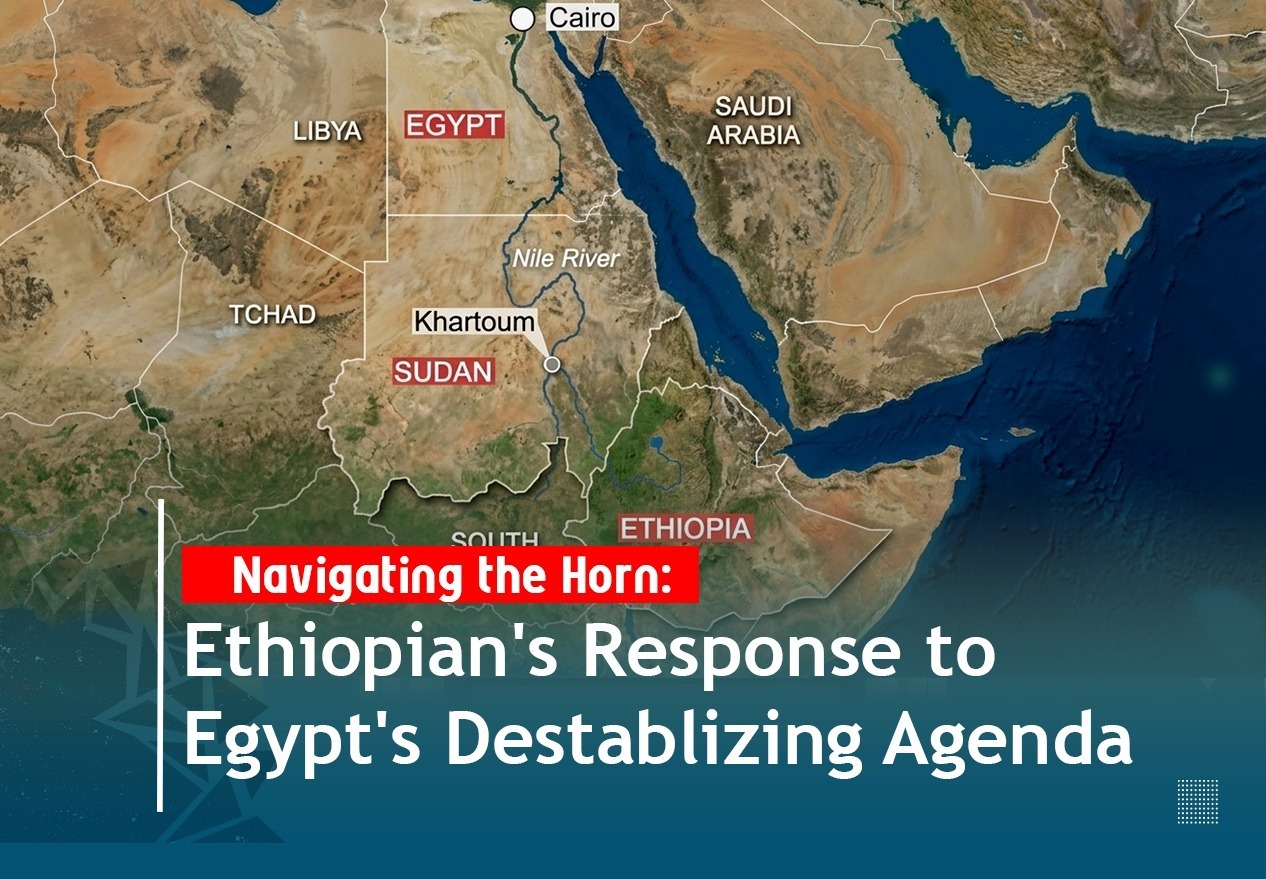
The diplomatic relationship between Ethiopia and Somalia has historically evolved through phases of confrontation, competition, and gradual pragmatic engagement. As neighboring states sharing long and porous borders, intertwined communities, and transboundary resources, the trajectory of their relations reflects broader geopolitical dynamics in the Horn of Africa. In recent years, however, the regional landscape has witnessed a renewed strategic contest shaped by external actors—most notably Egypt—whose increasing involvement in Somali and Red Sea affairs has introduced new complexities into regional diplomacy.
At the heart of the emerging geopolitical dynamic lies the intersection between Ethiopia’s pursuit of sustainable maritime access and Egypt’s long-standing water security concerns regarding the Nile River, particularly the Abbay River [TheBlue Nile]. Ethiopia’s approach to the Nile Basin has consistently been grounded in the principle of equitable and reasonable utilization of shared water resources, a doctrine recognized in international water law and reflected in its broader diplomatic engagement with Nile Basin states. Conversely, Egypt has historically framed the Nile primarily through a securitized lens, perceiving upstream development initiatives as strategic threats to its national survival.
In this context, Egypt’s expanding diplomatic and security engagement in Somalia—and increasingly with Eritrea—can be interpreted as an extension of its broader water securitization agenda. Rather than existing as isolated diplomatic outreach, Cairo’s growing presence in the Horn of Africa appears strategically aligned with efforts to counterbalance Ethiopia’s rising geopolitical influence and its legitimate quest for maritime access to the Red Sea and the Indian Ocean.
Despite some historical confrontations, diplomatic relations between Ethiopia and Somalia, the two countries were never entirely severed. The geographic realities of the Horn of Africa ensured that the security and stability of one country inevitably affected the other.
Ethiopia as a Stabilizing Anchor in the Horn of Africa
Over the past three decades, Ethiopia has emerged as one of the principal anchors of regional stability in the Horn of Africa. Its security policy toward Somalia has consistently prioritized the containment of violent extremism, the restoration of state institutions, and the prevention of regional spillover conflicts.
Ethiopian peacekeeping forces have played a central role in multinational stabilization missions, particularly under the auspices of the African Union Mission in Somalia. Ethiopian troops have been deployed in multiple Somali regions, contributing to counterterrorism operations against Al‑Shabaab and supporting efforts to rebuild Somalia’s security institutions.
These deployments demonstrate that Ethiopia’s engagement in Somalia has historically been driven by a security-stabilization imperative rather than expansionist ambitions. By maintaining a sustained peacekeeping presence and facilitating political dialogue among Somali actors, Ethiopia has contributed significantly to preventing the Horn of Africa from descending into deeper instability.
Moreover, Ethiopia’s diplomatic approach toward Somalia has increasingly reflected pragmatic engagement. Rather than focusing solely on federal authorities in Mogadishu, Ethiopian policymakers have recognized the importance of engaging regional administrations and traditional clan structures that shape Somali political dynamics.
Egypt’s Expanding Role in Somalia and the Horn of Africa
In recent years, Egypt has intensified diplomatic and security engagement in Somalia and neighboring states. This shift became particularly visible following regional debates surrounding Ethiopia’s maritime access initiatives and its evolving relations with Somaliland.
While Egypt frames its engagement in Somalia primarily in terms of supporting Somali sovereignty and regional cooperation, the broader strategic context suggests deeper motivations. Cairo’s expanding involvement in the Horn of Africa coincides with heightened tensions over the Grand Ethiopian Renaissance Dam and the broader Nile Basin water governance debate.
From Ethiopia’s perspective, Egypt’s growing presence in Somalia and Eritrea appears less about Somali stabilization and more about strategic balancing. By cultivating political and security relationships along Ethiopia’s eastern flank, Egypt potentially gains leverage in the broader geopolitical contest surrounding Nile water management.
Such involvement risks transforming Somalia into an arena for proxy competition among regional powers. Rather than strengthening Somali stability, external geopolitical rivalries could exacerbate internal divisions and undermine ongoing state-building efforts.
Implications for Ethiopia’s Maritime Aspirations
Ethiopia’s pursuit of sustainable maritime access is widely recognized as a legitimate economic and strategic objective for a country of more than 120 million people. As the largest landlocked state in the world by population, Ethiopia depends heavily on external ports for trade and energy imports.
Access to maritime corridors through the Red Sea and the Gulf of Aden is therefore not merely a geopolitical ambition but a structural economic necessity. Ethiopia has consistently emphasized that its maritime quest is grounded in diplomatic negotiation, regional cooperation, and mutually beneficial economic partnerships.
However, the increasing involvement of external actors in Somalia and Eritrea risks complicating this objective.
Ethiopia’s Pragmatic Diplomatic Response
Despite these challenges, Ethiopia’s foreign policy has largely remained anchored in pragmatic diplomacy. The country continues to prioritize dialogue with Somalia, emphasizing shared security interests, economic cooperation, and regional integration.
Since the political transition of 2018 under Abiy Ahmed, Ethiopia’s foreign policy orientation has undergone a significant transformation from the security-centric posture that characterized much of the Ethiopian People’s Revolutionary Democratic Front era to a more cooperative and integration-focused diplomatic framework. During the previous period, regional engagement was often shaped by a strategic siege mentality in which neighboring states were frequently perceived primarily through the lens of threat perception and security competition. Since 2018, however, Ethiopia has adopted a “Neighbor First” foreign policy approach rooted in the principles of the Medemer Philosophy, emphasizing dialogue, interdependence, and regional integration as the foundations of sustainable peace and development in the Horn of Africa. This shift reflects a broader strategic recalibration that seeks to transform historical rivalries into cooperative partnerships, promote economic connectivity, and position Ethiopia as a constructive anchor for regional stability by prioritizing diplomatic engagement, mutual benefit, and collective security with neighboring states.
The participation of Hassan Sheikh Mohamud in the inauguration of the Grand Ethiopian Renaissance Dam (GERD) symbolized the growing spirit of pragmatic cooperation between Ethiopia and Somalia. During the ceremony, the Somali president framed the dam not as a source of regional rivalry but as a potential stabilizing energy hub for the Horn of Africa, emphasizing that the electricity generated from GERD could benefit neighboring countries, including Somalia, through regional power connectivity and energy trade. He noted that the project represents an opportunity for “brotherly and neighborly partnership” among regional states and highlighted the importance of cooperative management of shared resources for long-term prosperity.
In recent months, President Mohamud has also undertaken several diplomatic visits to Addis Ababa, including his recent visit to Jigjiga with Djibouti’s president, H.E. Ismail Omar Guelleh, reaffirming the commitment of both governments to maintain constructive relations and to deepen collaboration in areas such as economic integration, infrastructure development, and joint security efforts against regional threats. These engagements reflect a broader effort by both countries to strengthen good-neighborly relations and to advance mutual benefits through coordinated economic and security cooperation in the Horn of Africa.
A balanced engagement strategy—one that simultaneously strengthens relations with federal and regional Somali authorities—remains essential. Deepening joint security mechanisms, intelligence sharing, and counterterrorism cooperation will be critical for safeguarding regional stability.
Equally important is Ethiopia’s continued commitment to multilateral diplomacy within African frameworks. By engaging institutions such as the African Union and regional organizations, like IGAD, Ethiopia can reinforce the principle that Horn of Africa security challenges be addressed through integrated neighboring countries rather than external geopolitical competition, the likes of destabilizing Egypt.
References
Belete, Belachew. ኢትዮጵያናጎረቤቶቿ (Ethiopia and Its Neighbours). Addis Ababa: Oland Printing Press, 2016.
Clapham, Christopher. The Horn of Africa: State Formation and Decay. London: Hurst & Company, 2017.
Garowe Online. “Somalia’s President Says GERD Power Can Foster Continental Partnership.” February 15, 2025. https://forums.swift.org/t/if-vs-available-vs-if-available/40266.
Osman, Abdullahi Hussein. “President Hassan Sheikh Arrives in Jigjiga for High-Level Regional Talks.” Somali National News Agency (SONNA), January 31, 2026. https://sonna.so/en/president-hassan-sheikh-arrives-in-jigjiga-for-high-level-regional-talks/.
By Kuchim Sileshe at IFA
Disclaimer:
The content disseminated by the Institute of Foreign Affairs (IFA) – including, but not limited to, publications, public statements, events, media appearances, and digital communications – reflects the views of individual contributors and does not necessarily represent the official positions or policies of the Institute, its partners, or any affiliated governmental or non-governmental entities.
While the IFA endeavors to ensure the accuracy, integrity, and timeliness of the information presented, it makes no representations or warranties, express or implied, regarding the completeness, reliability, or suitability of such content for any purpose. The Institute expressly disclaims any liability for errors or omissions, as well as for any actions taken or decisions made based on the information provided.
The inclusion of external links, references, or third-party resources does not constitute an endorsement by the Institute. Additionally, engagement on social media platforms – including, but not limited to, likes, shares, retweets (RTs), or reposts – shall not be interpreted as an endorsement or validation of the views expressed therein.
Readers and audiences are encouraged to exercise critical judgment and seek independent verification when interpreting or relying upon any information disseminated through publications and posts on the Institute’s platforms or representatives.