

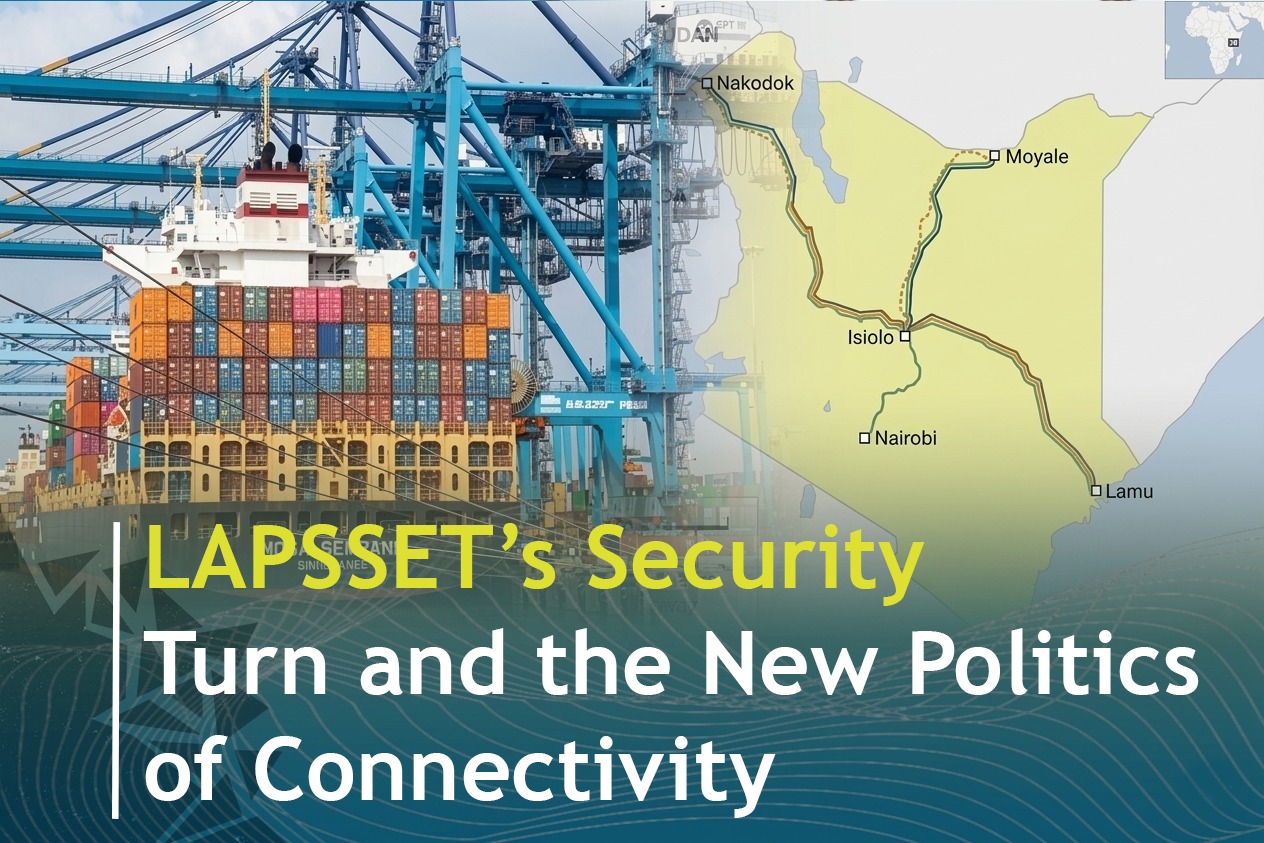
The Lamu Port-South Sudan-Ethiopia Transport Corridor, or LAPSSET, was conceived as a development mega-project: a chain of ports, roads, pipelines, and logistics hubs meant to connect northern Kenya to Ethiopia and South Sudan. That framing is no longer sufficient. The corridor is now governed through a security logic in which troop deployments, counterinsurgency, refugee management, maritime risk, and external power competition shape its tempo as much as engineering plans or financing models. This is not a passing reaction to insecurity. It reflects a structural shift in how states in the Horn understand infrastructure itself: not simply as a tool of growth, but as a strategic asset that must be secured, territorialized, and politically insulated. As instability metastasizes across Sudan, Somalia, and the Red Sea, LAPSSET is becoming a security regime in practice.
Kenya’s northern corridor strategy was once sold in the language of transformation. LAPSSET promised to redraw East African geography by linking Lamu to Ethiopia and South Sudan through highways, rail, pipelines, and logistics hubs. Yet the region it was supposed to integrate has become more volatile, not less. Sudan’s war has repeatedly threatened South Sudan’s oil lifeline through Port Sudan [1][2]. Al-Shabaab remains a live threat along Kenya’s coast and Somali frontier, compelling Nairobi to fuse corridor development with counterterrorism operations [3][4]. Red Sea disruption has made maritime access feel less like a commercial variable and more like a strategic vulnerability for the wider Horn [5][6]. The result is a fundamental shift: connectivity is no longer governed primarily through development planning but through a security regime.
From Mega-Project to Strategic Buffer
This turn emerged from exposure. LAPSSET’s original grammar emphasized trade, jobs, and regional integration. But the corridor linked three vulnerable spaces: Kenya’s historically marginalized north, landlocked Ethiopia’s search for diversified port access, and South Sudan’s dependence on unstable transit routes. That made LAPSSET attractive because it promised strategic redundancy. Ethiopia still routes most maritime trade through Djibouti, while South Sudan’s oil economy remains hostage to Sudanese transit and political risk [1][7]. For both states, diversification is not a luxury. It is insurance.
Kenya has also redefined the project through a security lens. The Ministry of Defence now openly describes Operation Amani Boni as helping secure the LAPSSET corridor through patrols, site protection, and civil-military engagement [3][4]. That matters. When a corridor’s viability depends on a standing counterinsurgency architecture, infrastructure ceases to be governed as a neutral development platform. It becomes a defended strategic zone. Parliamentary visits to Lamu in early 2026 likewise centered on readiness for oil evacuation and the state’s capacity to protect that function [8].
Material progress reinforces this shift. Kenyan port authorities increasingly present Lamu as an alternative gateway for regional trade, tied directly to the LAPSSET vision [9]. Yet incomplete corridors are often more security-sensitive than finished ones. They create sunk costs, expectations, and fixed targets without yet producing the stabilizing effects of dense trade. In that condition, the state must police anticipation itself. LAPSSET is therefore no longer simply a route to growth. It is a strategic buffer that Kenya must hold, reassure, and militarily underwrite.
Why Regional Disorder Is Rewriting Corridor Governance
What changed most decisively is the environment around the corridor. Somalia’s security transition remains fragile even after the African Union Support and Stabilization Mission in Somalia, or AUSSOM, replaced the African Union Transition Mission in Somalia at the start of 2025 [10][11]. The mission change signals continuity, but also continued dependence on external financing, force generation, and political coordination. A road, port, or logistics hub near a live insurgent geography cannot be managed like ordinary infrastructure.
Sudan’s war has intensified this logic from the other side. South Sudan’s export economy depends overwhelmingly on oil, and the pipeline through Sudan to Port Sudan has been repeatedly interrupted by conflict and force majeure episodes [1][2]. That exposure elevates the strategic appeal of alternatives running southward toward Kenyan territory, even when they remain incomplete. The point is not that LAPSSET can instantly replace Sudan’s oil route. It cannot. The point is that war in Sudan transforms the corridor’s value from developmental possibility into geopolitical hedge.
Refugee pressure adds a third layer. Kenya hosted 872,109 refugees and asylum seekers as of 30 November 2025, with large concentrations in Dadaab and Kakuma and major shares originating from Somalia and South Sudan [12]. These are not separate humanitarian facts outside corridor politics. They shape county administration, policing demands, aid burdens, and local perceptions of state presence across territories relevant to LAPSSET. Connectivity now runs through camps, checkpoints, patrol bases, and emergency budgets as much as through ports and roads.
Gulf Rivals, Great Powers, and the Externalization of Corridor Politics
The security turn is also external. Horn corridors are no longer judged only by domestic feasibility. They are measured against a competitive field of ports, financiers, and political patrons stretching from the Gulf to major multilateral lenders. Berbera’s rise under DP World, backed by large-scale Emirati investment, has sharpened competition around alternative gateways for Ethiopia and the wider Horn [7][14]. The issue is not merely commercial rivalry between Lamu, Djibouti, and Berbera. It is that ports now sit inside wider packages of diplomacy, security assistance, recognition politics, and sovereign bargaining.
That dynamic complicates LAPSSET in two ways. First, it raises the cost of delay. A corridor that moves too slowly risks losing traffic and strategic relevance to rival nodes that bundle infrastructure with faster political guarantees. Second, it increases the sovereignty stakes of financing. The LAPSSET rail prospectus still imagines blended finance involving multilateral development banks, partner states, and private capital [15]. The World Bank’s Horn of Africa Gateway Development Project similarly frames connectivity as movement, digital integration, and regional inclusion [13]. But once infrastructure is securitized, financiers are no longer backing roads alone. They are entering politically charged theaters where military protection, inter-state rivalry, and local legitimacy shape outcomes.
Great-power interests lurk beneath this landscape. The Red Sea shock has shown how quickly global trade disruptions can reorder route calculations and investment logic [5][6]. China remains embedded in East African infrastructure. The United States and European actors increasingly read the Horn through resilience and maritime-security lenses. Gulf states treat ports as commercial assets and geopolitical footholds at once. In that crowded field, LAPSSET is not just an economic corridor. It is a platform through which outside actors can acquire leverage over the Horn’s future connectivity map. What began as a map of commerce is hardening into a map of controlled circulation, where state presence, investor confidence, and regional diplomacy depend on the same guarded arteries across the wider region. That is why corridor politics now resembles border management more than orthodox development administration.
When Corridors Become Security Regimes
A security regime is more than the presence of soldiers around infrastructure. It is a durable pattern in which mobility is organized through coordinated coercive, administrative, and diplomatic mechanisms. By that standard, LAPSSET is moving in that direction. Kenya secures corridor zones through a multi-agency military framework [3][4]. Security has become the operating system of connectivity.
This creates gains and risks at the same time. The gain is obvious: without security, no corridor matures. Freight will not flow through roads that insurers price as war-adjacent, and investors will not treat exposed logistics nodes as stable assets. But the risk is equally serious. When corridors are governed primarily through emergency logics, civilian institutions tend to lag behind. Customs harmonization, land governance, community compensation, refugee inclusion, and county-level accountability can all become secondary to force protection. Development then survives only inside an armed shell.
Conclusion
LAPSSET’s evolution marks a wider turning point in the Horn of Africa. Infrastructure no longer sits downstream from security. It now helps organize security itself. Kenya, Ethiopia, and South Sudan are responding to real vulnerabilities: insurgency on the Somali flank, war along Sudan-linked routes, refugee pressure in fragile peripheries, and maritime uncertainty radiating from the Red Sea. Under those conditions, the corridor is being recoded from a development scheme into a strategic regime of protection, deterrence, and selective access.
That shift may be unavoidable, but it cannot remain conceptually unmanaged. Enhanced focus is now required for diligent institutional adaptation. The African Union, the Intergovernmental Authority on Development, county administrations, port authorities, and corridor agencies must treat security governance as integral to connectivity rather than as an improvised add-on. Yet they must also resist letting military logic crowd out civilian legitimacy. The next test for LAPSSET is therefore not simply whether more berths, roads, or pipelines are completed. It is whether the Horn can build institutions capable of securing infrastructure without hollowing out the developmental bargain that made connectivity politically meaningful in the first place. Without that adaptation, the corridor may still be paved and patrolled, but it will remain politically brittle: a line of movement protected by force, not a regional compact sustained by legitimacy, reciprocity, and predictable civilian rule across the Horn.
References
African Union. (2025, February 16). Assembly decisions, declarations and resolution of the Thirty-Eighth Ordinary Session.
African Union Peace and Security Council. (2025, December 15). Communiqué of the 1317th meeting on the situation in Somalia and operations of AUSSOM.
Kenya Ministry of Defence. (2025, January 14). Enhanced security and community engagement for the LAPSSET project.
Kenya Ministry of Defence. (2025, September 5). GOC EASTCOM assures security for LAPSSET contractors in Lamu.
Kenya Parliamentary Service. (2026, January 21). Lamu leaders push for speedy LAPSSET implementation.
Kenya Ports Authority. (2025, September 7). Container traffic surpasses 2 million TEUs.
PIDA. (n.d.). LAPSSET Railway Project – Investment Prospectus.
Reuters. (2024, March 25). Sudan war causes stoppages on South Sudan oil pipeline, officials say.
Reuters. (2025, January 6). Sudan lifts force majeure on oil to Port Sudan.
Reuters. (2026, January 13). Dubai’s DP World says operations at Somaliland’s Berbera port unaffected by UAE-Somalia dispute.
SWP Berlin. (2025, March 17). The United Arab Emirates’ engagement in Ethiopia.
UNCTAD. (2024, February 12). Impact to global trade of disruption of shipping routes in the Red Sea, Suez Canal and Panama Canal.
UNCTAD. (2025, September 28). Review of Maritime Transport 2025.
UNHCR & Government of Kenya. (2026, January). Kenya statistics package – 30 November 2025.
World Bank. (2025, September 16). Horn of Africa Gateway Development Project (P161305): Implementation status and results report.
By Iman Kedir at IFA
Disclaimer:
The content disseminated by the Institute of Foreign Affairs (IFA) – including, but not limited to, publications, public statements, events, media appearances, and digital communications – reflects the views of individual contributors and does not necessarily represent the official positions or policies of the Institute, its partners, or any affiliated governmental or non-governmental entities.
While the IFA endeavors to ensure the accuracy, integrity, and timeliness of the information presented, it makes no representations or warranties, express or implied, regarding the completeness, reliability, or suitability of such content for any purpose. The Institute expressly disclaims any liability for errors or omissions, as well as for any actions taken or decisions made based on the information provided.
The inclusion of external links, references, or third-party resources does not constitute an endorsement by the Institute. Additionally, engagement on social media platforms – including, but not limited to, likes, shares, retweets (RTs), or reposts – shall not be interpreted as an endorsement or validation of the views expressed therein.
Readers and audiences are encouraged to exercise critical judgment and seek independent verification when interpreting or relying upon any information disseminated through publications and posts on the Institute’s platforms or representatives.