

Introduction
Historically, women were excluded from voting. The question of women’s voting rights lastly became a concern in the 19th century. For the reason that, women’s vote right is a vital aspect of democracy, allowing women to participate in the political procedure and their influence in the governance is highly crucial (UNHCR, 2024). The right to vote bear as one of the most basic pillars of democratic governance, still for most of human history, this right has been denied to the massive of majority people. The evolution of voting rights signifies one of the greatest essential political transformations in contemporary history, a centuries-long struggle to enlarge political participation from narrow elite spheres to nearly world-wide adult suffrage. Comprehending this evolution matters because voting rights remain questionable and susceptible even today (Reed.R, 2012).The narrative of how societies decided who could participate in selecting leaders discloses profound truth about authority, inclusion, and the on-going tension amid democratic principles and many forms of exclusion.
From ancient Athens where free male citizens could vote alone, via centuries of possession qualifications and racial blockades, to contemporary contention over voter ID laws and liberty to the ballot, the question of who gets to vote has forever been fundamentally about who hold power in the society. For instance, in the Athenian democracy where the first experiment took place, citizens gathered in the Assembly to vote and debate on policies, laws, and major decisions. Nevertheless, it was deeply exclusionary by modern principles. This destined that woman, regardless of their birth condition, could never participated (Zamora.C, 2025). In a similar vein, the Roman Republic excluded women from voting despite it established a class-based participation that specifically fastened the political influence to social class and wealth (Boin. D, 2025).
In early 1500‑1800, the European countries evolved parliamentary institutions (kewes.P, 2021).Voting rights commenced to make more discernible forms, but remained tightly circumscribed. The property qualification becomes the criterion for restriction. The equation of voting rights with the ownership of property persist the exclusion of women. During the 19th century, the movements for universal male suffrage progressively prospered. However, almost everywhere, women remained thoroughly excluded from political participation. In the late 19th and early 20th century, the struggle for women’s voting rights become one of the most substantial social movements (Rise.H, 2021)
The Trajectory of Women suffrage Movements
In the mid-19th century, the women’s suffrage movement was the watershed moment for American women’s right activism surfaced (CRS, 2019). The other similar movements emerged across western countries and Europe. This early activism confronted enormous hostility and even ridicule. The early major breakthrough success was the New Zealand’s, attested that the women’s suffrage wouldn’t create social havoc that opponents anticipated (Taonga.M, 2024). Women voted reliably, society continued functioning, and the precedent inspired suffrage advocates elsewhere. Following that, women had won the right to vote in national election in New Zealand (1893), Australia (1902), Finland (1906), and Norway (1913) and several Scandinavian countries in early years of the 20th century. The achievement of women’s suffrage represented a massive success, but assuring significant political equality has demonstrated to be an on-going problem (WSM, 2026).
Although many western countries experianced a single, unified suffrage movement, African women often had to struggle two combats concurrently; one for national sovereignty from colonial rule and another for the right to vote as political citizens. The evolution of women vote right in Africa is not exactly a tale of legal moves; unless it is a story of revolution, decolonization, and a contemporary shove for ‘’power parity’ (J4WA,2024). The journey of African women to the ballot box was extensively interwoven with the end of European empires. In some colonies like Senegal, voting was conferred but often restricted by literacy status. Many African countries such as Kenya, Ghana, and Nigeria granted universal suffrage as they gained sovereignty. Additionally, South Africa holds its first multiracial election, lastly granting black women the right to vote. Generally, starting from 1930’s, women’s in some African countries such as south Africa (1930), Ghana (1954), Ethiopia (1957),Uganda (1958),Nigeria (1958), Kenya (1963),Tanzania (1961), Malawi (1964), Botswana (1965) gained the right to vote. However, until 1955 the women only gain the right to vote, not to be elected to parliament (Lewis.J, 2025).
Women’s Suffrage in Ethiopia
In Ethiopia, the parliament was established during Imperial Haile Selassie I in 1931, and the women representation was very limited with only few distinguished women’s. During these regime princes, nobles and military officers’ wives participated in the public sphere (Matiasayehegnon, 2025). The legal turning point for voting right was the 1955 revised constitution, but the first women parliamentarian was elected in 1957. There were only 2 and 5 female members of parliament in 1965 and in 1969 respectively. Nevertheless, in 1974, the number fell in to four during the Derg regime. But women’s instigated to participate in socio-political activities, involved in student movement and participated in demonstration by demanding “equal rights for women”. Besides, the creation of the Ethiopian Women’s Coordinating Committee was in 1975 to advocate women’s equality. Furthermore, the Revolutionary Ethiopian Women’s Association (REWA) set up by Derg in1980. The aim was to make the women economical and politically independent. Nonetheless, as women did not have the authority to set their own agenda, and then the above aim could not be achieved. More surprisingly; at the time of REWA establishment the other independent women associations (EWCC) were also banned. In 1987, Ethiopia has signed a convention on Elimination of All forms of Discrimination against Women (CEDAW). In 1987, only one women member is in the Workers Party of Ethiopia that remained equal to 1957 period (Zewdie, G, 2024). This showed that concern of the government was more to edify them its political ideology, not to assign the role towards women and not to make them the real participant in the political life.
Following that period, the women struggle against the regime begins by joining secretive political parties like Ethiopian People’s Revolutionary Party (EPRP) and the creation of women wing party (Ethiopian Women’s Organizations for Struggle) by women members which spread out to most part of our country. Due to the curtailment of several rights, the chance of nonviolent resistance reduced, large number of women’s joined the armed struggle and the establishment of women’s organization within the army. This stipulates that the women’s have the competence, devotion to what they believed in and fortitude of adversity. However, the regimes concentrated on the class struggle often obscured gender issues, and women’s right were not completely realized (Zewdie, G, 2024).
In 1991, after the downfall of the Derg, the EPRDF made exertions to address gender inequality. Besides, the 1995 FDRE Constitution explicitly assured women’s right and gender equality, by incorporating affirmative action measures to boost the women’s representation in public life and politics. Moreover, the constitution granted a woman’s the right to vote and to stand for election. Nevertheless, women have not been adequately represented at all level.
The Post- 2018 Period
Following the 2018 political transition,Prime Minster Dr. Abiy Ahmed made significant paces in women’s right related to political representation. Since this period, Ethiopia made worldwide headlines for its rapid gender reforms. Currently, women held about 41.9% of seats in the house of people’s representatives that shows gender parity cabinet and this make Ethiopia, one of the few countries in the globe to achieve this including the first female Minster of Defense. Additionally, in 2018, Sahle-Work Zewde was appointed as the first female president of Ethiopia (2018), and Meaza Ashenafi appointed as the first female president of the Federal Supreme court, and Birtukan Mideksa (a former opposition leader) was appointed to head the National Election Board of Ethiopia (NEBE). Recently, Melatwork Hailu is the board chairperson of NEBE.
However, the post-2018 period has also been characterized by numerous “new” and “old” hurdles, particularly affecting women’s capability to exercise their voting rights. First, legal and structural obstacles hamper the empowerment of women. During the 2019 amendment of the Electoral Law, proposals to make gender quotas obligatory for political parties were voted down. Inclusion remains largely voluntary for parties. Moreover, in the post 2018 multi-party political campaigns have become more costly; women usually have a low access to the independent sponsoring required to run. Second, the surge in conflict and security-driven displacement has also significant impact on women.Since 2020, internal conflicts, particularly in Tigray and other regions, have displaced millions. Women, who make up a large portion of Internally Displaced persons, often lose the documentation required to vote. Currently, NEBE is addressing the challenges faced by the displaced female voters by implementing a multi‑pronged strategy through technology‑driven framework (Digital registration) ‘’Vote-where-you-live’.
Conclusion and Policy Recommendations
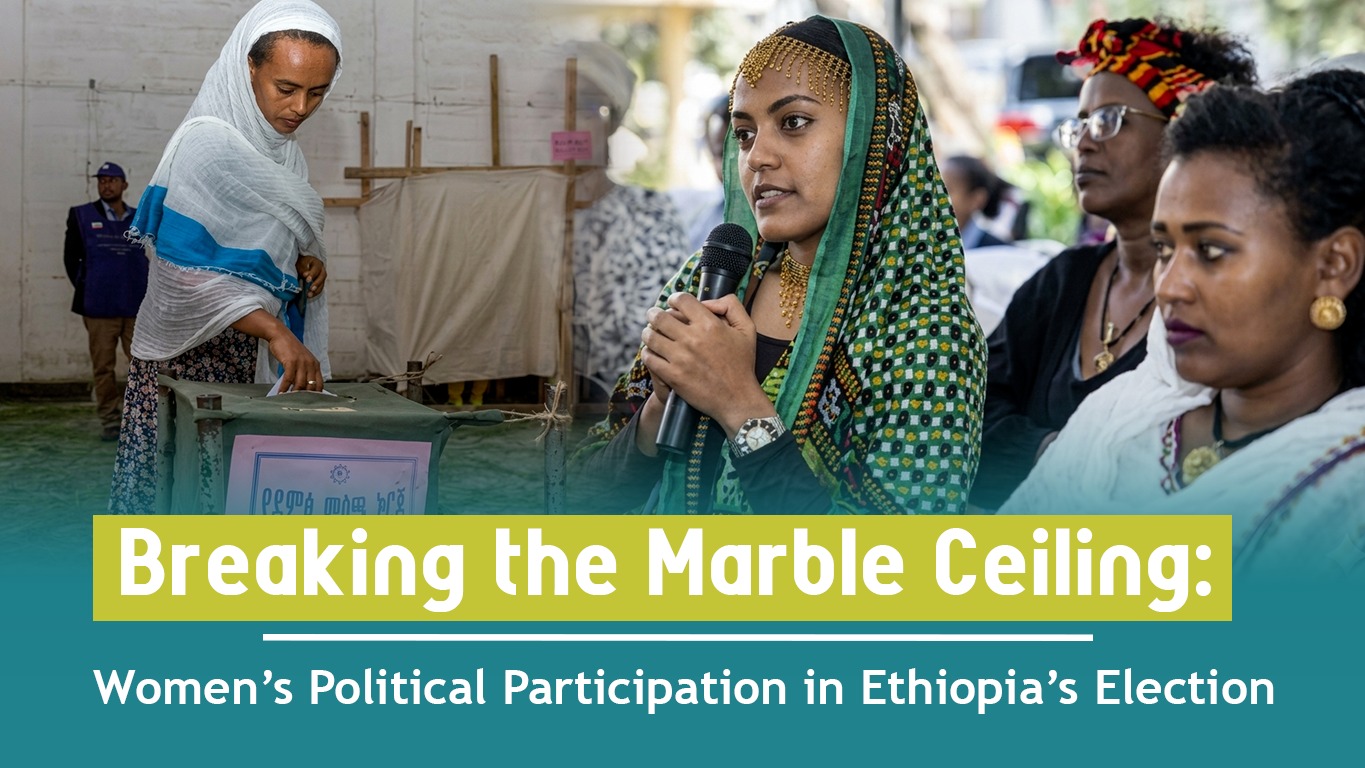
Ethiopia is currently preparing to hold its seventh general election. Ensuring women’s active political participation is crucial across all stages of the electoral process – pre, during and post-election periods. To this end, the post-2018 reforms must be fully implemented and accorded due consideration. While the post-2018 reforms were transformative, lack of mandatory quotas in the 2019 Election Proclamation means that women’s participation still relies heavily on the good will of political parties rather than structural law. More importantly, continued advocacy and legal reforms should be advanced towards full electoral participation in political sphere. This is because, women votes and voices are highly crucial to shape Ethiopia’s social and political future.
References
Boin. D, 2025. How Patriarchy undermined the roman Republic.
Britannica, 2026. The United States in Women’s Suffrage.
Congressional Research Service Report (CRS, 2019). Women’s Suffrage: Fact Sheet
History Rise, 2021. The Evolution of Voting Rights: A Comprehensive Global Historical Analysis.
Zewide.G, 2024. Women’s Political participation from 1974 to 1993.
J4WA, 2024. The Right to Vote: How Far Have African Women Come?
Kewes.P, 2021. Recovering Europe’s Parliamentary Culture, 1500-1700.
Lewis.J, 2025. International Women’s Suffrage Timeline: 1851-Present.
Matiasayehegnon, 2025. Women’s Rights Evolution in Ethiopia.
Reed.R, 2012. In many Parts of the country, the Voting Rights Act’ ‘is close to a deed letter’.
Taonga.M, 2024. New Zealand Women and the Vote.
UNHCR, 2024. Electoral Year: UN experts call for strengthening democracy and reversing.
global erosion of human rights.
Women Suffrage Movement: The right to vote, 2026.
Zamora.C, 2025. Athens’ democratic voting Rights: Who Shaped Ancient Greek Laws.
Zewide, G. P.117-127. Women’s Political Participation from 1974 to 1993.
About the author
Habiba Yesuf Ali
Foreign Affairs Trainer and Policy Consultant
MA in Development Studies, Mekelle University, Ethiopia
MSC in Urban Management and Development, Rotterdam University, the Netherlands
Disclaimer:
The content disseminated by the Institute of Foreign Affairs (IFA) – including, but not limited to, publications, public statements, events, media appearances, and digital communications – reflects the views of individual contributors and does not necessarily represent the official positions or policies of the Institute, its partners, or any affiliated governmental or non-governmental entities.
While the IFA endeavors to ensure the accuracy, integrity, and timeliness of the information presented, it makes no representations or warranties, express or implied, regarding the completeness, reliability, or suitability of such content for any purpose. The Institute expressly disclaims any liability for errors or omissions, as well as for any actions taken or decisions made based on the information provided.
The inclusion of external links, references, or third-party resources does not constitute an endorsement by the Institute. Additionally, engagement on social media platforms – including, but not limited to, likes, shares, retweets (RTs), or reposts – shall not be interpreted as an endorsement or validation of the views expressed therein.
Readers and audiences are encouraged to exercise critical judgment and seek independent verification when interpreting or relying upon any information disseminated through publications and posts on the Institute’s platforms or representatives.