

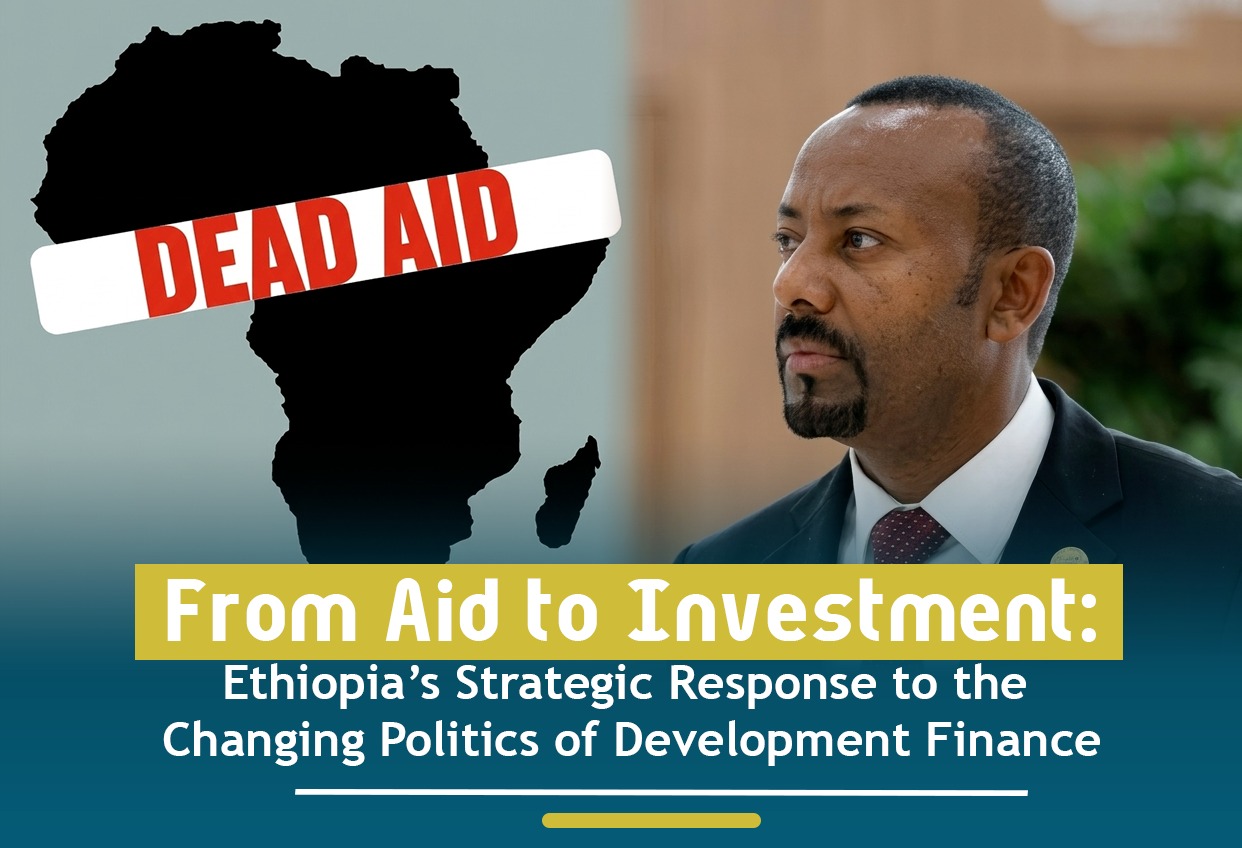
Donors Shift from Aid to Investment and Ethiopia’s Proactive Policy Responses since 2018
Introduction
Economist Dambisa Moyo argued in her famous book, ‘Dead Aid’, that long-term foreign assistance had become ineffective in Africa and depicted the result as ‘dead aid’. She argued that in the long run, Western foreign aid fostered dependency, weakened institutions, fueled rampant corruption, undermined accountability, and discouraged investment-led growth in Africa. More than a decade later, global development donors and practitioners appear to be moving in a direction that echoes this critique. Major donors and development partners from the West, such as the Scandinavian countries, the EU, major European countries such as Germany, France, Italy, the UK, and the USA, have currently shifted their policy away from traditional aid transfers toward private investment, blended finance, trade promotion, and domestic resource mobilization as the main drivers of development. This policy brief examined the politics of the transition from foreign aid to investment and analyzed how Ethiopia has proactively positioned itself in the changing foreign aid landscape since 2018. It focused on Ethiopia’s proactive policy responses to avoid commercial borrowing, debt restructuring, promote investment-led growth, and strengthen strategic autonomy through agricultural self-sufficiency, comprehensive disaster risk management, and investment in mega economic projects. The objective of this policy brief is to understand how Ethiopia’s policy choices reflect and respond to the global transformation in development finance and what lessons they offer for sustainable and self-reliant growth in Africa.
Foreign Aid: Contexts
Foreign aid encompasses the transfer of financial, technical, or military assistance from developed countries or organizations to developing countries with the official aim of promoting economic development, reducing poverty, or responding to humanitarian emergencies. It comprises several components, including grants, concessional loans, commercial loans, humanitarian assistance, military aid, and debt relief. First, a grant is funds freely given to developing countries to support humanitarian relief, education, and health programs. Second, a concessional loan is a loan given with low interest rates and long repayment periods, often used to finance infrastructure and development projects. Third, commercial loans are loans provided by private banks, financial institutions, or international investors at market interest rates and must be repaid within a fixed period, with full interest. Unlike concessional loans, which are given with low interest rates and long repayment periods, commercial loans are profit-oriented and offered based on the borrower’s creditworthiness and ability to repay. This type of foreign financial flow was one of the factors that led Ethiopia into a debt crisis, or debt syndrome, in 2018. Fourth, technical assistance, which involves training, expertise, and technological transfer to improve governance, agriculture, or industry in developing countries. The fifth is humanitarian aid, which provides emergency assistance during disasters such as famine, war, or natural catastrophes. Sixth, military aid, which includes weapons, military training, and financial support to strengthen allies’ defense capacity. Seventh, debt relief programs that reduce or cancel debts owed by developing countries, allowing them to invest more in social and economic development (Riddell, 2007).
All seven types of financial and technical assistance flow from developed countries and their organizations to developing countries, driven by vested interests in long-term economic benefits and foreign policy implementation. As sayings go, ‘someone who feeds you leads you!’, developed countries used technical and financial assistance as both a carrot and a stick in their foreign policy. Although aid is often presented as humanitarian and development assistance, it is, in fact, the strategic, political, and economic tools of donor countries (Lancaster, 2007). Since the end of the Cold War, aid has been increasingly used as an instrument of the neoliberal world order and has served as a condition for promoting and maintaining neoliberal values such as good governance, human rights, democracy, humanitarian responses, and a liberal economy worldwide. However, the policy crisis in the neoliberal world has gradually made foreign aid an insignificant foreign policy tool as donors/neoliberal agencies shifted their attention from globalization and interdependence to geopolitical competition and state assertiveness.
Donors Shift from Aid to Investment: Why shift?
Over the past few years, major Western donor countries have gradually shifted their development strategies from traditional foreign aid toward investment-centered approaches. Recently, major donor countries increasingly concluded that sustainable economic transformation requires private-sector growth, infrastructure development, and trade integration rather than long-term dependence on external aid. As a result, development policy now combines aid with trade partnerships, private investment, and infrastructure finance (Lancaster, 2007). There are internal and external factors that make foreign aid obsolete as an instrument of foreign policy and development. These are:
First, dependency syndrome and debt crisis. This shift was driven first by criticism of traditional aid. Scholars argued that continuous aid flows from developed countries to developing countries created dependency syndrome, corruption, and weak institutions in receiving countries. Economists such as Dambisa Moyo, in her book titled ‘Dead Aid’, argued that long-term aid reduced accountability because governments relied on donors rather than domestic taxation, thereby discouraging economic reform and entrepreneurship (Moyo, 2009). Other critics pointed out that aid often failed to produce industrialization or sustained economic growth (Easterly, 2006). These debates encouraged donor countries to promote investment strategies that create employment, exports, and long-term economic capacity. Thus, donors gradually concluded that development should focus on productive investment that generates income and tax revenue rather than loans that increase debt burdens (Riddell, 2007).
Second, internal political changes in donor countries. Internal political changes in donor countries have also strongly influenced this shift. Currently, many Western countries have experienced the rise of right-wing nationalist political movements that emphasize domestic priorities, migration control, and skepticism toward foreign aid spending. Leaders such as Donald Trump in the United States and Giorgia Meloni in Italy promoted policies that prioritize national economic interests and strategic partnerships. Trump’s America First policy proposed reducing foreign aid budgets and linking assistance to U.S. economic and security interests, while strengthening investment institutions such as the U.S. International Development Finance Corporation to mobilize private capital abroad. In Italy, the Mattei Plan for Africa and programs through Cassa Depositi e Prestiti emphasize investment in energy, infrastructure, and agriculture rather than traditional aid.
Similar trends appeared across other European countries. The European Union launched the Global Gateway initiative to finance infrastructure projects in Africa and Asia, while development banks from Germany’s KfW and France’s Agence Française de Développement are increasingly funding private-sector projects. The United Kingdom also reduced its aid budget in 2021 and expanded investment through British International Investment. These policies reflect domestic political pressure to show economic returns from foreign spending (Woods, 2008). Even Scandinavian countries, which traditionally have been among the most generous aid donors, have experienced similar shifts. Countries such as Sweden, Denmark, Norway, and Finland historically spent more than 0.7 percent of their national income on foreign aid. However, in recent years, political debates about immigration, security, and domestic welfare spending have led to reductions or reallocations of aid budgets. Some funds have been redirected toward domestic refugee costs or to investment-based development programs. These policies show that even traditional aid leaders increasingly view investment as a more sustainable and politically acceptable approach than foreign aid/assistance (OECD, 2021).
Third geopolitical competition. Geopolitical considerations have become one of the most important reasons why Western donor countries have shifted from traditional aid to investment-based development cooperation. One major geopolitical factor is China’s rise as a global development financier. Through infrastructure investment and construction projects across Africa and Asia, China expanded its economic and political influence. This investment-driven strategy showed that development finance could be used to secure trade routes, natural resources, and diplomatic support. Western countries responded by launching their own investment initiatives to remain competitive. For example, the European Union introduced the Global Gateway initiative, and the United States expanded financing through the U.S. International Development Finance Corporation. These programs aim to support infrastructure, energy, and digital projects in developing countries as alternatives to Chinese financing, demonstrating how development policy is shaped by geopolitical rivalry (Woods, 2008).
Ethiopia’s Proactive Policy since 2018
Avoiding commercial loans and Debt restructuring: at the verge of 2018 political reform, Ethiopia’s public debt risks had increased due to large-scale infrastructure investments, prompting the government to prioritize concessional financing and tighten borrowing policies. After years of ungoverned large infrastructure financing through commercial loans, Ethiopia fell into a debt crisis. Since 2018, the Ethiopian government has announced the avoidance of commercial borrowing to dodge excessive debt accumulation. Since then, Ethiopia has adopted a cautious external borrowing and financing strategy to reduce debt vulnerability and strengthen macroeconomic stability. This approach was intended to protect long-term development prospects by ensuring that investment-led growth would not be undermined by unsustainable debt burdens. At the same time, Ethiopia pursued debt restructuring negotiations with bilateral and multilateral creditors to extend repayment timelines and reduce debt-servicing pressures. Thus, since 2018, Ethiopia has taken three measures in relation to global development financing: avoiding commercial loans, debt restructuring to mitigate their negative consequences on the country’s long-term development, and working widely to enhance national resilience and financing capacity.
Homegrown Economic Reform and Investment Promotion: Ethiopia’s Homegrown Economic Reform Agenda represents another major policy shift toward private-sector-led growth and strategic economic autonomy. The reform program aims to liberalize key sectors, improve the business climate, and attract foreign direct investment. The Ethiopian Investment Holding Group and the Ethiopian Investment Commission have been strengthened to provide one-stop services to investors, reduce bureaucratic barriers, and coordinate sectoral investment promotion. Telecommunications liberalization, including the licensing of Safaricom Ethiopia, financial and monetary policy reforms, privatization of the bank sector, the beginning of franchised mega projects such as Bishoftu airports, ecotourism development, Gode Gas refinery, and fertilizer factory, demonstrated Ethiopia’s commitment to opening previously state-dominated sectors to private investment. These reforms align Ethiopia with global development trends, emphasizing investment, trade, and private-sector growth rather than dependence on aid. Such anchor/mega projects create long-term productive capacity and employment while supporting Ethiopia’s transition toward investment-led development and enhancing national resilience.
Strengthening Strategic Autonomy through food Self-Sufficiency (Wheat and Fertilizer): Food security has become a cornerstone of Ethiopia’s strategic priority to reduce dependence on aid. The government launched large-scale irrigation programs to increase wheat production and reduce wheat imports and foreign-currency expenditures. According to Ethiopia’s Ministry of Agriculture, wheat cluster farming, irrigation expansion, and improved seed distribution have significantly increased domestic production and are aimed at achieving national self-sufficiency (Ministry of Agriculture, 2025). These policies reduce reliance on food aid and strengthen rural development. Agricultural self-sufficiency also enhances national resilience to global supply shocks and contributes to macroeconomic stability. Also, dependence on imported agricultural inputs has long constrained Ethiopia’s agricultural productivity. To address this, Ethiopia initiated fertilizer producing plants to ensure a reliable domestic supply and stabilize crop production. Domestic fertilizer production is expected to support agricultural growth, increase yields, and reduce foreign-exchange pressures.
Disaster Risk Management and National Resilience: To sustain investment-led growth and develop national resilience, Ethiopia strengthened its disaster-risk management framework. For this purpose new comprehensive national disaster risk management policy was introduced, which authorized the establishment of a strong and comprehensive national disaster risk management commission, identifying and taking pre-emptive measures to disasters and risk, mobilizing sufficient disaster risk management finance, and overall establish comprehensive commission that looks after disaster and risk in the country in a way it realize national resilience. As part of this comprehensive response to disaster risk management, Ethiopia introduced the National Disaster Risk Financing Strategy (2023–2030), which seeks to reduce dependence on emergency aid by improving risk financing and institutional coordination. Improved disaster-risk management protects development gains and enhances investor confidence. This is a proactive policy response amid USAID and other Western humanitarian organizations that have started to reduce their humanitarian support in the global south.
To conclude, Ethiopia’s domestic and foreign policies since 2018 have reoriented toward national resilience and strategic autonomy, reflecting a deliberate shift from waiting for foreign aid to investment-led development and economic autonomy. By avoiding commercial loans and debt restructuring on the one hand, and by promoting agricultural self-sufficiency, expanding domestic production, strengthening national disaster risk management capacity, and investing in the anchor economy, the post-2018 Ethiopian government proactively responded to the shifting politics of foreign aid. Since 2018, Ethiopia has been working to reduce reliance on aid, build national resilience, and economic sovereignty amid global shifts. These reforms illustrate how a developing country can proactively respond to global shifts in development finance while pursuing national priorities.
Reference
Duffield, M. (2001). Global governance and the new wars: The merging of development and security. Zed Books.
Easterly, W. (2006). The white man’s burden: Why the West’s efforts to aid the rest have done so much ill and so little good. Penguin Press.
Federal Democratic Republic of Ethiopia. (2024). National Disaster Risk Financing Strategy 2023–2030.
Lancaster, C. (2007). Foreign Aid: Diplomacy, Development, Domestic Politics. University of Chicago Press.
Ministry of Agriculture. (2025). Ethiopia’s Wheat Self-Sufficiency Program Report.
Moyo, D. (2009). Dead aid: Why aid is not working and how there is a better way for Africa. Farrar, Straus and Giroux.
OECD. (2018). Making Blended Finance Work for the Sustainable Development Goals. OECD Publishing.
OECD. (2021). Global Outlook on Financing for Sustainable Development. OECD Publishing.
Riddell, R. (2007). Does foreign aid really work? Oxford University Press.
Woods, N. (2008). Whose aid? Whose influence? China, emerging donors, and the silent revolution in development assistance. International Affairs, 84(6), 1205–1221.
About the author
Shimellis Hailu Dessie is Europe & America Affairs director general at the Institute of Foreign Affairs
Disclaimer:
The content disseminated by the Institute of Foreign Affairs (IFA) – including, but not limited to, publications, public statements, events, media appearances, and digital communications – reflects the views of individual contributors and does not necessarily represent the official positions or policies of the Institute, its partners, or any affiliated governmental or non-governmental entities.
While the IFA endeavors to ensure the accuracy, integrity, and timeliness of the information presented, it makes no representations or warranties, express or implied, regarding the completeness, reliability, or suitability of such content for any purpose. The Institute expressly disclaims any liability for errors or omissions, as well as for any actions taken or decisions made based on the information provided.
The inclusion of external links, references, or third-party resources does not constitute an endorsement by the Institute. Additionally, engagement on social media platforms – including, but not limited to, likes, shares, retweets (RTs), or reposts – shall not be interpreted as an endorsement or validation of the views expressed therein.Readers and audiences are encouraged to exercise critical judgment and seek independent verification when interpreting or relying upon any information disseminated through publications and posts on the Institute’s platforms or representatives.