

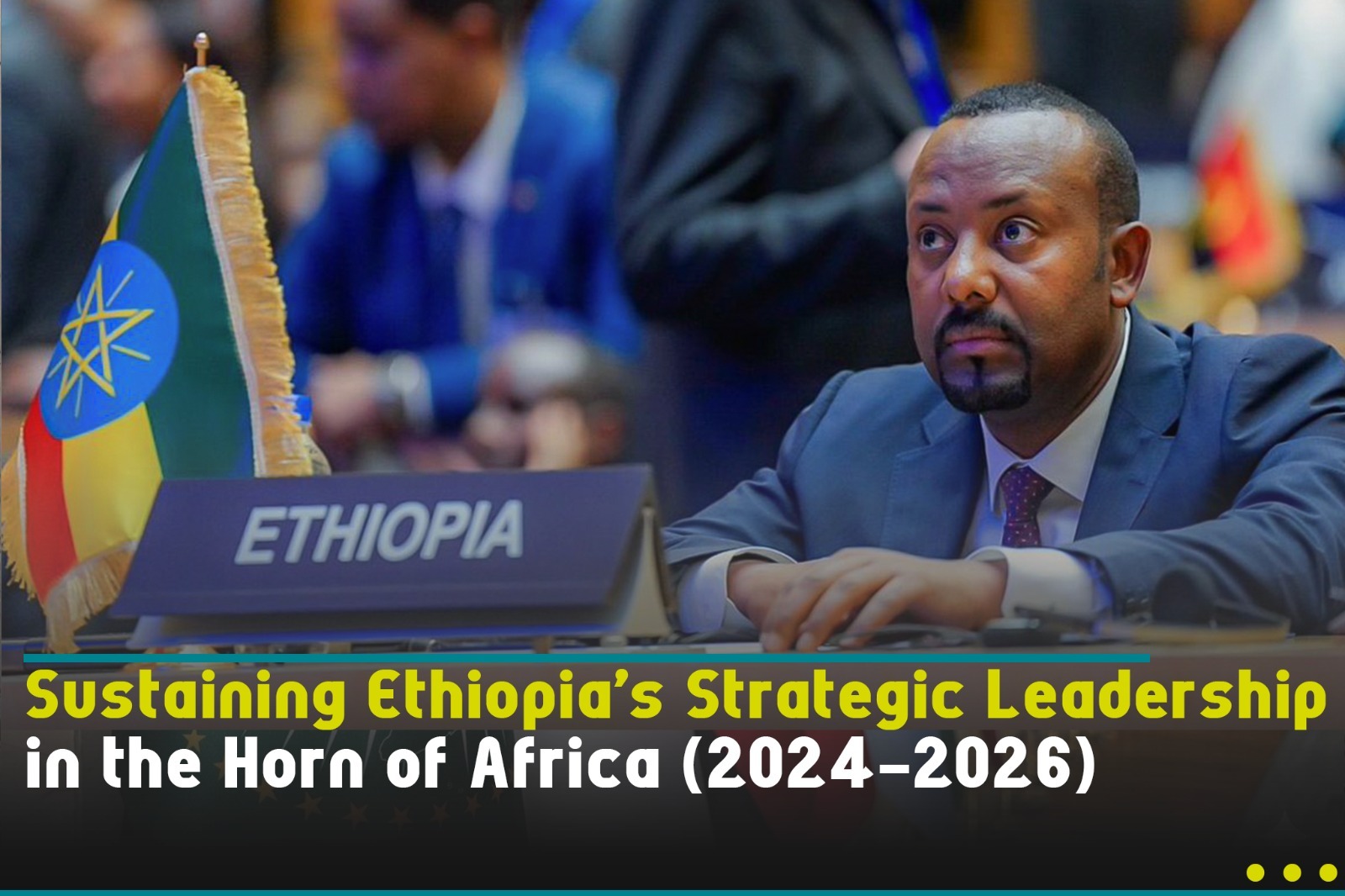
Executive Summary
Ethiopia has undergone a paradigm shift in its foreign policy, moving from unilateral security interventions to a “Horn First” strategy rooted in the principle of Medemer (synergy). This doctrine treats regional stability and domestic prosperity as an inseparable continuum. Driven by the “Two Waters” doctrine—linking the Nile’s energy potential with Red Sea maritime security—Ethiopia is positioning itself as the market maker of the Horn. To maintain this leadership, Ethiopia could direct intensifying global rivalries, finalize its maritime diversification, and institutionalize its energy exports as a stable stabilizer for regional peace.
2. Problem Statement: The Chokepoint of Regional Fragility
Despite Ethiopia’s significant demographic weight and its status as a rising economic powerhouse, its pursuit of regional leadership is fundamentally constrained by three interlocking vulnerabilities that threaten its strategic autonomy. First, the nation faces a precarious economic chokepoint [1], with approximately 90% of its national trade funneling through a single maritime outlet in Djibouti. This over-reliance creates a structural dependency that leaves the Ethiopian economy highly susceptible to logistical bottlenecks, sudden tariff hikes, and geopolitical “rent-seeking” that can be used as leverage against Addis Ababa. Second, the Horn of Africa has entered a phase of external “satiation,” as the strategic landscape becomes increasingly crowded and saturated by extra-regional powers such as Turkey, the UAE, and Egypt [2]. This growing presence of foreign interests frequently bypasses established local diplomatic channels, reframing domestic and bilateral issues as arenas for proxy competition among state-aligned actors. Finally, Ethiopia could contend with residual hostility stemming from its past interventionist approach. [1]. The legacy of the 2006 security-first model continues to fuel regional mistrust, leading some neighbors to view Ethiopia’s current push for “connectivity” and “synergy” with suspicion—interpreting renewable energy exports and water management not as tools for mutual growth, but as a sophisticated form of “hydro-hegemony.” Without addressing these constraints, Ethiopia’s “Horn First” strategy risks being viewed as a unilateral expansion rather than a collective regional evolution. [5][2][1].
3. Analysis of Current Strategic Drivers
3.1 The “Two Waters” Doctrine
Ethiopia’s strategic survival in the mid-2020s is increasingly defined by the “Two Waters” doctrine, a holistic framework that treats the Nile Basin and the Red Sea coastline as a singular, interconnected strategic corridor. This approach moves beyond traditional territorial defense to secure the vital resources and trade routes necessary for national sovereignty. [3][1].
- The Nile (Hydro-politics): The completion and full operationalization of the Grand Ethiopian Renaissance Dam (GERD)—recognized as the “Industrial Energy Project of the Year 2026″—has fundamentally altered regional power dynamics. Ethiopia has successfully pivoted the diplomatic discourse from contentious “water rights” to a pragmatic model of energy integration. By generating a massive electricity surplus, Ethiopia earned approximately $118 million in 2025 through power exports to Kenya, Djibouti, and Sudan. This creates a “mutual dependency” where the regional economy relies on Ethiopian electrons, effectively raising the opportunity cost of political or military conflict for all basin states. [3][1].
- The Red Sea (Maritime Quest): Simultaneously, Ethiopia’s “Maritime Quest” has transitioned from a commercial convenience to an existential sovereign necessity. To break the “single point of failure” inherent in its 95% dependency on Djibouti, Addis Ababa has aggressively pursued diversified access through Berbera in Somaliland and explored viable corridors through Eritrean and Kenyan ports (Lamu). This diversification is designed to ensure that no single neighbor can exercise a veto over Ethiopia’s economic lifeblood, thereby securing its long-term strategic autonomy. [3][1][5].
3.2 Connectivity as a Security Tool
Beyond resource management, the “Horn First” strategy leverages “connectivity as a stabilizer.” Ethiopia is actively constructing a “security shield” by embedding its neighbors into a web of shared infrastructure and institutional frameworks.
- Institutional Fortification: By championing a revitalized IGAD (Intergovernmental Authority on Development), Ethiopia seeks to create a regional buffer that reduces the leverage of extra-regional powers. [1].
- Infrastructure Interdependency: Projects such as the Ethiopia-Kenya-Tanzania power interconnection serve as more than just utility lines; they are diplomatic anchors. [4].
- A New Security Paradigm: This shift marks the end of the “interventionist era.” By prioritizing cooperative border management and the creation of common regional markets, Ethiopia is moving toward a security model where stability is maintained through shared economic interests rather than unilateral military force. In this framework, integrated trade becomes the primary deterrent to regional violence. [2].
4. Transitions toward Regional Institutionalization
To solidify the “Horn First” strategy through the remainder of 2026 and into the next decade, Ethiopia’s shift from conceptual frameworks to institutionalized systems carries profound implications for the regional order. The transition necessitates the following strategic evolutions:
- Establishing the “Energy-for-Security” Nexus: By utilizing its status as a regional “green powerhouse” to anchor the African Single Electricity Market (AfSEM), Ethiopia transforms a utility export into a fundamental pillar of regional stability. The implication of a formal “Green Energy Pact” is the creation of a structural “peace dividend.” Offering discounted electricity in exchange for collaborative security protocols effectively internalizes the security interests of neighboring states. This aligns the regional survival of partners with the operational success of Ethiopian infrastructure, making regional peace a prerequisite for affordable energy. [14][3].
- Redefining Sovereign Access through Commercial Diplomacy: Resolving the “landlocked dilemma” through peaceful, multi-port settlements implies a shift from territorial ambition to interdependent equity. By focusing on joint-venture port management in Berbera and Lamu, Ethiopia signals a move away from zero-sum geopolitical claims toward shared economic prosperity. The strategic implication is the mitigation of “hegemonic anxiety” among neighbors; Ethiopia positions itself not as a disruptive power seeking territory, but as a primary commercial anchor whose growth provides the cargo volumes necessary for the viability of regional ports. [4][5].
- Fortifying the “Regional Shield” via IGAD: By revitalizing IGAD, Ethiopia can strengthen the Horn’s “regional shield” and move toward greater strategic autonomy. Creating a more capable regional conflict early-warning and mediation system would reduce dependence on extra-regional actors, limiting the extent to which sovereignty is affected by outside power intervention. In this way, local intelligence-sharing and IGAD-led dispute resolution can help keep crises within regional mechanisms and reduce proxy competition. Building on this, Ethiopia should anchor external engagement in IGAD- and AU-aligned frameworks, treat IGAD as the primary venue for conflict management, and pair any connectivity expansion with confidence-building and benefit-sharing measures—such as jointly governed corridors, streamlined customs, and clearly visible regional gains—to rebuild trust and stabilize relations with neighbors. [5].
- Standardizing a Green-Technology Corridor: Leveraging Ethiopia’s 2024 transition to e-mobility implies the creation of a regional technological bloc. By spearheading the standardization of EV infrastructure and battery protocols, Ethiopia ensures that neighboring economies are not just trading partners, but are technologically integrated. The implication is a leapfrogging of traditional industrial hurdles, positioning the Horn of Africa as a unified, green-industrial market that attracts global climate finance and solidifies Ethiopia’s role as the technological vanguard of the region. [2[5[2[
5. Conclusion
Ethiopia’s “Horn First” strategy is no longer a theoretical preference but a survival mandate. By transitioning from a “securitized” state to a “connectivity hub,” Ethiopia can transform the Horn from a collection of competing actors into an integrated, market-driven bloc. The success of this strategy hinges on Ethiopia’s ability to demonstrate that its leadership is not a zero-sum game, but a shared path toward regional sovereignty and prosperity.
References
- Institute of Foreign Affairs (IFA). (2024). The Doctrine of Two Waters: Integrated Strategic Corridors. Addis Ababa.
- Institute for Peace and Security Studies (IPSS). (2025). From Interventionism to Interdependence: Ethiopia’s Security Evolution.
- Africa Trade Chamber. (2026). GERD: Industrial Energy Project of the Year Report.
- World Bank. (2026). Regional Economic Integration in the Horn: The Role of Energy Connectivity.
- Gashaw, T. (2024). The Geopolitics of Port Diversification in Landlocked Ethiopia. Journal of African Trade & Diplomacy.
About the author
Yitina Gebre (Ph.D.), Researcher at the Multilateral Affairs Department, Institute of Foreign Affairs
Disclaimer:
The content disseminated by the Institute of Foreign Affairs (IFA) – including, but not limited to, publications, public statements, events, media appearances, and digital communications – reflects the views of individual contributors and does not necessarily represent the official positions or policies of the Institute, its partners, or any affiliated governmental or non-governmental entities.
While the IFA endeavors to ensure the accuracy, integrity, and timeliness of the information presented, it makes no representations or warranties, express or implied, regarding the completeness, reliability, or suitability of such content for any purpose. The Institute expressly disclaims any liability for errors or omissions, as well as for any actions taken or decisions made based on the information provided.
The inclusion of external links, references, or third-party resources does not constitute an endorsement by the Institute. Additionally, engagement on social media platforms – including, but not limited to, likes, shares, retweets (RTs), or reposts – shall not be interpreted as an endorsement or validation of the views expressed therein.
Readers and audiences are encouraged to exercise critical judgment and seek independent verification when interpreting or relying upon any information disseminated through publications and posts on the Institute’s platforms or representatives.