

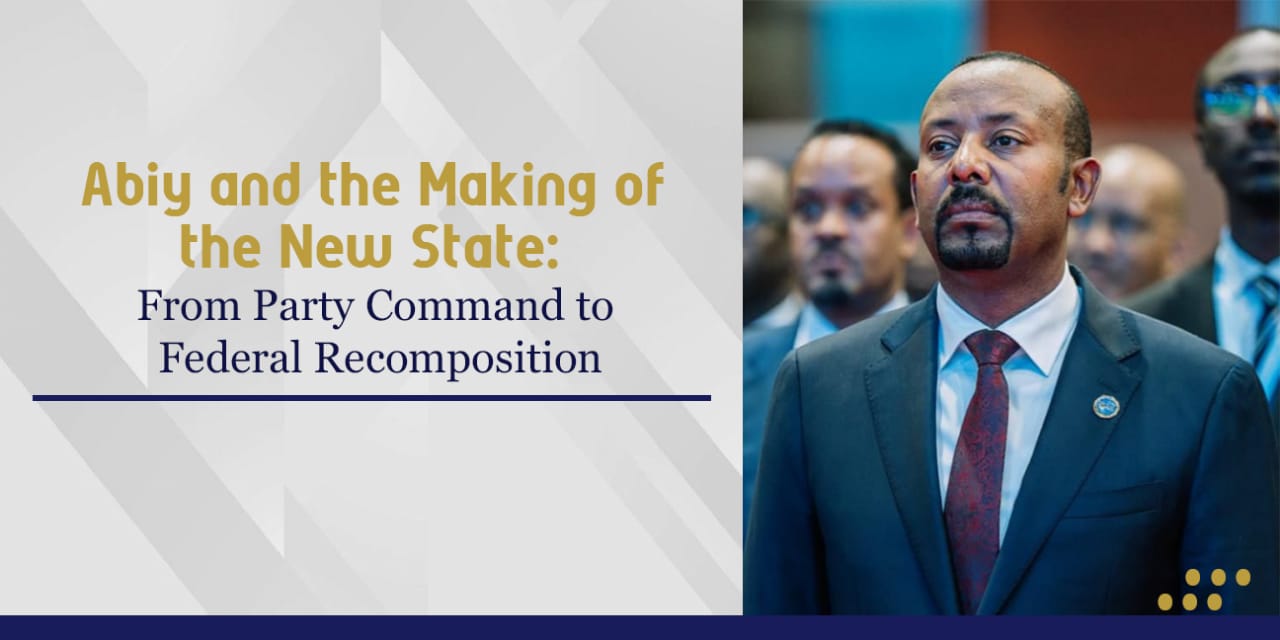
Ethiopia’s 2026 election is taking place inside a political order that is often described with the wrong vocabulary. The dominant external frame treats the country as if it were moving in a straight line from federal pluralism into central command. That reading is tidy, but it is analytically thin. Ethiopia’s real transition is not the replacement of federalism by one-man rule. It is the reallocation of authority after the exhaustion of a party-command system that once disciplined the federation from above.
The difference matters. A state can preserve federal form while recentring certain functions necessary for survival: security coordination, macroeconomic stabilization, external policy, infrastructure integration, and constitutional continuity. It can also expand regional self-government while suffering deeper political turbulence. Ethiopia now carries both dynamics. Its regions are more politically assertive than they were under the earlier dominant-party order, yet the national state is also trying to recover capacities without which federalism itself becomes brittle.
A Federation Without Its Old Command
Ethiopia’s constitutional architecture is among the most radical federal experiments in the contemporary state system. It recognises the right of nations, nationalities, and peoples to self-determination, including the right to secession, and guarantees a full measure of self-government in territories they inhabit.1 On paper, this is not a timid decentralising arrangement. It is a constitutional order built around the political recognition of collective identity.
The deeper question has always been whether constitutional self-rule could be converted into democratic regional autonomy. For much of the post-1991 period, the answer was constrained by the ruling coalition’s command structure. Regional autonomy operated within a hierarchy of party discipline, coalition management, and security coordination. The federation’s constitutional vocabulary was expansive; its political practice was more controlled.
This is why Ethiopia’s post-2018 turbulence should not be confused with the disappearance of federalism. The old system did not collapse because regions had too much real autonomy. It weakened because autonomy, representation, and authority had long been mediated through a political machinery that eventually lost legitimacy. Once that machinery fractured, the regional question returned in a more open, more competitive, and more contestable form.
Why centralisation is the wrong diagnosis
The standard centralisation thesis misses one empirical reality: Ethiopia’s regional field has become more, not less, consequential. The electoral map itself reflects a broader federal landscape in which multiple regions, including Sidama, South Ethiopia, Central Ethiopia, and South West Ethiopia, now appear as distinct administrative-electoral units.2 This is not the signature of a state abolishing regional political space.
The more accurate term is not centralisation, but recomposition. Ethiopia is recomposing the relationship between self-rule and shared rule after the weakening of the old party system. In such a setting, national authority becomes simultaneously necessary and contested. Too little authority allows armed fragmentation, insecurity, and fiscal disorder. Too much authority risks suffocating the regional autonomy on which the federal compact depends.
The central task is therefore not to choose between unity and federalism. It is to prevent self-rule from degenerating into armed veto politics while preventing unity from hardening into administrative domination.
Beyond the mythology of perfect conditions
The 2026 election should be judged against the conditions Ethiopia actually faces, not against an abstract model of electoral normalcy. It is being conducted in a country where security remains uneven, opposition forces are fragmented, and parts of the political landscape are still shaped by war’s residue. The electoral board’s own materials show an extensive administrative machinery of constituencies, candidate registration, complaints handling, provisional results, and transfers of polling-station representatives.2 These procedural layers matter, elections under stress are not only contests for office; they are mechanisms for keeping politics inside constitutional form.
This does not mean every constraint is acceptable. Restrictions on civic space, local insecurity, and uneven participation require scrutiny. But the analytical distinction is important: a difficult election is not automatically a meaningless election. In fragile federations, elections often perform the less glamorous but vital function of institutional maintenance. They renew authority, register participation where participation is possible, and prevent political competition from being entirely displaced by coercive bargaining.
The burden on opposition politics
A serious reading must also move beyond the assumption that ruling-party dominance can be explained by coercion alone. State advantage is real in many African electoral systems, Ethiopia included. But opposition weakness also reflects organisational fragmentation, regional narrowness, weak national programmatic coherence, and limited ability to speak simultaneously to security, inflation, federalism, service delivery, and national cohesion.
Ethiopia’s voter is not merely a passive object of state power. Citizens make calculations under pressure. They evaluate local stability, food prices, road access, public services, identity security, national continuity, and the credibility of alternatives. To erase this agency is to turn Ethiopian society into a stage prop in an external morality play.
Maritime Access as Geoeconomic Insurance
Ethiopia’s maritime agenda should be understood as part of the same strategic challenge. A large landlocked state cannot outsource its entire strategic horizon to a single external corridor forever. World Bank project documentation notes that the Ethio-Djibouti corridor links Ethiopia to the Port of Djibouti, the dominant gateway for more than 95 percent of Ethiopia’s imports and exports.3 That level of dependence is not merely commercial. It is a structural exposure.
In an era of Red Sea militarisation, supply-chain disruption, port competition, and rising insurance costs, reliable access to maritime infrastructure is a question of national survival and resilience. It is not inherently expansionist. It becomes destabilising only if pursued through coercion rather than negotiation.
The Ethiopian government’s stated position has been to frame the Red Sea question through peaceful dialogue, regional cooperation, and negotiated arrangements. Reports of the Prime Minister’s parliamentary remarks presented the request as one of peaceful negotiation and explicitly rejected force as the method.4 One may debate the diplomacy, sequencing, and regional sensitivities. But criminalising the need itself only normalises Ethiopia’s vulnerability.
The Politics of Containment
The wider pattern is familiar: Ethiopia’s constraints are treated as permanent facts, while Ethiopia’s attempts to alter those constraints are treated as destabilising ambition. That is not neutral analysis. It is a politics of containment expressed through the language of caution.
A stable Horn of Africa cannot be built by asking its largest state to accept strategic exposure as responsible conduct. Nor can Ethiopia build durable influence through unilateral impatience. The sustainable path lies in negotiated connectivity: corridors, ports, power interdependence, customs cooperation, rail and road integration, and shared security arrangements. That is where Ethiopia’s maritime question should be located.
Reform, Risk, and the New State
Ethiopia’s reform programme is not a side issue. It is part of the political architecture of the new state. The government’s macroeconomic reform shifted Ethiopia toward market-determined exchange rates, removed selected current-account restrictions, and introduced an interest-rate-based monetary policy framework, supported by international financing and debt-relief processes.5 These measures are not painless technical adjustments. They redistribute pressure across households, firms, importers, exporters, creditors, and public institutions.
Political judgment of the current order must therefore include the difficulty of governing through reform. Currency adjustment, inflation control, debt restructuring, tax mobilisation, and investment liberalisation all generate winners and losers. In a fragmented federation, those economic pressures quickly acquire regional and political meaning.
Ethiopia is not simply being pulled into centralisation, nor can it be understood as a leader’s personal project. It is a state attempting recomposition after the decline of party command, under the simultaneous pressure of federal contestation, economic reform, corridor vulnerability, and regional volatility. The 2026 election is one episode in that larger reordering. Its significance lies less in the predictability of outcome than in whether constitutional politics can continue to absorb the stresses of a federation still searching for a stable equilibrium.
References
- Constitution of the Federal Democratic Republic of Ethiopia, Article 39, recognising self-determination, language and cultural rights, and “a full measure of self-government.” ↩
- National Election Board of Ethiopia, “The 7th General Election,” including constituency materials, regional lists, and constituency functions under Ethiopian electoral law. (National Election Board of Ethiopia) ↩ ↩2
- World Bank, Ethiopia Trade Logistics Project, project documentation noting that the Ethio-Djibouti corridor links Ethiopia to the Port of Djibouti, the dominant gateway for over 95 percent of Ethiopia’s imports and exports. (World Bank) ↩
- Government Communication Service of Ethiopia, “Prime Minister Abiy Ahmed Addressed Red Sea Access in Parliament,” 3 February 2026. (GCS) ↩
- World Bank Group, “Ethiopia,” country overview, noting the July 2024 macroeconomic reform package, market-determined exchange rates, current-account reforms, interest-rate-based monetary policy, and support from international financing and debt-relief processes. (worldbank.org) ↩
By IFA Staff writer
Disclaimer:
The content disseminated by the Institute of Foreign Affairs (IFA) – including, but not limited to, publications, public statements, events, media appearances, and digital communications – reflects the views of individual contributors and does not necessarily represent the official positions or policies of the Institute, its partners, or any affiliated governmental or non-governmental entities.
While the IFA endeavors to ensure the accuracy, integrity, and timeliness of the information presented, it makes no representations or warranties, express or implied, regarding the completeness, reliability, or suitability of such content for any purpose. The Institute expressly disclaims any liability for errors or omissions, as well as for any actions taken or decisions made based on the information provided.
The inclusion of external links, references, or third-party resources does not constitute an endorsement by the Institute. Additionally, engagement on social media platforms – including, but not limited to, likes, shares, retweets (RTs), or reposts – shall not be interpreted as an endorsement or validation of the views expressed therein. Readers and audiences are encouraged to exercise critical judgment and seek independent verification when interpreting or relying upon any information disseminated through publications and posts on the Institute’s platforms or representatives.