

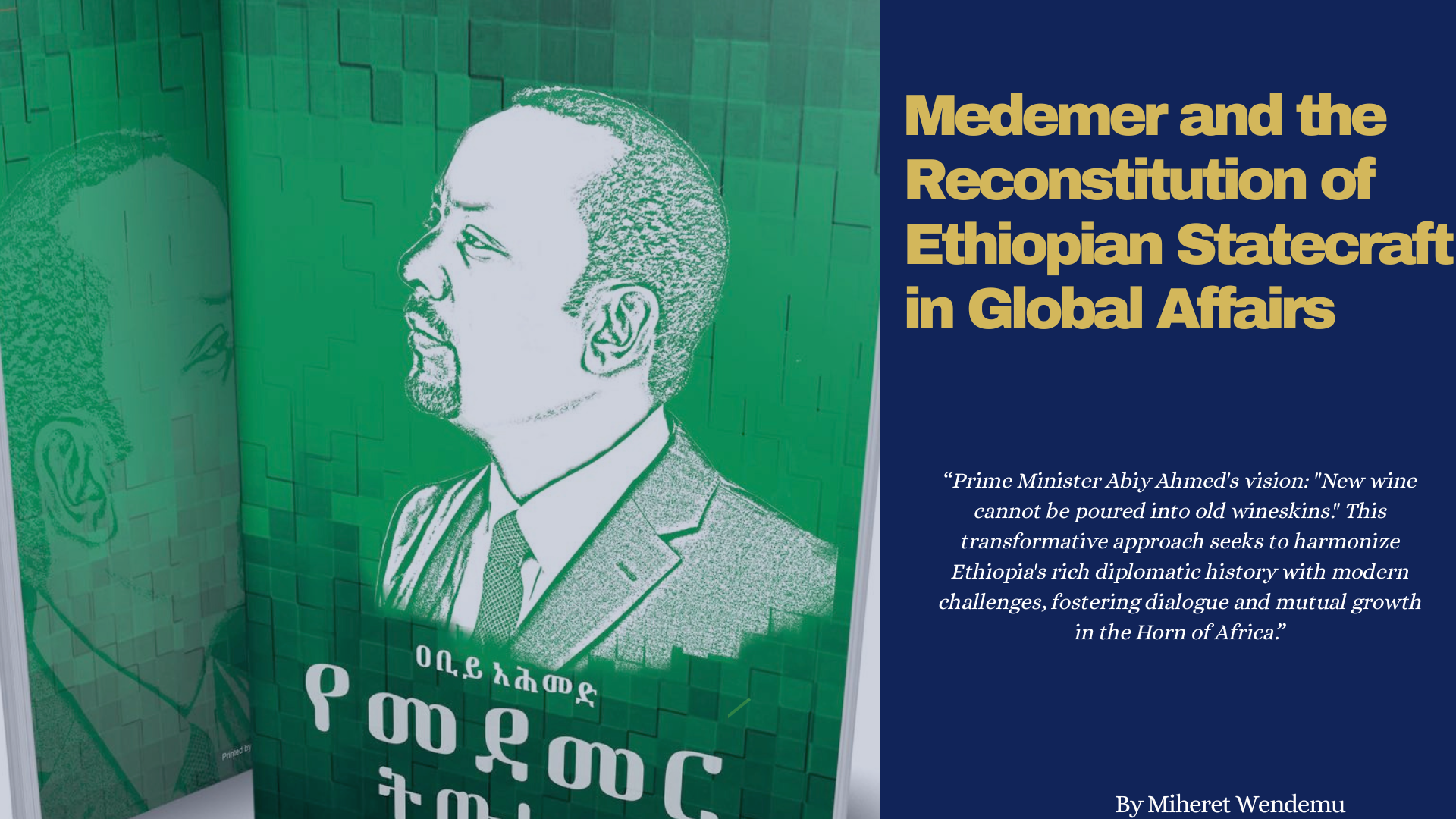
In a recent interview with Ethiopian Television, Prime Minister Dr. Abiy Ahmed articulated the pressing necessity of reforming Ethiopia’s foreign affairs sector. To emphasize the urgency and transformative nature of this endeavor, he employed a striking metaphor: one does not pour new wine into old wineskins. This analogy – widely recognized in both cultural and philosophical discourse – was deployed to illustrate a central premise of institutional reform: that novel ideas and evolving paradigms cannot be sustained within outdated, ill-suited frameworks. The Prime Minister thus made clear that the restructuring of the foreign affairs sector is not merely aspirational – it is already underway, strategically aligned with emerging diplomatic imperatives and policy trajectories.
This institutional realignment signals a fundamental shift in Ethiopia’s approach to foreign engagement: from a system once defined by protocol, routine, and formalism toward a model characterized by dynamism, innovation, responsiveness, and strategic foresight. The reform is both justified and actively unfolding. Yet, a crucial question remains: By what principles should this transformation be guided and sustained? It is in response to this question that the philosophy of Medemer emerges as both a normative foundation and strategic compass. This paper argues that the core tenets of Medemer can serve as the intellectual and operational cornerstone for the reformation of Ethiopia’s foreign policy and diplomatic architecture.
In the interview, Dr. Abiy highlighted several dimensions of Medemer’s foreign policy orientation – including a strategic focus on the Horn of Africa and a renewed emphasis on economic diplomacy. These themes suggest that Medemer is already informing the substance and direction of foreign policy reform. To fully comprehend the current trajectory of Ethiopia’s external engagement, it is therefore imperative to undertake a comprehensive analysis of Medemer’s principles and their application to diplomacy.
Medemer as Indigenous Philosophy in Statecraft
Medemer is a political and governance philosophy introduced by Prime Minister Abiy Ahmed as a holistic framework for national renewal. Before it took shape as an articulated doctrine, Medemer existed as an internalized set of values cultivated throughout the Prime Minister’s life experience. It evolved organically – shaped less by abstraction than by practical observation, strategic reasoning, and a deep engagement with Ethiopia’s historical, social, and political complexities.
At its core, Medemer promotes a vision of national development anchored in local agency and contextual intelligence. It advocates for endogenous solutions – ideas, institutions, and reforms crafted to suit Ethiopia’s unique social fabric and historical trajectory. In so doing, it rejects the long-standing inclination to import governance models or policy prescriptions from foreign contexts, particularly those shaped by Western assumptions and priorities. The recurring failure of such models in the Ethiopian context has revealed their structural inappropriateness and cultural dissonance.
Continuity as Strategy: Tradition, Memory, and the Evolution of Ethiopian Diplomacy
Medemer extends its relevance beyond domestic governance into the sphere of international relations, offering a framework rooted in Ethiopia’s civilizational identity, enduring values, and storied diplomatic legacy. Far from seeking to rupture with the past, it highlights the continuity between historical achievements and contemporary strategic needs. The saying “The apple doesn’t fall far from the tree” captures this ethos: Ethiopia’s diplomatic culture – shaped over millennia – continues to inform its modern foreign policy.
Historically, Ethiopia has engaged the world through a foreign policy that privileges solidarity, non-aggression, justice, and sovereign dignity. Medemer does not seek to replace this tradition; rather, it builds upon it, reinterpreting it for the twenty-first century. Iconic moments such as the victory at Adwa, which affirmed Ethiopia’s resistance to colonial domination; its early membership in the League of Nations; and its foundational role in the creation of the Organization of African Unity, are not merely commemorative – they constitute elements of Ethiopia’s strategic capital in global diplomacy.
At the same time, Medemer identifies the limitations and inconsistencies that have characterized Ethiopia’s foreign policy over the last several decades. For too long, its diplomatic posture was reactive, constrained by outdated paradigms and institutional inertia. The reforms now being undertaken – guided by Medemer – represent a decisive reorientation, one that is already manifesting in both policy and practice.
The ‘Horn First’ Doctrine and the Ethics of Cooperative Security
A key innovation of Medemer’s diplomatic strategy is the prioritization of regional cooperation as the cornerstone of national security and foreign engagement. While acknowledging Ethiopia’s need for global partnerships, Medemer argues that meaningful progress must begin in its immediate neighborhood – the Horn of Africa. Central to this philosophy is the belief that dialogue, negotiation, and mutual understanding offer the most effective instruments for resolving conflict and fostering stability.
Historically, Ethiopia’s foreign relations were structured around a realist model that treated other states as instruments for securing narrow national interests. This approach fostered suspicion and undermined regional cooperation, creating adversarial dynamics even among proximate neighbors. In contrast, Medemer proposes a collaborative framework, rejecting zero-sum thinking in favor of integrative diplomacy. It envisions international relations as arenas for mutual advancement rather than arenas of rivalry.
Medemer’s Dialogical Turn in International Relations
Equally significant is Medemer’s reconceptualization of national interest. No longer viewed as static or self-contained, national interest under Medemer is dynamic – subject to negotiation, recalibration, and alignment with broader regional objectives. This intellectual shift is most clearly embodied in the “Horn of Africa First” doctrine, which counters decades of defensive posturing. Where past engagements were conditioned by mistrust and threat perception, Medemer identifies untapped strategic, economic, and developmental opportunities in regional interdependence.
In this revised paradigm, diplomacy becomes not merely a tool for defending interests, but a means for co-creating them. The normalization of relations with Eritrea and Ethiopia’s role in the Ankara Declaration are illustrative of this shift – concrete manifestations of a diplomacy rooted in reconciliation and strategic foresight.
Medemer also affirms Ethiopia’s role as a proactive regional actor. Rather than positioning itself defensively in response to external dynamics, Ethiopia is reasserting itself as a catalyst for peace, stability, and inclusive development within the Horn. Recognizing the interconnected nature of the region’s challenges – from security dilemmas to resource competition – Medemer calls for a systemic approach that addresses shared vulnerabilities through cooperative mechanisms. It acknowledges that Ethiopia’s future is inseparably tied to that of its neighbors and that regional prosperity is a precondition for national advancement.
Harnessing Strategic Potential in a Multipolar World
Another key tenet of Medemer is the assertion of Ethiopia’s geopolitical agency. It directly challenges the implicit marginalization of Ethiopia in previous foreign policy doctrines and affirms the country’s strategic significance on the continental and global stage. This recognition is not merely symbolic – it is operational, informing how Ethiopia understands and exercises its diplomatic power.
Medemer emphasizes that both hard power (such as geography, population, and military capability) and soft power (such as cultural influence, moral authority, and historical legitimacy) must be mobilized in a coherent strategy. Ethiopia’s ability to shape its own diplomatic terms – choosing whom to engage with, how, and on what basis – derives from this reassessment of its geopolitical assets.
Such strategic clarity enables Ethiopia to move beyond externally imposed frameworks. Rather than adapting itself to global systems that do not reflect its priorities, Ethiopia, under Medemer, seeks to construct its own foreign policy logic – one that is attuned to its values, strategic interests, and long-term goals.
Toward a Philosophy of Foreign Engagement: Medemer as Framework and Praxis
Medemer offers a transformative vision for Ethiopia’s foreign policy – one that is historically grounded, intellectually rigorous, and strategically pragmatic. It reframes diplomacy as an arena for principled engagement, regional solidarity, and endogenous leadership. By harmonizing Ethiopia’s diplomatic heritage with the evolving realities of global politics, Medemer lays a durable foundation for reform.
Far from discarding the past, it integrates historical achievements into a forward-looking strategy. Medemer redefines national interest as a relational construct – shaped through cooperation, negotiation, and shared development. As such, it transcends the limitations of prior approaches, providing Ethiopia with a coherent and resilient framework to navigate a complex international order.
In doing so, Medemer not only reforms Ethiopia’s foreign affairs apparatus – it reimagines the very purpose of foreign policy itself.
About the Author
Miheret Wendemu is an Associate Researcher at the Institute of Foreign Affairs. She holds LLB in Law and currently working as Personal Assistant and Protocol to the Executive Director of the Ethiopian Institute of Foreign Affairs. Prior to this position, she has been doing internship as a partnership officer in the same Institute. Her research interest includes foreign policy, geo-politics, international relations, and international laws.
Disclaimer:
The content disseminated by the Institute of Foreign Affairs (IFA) – including, but not limited to, publications, public statements, events, media appearances, and digital communications – reflects the views of individual contributors and does not necessarily represent the official positions or policies of the Institute, its partners, or any affiliated governmental or non-governmental entities.
While the IFA endeavors to ensure the accuracy, integrity, and timeliness of the information presented, it makes no representations or warranties, express or implied, regarding the completeness, reliability, or suitability of such content for any purpose. The Institute expressly disclaims any liability for errors or omissions, as well as for any actions taken or decisions made based on the information provided.
The inclusion of external links, references, or third-party resources does not constitute an endorsement by the Institute. Additionally, engagement on social media platforms – including, but not limited to, likes, shares, retweets (RTs), or reposts – shall not be interpreted as an endorsement or validation of the views expressed therein.
Readers and audiences are encouraged to exercise critical judgment and seek independent verification when interpreting or relying upon any information disseminated through publications and posts on the Institute’s platforms or representatives.