

Introduction
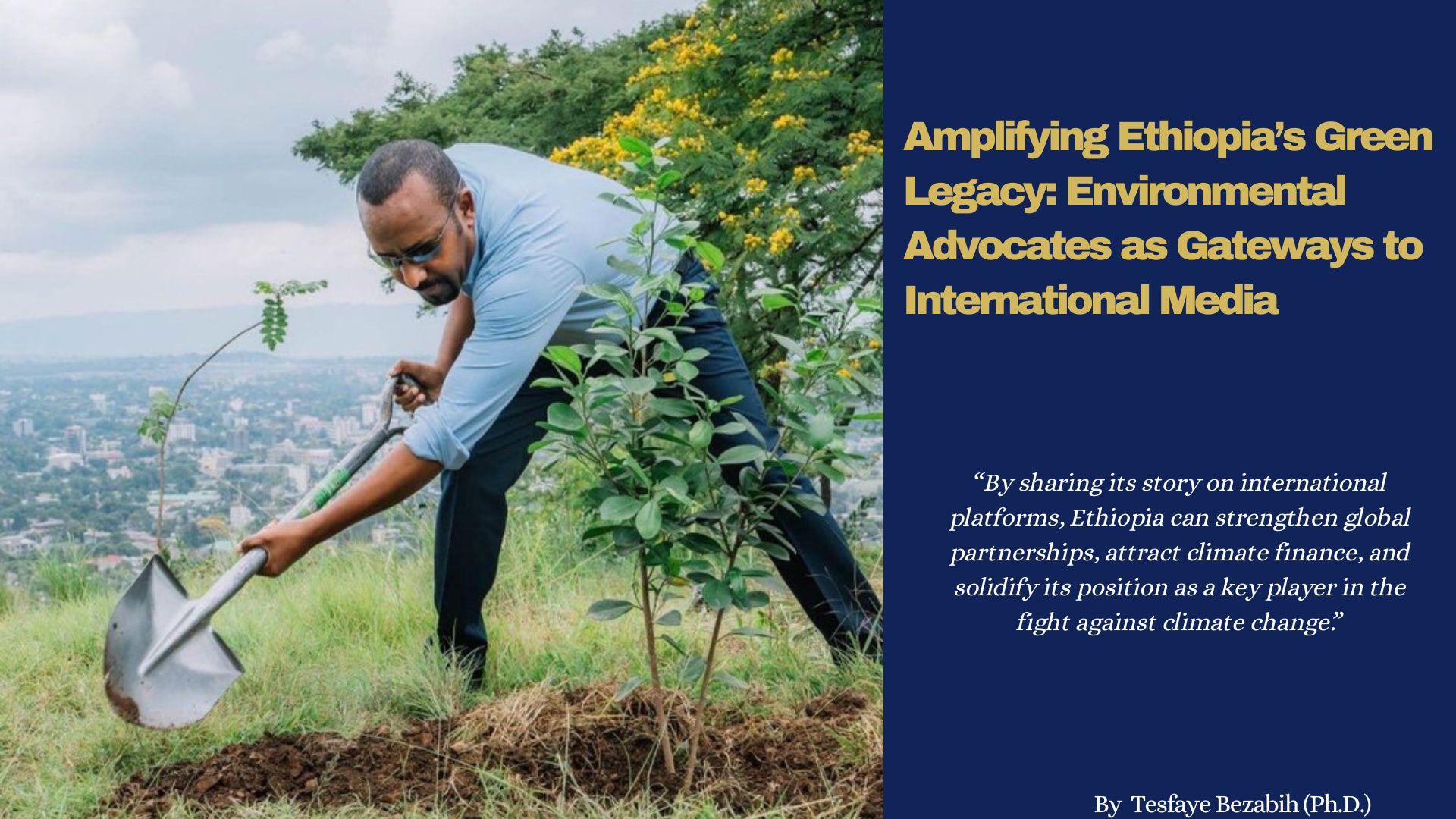
Ethiopia’s the Green Legacy Initiative on reforestation and climate resilience campaign began in 2019 and has planted over 30 billion trees so far, which makes the initiative as one of the most ambitious campaigns in the continent. The program is to help fight environmental degradation and ecosystem restoration, and sustainable development. But the Green Legacy, although it seems enormous in its scope and effect, has not gotten equivalent attention and awareness in the foreign press and the global environmental community. This message gap restricts the recognition of Ethiopia as a global climate leader and decreases the possibility of strategic partnerships, climate finance, and soft power.
One major but not enough exploited asset in bridging this divide has been the environmental advocates network in the country comprising of journalists, scientists, activists and the like who stand with credibility and platforms to beam Ethiopia achievement to the rest of the world. These champions could become very crucial in terms of interpreting national success stories into universal stories that would have a global appeal.
The brief suggests the following to overcome this: (1) launch an “Eco-Ambassadors Program” to train and mobilize international outreach advocates; (2) collaborate with foreign media houses via environmental reporting fellowships; (3) make a coordinated media effort part of the Green Legacy campaign; and (4) use embassies and diaspora networks to extend the global reach. The moves will support the climate branding, the public diplomacy, and the international outreach of Ethiopia.
- Context
Climate change is an issue of great concern to the world over in recent decades, and it has since been popularly regarded as one of the most urgent environmental issues in front of mankind. With this, there was the formation of Paris Agreement in 2015, a global treaty of almost 200 nations to curb greenhouse emissions and reduce temperature on the global surface to well below 2C and offer climate funds to developing countries. [1]
After this Ethiopia has initiated Green Legacy Initiative that the world needs to secure a healthy and safe future. In its main aim, the initiative targets to depress deforestation and rehabilitate degraded ecosystems. Lessening the environmental impact, individuals will be able to save the natural resources, minimize the air and water pollution, and even cope with climate change. By being green (conservation of energy, reduction of wastes and renewable energy), we can aid in making sure that the planet exists when our children and grandchildren come along. It is our responsibility to help in making a green legacy to them.
So far, the forests in Ethiopia have reduced because of conversion to agricultural land, rising demand of wood as source of fuel and construction, and over-grazing by livestock. Subsequently using the situation of global warming and the numerous issues that are troubling the environmental ecosystem in the country, the country has come up with some high-level tree planting initiatives such as the Green Legacy Initiative (GLI). Those who support the program argue that the GLI will lead to re-greening of the country, developing better livelihoods of the locals and form climate resilience, whereas those against it argue that the program is nothing but a means of gaining political advantage. In this instance, Ethiopia has panned to pant 7.5 billion seeding this year to combat the global warming and to maintain the global ecosystem.
Although Green Legacy Initiative is of large scale and impact in Ethiopia, the country has low visualization in the international environmental discourse. That in effect diminishes the foreign power potential of Ethiopia in climate negotiations and underuses its soft power.
As we know the Green Legacy Initiative is just not a local initiative but has made Ethiopia the role model in fighting environmental degradation, deforestation in the recent five years. This eloquently explains that the Green Legacy Initiative of Ethiopia has enhanced the reputation of Ethiopia before the international community of nations through its effort to take the lead to protect the environment and the whole world through its quest to plant trees to utilize its soil and be in Solidarity with the world in terms of Environmental Sustainability benchmark that can be used in other climatical interventions in Africa and in the Global South.
Most importantly, the Green initiative extends past the domestic interest of the country and can be said to contribute to the global ambitions such as addressing climate change, reforestation and biodiversity conservation among others. What Ethiopia is therefore doing is not only dealing with the ecological problems that it faces, but also establishing a precedent that could in future be imitated by other states particularly in regions where existing states that are adversely affected by the actions of deforestation and climate stress exist.[2]
4. Policy Gap and Opportunity
It can be noted that Ethiopia has become essential in overcoming climate-related problems with the use of the Green Legacy ordeal. It is more to the point that the effective introduction of the initiative has been observed in the restoration of improvised land and reactivating the damage done to the environment, as soon as possible. Since the beginning of the Green Legacy Initiative everyone in every walk of the society has successfully and in a winning way sown tree seedlings in every nook and cranny of the country. As an aspect of the program, the country has planted billions of tree seedlings to every corner of the nation as early as possible. Some gaps and rifts are however present in the communication and media outreach strategies in Ethiopia especially in relation to amplifying the Green Legacy Initiative to the international media and environmental advocators , which in turn prevents the wide reaching of the initiative in terms of awareness and impact. The interaction of the media with the international media firms in addition to the environmental activists is rather minimal. It is common and clearly customary that media strategy of Ethiopia over the ages has mostly been on domestic coverage with little or no proactive traditional attempts to reach major international media entities. Consequently, the world and environmental forums are not best informed or conversant with the volume and importance of the billions of trees planted on environmental Green Legacy Initiative.
Moreover, the limited strategic storytelling and data visualization is also another reason. The news coverage in any of the media houses in regard to such massive issues does not have strong storyline delivery, visual archival, and statistic contained accounts that affiliated to international media regulations. Add to this the unavailability of commercially appealing, media friendly materials such as high quality video clips, infographics and plastic free success stories that allow international journalists and climate opinion formers to present the Ethiopian success in green inheritance.
Almost there are minimal interactions with worldwide environmental activists and well known international personalities such as Greta Thunberg. The environmental activists like her are making big and impacting movements in the multilateral sector in the current times. It is also interesting that some authors referred to environmental activists as to an eco-influencers, and some coins a term green-influencers. Recently, there emerged so-called “green” influencers (also known as greenfluencers), who share the content related to the issues of sustainability, and have their own influences.[3] There are two of the digital activism in environmental activism: “fast activism” and the slow, passive “slacktivism” activism; out of which an idea of the slacktivism is a two-edged sword. The influence of the slack activism is also of utmost significance in presenting green efforts of nations to the media of the world at large. [4]
In line with this there is absence of formal mechanism or platform for engaging environmental advocates both locally and internationally as partners in promoting Ethiopia’s achievements. As a result, influential climate communicators, scientists, and influencers who can work sustainably are not mobilized to echo Ethiopia’s green success on the global stage. Similarly, the country’s use of social media, international platforms, and diaspora networks seems still limited, especially in strategic languages and formats for instance in crafting well-articulated messages in the multilingual content, LinkedIn climate networks, international science journals. This in its side also limits Ethiopia’s ability to engage broader environmental audiences worldwide.
Most importantly, loss of modes of public diplomacy, climate branding, and soft power will arguably undermine the potential of Ethiopia to make its record on becoming a success story in Green Legacy Initiative. As much as that initiative has sown billions of trees and displayed its commitments worldwide, this has prevented the initiative to have a direct effect on international discourses and collaboration because the initiative currently lacks a consequent international communication strategy.[5] In the absence of a well-developed and sustaining the use of the diplomacy mechanisms, Ethiopia cannot influence the perception of foreign governments, international organization, and the global media on its environmental undertaking. Similarly, there is no climate branding, and thus the Green Legacy is not currently being sold as an African exemplar of sustainability and climate vulnerability. Consequently, Ethiopia is losing the opportunity to increase its international profile, climb the ladder of climate financing and shape regional green policy.
5. Strategic Policy Options
Having clearly understood the above Ethiopia’s Green Legacy context and the policy gaps and better opportunities we have in the country, it is possible, to deduce some strategic policy options that would be prominent for the upcoming 2020 Country wide Green Legacy program:
- Forming an Eco-Ambassadors Program’ which can train and mobilize international communication advocates. This initiative would bring, train, and mobilize a mixed demographic of environmental activists that encompasses journalists, youth leaders, scientists, influencers, and diasporas that would work as the Eco-Ambassadors of the Ethiopian Green Legacy Initiative. These ambassadors would later promote the green accomplishments of Ethiopia on international forums through capacity building and amplification in the field of climate communication, involvement in the media and digital storytelling. The program would also connect them wisely with international media, environmental networks, and even the diplomatic missions to have the image of Ethiopia as environmental leader, and also to win the attention of the globe. The alternative offers inclusive and people-based climate diplomacy together with a filling the gap between national achievement and international presence.
- Creating partnerships with world media outlets in the form of environment-oriented reporting fellowships. Through this policy, reporting fellowships would be created to partner with established international media houses to facilitate detailed, ground reports on the green legacy initiative in Ethiopia. The program would invite foreign journalists to report the reforestation project in Ethiopia, community stories and what the reforestation activity is doing to the environment, this will ensure this global reporting cannot be faulted. These fellowships would enhance the presence of Ethiopia in the international media, establish long-term media contacts, and help to construct Ethiopia as one of the main voices on climate; it would contribute to greater media coverage of the country. At that, the strategy uses storytelling as a soft power and complements credibility with the high-quality and independent journalism.
- Coordinating with multi-stakeholders to incorporate media strategy in the Green Legacy campaign. This alternative would entail incorporating a full-fledged media and communication plan into the Green Legacy Initiative; that is, through integration of the work of the various government agencies, civil society and the media industry, as well as the private sector. To this end, a specific communication taskforce would create messaging slogans, create multilingual and multimedia products, and coordinate outreach with some of the biggest worldwide environmental events. With such partnership, the green successes of Ethiopia will be bedded through a well-integrated, systematic and long-term promotion of Ethiopia and its green success through leveraging the strengths of multiple stakeholders to promote their green success.
- Widening the global reach by using diaspora networks and embassies abroad. Such a path prioritizes promoting the green legacy initiative internationally through Ethiopia’s embassies and vibrant diaspora communities, particularly the third generation diaspora. The efforts of environmental diplomacy would be coordinated by embassies, and they would participate in climate forums, share success stories with media outlets in the host nation.. Meanwhile, trained diaspora advocates could serve as an informal ambassadors who can share content, organizing green events, and influencing opinion leaders abroad. Such an approach actually harnesses existing networks to expand Ethiopia’s global visibility and foster international support for its environmental leadership.
- Working with Embassies with the Global Environmental Advocates to enhance the Ethiopia Green Legacy. This policy will aim at deploying Ethiopian embassies to source, invite, and contract global green influencers like Greta Thunberg and others as green voice amplifiers to actively participate in upcoming Ethiopia Green Legacy campaign. Embassies would provide the diplomatic contact required to establish the relationship with global climate activists, as well as plan visits to renewal forests and deliver common events or pronouncements. With the help of the influence and authority of these advocates, Ethiopia may gain access to the world media and enhance climate power and household competencies in terms of environmental sustainability.
6. Conclusion
The Green Legacy Initiative of Ethiopia is one of the most amazing and impressive projects of reforestation and environmental recovery in Africa and in the world. Although the homegrown success story of planting 30 billion trees is great and worthy of credit, the global publicity and awareness of planting this number of trees are scanty. This lack of awareness hinders the ability of the country to use its leadership in the environment to create climate diplomacy, global connections, as well as soft power.
Reducing this communication gap is a must and at the same time an opportunity. With proper framing of environmental activists and media and diaspora networks, Ethiopia will be able to give its stories front row seats in the international arena and encourages other Global South leaders to do the same. Having such initiatives as the creation of Eco-Ambassadors Program and the collaboration with the external media, the empowerment of the embassies and diaspora advocates, the path to a larger promotion of the green success in Ethiopia would be a viable and rather effective route.
When effectively carried out, such strategies will help not only improve the image of Ethiopia as a nation that is resilient to weather disasters but also allow the Green Legacy to exemplify an example of a sustainable development that can be replicated. At the end of the day, this will result in the achievement of more powerful international partnerships, the usage of climate finance, and the strengthening of the global role of Ethiopia as a contributor to the protection of the environment and the mitigation of climate changes.
[1] United Nations. Paris Agreement. United Nations Framework Convention on Climate Change (UNFCCC), 2015. https://unfccc.int/process-and-meetings/the-paris-agreement/the-paris-agreement
[2] Fentaw, G., Beneberu, G., Wondie, A., Getnet, B., 2024. Physical and chemical features of hydro-geologically connected wetlands in the Abbay River basin, Ethiopia. Environ. Sustain. Ind. 22. https://doi.org/10.1016/j.indic.2024.100387.
[3] H. Knupfer, A. Neureiter, J. Matthes, From social media diet to public riot? Engagement with “greenfluencers” and young social media users‘ environmental activism, “Computers in Human Behavior” 2023, 139:107527
[4] A. Delfanti, A. Arvidsson. Introduction to digital media, John Wiley & Sons, New York 2019.
[5] Bhandari, M. P. (2021). “Climate Diplomacy and Soft Power: The Role of Global Environmental Narratives.” Environmental Policy and Law, 51(1), 15–24. https://doi.org/10.3233/EPL-200226
About the Autho
Dr . Tesfaye Bezabih is a lead researcher at the Institute of Foreign Affairs. He got his Ph.D. in Journalism and Mass Communication from Assam University through the Indian Cultural Council Relations African Scheme scholarship program. Formerly he was an Assistant Professor of Journalism and communication at Wollo University. He has been also serving as an External examiner and Guest Lecturer at AAU. He has published several empirical and policy research papers in the area of media and communication, Foreign policy, climate diplomacy, public diplomacy and much more. His Ph.D. dissertation has also won the 2017 Open Society Research Grant. He currently works as a Foreign policy Researcher at the Europe and America Research Directorate at the Institute of Foreign Affairs (IFA) and Director General of Knowledge Management at the Training unit at IFA. Professionally he has been participating in several government and Non-government duties and accomplished fundamental achievements.
You can reach him at
tbezabih@gmail.com or tesfaye.b.gezahagne@ifa.gov.et
x:@TesfayeBezabih3, Linkedin: https://www.linkedin.com/in/tesfaye-bezabih-phd-042726113?utm_source=share&utm_campaign=share_via&utm_content=profile&utm_medium=android_app
Disclaimer:
The content disseminated by the Institute of Foreign Affairs (IFA) – including, but not limited to, publications, public statements, events, media appearances, and digital communications – reflects the views of individual contributors and does not necessarily represent the official positions or policies of the Institute, its partners, or any affiliated governmental or non-governmental entities.
While the IFA endeavors to ensure the accuracy, integrity, and timeliness of the information presented, it makes no representations or warranties, express or implied, regarding the completeness, reliability, or suitability of such content for any purpose. The Institute expressly disclaims any liability for errors or omissions, as well as for any actions taken or decisions made based on the information provided.
The inclusion of external links, references, or third-party resources does not constitute an endorsement by the Institute. Additionally, engagement on social media platforms – including, but not limited to, likes, shares, retweets (RTs), or reposts – shall not be interpreted as an endorsement or validation of the views expressed therein.
Readers and audiences are encouraged to exercise critical judgment and seek independent verification when interpreting or relying upon any information disseminated through publications and posts on the Institute’s platforms or representatives.