

Introduction
The roots of Ethiopia–Italy diplomatic relations trace back to the late 1800s, a time when European powers competed for control over Africa. Italy’s efforts to colonize Ethiopia resulted in two major wars, the Battle of Adwa in 1896 and the Italian occupation of Ethiopia from 1935 to 1941, until Ethiopian patriots’ successfully regained independence in 1941. Even though the two countries normalized diplomatic relations through the 1947 peace treaty, the lasting effects of colonial legacy and mutual distrust continued to hinder the development of a trust-based partnership between the two countries (Marcus, 2002; Zewde, 2008). For decades, diplomatic relations were limited by prolonged resentment and the asymmetric narratives of development and modernization.
However, Ethiopia and Italy’s bilateral relations have experienced a significant transformation since 2018, shifting from a history shaped by colonial legacy to a model of pragmatic partnership and cooperative diplomacy. The relationship has grown across various sectors such as development, defense, cultural exchange, and migration governance, now reaching the level of a multi-sectoral strategic partnership. This policy brief explores the historical path of this relationship, examines the drivers behind its recent revitalization, and provides insights into how Ethiopia and Italy can maintain and sustain their multi-sectoral partnership. The transformation has been mainly driven by three interconnected factors: leaders’ diplomatic style, converging national interests, and the shift in global order.
Evolving Multi-Sectoral Relations
Since 2018, Ethiopia and Italy have made significant progress in expanding and strengthening their cooperation across various sectors. The partnership has grown beyond traditional diplomatic relations to include economic, defense, cultural, diplomatic, and technological aspects. In 2019, the two countries signed a defense cooperation agreement that established joint military training programs, peacekeeping missions, and collaborative efforts in military healthcare, which was approved by Ethiopia’s House of People’s Representatives (HPR) in 2021. This agreement marked a concrete step toward security collaboration based on equality and the principle of reciprocity rather than dependence.
Economic, cultural, and development cooperation has also been intensified. The 2023 signing of the Ethiopia-Italy Declaration of Cooperation Framework, valued at €180 million, marked a milestone in Ethiopia and Italy’s bilateral relations. It includes concessional loans, guarantees, and grants aimed at promoting job creation, vocational training, climate-resilient agriculture, and expanded access to essential services such as healthcare and education (Italian Ministry of Foreign Affairs, 2023). These programs align with Ethiopia’s Ten-Year Development Plan (2021-2030) development priorities and reflect Italy’s growing commitment to supporting African-led initiatives.
The return of Ethiopia’s first aircraft, Tsehay, from Italy in 2024 further symbolizes a strong act of cultural diplomacy and renewed mutual trust between the two countries. As a gesture of historical pacification, it acknowledges past injustices caused by the Italian occupation while simultaneously honoring Ethiopia’s technological heritage and sovereignty. This act not only restores a vital part of Ethiopian identity but also enhances bilateral relations, demonstrating Italy’s respect for Ethiopia’s history and commitment to a fair partnership. Ultimately, the 2024 return turns a piece of colonial legacy into a bridge for cooperation, dialogue, and enduring friendship.
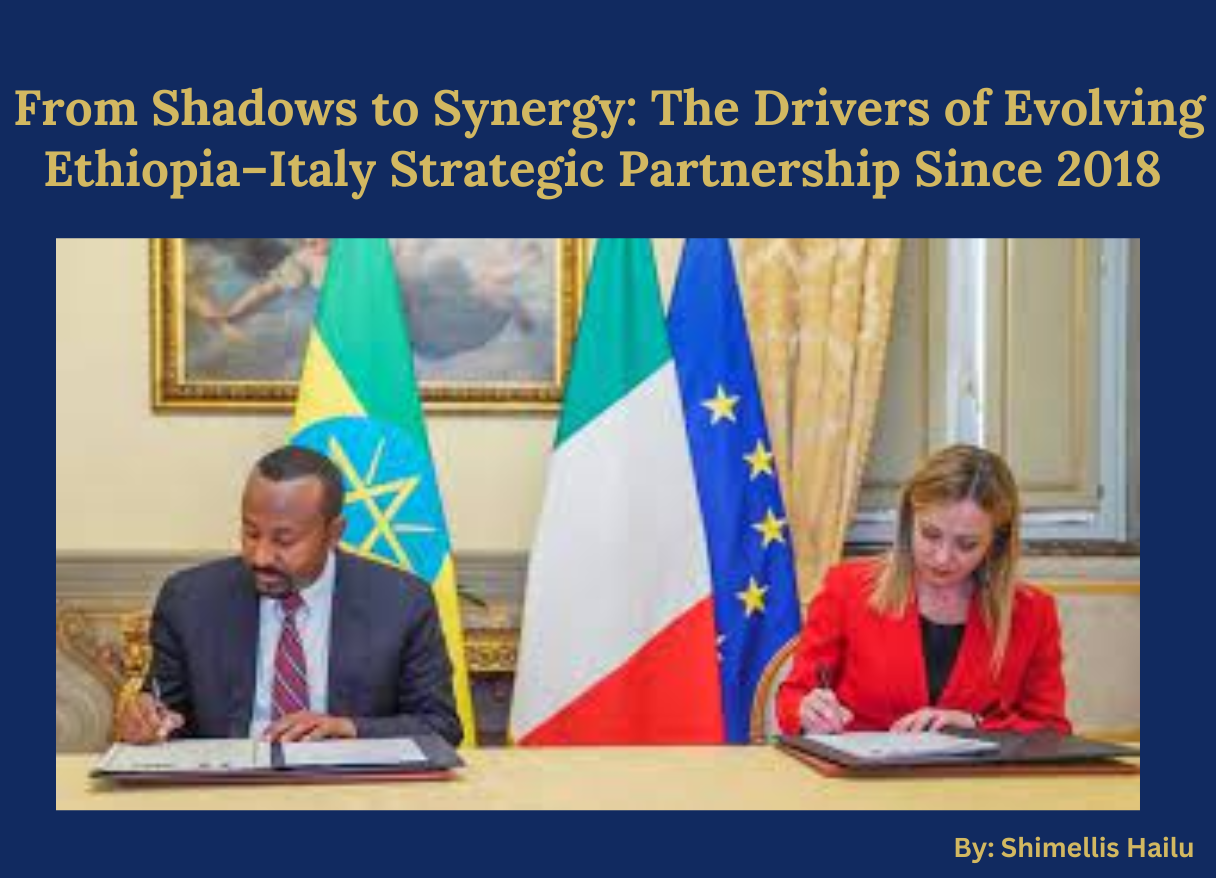
In 2025, the relationship reached new heights during the Second United Nations Food Systems Summit in Addis Ababa, co-hosted and co-chaired by the leaders of the two countries. On the side of the food system summit, Prime Ministers Abiy Ahmed and Giorgia Meloni signed a joint declaration reaffirming their cooperation and launching new sector-specific agreements implemented under the project of Italy’s Mattei Plan for Africa. These included a comprehensive agricultural modernization partnership aimed at enhancing Ethiopia’s coffee value chain, strengthening food processing industries, and expanding fisheries. The Mattei Plan for Africa also established a five-year joint committee to institutionalize collaboration and monitor implementation. Alongside these Africa-Italy partnership initiatives, Italy has continued to promote cultural exchange through scholarship programs, academic partnerships, and the restoration of historical sites, which further embedded cultural diplomacy as a key part of bilateral relations.
Drivers of the Evolving Strategic Partnership
The revitalization of Ethiopia–Italy relations since 2018 has been driven by three principal factors: converging leaders’ diplomatic styles, converging national interests, and broader shifts in the global geopolitical order.
Converging Leaders Diplomatic Styles
Ethiopia’s Prime Minister Abiy Ahmed and Italy’s Prime Minister Giorgia Meloni have both redefined the conduct of their respective countries’ foreign relations through statist, pragmatic, and historically aware approaches to diplomacy. Abiy’s leadership style blends symbolism with practical outcomes, history with current and prospects, and pragmatism with realism. For instance, his efforts to reclaim Tsehay, Ethiopia’s first aircraft looted by Mussolini, demonstrated how national heritage can serve as a vehicle for pacification and renewed cooperation. At the same time, Abiy has strategically linked symbolic gestures to tangible achievements, such as Italian commitments to Ethiopia’s reforms, development, and infrastructural expansion. His emphasis on flexible personal diplomacy and direct engagement with other heads of state has strengthened Ethiopia’s strategic autonomy through pursuing balanced relations with both Western and non-Western partners.
Meloni, on her part, has blended Italy’s Africa policy with revised ideological coherence and practical purpose. Through the Mattei Plan, she has articulated a vision of partnership that rejects the negative shadow of colonial legacies, neo-colonial dependency models, and condition aid in favor of mutual benefit and respect for state sovereignty. Her leadership combines ideological conviction with active engagement, as evidenced by her two official visits to Addis Ababa and co-chairing of multilateral events alongside African counterparts. Meloni’s preference for direct diplomacy over bureaucratic processes converged with Abiy’s diplomatic style and has helped accelerate negotiations and restore Italy’s credibility as a constructive partner on the continent. Together, Abiy’s statist, historical-driven pragmatism and Meloni’s sovereignty-focused realism have forged a new, leader-driven rapprochement based on respect, trust, and shared ambition.
Converging National Interests
Beyond converging leadership diplomatic style, the revitalization of Ethiopia–Italy relations has been anchored in the convergence of the two countries’ national priorities. Italy’s broader reorientation in foreign policy, moving away from the European Union’s traditional conditionality on governance and human rights toward respect for national sovereignty, has created fertile ground for closer cooperation with Ethiopia, whose leaders also introduced a foreign policy based on respect for its citizens and state sovereignty. Based on these converging policy reforms, for Italy, Ethiopia represents both a strategic partner in addressing irregular migration across the Mediterranean Sea and a gateway to African diplomacy and Horn of Africa geopolitics. For Ethiopia, Italy remains a crucial source of development finance, infrastructure expertise, and technology transfer.
The 2019 military agreement, the 2023 Declaration of Cooperation Framework, the return of Tsehay aircraft in 2024, the 2024 Work Corridors initiative, and the 2025 comprehensive cooperation framework agreement highlight this alignment of interests. For example, the 2024 Work corridors agreement established legal migration channels for Ethiopian workers to meet Italy’s labor demands while also addressing Ethiopia’s employment challenges (FAO, 2024). These initiatives show how shared priorities such as development, stability, and sovereignty have come together to create a partnership that is both practical and mutually beneficial.
Shifting Global Order
Finally, the global transition from unipolar order toward multipolarity and the erosion of Western cohesion have positively contributed for the Ethiopia–Italy rapprochement. As traditional Western alliances and transatlantic cohesion face internal fragmentation driven by the Russia-Ukraine war, fragmentation of NATO, Brexit, US retreat following the enthronement of Trump, U.S.–China competition, European divisions over migration and security policy, and the retreat of transatlantic consensus, value-based diplomacy and multilateral diplomacy decline as the top priority for partnerships. Following these shifts, countries such as Italy have increasingly pursued bilateral strategies to maintain diplomatic relations and extend their influence (Keukeleire & Hooijmaaijers, 2019). Ethiopia, for its part, has introduced a new diversification policy to cope with the shifting global order and maintain its partnerships with both the West and East, North and South. Ethiopia continued to maintain cordial partnerships with EU member countries, the UK, and the US, while also engaging with China, Turkey, Russia, and the Gulf States to preserve its strategic autonomy (Feldman, 2023). Both nations thus share a worldview that privileges sovereignty, non-interference, and pragmatic cooperation over ideological alignment. In this sense, the Ethiopia–Italy partnership reflects pragmatism and an adaptive response to the fragmented and transactional nature of the contemporary global system.
Policy Implications and Recommendations
Under the leadership of Prime Ministers Abiy Ahmed and Giorgia Meloni, Ethiopia and Italy have transformed a historically burdened relationship into a forward-looking partnership marked by mutual respect and shared interests. The relationship now reaches a level of multi-sectoral strategic partnerships, marking a definitive transition from long-term symbolic pacification overshadowed by colonial legacy to practical synergy. This transformation reflects both countries’ pragmatic and adaptive responses to their respective national priorities and shifting global realities. To sustain and deepen this momentum, Ethiopia and Italy must move from episodic collaboration to enduring institutionalized cooperation. To maintain these revitalized strategic partnerships, the two countries should develop a joint policy mechanism, and this policy brief recommends the following;
- Establishing a Joint Strategic Council to facilitate regular dialogue, coordinate development projects, and monitor implementation across all sectors.
- Institutionalizing the Mattei Plan for Africa within the frameworks of the African Union’s Agenda 2063 and the European Union–Africa Strategy, which will ensure policy coherence and continuity beyond leadership changes.
- Enhancing cultural and media diplomacy through exchanges, documentary co-productions, and mutual language programs, which will foster public understanding and chase away historical stereotypes.
- Expanding vocational education and research collaboration via joint university programs and innovation hubs, which will further strengthen people-to-people connections.
- Lastly, creating circular migration schemes can promote ethical recruitment, skills transfer, and the long-term sustainability of labor mobility between the two countries.
References
Baharu, Zewde. (2008). A History of Modern Ethiopia, 1855–1991. Ohio University Press.
Ethiopian Broadcasting Corporation (EBC). (2025, July 29). Ethiopia and Italy bolster ties with new cooperation framework.
https://www.ebc.et/english/Home/NewsDetails?NewsId=191
Feldman, N. (2023). The Multipolar Moment and African Agency. Brookings Institution.
Food and Agriculture Organization (FAO). (2024). Ethiopia–Italy Cooperation on Sustainable Agriculture under the Mattei Plan.
https://www.fao.org/newsroom/detail/ethiopia-italy-cooperation-on-sustainable-agriculture/en
Italian Ministry of Foreign Affairs and International Cooperation (MAECI). (2023, November). Italy allocates €39 million in humanitarian aid for Ethiopia and crisis regions.
https://www.esteri.it/en/sala_stampa/archivionotizie/comunicati/2023/11/stanziamento-di-oltre-39-milioni-di-euro-per-interventi-umanitari-in-etiopia-e-altri-contesti-di-crisi/
Italian Embassy in Addis Ababa. (2024). Return of the Tsehai aircraft to Ethiopia: A symbol of renewed partnership. https://ambaddisabeba.esteri.it/en/italia-ed-etiopia/
Marcus, H. G. (2002). A History of Ethiopia. University of California Press.
About the author
Shimellis Hailuis a researcher at the Department of America and Europe, Institute of Foreign Affairs (IFA), and a PhD candidate in Political Science at Addis Ababa University. His research interests focus on Ethiopia’s foreign policy in relation to the dynamics of great power competition, evolving geopolitics, and surfacing new diplomacy
Disclaimer:
The content disseminated by the Institute of Foreign Affairs (IFA) – including, but not limited to, publications, public statements, events, media appearances, and digital communications – reflects the views of individual contributors and does not necessarily represent the official positions or policies of the Institute, its partners, or any affiliated governmental or non-governmental entities.
While the IFA endeavors to ensure the accuracy, integrity, and timeliness of the information presented, it makes no representations or warranties, express or implied, regarding the completeness, reliability, or suitability of such content for any purpose. The Institute expressly disclaims any liability for errors or omissions, as well as for any actions taken or decisions made based on the information provided.
The inclusion of external links, references, or third-party resources does not constitute an endorsement by the Institute. Additionally, engagement on social media platforms – including, but not limited to, likes, shares, retweets (RTs), or reposts – shall not be interpreted as an endorsement or validation of the views expressed therein.
Readers and audiences are encouraged to exercise critical judgment and seek independent verification when interpreting or relying upon any information disseminated through publications and posts on the Institute’s platforms or representatives.