

- Introduction
Turkiye has emerged as a regional actor in Europe, Middle East and Africa, expanding its foreign relations across the globe (Rugutt et al., 2023). In particular, Afro-Turkish engagements have been pronounced following Ankara’s ambitious and multi-faceted long-term strategies. Historically, the late 1990s marked a significant paradigm shift in the Turkish foreign policy towards Africa (Dipama and Parlar, 2023). This shift was largely derived by the European Union’s rejection of Turkish membership bid at the 1997 summit (Özkan, 2017). Consequently, Turkiye’s problem with the European Union forced Ankara to turn its attention away from Europe, necessitating to launch the “Africa Action Plan” in 1998 (Horn Bulletin, 2022). This strategy catalyzed the re-establishment of the historical partnership between Africa and Turkiye, dating back to the era of the Ottoman Empire (Elem, 2012). Notwithstanding, the Turkish government could not effectively implement several elements of this plan until 2005. Importantly, its adoption of a new “Open to Africa Policy” in 2005, and the declaration of the same very year as “the Year of Africa” brought the aforementioned plan to the fore with renewed efforts of engagement, notably through mediation diplomacy (Bacchi, 2015),
It should be noted that Turkiye has become a key player of mediation diplomacy since the Justice and Development Party (AKP) formally adopted the platform as a strategic foreign policy instrument since 2003. This makes Turkish mediation engagements prominent internationally. Somalia, Ethiopia, Libya, Afghanistan, Iraq, Israel, Azerbaijan, Russia, Ukraine, Palestinian and Iran are some of the beneficiary countries that could be cited in this regard (Sofos, 2022). Beyond bilateral efforts, Turkiye has also shown a strong commitment to multilateral mediation diplomacy. This is epitomized by the establishment of the joint Turkish-Finnish Friends of Mediation Initiative, launched under the auspices of the United Nations Organizations. The commitment of Turkiye and other supporting countries on the initiative finally led to the development of “Friends of Mediation Group” which comprised of fifty three member countries (United Nations Organization, 2024).
Turkish proactive role in mediation diplomacy has a potential to reshape the frame through which Turkish engagement with Africa is perceived. Ankara’s acclaim as a “reliable and impartial mediator” coupled with its strategic importance for the Global North and South, makes Turkiye as a suitable mediator (Davutoğlu, 2013). Quite on the contrary, though Turkish mediation diplomacy has gained widespread acceptance, its recent motive towards more assertive geopolitical and security roles may prompt a cautious response from African countries, including Ethiopia (Clingendael, 2019). Notably, the unpredictable nature of its engagement with different countries is worth to be mentioned (Mukerem, 2024. However, Turkish assertive involvement in mediation diplomacy exemplified by the Ankara Declaration has helped to mitigate apprehensions related to Turkiye while reaffirming its commitment to balanced diplomacy.
- Ankara Process as A Litmus-Test
Stakeholders from East to West welcomed the Turkish mediation efforts that defuse Ethio-Somalia dispute. The outcome of the mediation could serve as a model for how middle powers like Turkiye can use economic and cultural links to facilitate mediation diplomacy in complex regional scenarios. It also signals the challenges faced by mediators who have significant stakes in the disputes they seek to resolve. Having close relationship with both Ethiopia and Somalia, it may not surprise Turkiye ‘naturally’ found itself as a key mediator amidst the outbreak of conflict between the two Horn countries. On their part, cognizant of the potential contribution of Turkish diplomacy in resolving conflicts, the neighboring countries – Ethiopia and Somalia – confirmed their commitment to undergo a series of discussions.
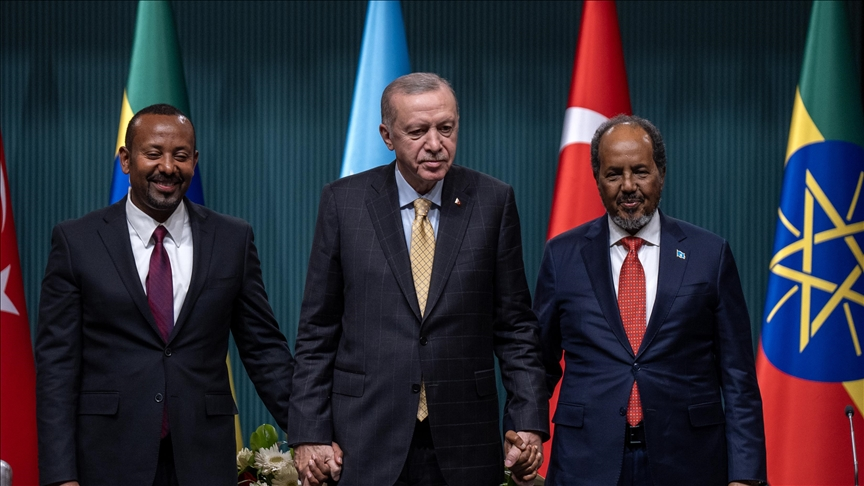
Turkish recent mediation endeavor resonates to its previous mediation engagements, such as seen with the Balkan countries. Starturka (2024) noted that Turkiye has become a reliable partner for Balkan countries thanks to its economic investments and political initiative. At the moment, the Turkish mediation diplomacy restrained the Ethio-Somalia tension with the subsequent historic agreement of the “Ankara Declaration” signed on 11 December 2024. Following the Ankara discussion, in his press statement, Ethiopian Prime Minister, Abiy Ahmed reiterated, “Ethiopia’s desire for secure access to the sea is a peaceful venture and will benefit our neighbors, it is a venture that must be seen in the spirit of cooperation, not suspicion.” While overseeing three rounds of discussion, Turkish President Recep Tayyip Erdogan also hailed the agreement which would eventually ensure access to the sea for the landlocked country, Ethiopia. From Ethiopia’s perspective, therefore, the Ankara declaration was a great victory for the landlocked country, Ethiopia.
The various phases of the Ankara process highlighted that Turkiye’s commitment on facilitating mediation between the disputing parties whatever the outcome is. Fortunately, the December 2024 discussion mediated by president Erdogan concluded with a “win-win-win solution”, implying the three states – Ethiopia, Turkiye and Somalia – had benefited from the Ankara declaration. In this connection, it can be said that Ankara’s diplomatic experience and commitment to peace-building efforts are immensely important as the Turkish government took a lead in mediating the Ethio-Somalia dispute that followed the Memorandum of Understanding (MoU). Despite being wrongly interpreted as a means of annexation by the Somali government, and its rejection by the Turkish Government, Ethiopia hopes that the MoU will “pave the way to realize the aspiration of the country to secure access to the sea and diversify its access to seaports” (Ethiopia News Agency, 2024).
As witnessed by the Ankara declaration, Turkiye’s role as a mediator has been apparently instrumental for Ethiopia and Turkiye’s foreign relations. Some analysts claimed, from the inception, Turkiye’s rejection of the MoU is inconsistent with the tradition of Ethio-Turkish friendship. History proved that the Ethio – Turkish bilateral relationship was built on a rock foundation. For that to happen, for instance, Turkiye supported Ethiopia’s cause and voted against Italy in the League of Nation’s assembly. In the then time, Turkish Foreign Minister Tevfik Rüştü Aras reportedly said that “the integral maintenance of the covenant of the League ‘was the foundation of Turkey’s foreign policy” (Horn Bulletine, 2022).
In response, Emperor Hailesellasie frequently expressed his interest in strengthening relations with Turkiye. In a similar vein, more recently, during the outbreak of the Northern Conflict in Ethiopia, Turkiye stood up with Ethiopians to bring law and order in the country. Ethiopia will never forget these practical supports during its hardest time. As in the past, therefore, there is a reasonable ground to expect a similar determination from the Turkish government regarding, for example, Ethiopia’s quest to access to sea ports.
Partner countries such as Turkiye appear to understand Ethiopia’s longstanding quest for access sea ports. This is a concern that even the President of Somalia, Hassen Sheih Mohammed, approved amidst the controversy over the MoU. He unequivocally stated, “Somalia wants Ethiopia to have access to the sea” (Aljezeera, 2024), implying the tension between Ethiopia and Somalia is surmountable with the involvement of mediators like Turkiye.
- Conclusion and Policy Recommendations
The recent Turkish mediation efforts aimed at settling Ethio-Somalia dispute have elevated Ethiopia’s legitimate quest of sovereign access to the sea to the international diplomatic arena, after decades of maritime detachment from the Red Sea. Beyond that the subsequent Ankara declaration challenges Egypt’s ambition while promoting Ethiopia’s national interest in the Horn of Africa. Amidst Ethio-Somalia tension, Egypt has been strategically strengthening its alliances with Somalia and Eritrea, ultimately targeting to pressure Addis Ababa over the GERD dispute. From Ethiopia’s perspective, the inception of an Egyptian-Eritrean-Somali alignment is viewed with caution, potentially posing a threat to its national interest in the long run. It is at this critical juncture, Turkish mediation effort bore a fruit, bringing the two conflicting Horn countries together in Turkiye, where they signed the Ankara declaration.
The Ankara process magnified Turkish prestige at the expense of Egypt – a historic arch-foe of Ethiopia. Turkish mediation diplomacy could potentially disrupt Egypt’s carefully calculated move which necessitated the creation a trilateral arrangement consisting of Egypt, Somalia and Eritrea. In other words, the fate of Egyptian-Eritrean-Somali alliance becomes uncertain, reducing the probability of the outbreak of conflict in the Horn region pertaining to the recent Ethio-Somalia tension (Nasr, 2024). This development could have a serious security implication in the Horn region.
Therefore, Turkish mediation diplomacy has introduced a new dynamic that could reshape alliances and the security terrain of the Horn region in the years to come constructively. To this end, Ethiopia and Türkiye should deepen their strategic collaboration in the realm of mediation diplomacy, extending far beyond the immediate outcome of the Ankara declaration. In particular, Türkiye can play a vital role in supporting Ethiopia’s legitimate aspiration for sovereign access to the sea through its proactive and principled mediation efforts, as Ethiopia can no longer remain confined to an artificially designed and imposed geographical prison.
4. References
Aljazeera. (2024). Don’t do it’: Somali president warns Ethiopia over Somaliland port deal. Available at https://www.aljazeera.com/
Bacchi, E. (2015). A timeline of the Turkish Africa Policy. Available at https://ovipot.hypotheses.org/
Clingendael, (2019). Turkiye in the Horn of Africa CRU Policy Brief Between the Ankara Consensus and the Gulf Crisis
Davutoğlu, A. (2013). Turkiye’s mediation: Critical reflections from the field.
Dipama, S., & Parlar, E. (2023). Assessing Turkiye-Africa Engagements (APRI Policy Brief 2/2023). Berlin: APRI. https://doi.org/
Elem, T. (2017). Economic relations between Turkiye and Africa: Challenges and prospects. Yasar University, Turkiye.
Ethiopian News Agency. (2024). Nejashi Zero Zero Project Instrumental to Promote Ethiopia’s Ancient History to World
Horn Bulletin. (2022). Turkiye and Ethiopia Perspective. Volume V Bulletin Issue II March-April 2022.
Mukerem Miftah. (2024). The socioeconomics of Ethio-Turkish relations: an appraisal of two decades. Cogent Social Sciences. https://doi.org/10.1080/23311886.2024.2338860
Ozkan, M. (2017). The Turkish way of doing development aid?: An analysis from the Somali
Rugutt, W., Nzomo., M and Okoth, P. (2023). Examining Foreign Development Assistance in Africa through Emerging Power Dynamics: A Focus on Turkiye’s Engagement in the Horn of Africa
Sofos, S. (2022). Turkye as a mediator, The Peace and Conflict Resolution Evidence Platform School of Law, Old College, The University of Edinburgh
Starturka. (2024). Turkiye is Seen as a Reliable Partner in Balkans. Available at https://www.straturka.com/
United Nations Organization (2024). Groups of Friends of Mediation. Available at https://peacemaker.un.org/
About the author
Suadiq Sufian (PhD), Senior Researcher at the Institute of Foreign Affairs.
He can be reached at Sufiansuadiq8@gmail.com
Disclaimer:
The content disseminated by the Institute of Foreign Affairs (IFA) – including, but not limited to, publications, public statements, events, media appearances, and digital communications – reflects the views of individual contributors and does not necessarily represent the official positions or policies of the Institute, its partners, or any affiliated governmental or non-governmental entities.
While the IFA endeavors to ensure the accuracy, integrity, and timeliness of the information presented, it makes no representations or warranties, express or implied, regarding the completeness, reliability, or suitability of such content for any purpose. The Institute expressly disclaims any liability for errors or omissions, as well as for any actions taken or decisions made based on the information provided.
The inclusion of external links, references, or third-party resources does not constitute an endorsement by the Institute. Additionally, engagement on social media platforms – including, but not limited to, likes, shares, retweets (RTs), or reposts – shall not be interpreted as an endorsement or validation of the views expressed therein.
Readers and audiences are encouraged to exercise critical judgment and seek independent verification when interpreting or relying upon any information disseminated through publications and posts on the Institute’s platforms or representatives.