

Introduction
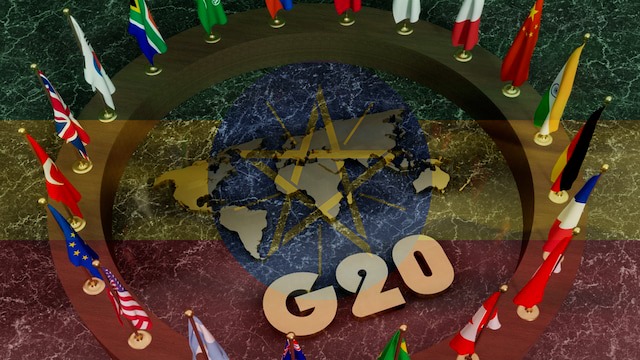
The 20th Summit of the Group of Twenty (G20), convened in Johannesburg, South Africa, marked a historic moment for Africa within global economic governance. For the first time, African voices—represented by the African Union as a permanent G20 member—held a decisive role in shaping the agenda for sustainable growth, digital equity, and climate resilience. For Ethiopia, a leading diplomatic power in the Horn of Africa and a champion of continental integration, the summit provided both a diplomatic opportunity and a developmental imperative. It demonstrated Ethiopia’s evolving statecraft: positioning itself as a bridge between developing economies and major economic powers while advancing an African-led policy consensus around equitable growth, the energy transition, and innovation governance (African Union Commission [AUC], 2025; Ministry of Foreign Affairs of Ethiopia [MoFA], 2025).
Strategic Anchors: From National Vision to Global Advocacy
Ethiopia’s engagement at the 2025 G20 Summit is underpinned by its domestic policy frameworks, particularly the Digital Ethiopia 2025 strategy and its successor, Digital Ethiopia 2030 (DE2030). These frameworks seek to transform Ethiopia into a digitally driven economy with equitable access to technology and opportunities (World Bank, 2024). DE2030 expands the original digital strategy by placing greater emphasis on ethical artificial intelligence (AI) development, cybersecurity, and cross-border data governance. This domestic focus aligns with the global G20 agenda on shaping safe and inclusive digital economies.
At the same time, Ethiopia’s Climate-Resilient Green Economy (CRGE) strategy serves as a foundation for its energy diplomacy within the G20. The nation’s messaging at the Johannesburg summit centered around advancing a Just Energy Transition—promoting clean energy access without compromising growth trajectories. Ethiopia’s argument is framed through the normative lens of Common but Differentiated Responsibilities and Respective Capabilities (CBDR-RC), which posits that industrialized nations must bear a greater burden for financing Africa’s transition to renewable energy (African Development Bank [AfDB], 2024).
Leveraging its vast potential for hydropower, solar, and geothermal energy, Ethiopia called for multilateral support in scaling renewable infrastructure through debt-for-climate swaps, concessional financing, and technology sharing. This position resonated with continental initiatives such as the AU’s Addis Ababa Declaration on Climate Change and Call to Action (AUC, 2025), reinforcing Ethiopia’s leadership in the global South’s collective demand for climate justice.
Digital Sovereignty and the Fight against “Digital Colonialism”
A major dimension of Ethiopia’s strategy at the G20 was the advocacy for equitable digital governance. The emergence of an AI-driven global economy presents both opportunities and risks for developing states. Ethiopia’s intervention on Artificial Intelligence Governance emphasized closing the digital divide while preventing what its delegation termed “digital colonialism”—a situation where technological dependency perpetuates structural inequities between the Global North and South (Kassa, 2024).
Under the DE2030 framework, Ethiopia promotes principles of digital sovereignty, advocating for open data ecosystems, localized innovation ecosystems, and regional cloud infrastructure built on African regulatory frameworks. By aligning these proposals with the African Union’s ongoing work to establish a Continental Artificial Intelligence Strategy, Ethiopia positioned itself as a policy entrepreneur within the G20 digital inclusion agenda (Agarwal, 2025). These advocacy efforts drew inspiration from the UN’s Global Digital Compact, highlighting the country’s commitment to a digital order that upholds ethical standards, inclusivity, and transparency (United Nations, 2024).
Finance, Fairness, and Reforming Global Economic Institutions
Beyond sectoral initiatives, Ethiopia’s diplomacy at the Johannesburg Summit was guided by the principle of structural reform within international financial governance. As a member state closely tied to the BRICS+ architecture, Ethiopia endorsed calls for a more representative global financial system focused on sustainable development financing and debt relief for developing economies (BRICS Secretariat, 2024).
Ethiopia’s delegation underscored the mismatch between Africa’s demographic and resource endowments and its limited representation in global decision-making bodies. Its proposals included the expansion of the International Monetary Fund’s Special Drawing Rights (SDRs) for low-income countries and the redirection of climate finance through multilateral development banks such as the African Development Bank and the New Development Bank (NDB, 2025). These mechanisms, Ethiopia argued, could bolster Africa’s fiscal space without deepening debt distress.
The Ethiopian Prime Minister’s address also echoed themes of developmental multilateralism, calling for an integrated approach to trade, climate adaptation, and digital infrastructure. Such positions were critical in reinforcing Ethiopia’s identity as both a reformist and a bridge-builder between the Global South and established economic powers (Ahmed, 2025).
Pan-African Coordination and Leadership
Ethiopia’s participation in the Johannesburg Summit illustrated the convergence between its domestic reforms and its continental diplomacy. As host of the African Union Headquarters and a permanent voice within Africa’s G20 delegation, Ethiopia coordinated closely with South Africa, Nigeria, and Egypt to articulate a common African position on global equity, technology transfer, and sustainable industrialization.
By linking national strategies to Agenda 2063’s flagship projects—including the African Continental Free Trade Area (AfCFTA) and the Pan-African Payment and Settlement System—Ethiopia reinforced the message that Africa’s integration is indispensable to global prosperity (AUC, 2025). This cooperative posture underscored Ethiopia’s transformation from a largely aid-dependent economy into a diplomatic actor advocating for fairness, autonomy, and shared advancement.
Conclusion: A Catalyst for African Voice and Vision
Ethiopia’s policy architecture at the 2025 G20 Summit embodies the country’s broader transition from inward development planning to proactive global engagement. Grounded in its technological modernization agenda and commitment to green growth, its diplomacy in Johannesburg provided a template for how African economies can negotiate a seat at the table of global governance—on their own terms.
By promoting Just Energy Transition, Digital Sovereignty, and Global Institutional Reform, Ethiopia positioned itself not as a peripheral observer but as a key player in the reconfiguration of economic power. In doing so, it reaffirmed its status as a continental thought leader navigating a rapidly transforming global landscape.
References
African Development Bank (AfDB) (2024) Horn of Africa regional infrastructure collaboration report 2024. Addis Ababa.
African Union Commission (AUC) (2025) Addis Ababa Declaration on Climate Change and Call to Action. AUC Press.
Agarwal, S. (2025) AI ethics and governance in emerging economies: African partnership models. Global Policy Review, 8(2), pp. 55–71.
Ahmed, A. (2025) Speech delivered at the BRICS Summit, Rio de Janeiro. Office of the Prime Minister of Ethiopia.
BRICS Secretariat (2024) BRICS expansion and global multipolarity report. BRICS Policy Paper.
Kassa, M. (2024) Ethiopia’s economic diplomacy in a multipolar era. Addis Ababa University Review, 12(1), pp. 33–49.
Ministry of Foreign Affairs of Ethiopia (MoFA) (2025) Ethiopia–India joint statement on strategic partnership. Addis Ababa: MoFA.
NDB (New Development Bank) (2025) Expanding Horizons: Project financing statistics 2024–2025. NDB Annual Report.
United Nations (2024) Global Digital Compact: Summary and outcomes report. New York: United Nations Publications.
World Bank (2024) Ethiopia economic update: Refugees, inclusion, and development. Washington, D.C.: World Bank Group.
Yitina Gebre (Ph.D.), Senior Researcher at the Multilateral Affairs Department, Institute of Foreign Affairs
Disclaimer:
The content disseminated by the Institute of Foreign Affairs (IFA) – including, but not limited to, publications, public statements, events, media appearances, and digital communications – reflects the views of individual contributors and does not necessarily represent the official positions or policies of the Institute, its partners, or any affiliated governmental or non-governmental entities.
While the IFA endeavors to ensure the accuracy, integrity, and timeliness of the information presented, it makes no representations or warranties, express or implied, regarding the completeness, reliability, or suitability of such content for any purpose. The Institute expressly disclaims any liability for errors or omissions, as well as for any actions taken or decisions made based on the information provided.
The inclusion of external links, references, or third-party resources does not constitute an endorsement by the Institute. Additionally, engagement on social media platforms – including, but not limited to, likes, shares, retweets (RTs), or reposts – shall not be interpreted as an endorsement or validation of the views expressed therein.Readers and audiences are encouraged to exercise critical judgment and seek independent verification when interpreting or relying upon any information disseminated through publications and posts on the Institute’s platforms or representatives.