

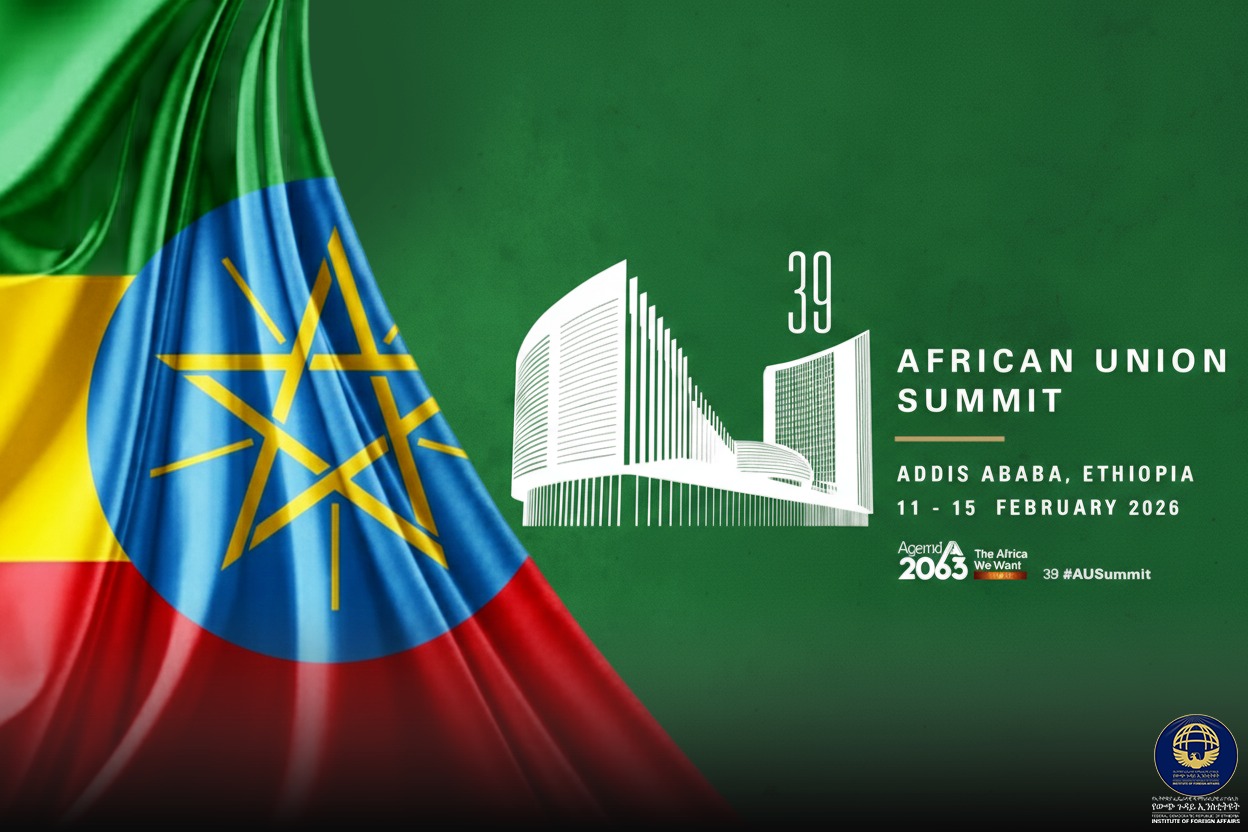
Traditional security is no longer the dominant agenda of the African Union summit. Instead, water has become the central focus for 2026. The designation of “Assuring Sustainable Water Availability and Safe Sanitation Systems to Achieve the Goals of Agenda 2063”[1] as the theme of the year indicates the centrality of water in the continental transformation envisioned by Agenda 2063. Nevertheless, water is a highly sensitive issue. The traditional conception of water as merely H₂O, abstract, apolitical, asocial, and a purely hydrological process has been challenged in academia and public discourse.[2] Water is inherently political, both in terms of allocative politics, that is, ‘who gets how much water, when, where, and how,’ and in shaping the question of ‘who I am’ as an individual, a society, and a state. It is simultaneously a matter of physical security and ontological security.
Furthermore, water is embedded in multiple socially constructed realities, where power plays a significant role in privileging certain ways of viewing water while marginalizing others. The elusive question, therefore, is how the AU Summit will reconcile competing views of water and divergent resource development paradigms such as the hydraulic mission, integrated water resource management, and the water-energy-food-ecosystem nexus. And in doing so, how it shapes a shared continental water world(s) grounded in a common political and developmental logic. Will its agenda and outcomes bring a paradigm shift in water resource management and development, and more importantly in the very notion of the so-called “water security”? Such a shift could have significant implications for member states’ water policies, resource management and development, Africa’s common position on water security, and, importantly, the financial and investment landscape of the water sector.
The AU Theme for 2026, “Assuring Sustainable Water Availability and Safe Sanitation Systems to Achieve the Goals of Agenda 2063”, was adopted during the 38th Ordinary Session of the Assembly of the Union, held from 15-16 February 2025.[3] It was one of the key outcomes of the 2025 summit. From the AU’s perspective, the theme was chosen because achieving water security is regarded as essential for realizing Africa’s aspirations under Agenda 2063.
Second, although the theme appears to be an isolated theme, it is in fact central to the broader Agenda 2063. Water contributes directly and indirectly to the realization of all listed goals and priorities of the Agenda. It complements other AU initiatives and, in particular, aligns with Goal 7, which emphasizes building “environmentally sustainable and climate-resilient economies and communities.”[4]
Third, the focus on water also provides the AU with an opportunity to align its theme with the Sustainable Development Goals, especially Goal 6 on clean water and sanitation.[5] Furthermore, by making water security as a continental agenda, the AU can shape the UN Water Conference of 2026, which will focus on Goal 6. In this way, the AU’s 2026 summit outcome on water has strategic importance for the continent as it may shape both the agenda and the outcomes of the UN Water Conference. This, however, depends on whether the AU adopts a common position on water and whether member states commit to it, rather than prioritizing narrow national interests in global forums, which is a siloed approach that undermines the continental bargaining power. To advance this, the 2025 AU Assembly tasked the Commission “to develop an Africa Policy on Water that provide a strategic framework towards inclusive and climate resilient water security in the continent beyond 2025”.[6]
In line with the AU 2025 summit outcomes, Africa Water Vision 2026 and Policy (AWVP63) were prepared by the African Ministers’ Council on Water (AMCOW).[7] AMCOW adopted AWVP63 during its 14th Ordinary Session on 29 September 2025 in Dakar. Hence, the AU Assembly of Heads of State and Government, which is the highest decision-making body of the Union, may endorse the proposed Africa Water Vision 2026 and Policy (AWVP63). In its communiqué, AMCOW also decided to finalize the policy by submitting to relevant body for the consideration of endorsement by the AU Assembly of Heads of State and Government during its 39th Ordinary Session in 2026. AWVP63 envisions “a water-secure and resilient Africa with safe sanitation for all”.[8] AWVP63 was designed to serves as the “continent’s transformative and strategic framework” for two purposes: to realize an inclusive and climate-resilient water security; and guide continental action towards the attainment of agenda 2063.[9]
AWVP63 and the water security centered AU 2026 summit intended to bring paradigm shift in Africa’s water security discourse. It has several unique features. First, what is new at the continental level is the transition from siloed thinking to nexus thinking. The African Water Policy adopts the Water-Energy-Food-Ecosystems (WEFE) nexus as a guiding framework for water resource development and planning.[10] This indicates a shift from the earlier integrated water resources management approach toward a more comprehensive nexus perspective. The nexus framework helps to identify and manage trade-offs and synergies among interconnected sectors (water, energy, food, and environment) both within national boundaries and across borders in the case of transboundary water resources. If effectively applied, the nexus can strengthen water, food, energy, and environmental security at national, regional, and continental levels. However, operationalizing and implementing the nexus may be constrained by existing siloed approaches embedded in countries’ legal systems, institutional structures, and prevailing water worldviews. Despite the challenges of operationalizing, the adoption of nexus framework has significant implications for water resource management, development, and financing.
Second, there is a shift in the meta-narratives about water as the policy takes valuing water as a principle. The policy encourages member states, societies, the private sector, and water users to move beyond traditional fragmented water use and management toward systemic and holistic approach. It also calls for a rethinking of water itself, not as a mere resource to be exploited, but as something to be valued and placed at the center of Africa’s transformation. Water security is framed both as a goal in its own right and as a means to achieving other continental objectives under Agenda 2063. In this sense, “the development of water” is understood as “a means to an end.”[11]
Third, water security is conceived as extending beyond national security, becoming a continental and, more importantly, a global security issue. Fourth, the policy may create a favorable environment for water investments in Africa. Fifth, it emphasizes on the equitable and sustainable use and management of water resources. Sixth, there is strong alignment of AWVP63 with both the continental Agenda 2063 and the global Sustainable Development Goals.
In conclusion, the 39th Ordinary Session of the Assembly of the African Union Heads of State and Government may redefine the concept of water and water security, with implications for how water is understood, the prevailing paradigms of water resource management, the development of water infrastructure, and Africa’s role in the global water discourse. A major expected outcome of the summit is the endorsement of the Africa Water Vision 2026 and Policy. Complementary to this, if the AU Assembly endorses AWVP63 as Africa’s Common Position, it will raise Africa’s priorities in the water sector to the level of the global water agenda. This would also shape the United Nations 2026 Water Conference, particularly its focus on Goal 6 concerning clean water and sanitation. Furthermore, the Assembly is expected to launch the Theme of the Year 2026 to mark and commemorate this continental commitment.
[1] African Union (2025, February 15-16). Decision on the African Union Theme of the Year 2026 “Assuring Sustainable Water Availability and Safe Sanitation Systems to Achieve the Goals of Agenda 2063” (Assembly/AU/Dec.912(XXXVIII)). 38th Ordinary Session of the Assembly of the Union, Addis Ababa, Ethiopia.
[2] Linton, Jamie (2014). Modern water and its discontents: a history of hydrosocial renewal. Wiley
Interdisciplinary Reviews: Water, 1(1), 111-120.
[3] African Union (2025, February 15-16). Decision on the African Union Theme of the Year 2026 “Assuring Sustainable Water Availability and Safe Sanitation Systems to Achieve the Goals of Agenda 2063” (Assembly/AU/Dec.912(XXXVIII)). 38th Ordinary Session of the Assembly of the Union, Addis Ababa, Ethiopia.
[4] See African Union. Goals & Priority Areas of Agenda 2063. Available at: https://au.int/en/agenda2063/goals
[5] United Nations. Goal 6: Ensure access to water and sanitation for all. Available at:
https://www.un.org/sustainabledevelopment/water-and-sanitation
[6]African Union (2025, February 15-16). Decision on the African Union Theme of the Year 2026 “Assuring Sustainable Water Availability and Safe Sanitation Systems to Achieve the Goals of Agenda 2063” (Assembly/AU/Dec.912(XXXVIII)). 38th Ordinary Session of the Assembly of the Union, Addis Ababa, Ethiopia.
[7] African Ministers’ Council on Water (2025, September 29). Communiqué on the adoption of the Africa Water Vision 2063 and Policy and launch of its implementation. 14th Ordinary Session of the Governing Council, Dakar, Republic of Senegal.
[8] African Ministers’ Council on Water (2025, September 29). Communiqué on the adoption of the Africa Water Vision 2063 and Policy and launch of its implementation. 14th Ordinary Session of the Governing Council, Dakar, Republic of Senegal.
[9] African Ministers’ Council on Water (2025, September 29). Communiqué on the adoption of the Africa Water Vision 2063 and Policy and launch of its implementation. 14th Ordinary Session of the Governing Council, Dakar, Republic of Senegal.
[10] African Union (2025, February 15-16). Hosting of the Third African Implementation and Partnership Conference on Water (PANAFCON) from 27-29 May 2025, in Lusaka, Zambia (Assembly/AU/22(XXXVIII)). Thirty-Eighth Ordinary Session of the Assembly of the Union, Addis Ababa, Ethiopia.
[11] African Union (2025, February 15-16). Hosting of the Third African Implementation and Partnership Conference on Water (PANAFCON) from 27-29 May 2025, in Lusaka, Zambia (Assembly/AU/22(XXXVIII)). Thirty-Eighth Ordinary Session of the Assembly of the Union, Addis Ababa, Ethiopia.
Gashaw Ayferam Endaylalu, Ph.D., is Directorate General of the African Affairs department at the Institute of Foreign Affairs,
Disclaimer:
The content disseminated by the Institute of Foreign Affairs (IFA) – including, but not limited to, publications, public statements, events, media appearances, and digital communications – reflects the views of individual contributors and does not necessarily represent the official positions or policies of the Institute, its partners, or any affiliated governmental or non-governmental entities.
While the IFA endeavors to ensure the accuracy, integrity, and timeliness of the information presented, it makes no representations or warranties, express or implied, regarding the completeness, reliability, or suitability of such content for any purpose. The Institute expressly disclaims any liability for errors or omissions, as well as for any actions taken or decisions made based on the information provided.
The inclusion of external links, references, or third-party resources does not constitute an endorsement by the Institute. Additionally, engagement on social media platforms – including, but not limited to, likes, shares, retweets (RTs), or reposts – shall not be interpreted as an endorsement or validation of the views expressed therein.
Readers and audiences are encouraged to exercise critical judgment and seek independent verification when interpreting or relying upon any information disseminated through publications and posts on the Institute’s platforms or representatives.