

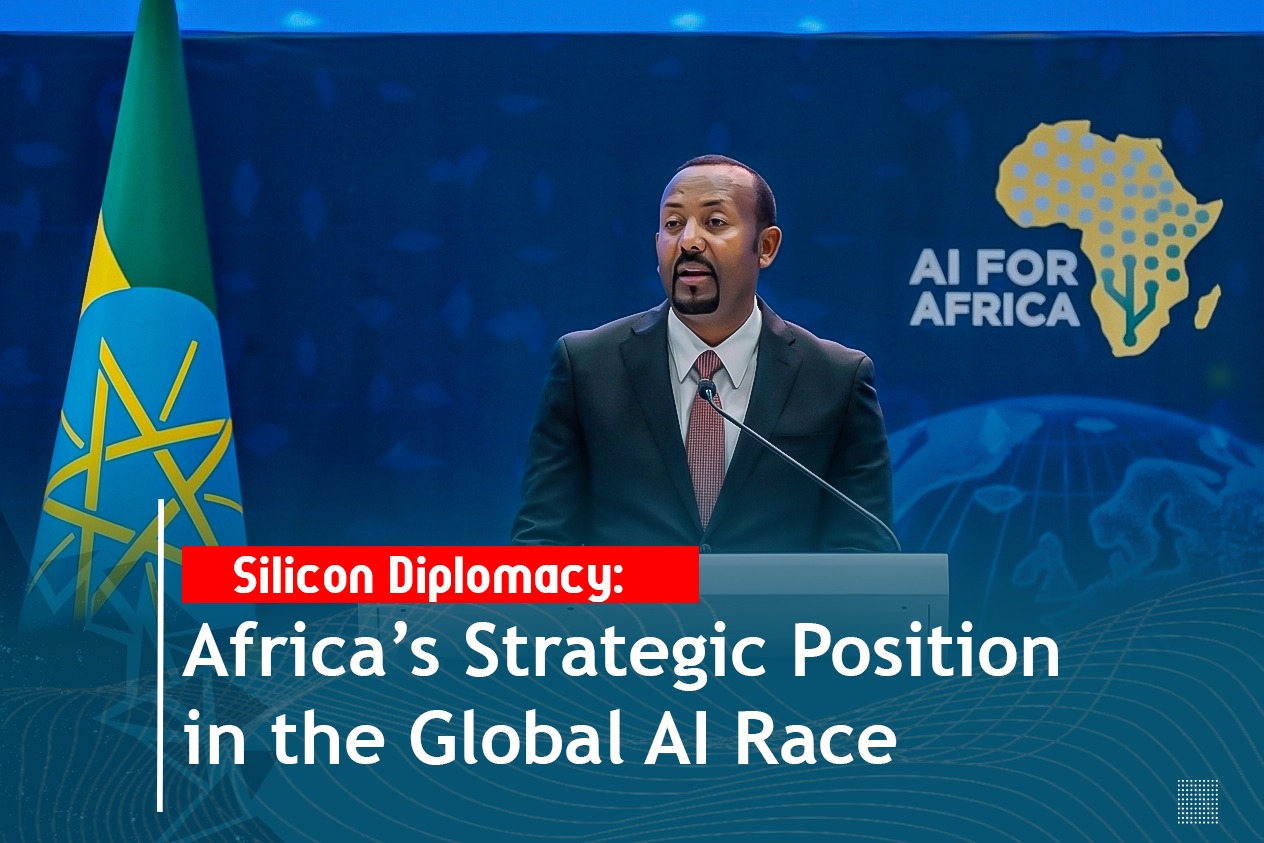
Artificial Intelligence (AI) is quickly transforming the global geopolitics, economics, and the system of innovations in the world. Established forces like the United States and China are engaged in technological supremacy, placing a lot of money in AI research, infrastructure, regulatory leadership, and world standard arrangement (Financial Times, 2025). The implications of this competition are far-reaching on other regions outside the boundaries of these powers such as Africa whereby digital technologies are becoming a key component in the economic changes and the governance system. African states cannot afford to remain passive consumers of technologies developed in other regions. Therefore, a strategic approach to AI is a foreign policy requirement—which this brief refers to as Silicon Diplomacy—to incorporate technological priorities into diplomatic, economic, and security planning. In the case of Africa, continental action can positively modify global norms, build local capacity and streamline the development of AI with long term sovereignty and prosperity objectives.
Ethiopia provides a clear example of how one nation in Africa is converting the AI strategy into a national policy and institutional innovation. In 2020, Ethiopia created the Ethiopian Artificial Intelligence Institute (EAII) to organize the research, regulation, and application of AI in the country, including in healthcare, agriculture, and the government (AllAfrica.com, 2025; ENA English, 2024). Recent reports suggest that an African second specialized AI university is underway, which will be operational at the next Ethiopian year (2026-2027), and through which it is anticipated to produce thousands of AI skilled professionals and host a center of applied and practical AI education (ENA English, 2026; AfroInsightNews, 2026). Those developments explain why Ethiopia is further planning to establish itself as an African and a global leader in AI, applying innovation to foreign policy and human capital formation.
1. The Global AI Geopolitical Situation.
Artificial intelligence has become the center of balance in the world, and the largest states are competing not only in their ability to develop technologies but also in their control over regulations. China has put forward plans of international collaboration on AI regulation, whereas the Western countries focus on protecting technological resources and establish norms using standards and export regulations (Reuters, 2025a; Financial Times, 2025). In these regards African states may either submit to technologies and styles of governance developed in other countries or engage in the development of rules and norms. The European Union, e.g. has gone further to come up with regulatory frameworks like the AI act aimed at exporting their standards. In such high-level debates, African concerns are likely to be sidelined unless there is a coordinated continental engagement.
2. Emerging Strategic Agenda in Africa.
Institutions in Africa are strongly appreciating the importance of AI and its strategic value. In 2024, the African Union (AU) established the Continental Artificial Intelligence Strategy which makes AI a driver of socio economic transformations and ethical leadership on the continent (African Union, 2024a). In line with this, there exists the African Digital Compact that envisions common digital change objectives (African Union, 2024b). In the course of the High Level Policy Dialogue on the Development and Regulation of AI in Africa, the delegates of over 40 African states have reached a consensus, that continental frameworks are necessary to foster capacity building, innovation ecosystems, and safeguard the rights of the citizens in the digital setting. These policy achievements are an indication of a developing agreement that AI should be incorporated into more comprehensive diplomatic, economic, and security policies to ensure maximum benefits and minimum risks.
3. The Strategy of AI and Institutional Innovation in Ethiopia.
Ethiopia has become one of the most dynamic states in Africa when it comes to creating AI institutional ecosystems. Since the launch of the Ethiopian Artificial Intelligence Institute (EAII) in 2020, AI has been used in the country in various fields, such as the agricultural industry, service delivery, and cloud computing (ENA English, 2023). Prime Minister Abiy Ahmed has emphasized on multiple occasions that AI is one of the national priorities, stating that Ethiopia aspires to become a leader in the era of intelligence on the continental level (ENA English, 2026a). During the 39th AU Summit, he emphasized the fact that Ethiopia was about to open a specialized AI university, based on the its philosophy of Medemer (synergy) and focused on integrating local values with the rigour of science and pragmatic innovation (ENA English, 2026a; ENA English, 2026b). It is being prepared and is set to graduate up to 1,000 specialists in a year, and provide scholarships to students of the rest of Africa (AfroInsightNews, 2026).
Besides the educational institutions, Ethiopia has recently opened the Artificial Intelligence University Innovation Pod (AI UniPod) in Addis Ababa as a research and innovation center set up by the EAII in collaboration with Addis Ababa University and the United Nations Development Programme (UNDP) through its Timbuktoo Initiative (AllAfrica.com, 2026). The facility will help to develop local talent, startups, and connect research to real-world uses of AI. Deputy Prime Minister Temesgen Tiruneh called the AI UniPod a game-changer project that will turn Ethiopia into a technology-consumer nation into a technology-maker and shaper of its own digital future (FMC, 2026). The AI university and innovation hub are structural components of Ethiopia’s Silicon Diplomacy strategy, combining domestic capacity development and continental connectivity with international affairs.
4. African AI Development risks and opportunities.
Although Ethiopia and much of Africa are increasingly serious about AI through institutional efforts, there are weaknesses in the structure. African countries are highly unequal in terms of digital infrastructures, education, and governance capabilities, which may limit the creation of beneficial, inclusive AI ecosystems (ArXiv, 2026a; ArXiv, 2026b). In case of lack of coordination, investments may be isolated and regulatory fragmentation would pull down the competitiveness of the continent. In addition, there exists the threat of digital colonialism, where the international technology companies harvest data and economic benefits with little transfer of technology and orientation to local development goals (Pan African Parliament, 2025).
Nevertheless, the demographic power of Africa, which has a large young population that is willing to be involved in digital innovation, and its endowed material base gives it strategic advantage. Programmes, such as the African Continental Free Trade Area (AfCFTA), open chances to harmonize digital trade and implement AI policies in various economies, which can contribute to a bigger market, will be able to draw in investment and obtain an advantage in any international negotiations (African Union, 2024b). By integrating AI into institutional structures and the foreign policy planning process, Africa will be able to use its internal advantages to influence international norms and develop fair technological destinies.
4.1. The Geopolitical Tightrope: From Passive Consumer to Strategic Player
To realize the vision of Silicon Diplomacy, African states must move beyond a binary choice between the United States and China and instead adopt a strategy of strategic multi-alignment. This approach requires deliberately leveraging competition among global powers to secure maximum national and continental benefit.
With China, negotiations should prioritize the rapid deployment of physical digital infrastructure—such as fiber-optic networks, 5G systems, and data centers—as well as affordable smart devices. In return, African countries can offer access to their expanding digital markets and, where relevant, critical minerals essential to global technology supply chains, but strictly in exchange for firm commitments on local employment, technology transfer, and joint ventures that build domestic capacity.
Engagement with the European Union (EU) should focus on strengthening regulatory and institutional capacity. Given the EU’s leadership in digital governance, African institutions can collaborate to design context-sensitive regulatory frameworks that enhance sovereignty in rule-making rather than merely replicating external standards.
With the United States, the emphasis should be on harnessing private-sector dynamism by attracting venture capital, promoting startup exchange programs with hubs like Silicon Valley, and strengthening innovation ecosystems such as Ethiopia’s AI UniPod. Agreements should create favorable conditions for U.S. technology investment while securing commitments to mentor local entrepreneurs and establish regional headquarters in Africa.
At the same time, African states should deepen cooperation with partners across the Global South—including countries such as Brazil, India, and Indonesia—particularly within platforms like the Group of 77. A coordinated bloc can advocate for a more equitable global AI governance framework at the United Nations and challenge the dominance of OECD-led rule-setting. This multi-pronged strategy demands a sophisticated and well-coordinated foreign service, but it remains the most viable pathway to ensuring that Africa’s engagement with global powers translates into genuine, durable technological capacity and strategic autonomy.
5. The Case for Silicon Diplomacy.
Here, Silicon Diplomacy is described as an approach to foreign policy that incorporates technological interests into foreign policy, considering AI to be a space of international rivalry and collaboration. In the case of African nations, and including Ethiopia, the Silicon Diplomacy involves the proactive negotiation of technology alliances, which would focus on the capacity building, data sovereignty, ethical implementation, and knowledge transfer. Unified continental activity enables the African states not only to pursue interests on common fronts in their international forums, but also to check external demands that could otherwise favor the market over local interest. Ethiopia’s upcoming AI University and research hubs demonstrate how national institutions can serve as a blueprint for larger diplomatic initiatives, linking domestic innovation to global collaboration and leadership.
6. Policy Recommendations
In order to convert the Silicon Diplomacy dream into reality and the sovereignty of a nation in terms of technological capability, the African states need to follow a coordinated policy founded on three pillars: Collective Bargaining, Strategic Investment and Proactive Deal-Making. The recommendations that will be in place are expected to be applied on national, regional and continental level.
Pillar I: Organizational Bargaining and Regulatory Statecraft.
The African countries need to act with a united voice to influence, but not merely follow, world standards of AI. A disjointed regulatory framework undermines the bargaining capacity of the continent and opens up a competition to the bottom. Move AI Ethics and Data Governance to a Binding Continental Convention: The African Union (AU) ought to speed up the process of developing the Continental Artificial Intelligence Strategy and make it a binding legal document.
Pillar II: Strategic Investment and Eco Development.
Diplomatic leverage is anchored on domestic capacity. The investments should not be a one-off project but should be constructed to create systems that are resilient and interconnected. Create an AI Readiness First Fund: Special financing, supported by the AfCFTA and African Development Bank, needs to be created with a specific focus on investing in the underlying infrastructure of AI readiness. This is not limited to general infrastructure but rather it is concentrated on data Infrastructure: Funding the production of open, high-quality, and anonymised African data to train AI in essential fields such as agriculture, healthcare and delivery of public services.
Pillar III: Relationship By Deal / Relationship By Conditional Partnerships.
Africa should not be treated as a mere recipient of aid and technology from world powers, but as a strategic partner with explicit requirements. Implement a Compulsory “Technology Transfer & Local Content” Model on all Large Major AI Procurement: All major AI contracts between an African government or continental organization and a foreign party (whether public or private) will have enforceable provisions regarding:
- Local R&D Requirements: The research and development should be a certain percentage of the work done by African engineers.
- Joint Intellectual Property (IP) Ownership: The IP resultant out of partnerships between African data or public resources must not be exclusively owned by the foreign partner.
- Conditional Market Access (The “Africa First” Clause): Bait on the huge AfCFTA market. As an illustration, we may force the international ride-hailing or e-commerce application to share anonymized information with the local universities and share equity with the local partners as a requirement to operate nationwide.
- Assign “Tech Attachés to Strategic Diplomatic Missions: Ministries of Foreign Affairs ought to hire and post technology diplomats to major posts (Beijing, Washington D.C., Brussels, Geneva, Dubai, and Bangalore). Their mandate would be mapping and analyzing host countries’ AI strategies, corporate landscapes, and regulatory trends to inform African policymaking, proactively negotiate on technology partnerships that align with the “Africa First” framework, prioritizing data sovereignty, infrastructure investment, and ethical AI implementation, forging alliances with like-minded mid-power nations (e.g., Brazil, India, Indonesia) to build a Global South bloc capable of counterbalancing US-China-EU dominance in global AI governance forums, and lastly facilitating technology transfer by connecting African startups and researchers with potential investors, partners, and knowledge networks in the host country.
7. Conclusion
The AI is not limited to the worlds of lab work or commercial innovation anymore; it is a military aspect of power on an international scale, on the arena of economic activity, and on the global foreign policies. With empowerment of institutions and continental collaboration, Africa can become an active agent in the development of the global AI environment through the implementation of a Silicon Diplomacy agenda that will allow the continent to capitalize on demographic advantages, institutional investments, and regional collaboration to create equitable and sovereign technological futures. Ethiopia’s investments in national AI institutions, education, and innovation partnerships provide a compelling model of how a nation can align domesticcapacity with internationalstrategy. This approach not only drives national development but also positions the country for technological leadership across the continent in the 21st century.
References
African Union. (2024a). Continental Artificial Intelligence Strategy. African Union Commission. https://au.int/en/pressreleases/20240617/african-ministers-adopt-landmark-continental-artificial-intelligence-strategy
African Union. (2024b). African Digital Compact. African Union Commission. https://au.int/en/pressreleases/20240617/african-ministers-adopt-landmark-continental-artificial-intelligence-strategy
AllAfrica.com. (2026). Newly launched AI UniPod set to transform Ethiopia into Africa’s tech hub. https://allafrica.com/stories/202602170117.html
ArXiv. (2026a). AI readiness and infrastructure gaps in Africa. https://arxiv.org/abs/2601.06145
ArXiv. (2026b). AI capacity development and digital ecosystems in Africa. https://arxiv.org/abs/2512.05432
FMC. (2026). Ethiopia poised to shift from technology consumer to digital creator. https://www.fanamc.com/english/ethiopia-poised-to-shift-from-technology-consumer-to-digital-creator-deputy-pm-says-at-ai-unipod-launch/
Financial Times. (2025). US–China competition in AI technology and global governance. https://www.ft.com/content/f7a5b184-1fef-4f02-b957-4c2b07adf91f
ENA English. (2024). Nation strengthening AI technology to modernize, enhance efficiency. https://www.ena.et/web/eng/w/eng_3633464
ENA English. (2026a). Ethiopia sets sight on AI leadership in Africa. https://www.ena.et/web/eng/technology
ENA English. (2026b). Ethiopia’s first AI University to become functional next Ethiopian year. https://www.ena.et/web/eng/w/eng_8234034
Pan‑African Parliament. (2025). Data sovereignty and digital colonialism in Africa. https://pap.au.int/en/news/press-releases/2025-07-25/pan-african-parliament-champions-africas-quest-data-sovereignty-and
Reuters. (2025a). China’s premier proposes global AI cooperation organisation. https://www.reuters.com/world/china/chinas-premier-li-proposes-global-ai-cooperation‑organisation‑2025‑07‑26
About the author
Dr. Tesfaye Bezabih is a lead researcher at the Institute of Foreign Affairs. He got his Ph.D. in Journalism and Mass Communication from Assam University through the Indian Cultural Council Relations African Scheme scholarship program. Formerly, he was an Assistant Professor of Journalism and Communication at Wollo University. He has also been serving as an External examiner and Guest Lecturer at AAU. He has published several empirical and policy research papers in the areas of media and communication, Foreign policy, climate diplomacy, public diplomacy, and much more. His Ph.D. dissertation has also won the 2017 Open Society Research Grant. He currently works as a Foreign Policy Researcher at the Europe and America Research Directorate at the Institute of Foreign Affairs (IFA) and as Director General of Knowledge Management at the Training Unit at IFA. Professionally, he has been participating in several government and Non-government duties and accomplished fundamental achievements.
Disclaimer:
The content disseminated by the Institute of Foreign Affairs (IFA) – including, but not limited to, publications, public statements, events, media appearances, and digital communications – reflects the views of individual contributors and does not necessarily represent the official positions or policies of the Institute, its partners, or any affiliated governmental or non-governmental entities.
While the IFA endeavors to ensure the accuracy, integrity, and timeliness of the information presented, it makes no representations or warranties, express or implied, regarding the completeness, reliability, or suitability of such content for any purpose. The Institute expressly disclaims any liability for errors or omissions, as well as for any actions taken or decisions made based on the information provided.
The inclusion of external links, references, or third-party resources does not constitute an endorsement by the Institute. Additionally, engagement on social media platforms – including, but not limited to, likes, shares, retweets (RTs), or reposts – shall not be interpreted as an endorsement or validation of the views expressed therein.
Readers and audiences are encouraged to exercise critical judgment and seek independent verification when interpreting or relying upon any information disseminated through publications and posts on the Institute’s platforms or representatives.