

Introduction
Muslim Brotherhood-affiliated movements are in retreat amid internal fragmentation, government crackdowns, and international designations though the Southern Red Sea region shows a divergent trajectory. The overlapping crises of Sudan’s civil war, Yemen’s protracted conflict, and Somalia’s hybrid political and security (dis) order have created a safe haven that Brotherhood-linked networks is seeking to exploit.
As (in) security dynamics across the Sahel, the Horn of Africa, and the Middle East become more interconnected, these networks rely on local alliances and cross-border ties to sustain and, in some areas, expand their presence, particularly along coastal and maritime zones. Sudan bridges the Sahel and the Horn of Africa, serving as both a land and maritime gateway. The Red Sea and the Gulf of Aden connect the Horn with the Middle East and to the wider Indo-Pacific. There is also growing interaction among transnational security actors operating in the three regions. External actors, mainly Middle Eastern states, are also engaging competitively in various ways.
The question that remains elusive is whether the Southern Red Sea corridor could serve as a new space for trans-regional expansion by Brotherhood-linked groups, or whether regional and international actors can contain any further consolidation before it contributes to shifts in the balance of power across Africa, the Middle East, and Red Sea routes. This policy brief seeks to frame that question, assess the key drivers behind these dynamics, and outline the implications for regional and global security.
Drivers of Divergent Trends
Founded in Egypt in 1928 by Hassan al-Banna, the Muslim Brotherhood (hereafter MBH) is a transnational Sunni Islamist movement. It is not a monolithic organization; rather, it operates as a decentralized transnational network of national branches and ideologically aligned movements spanning the Middle East, North Africa, Europe, and Asia. While conservative in its religio-political foundations, its strategies and modes of engagement vary along a continuum from pragmatic political participation to more rigidly conservative approaches. [1] Consequently, this internal diversity has led to wide-ranging interpretation[2]
While its organizational structures, strategies, and engagement modes differ by country, the movement broadly aims to reshape political and social order in line with its ideology. In some Western policy and academic debates, MBH is viewed as a global Islamist network seeking a sharia-governed order, often seen as challenging democratic institutions and liberal norms, most often termed as ‘western values’.[3] Other perspectives frame it as a socio-political or liberation movement[4] opposing Western imperialism, capitalism, materialism, colonialism, and secular nationalism[5] by integrating Islamic principles into public life. Analyses range from portraying it as ‘a pragmatic actor’ in politics and social mobilization to labeling it as ‘extremist, militant, transnational political, or terrorist,’ depending on the lens. Egypt, Saudi Arabia, the UAE, and, more recently, Jordan have banned the organization or branches, [6] while in others (e.g., Jordan pre-2025, Tunisia, Morocco, Turkey, Kuwait, Qatar, Somalia, Sudan, Yemen) it has operated legally[7] through parties, charities, or social networks.
MBH maintains a presence in over 70 countries worldwide[8] via its branches and affiliates as political parties, charities, educational networks, and other social institutions. [9] Its structure, leadership, and operations vary depending on the political, social, and cultural context of each country where it is active. [10] The MBH has its strongest presence in the Middle East and North Africa (MENA) region, but it also operates in Europe and North America, engaging with diaspora communities and networks.[11]
In the Middle East, for instance, it has a strong presence in Bahrain, Iraq, Jordan, Kuwait, the Palestinian Territories, Qatar, Saudi Arabia, the Syrian Arab Republic, the United Arab Emirates, Yemen, and Turkey. In North Africa, its presence is notable in Algeria, Egypt, Libya, Morocco, and Tunisia.[12] Additionally, the organization has influential bases in the Horn of Africa, specifically in Somalia and Sudan, and across the Southern Red Sea region.
MBH’s political influence, particularly in the MENA region, has passed through three phases. The first is the rising phase (2010-2013), when the MBH affiliates gained power in some Arab countries amid the Arab Spring.[13] The second is the decline phase, following the ousting of Morsi in Egypt in 2013, and the third is the crisis phase (2013 onwards). Global trends indicate that the MBH has been in decline due to a combination of internal and external factors. Among the internal factors, the most significant are fragmentation, leadership disputes, weakened media and mobilization capacity, recurring failures in governance, and the deaths of key leaders.[14] External factors include political pressure, designation as a terrorist organization, legal prosecutions, and international bans. Recent major developments, such as the fall of Al-Bashir in Sudan (2019), Al-Assad in Syria (2024), and the Iran war (2026), also have far-reaching implications for MBH.
According to the Muslim Brotherhood International Power Index (MBIPI), the MBH’s overall power decreased from 64% (strong) in 2021 to 49.3% (medium) in 2022.[15] Regionally, the decline is most evident in the Arab World (from 77.5% to 34.7%), Europe (from 82.7% to 53.5%), and the Americas (86.5% to 64.1%), while its influence increased in Africa (from, 60.4% to 65.8%) and Asia (68.7% to 83.2%),[16] indicating that despite overall global decline, the MBH is gaining influence in regions outside its traditional Arab heartland.
Africa and Asia diverge from the global trajectory of declining MBH influence. In Africa, protracted conflicts and the intervention of Middle Eastern power, both supportive of and hostile to the MBH have created conditions conducive to its reconstitution, particularly in North Africa, the Sahel, and the Horn of Africa. Instability in the Southern Red Sea, notably in Sudan, Yemen, and Somalia, has also created spaces for recovery and consolidation. The MBH has sought to occupy emerging power vacuums by embedding itself within political and military structures, while simultaneously receiving political and logistical support from Qatar, Turkey, and Iran.
Sudan
Sudan has been one of the countries with a strong establishment of MBH affiliates across state political, military, and social institutions, as well as within opposition political groups. Following the fall of the pro-MBH regime of Omar al-Bashir in 2019, however, many anticipated that Sudan could successfully transition to a democratic order while MBH influence would decline. Neither expectation has materialized. To the contrary, the political transition was disrupted by the October 2021 coup led by General Abdel Fattah al-Burhan and Mohamed Hamdan Dagalo (Hemedti). The coup leaders subsequently plunged Sudan into civil war in April 2023, pitting the Sudanese Armed Forces (SAF), under al-Burhan, against the Rapid Support Forces (RSF), under Dagalo (Hemedti).
While the primary combatants remain the SAF and RSF, other numerous non-state armed groups also operate. Some align with either side, while others engage in horizontal conflicts against rivals or vertical struggles within broader alliances. Among SAF-aligned actors are MBH affiliates and ISIS-linked elements, both of which could pose risks not only to Sudan’s trajectory in the war but also to its post-conflict future and the wider region. As a result, the conflict has left Sudan with hybrid insecurity disorder.
MBHs: The MBH has re‑emerged as a player in Sudan’s current war. These are diverse groups, but the National Congress Party (NCP) is the primary one seeking to regain power by altering the course of the conflict in its favor. To achieve this, the NCP is reasserting its influence by reintegrating former members into Sudan’s political, military, intelligence, and bureaucratic apparatus. Among domestic actors, the NCP is the primary backer of SAF, providing logistics and finance. It also leverages its ties with Qatar, Turkey, and Iran. Sources indicate that the NCP has contributed nearly 3,000 fighters.[17] The SAF-NCP relationship is mutually dependent: each needs the other to ensure survival. The key question, however, is who will ultimately have the upper hand in shaping Sudan’s future during and after the war. The NCP sees the conflict as a political and security vacuum to re-emerge as the primary political actor, while General al-Burhan has promised multiple stakeholders that the NCP will not return to power once the war ends.
The Baraa Ibn Malik Brigade, affiliated with the NCP, is the main military wing of these MBHs-linked networks. The U.S. designated it as a Specially Designated Global Terrorist organization in September 2025, and designated the Sudanese Muslim Brotherhood in March 2026.[18] Another group, the Broad Islamic Current, was established after the 2021 coup. As shown in the table, this coalition is composed of various MBH factions and Islamist groups that opposed the agreement establishing the Sovereign Council after Bashir’s ouster in 2019. The telos of MBHs is to regain power. To this end, some factions have integrated with the SAF, while others remain aligned. Prospects for a ceasefire and cessation of hostilities are highly complicated as a result. Hardline radicals may obstruct the peace process and pressure al-Burhan, potentially placing him under the influence of these hardline radical factions.
Muslim Brotherhood-Affiliated/Islamist Networks in Sudan
| Organization | Type | Period | Status | Notes |
| Islamic Charter Front (ICF) | Political party | 1960s | Transformed into the National Islamic Front | Dissolved by President Nafar al-Numayri after the 1969 military coup. |
| National Islamic Front (NIF) | Political party | 1980s | Transformed into the National Congress Party | The main Islamist political force backing the 1989 coup that brought Omar al-Bashir to power. |
| National Congress Party (NCP) | Ruling political party | 1998-2019 | Dissolved in 2019 by Sudan’s Sovereign Council | Successor to the NIF and ruling party during Bashir’s presidency until his removal in 2019. |
| NCP-affiliated Islamic Movement (IM) | Islamist ideological network | Since 1999 | Fragmented/weakened | Created to counter Turabi’s PNCP faction |
| Popular National Congress Party (PNCP) | Political party | 1999-present | Active but weakened | Splinter group from NCP under Turabi |
| al-Baraa Ibn Malik brigade | NCP-affiliated military wing | Active | Islamist fighters linked to the former Bashir’s Popular Defence Force. Aligned with SAF in the current conflict; sanctioned by the U.S. | |
| Broad Islamic Current | Opposition group to the framework agreement | Established after the 2021 coup | Active | Established by former NCP members, the Islamic movement, Just Peace Forum, two factions of the Muslim Brotherhood, the Reform Now movement, and the State of Law and Development Party |
| ISIS | Isalmist | Active but small in numbers | Aligned with SAF |
ISIS: Open-source intelligence indicates that more than 400 ISIS members are currently fighting alongside SAF. The group also maintains a strong presence in the Sahel and Somalia, particularly in Puntland. There is also ISIS infiltration into other countries of the region, including Ethiopia. For instance, Ethiopia’s National Intelligence and Security Service (NISS) reported the arrest of 82 ISIS recruits trained in Puntland, who were preparing for deployment across Ethiopia.[19]
Somalia
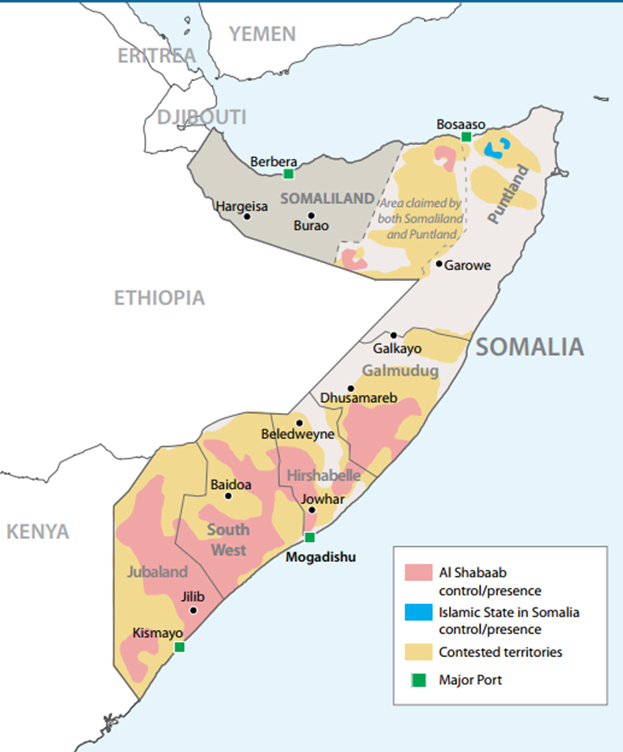
Somalia, since 1991, has been a center of international, regional, and national security and insecurity providers where competing forces-MBHs, al-Qaeda, and ISIS affiliates-operate. Particularly, the MBHs and Al-Shabaab are influential actors, the latter posing a serious threat to regional peace and security. MBHs, through the Al-Islah affiliate and its splinter group Damul Jadiid, have significant influence and control over state institutions, universities, schools, and banks.
Al-Islah was the Somali chapter of the Egyptian Muslim Brotherhood, active in Somalia since the 1970s.[20] After facing government crackdowns during Siad Barre’s reign, it re-emerged by taking advantage of the power vacuum following the 1991 state collapse. Embracing a more conservative orientation, Dam Jadiid split from Al-Islah and later joined the Islamic Courts in armed resistance against the Transitional Federal Government and Ethiopia in 2006. Over time, Damul Jadiid’s strategy shifted: initially non-violent, it turned to violence during the 2006-2008 Ethiopia intervention in Somalia, then reverted to non-violence, and eventually became a main influencer of Somalia’s political transition.
Damul Jadiid significantly shaped Somalia’s political transition. During the first term of Hassan Sheikh Mohamud (2012-2017), founder and chairman of the Al-Islah-affiliated Peace and Development Party, members of Damul Jadiid held key government positions in ministries such as State, Interior, Justice, Social Affairs, Education, Planning, and Security.[21]
During this period, Somalia’s foreign policy shifted away from continental and regional organizations (AU and IGAD) and reoriented towards the Arab and Muslim world, largely due to Damul Jadiid’s influence.[22] Qatar, Turkey, and Egypt who are main backers of MBHs emerged as Somalia’s new partners, reinforcing the country’s Arabization and de-Africanization of foreign policy, while complicating relations with African partners.
Muslim Brotherhood-Affiliated and Other Islamist Networks in Somalia
| Organization | Type / Affiliation | Status | Notes (with Sources) |
| Al-Islah | The Somali branch of the Muslim Brotherhood | Active civic/reform movement (non-violent) | Long-established Islamist reform movement tied to Brotherhood ideas, historically engaged in social, educational, and political activities; some elements (Damul Jadiid) participated in armed resistance circa 2006, but Al-Islah generally pursues political and social influence. |
| Damul Jadiid (“New Blood”) | Faction/Offshoot of Al-Islah | Active and has high policy influence indirectly | Originated as a militant faction within Islamist politics; its members have held political power, giving it indirect influence in governance. |
| Al-Shabaab | Armed Islamist militant group (Al-Qaeda affiliate) | Active | Controls significant rural and some urban areas in South-Central Somalia of Jubaland, South West State, Hirshabelle, and Galmudug. It also has a limited presence in the newly established SSC-Khaatumo; pledged allegiance to al-Qaeda, and remains the dominant militant Islamist organization in Somalia |
| ISIS-Somalia | Armed Islamist militant group (ISIS affiliate) | Active | Formed by defectors from al-Shabaab, pledged allegiance to ISIS; active mainly in Puntland |
Damul Jadiid remains influential in the incumbent government, too. The emergence of Turkey as an assertive actor in Somalia may further strengthen MBH affiliates. Turkey is thus poised to become the primary actor in Somalia and Sudan by backing MBHs, projecting power from Somalia to Libya, and extending its influence into the Red Sea, Gulf of Aden, and Indian Ocean.
Adapted from Bryden, M., 2025
Yemen
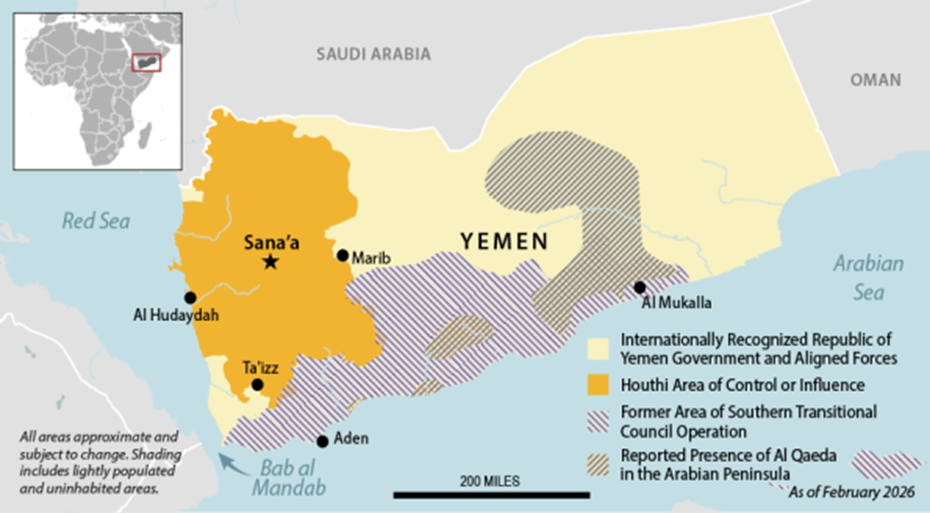
Yemen has been in a protracted war since 2014. The main actors are the Sana’a-based Iran-backed Houthis; the UAE-backed Southern Transitional Council (STC); the Saudi-backed internationally recognized government of Yemen, known as the Presidential Leadership Council (PLC); Al-Islah, an allied force of the PLC; and al-Qaeda affiliates. Both the UAE and the STC consider Al-Islah to be affiliated with the Muslim Brotherhood and classify it as a “terrorist organization.” The northwestern regions of Yemen, along with the Red Sea coast—including the strategic Hodeidah port—are controlled by the Houthis.[23] This gives Houthis leverage over the Bab al-Mandab Strait. Before the withdrawal of UAE forces, the Southern Transitional Council controlled large areas of Southern Yemen, including strategic parts of the Red Sea coast, Bab al-Mandab Strait, and nearby islands. The PLC controls vast areas bordering Saudi Arabia, Oman, and the Arabian Sea. The northern part of the Bab al-Mandab Strait is controlled by Tareq Saleh’s National Resistance Forces, while the southern part is controlled by the STC.[24]
Reports indicate that the Muslim Brotherhood may regain influence in Yemen after the UAE’s withdrawal amid the UAE-Saudi rift.[25] The PLC-aligned Al-Islah Party, associated with the Muslim Brotherhood, has remained a major political actor in Yemen since the 1990s. Its roots trace back to the 1970s Muslim Brotherhood organization known as the Islamic Vanguard Movement, from which the Yemeni Congregation for Reform (Al-Islah Party) was established in 1990. However, Al-Islah has repeatedly denied connections with international Muslim Brotherhood organizations; a stance analyst interprets as a tactic to sustain its identity amid international pressure.[26]
The UAE-backed separatist STC is highly critical of the Muslim Brotherhood in southern Yemen. Following the UAE’s withdrawal in January 2026, the STC asserted that the departure of UAE forces would create a security vacuum that could allow the Muslim Brotherhood to regroup. It also expressed concern about a possible alliance between the Muslim Brotherhood and the Iran-backed Houthis to fill this vacuum. The STC has framed its struggle not merely against Saudi-backed forces but specifically against Brotherhood-aligned actors in southern Yemen. Both the UAE and the STC view Al-Islah and the Houthis as significant actors affecting regional security. UAE wants to export its own model “which is grounded in apathy and magnanimity, in confronting terrorism and supporting peace and stability”.[27]
Adapted from Christopher M. B., 2026
Conclusion
Amidst the wider instability stretching from the Sahel to the Horn of Africa and the Middle East, the growing influence of MBHs affiliated networks may re-shape the political and security landscape of the region. The protracted conflict and instability in Sudan, Somalia, and Yemen may also further open the space for transnational security actors. It also creates a hybrid insecurity disorder. Crisis-driven Middle Eastern interventions combined with internal instability are among the most important factors fueling this re-emergence.
In Sudan, the war since April 2023 created space for MBH affiliates to reassert themselves, backed primarily by Iran and Turkey. In Somalia, MBH influence is also growing due to the hybrid order and Turkey’s assertive involvement. There are also varying levels of alignment among external actors, with crisis-led interventions often exacerbating instability:
- Yemen: The UAE backs the STC, which is critical of MBHs; Saudi Arabia supports the PLC and its MBH-affiliated Al-Islah Party; Iran backs the Houthis.
- Sudan: Saudi Arabia, the UAE, Iran, Turkey, Eritrea, Egypt, and Pakistan (indirectly, as an extension of Saudi-Pakistan defense pact) back the SAF, which includes MBH affiliates, while the UAE supports the RSF, which is critical of MBHs.
- Somalia: Turkey is the dominant external actor, but Egypt, Saudi Arabia, the UAE, and Israel also play roles.
Furthermore, the UAE and Israel are critical of MBH; Turkey and Qatar are pro-MBH; Egypt and Saudi Arabia have banned MBHs domestically but maintain ties with MBH affiliates in Yemen, Sudan, and Somalia; and Iran also backs MBH affiliates though ideologically different. This complex web of internal crises and external interventions underlines the risk of escalating instability across the Red Sea corridor and beyond, with maritime security and regional order increasingly vulnerable to the interplay of local conflicts and transnational ideological struggles.
[1] The Meir Amit Intelligence and Terrorism Information Center. (2011, June 19). The Muslim Brotherhood (Report No. 033-11). Meir Amit Intelligence and Terrorism Information Center. https://www.terrorism-info.org.il/Data/pdf/PDF_11_033_2.pdf
[2] Lagervall, R. (2021). The Muslim Brotherhood. In C. M. Cusack & M. A. Upal (Eds.), Handbook of Islamic sects and movements (pp. 73–85). Brill. https://doi.org/10.1163/9789004435544_006
[3] Stott, P. and Tommaso, V. (2021). Network of Networks: The Muslim Brotherhood in Europe. European Conservatives and Reformists Group. https://ecrgroup.eu/files/MuslimBrotherhood.pdf
[4] Adam, A. M. (2013). The rise of the Muslim Brotherhood in several Middle Eastern countries (Master’s thesis, Rutgers University, Camden, NJ). Rutgers University Libraries. http://rucore.libraries.rutgers.edu/rutgers‑lib/39402/
[5] Rękawek, K., & Sasnal, P. (2012). The Muslim Brotherhood in a post‑dictator reality (Strategic File No. 19). Polish Institute of International Affairs. https://www.pism.pl/upload/images/artykuly/legacy/files/9794.pdf
[6] Tawhidi, I. M. (2025, November 3). The Muslim Brotherhood and the case for U.S. designation. TRENDS Research & Advisory. https://trendsresearch.org/insight/the-muslim-brotherhood-and-the-case-for-u-s-designation/
[7] U.S. House of Representatives, Subcommittee on National Security of the Committee on Oversight and Government Reform. (2018, July 11). The Muslim Brotherhood’s global threat: Hearing before the Subcommittee on National Security of the Committee on Oversight and Government Reform, House of Representatives, One Hundred Fifteenth Congress, Second Session, Serial No. 115‑90. U.S. Government Publishing Office. https://www.congress.gov/event/115th-congress/house-event/108532/text
[8] U.S. House of Representatives, Subcommittee on National Security of the Committee on Oversight and Government Reform. (2018, July 11). The Muslim Brotherhood’s global threat: Hearing before the Subcommittee on National Security of the Committee on Oversight and Government Reform, House of Representatives, One Hundred Fifteenth Congress, Second Session, Serial No. 115‑90. U.S. Government Publishing Office. https://www.congress.gov/event/115th-congress/house-event/108532/text
[9] Tawhidi, I. M. (2025, November 3). The Muslim Brotherhood and the case for U.S. designation. TRENDS Research & Advisory. https://trendsresearch.org/insight/the-muslim-brotherhood-and-the-case-for-u-s-designation/
[10] Counter Extremism Project. (n.d.). Muslim Brotherhood. Counter Extremism Project. https://www.counterextremism.com/threat/muslim-brotherhood
[11] Stott, P. and Tommaso, V. (2021). Network of Networks: The Muslim Brotherhood in Europe. European Conservatives and Reformists Group. https://ecrgroup.eu/files/MuslimBrotherhood.pdf
[12] Counter Extremism Project. (n.d.). Muslim Brotherhood. Counter Extremism Project. https://www.counterextremism.com/muslim-brotherhood
[13] Roggero, C. (2025, March 20). Rise, decline… and the eternal return of political Islam. Istituto per gli Studi di Politica Internazionale (ISPI). https://www.ispionline.it/en/publication/rise-decline-and-the-eternal-return-of-political-islam-203326
[14] Open Doors International. (2021, October 10). Morocco/Middle East/North Africa: Muslim Brotherhood in decline. https://www.opendoors.org/en-US/research-reports/articles/stories/morocco-middle-east-north-africa-muslim-brotherhood-in-decline/
[15] Saleh, W., Brodeur, P., & Al Hosani, H. (2024, May 19). The Muslim Brotherhood’s International Power Index (MBIPI) 2022–2023. TRENDS Research & Advisory. https://trendsresearch.org/insight/trends-muslim-brotherhoods-international-power-index-2022-2023/
[16] Saleh, W., Brodeur, P., & Al Hosani, H. (2024, May 19). The Muslim Brotherhood’s International Power Index (MBIPI) 2022–2023. TRENDS Research & Advisory. https://trendsresearch.org/insight/trends-muslim-brotherhoods-international-power-index-2022-2023/
[17] Reuters. (2025, July 25). Sudan’s ousted ruling party aligns with army in bid to regain power. Daily Sabah. https://www.dailysabah.com/world/africa/sudans-ousted-ruling-party-aligns-with-army-in-bid-to-regain-power
[18] U.S. Department of State. (2026, March 16). Terrorist designation of the Sudanese Muslim Brotherhood. https://www.state.gov/releases/office-of-the-spokesperson/2026/03/terrorist-designation-of-the-sudanese-muslim-brotherhood
[19] POA English. (2026, March 7). Ethiopia’s National Intelligence and Security Service thwarts ISIS threat, detains. https://web.facebook.com/poaenglish/posts/ethiopias-national-intelligence-and-security-service-thwarts-isis-threat-detains/122149044524683092/
[20] Hansen, S. J., Wasuge, M., Abdullahi, A., & Adan, A.. The role of religious actors in contemporary Somali politics: Key dynamics and opportunities for engagement. Rift Valley Institute & Somali Public Agenda.
[21] Counter Extremism Project. (n.d.). Muslim Brotherhood in Somalia. Counter Extremism Project. Retrieved March 18, 2026, from https://www.counterextremism.com/sites/default/files/mb_pdf/MB%20Branch_Somalia_043019.pdf
[22] Bryden, M. (2013). Somalia redux? Assessing the new Somali federal government (Report of the CSIS Africa Program). Center for Strategic and International Studies. https://ciaotest.cc.columbia.edu/wps/csis/0029248/f_0029248_23739.pdf
[23] Chughtai, A., & Hussein, M. A. (2026, January 14). Mapping who controls what in Yemen in 2026. Al Jazeera. https://www.aljazeera.com/news/2026/1/14/mapping-who-controls-what-in-yemen-in-2026
[24] Chughtai, A., & Hussein, M. A. (2026, January 14). Mapping who controls what in Yemen in 2026. Al Jazeera. https://www.aljazeera.com/news/2026/1/14/mapping-who-controls-what-in-yemen-in-2026
[25] BBC Monitoring. (2026, January 1). Briefing: UAE media warn of Muslim Brotherhood resurgence in southern Yemen. BBC Monitoring. https://monitoring.bbc.co.uk/product/b00056yc
[26] bdulmoghni, M. (2025, December 7). The U.S. trajectory for designating Muslim Brotherhood affiliates as terrorist organisations: Where does Al-Islah Party stand? Yemen & Gulf Centre for Studies. https://ygcs.center/en/estimates/article199.html
[27] Al‑Ali, M. A. (2026, January 16). Houthis and the Muslim Brotherhood threaten Yemen and Gulf security. TRENDS Research & Advisory. https://trendsresearch.org/news/houthis-and-the-muslim-brotherhood-threaten-yemen-and-gulf-security/
About the author
Gashaw Ayferam (P.h.D), African Affairs Senior Researcher. The author research interest is geopolitics of the northeastern Africa, hydro-politics, emerging technologies, and political transition. He can be reached via mugashawbzu@gmail.com
Disclaimer:
The content disseminated by the Institute of Foreign Affairs (IFA) – including, but not limited to, publications, public statements, events, media appearances, and digital communications – reflects the views of individual contributors and does not necessarily represent the official positions or policies of the Institute, its partners, or any affiliated governmental or non-governmental entities.
While the IFA endeavors to ensure the accuracy, integrity, and timeliness of the information presented, it makes no representations or warranties, express or implied, regarding the completeness, reliability, or suitability of such content for any purpose. The Institute expressly disclaims any liability for errors or omissions, as well as for any actions taken or decisions made based on the information provided.
The inclusion of external links, references, or third-party resources does not constitute an endorsement by the Institute. Additionally, engagement on social media platforms – including, but not limited to, likes, shares, retweets (RTs), or reposts – shall not be interpreted as an endorsement or validation of the views expressed therein.
Readers and audiences are encouraged to exercise critical judgment and seek independent verification when interpreting or relying upon any information disseminated through publications and posts on the Institute’s platforms or representatives.