

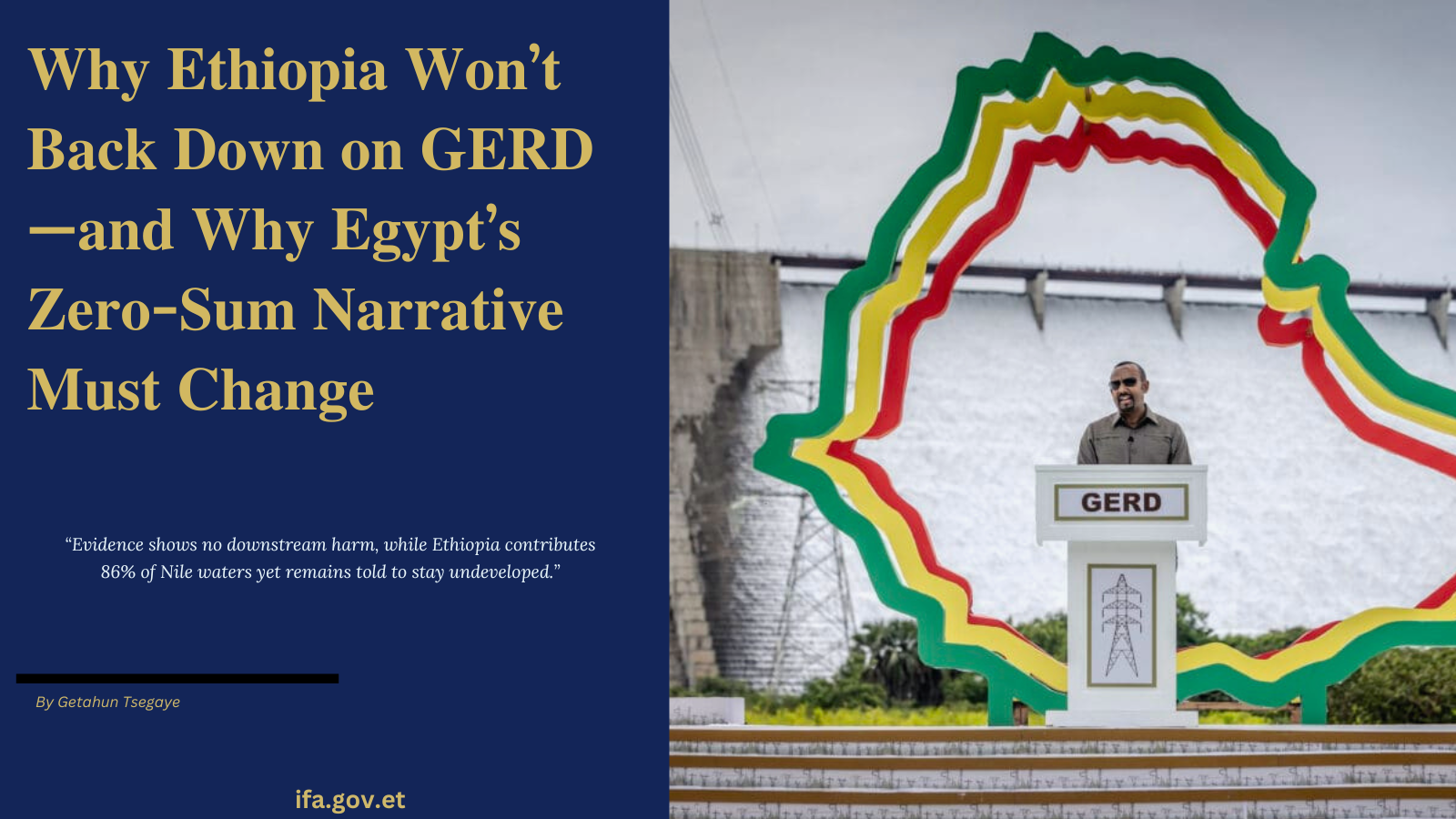
The Grand Ethiopian Renaissance Dam (GERD) stands as a transformative national project for Ethiopia — a generational public work designed to generate up to 5,150 megawatts (MW) of renewable energy, expand tourism, and accelerate industrialization. For Ethiopia, the GERD is not merely a hydropower facility; it is a cornerstone of poverty reduction, electrification, and regional energy integration. It also represents a long-delayed assertion of the country’s sovereign right to equitable and reasonable use of the Nile waters.
However, Egypt continues to oppose the dam’s operation and development trajectory. On 7 December 2025, Egypt’s Foreign Affairs Minister Badr Abdelatty repeated in a BBC-Africa interview accusations that Ethiopia is a “non-negotiating team,” marking the second time in less than a month he has used similar language. He stated: “We talked for 13 years and we reached nothing. Zero. Nothing… we will not continue in this endless track and giving the other side the opportunity to create more facts on the ground.” Abdelatty went on to argue that Egypt’s negotiations “in good faith” were allegedly exploited by Ethiopia to “impose a fait accompli,” calling the GERD “illegal” and characterizing it as a unilateral measure. He declared all talks “absolutely” frozen and asserted that Egypt “preserves the full rights to defend our national interest, and our water security… in accordance with international law.”
Ethiopia firmly rejects these claims. In September 2025, the Ministry of Foreign Affairs submitted a detailed written response to the United Nations Security Council (UNSC), underscoring that the GERD’s construction and filling are lawful expressions of Ethiopia’s sovereign right to development. The Ministry described Egypt’s position as reflecting a “colonial mindset,” stressing that Ethiopia seeks only “equitable water use and a fair right to development.” The completion of the dam, the Ministry emphasized, is “a generational aspiration fulfilled” — reshaping outdated narratives that have historically marginalized upstream nations.
Hydrologically, Ethiopia’s stance is grounded in well-established scientific realities. The Ethiopian highlands supply the overwhelming majority of Nile waters through the Blue Nile (Abbay), the Tekeze–Atbara, and the Baro-Akobo-Sobat sub-basins, contributing roughly 85–86% of the Nile’s total flow (ScienceDirect). This dominant upstream contribution reinforces Ethiopia’s principled argument that it cannot indefinitely be excluded from using its own natural resources for hydropower, agricultural modernization, and national development.
Scientific research continues to contradict alarmist claims that GERD poses significant harm to downstream countries under normal hydrological conditions. A 2024 multi-sensor remote-sensing study found no significant negative changes in downstream reservoir storage in Sudan and Egypt during the first GERD filling stages (2020–2022), with recorded variations attributed to rainfall patterns rather than Ethiopian dam operations. These findings add empirical weight to Ethiopia’s assertion that Egypt’s narrative does not align with observable scientific evidence.
Many Ethiopians, along with several upstream Nile Basin states, argue that colonial-era water treaties that awarded fixed shares exclusively to Egypt and Sudan are structurally unjust and obsolete. The emerging basin-wide cooperative framework endorsed in 2024 seeks to rectify these imbalances and promote equitable governance across the Nile Basin.
Abdelatty’s December remarks therefore signal a deliberate hardening of Egypt’s diplomatic posture and a refusal to re-enter negotiations except on Cairo’s terms. His insistence that talks are “absolutely” frozen suggests a strategic pivot toward political pressure rather than technical or fact-based dialogue. Ethiopia, in its UNSC communication, argues that such pressure represents a continuation of historic attitudes that disregard Ethiopia’s rights despite the Nile’s primary runoff originating from Ethiopian highlands.
Ultimately, the minister’s intervention highlights not just bilateral friction but a widening strategic divide over the future of the Nile. Egypt continues to frame GERD as a unilateral threat, whereas Ethiopia insists on its sovereign right to equitable water use, supported by hydrological science and modern international water law principles.
The unresolved question now is whether the Nile Basin will move toward cooperation based on fairness and updated hydrological science—or remain trapped in a zero-sum narrative shaped by outdated historical arrangements.
About the author
Getahun Tsegaye, Associate Researcher @IFA
Disclaimer :
The content disseminated by the Institute of Foreign Affairs (IFA) – including, but not limited to, publications, public statements, events, media appearances, and digital communications – reflects the views of individual contributors and does not necessarily represent the official positions or policies of the Institute, its partners, or any affiliated governmental or non-governmental entities.
While the IFA endeavors to ensure the accuracy, integrity, and timeliness of the information presented, it makes no representations or warranties, express or implied, regarding the completeness, reliability, or suitability of such content for any purpose. The Institute expressly disclaims any liability for errors or omissions, as well as for any actions taken or decisions made based on the information provided.
The inclusion of external links, references, or third-party resources does not constitute an endorsement by the Institute. Additionally, engagement on social media platforms – including, but not limited to, likes, shares, retweets (RTs), or reposts – shall not be interpreted as an endorsement or validation of the views expressed therein.
Readers and audiences are encouraged to exercise critical judgment and seek independent verification when interpreting or relying upon any information disseminated through publications and posts on the Institute’s platforms or representatives.