

Introduction
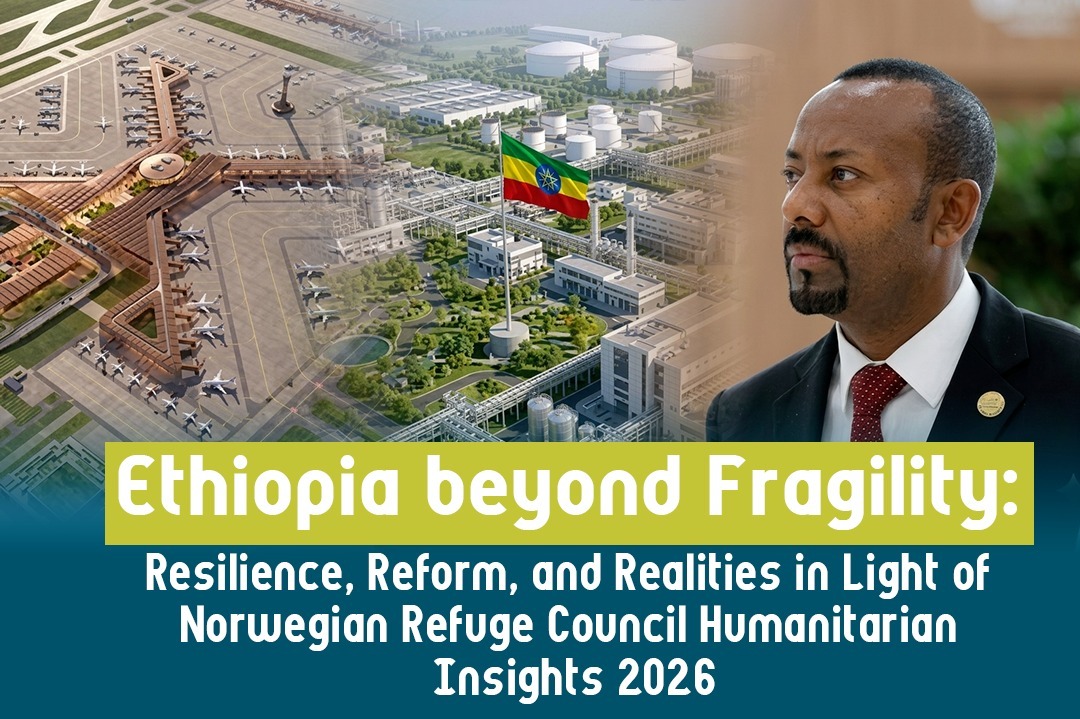
The brief by the Norwegian Refugee Council (NRC) on Humanitarian Insight 2026 portrays Ethiopia primarily through a narrative of structural fragility, political instability, and escalating humanitarian crises. While the report raises legitimate concerns about ongoing conflicts and humanitarian challenges in regions such as Amhara, Oromia, and Tigray, the analysis presents a largely pessimistic interpretation of Ethiopia’s trajectory. It overlooks the country’s ongoing peacebuilding efforts, including the Ethiopian National Dialogue Commission’s progress, efforts to address unresolved settlements in Tigray, peaceful calls for armed actors to negotiate, economic reforms under the Homegrown Economic Reform Agenda, and preparations for the 7th national election with broad participation from political parties and independent candidates. This policy brief aims to conceptualize the NRC’s focus on Ethiopia within its 2026 humanitarian insights.
Structural Fragility
The Norwegian Refugee Council (NRC) report portrays Ethiopia in 2026 as structurally fragile, with a federal government that projects authority outwardly but faces uneven governance, local conflicts, economic and social pressures, climate impacts and humanitarian challenges across its diverse and expansive periphery. While the reality on the ground indicates that Ethiopia enters 2026 with strong regional states that function in line with the powers and rights granted to them under the constitution, governance in these regions is far from being imposed through coercion.
The federal government actively supports regional administrations, and tangible investments in infrastructure and development are evident. These include urban corridor projects, and rural improvements that connect communities and facilitate robust economic activity.
Contrary to the NRC’s framing of Ethiopia as “ethnically fractured” and its claim that national cohesion is under threat, the country’s ethnic and cultural diversity serves as a source of strength rather than conflict. This diversity reflects a long history of peaceful coexistence and social stability. For millennia, Ethiopians have maintained a shared sense of identity and lived together harmoniously, transcending individual differences to build a unified national fabric.
Ethiopia strives to resolve internal conflicts and achieve political stability through peaceful mechanisms, such as national dialogue, rather than coercion. Evidence indicates that thousands of representatives from more than 600 districts—including civil society organizations, academic institutions, and other key stakeholders—participated in the national dialogue process throughout 2025. Notably, consultations in the Amhara region continued despite ongoing challenges, while engagement in Tigray progressed by December 2025. This inclusive process also incorporated vital input from the Ethiopian diaspora across Europe, North America, and Africa [1].
Despite global and domestic economic pressures, Ethiopia has achieved promising results through the Homegrown Economic Reform Agenda (HGER). The country has exceeded expectations in macroeconomic stability, with inflation declining to 11.9% in 2025/2026, alongside robust export growth and increased international reserves—achievements recognized by both the IMF and the World Bank [2].
Furthermore, Ethiopia has been implementing agricultural transformation programs to expand crop production and increase productivity in the dairy, meat, poultry, fisheries, and honey sectors. These efforts are supported by initiatives such as Yelemat Tirufat and the Green Legacy Initiative (GLI), which focus on nutritional bounty and climate-smart agriculture, respectively, to strengthen food security and economic resilience across the country [3].
The 7th Ethiopian National Election
The brief by Norwegian Refugee Council also argues that the upcoming Ethiopia’s 7th national election may not function as a credible mechanism for political legitimacy, suggesting that insecurity and pressure on opposition groups could limit competitive politics. However, recent developments reported by the National Election Board of Ethiopia (NEBE) indicate substantial electoral preparations. A total of 47 legally registered political parties are competing in the upcoming election, fielding 10,934 candidates, including 2,198 for the Federal Parliament and 8,736 for regional councils. In addition to party-affiliated contenders, 73 independent candidates have registered to participate. The electoral process has also entered the campaign phase, with competing parties actively engaging in public media outreach [4].
Furthermore, efforts are underway to increase accessibility and transparency in voter registration through both manual and digital systems. A notable example is the launch of the “Mirchaye” (My Election) mobile application, which stands as an exemplary development. This digital platform showcases ongoing institutional initiatives to facilitate broad participation and strengthen the credibility of Ethiopia’s 7th national election.
Although the Norwegian Refugee Council suggests that the electoral environment may consolidate authority around Dr. Abiy Ahmed and the Prosperity Party, trends following Ethiopia’s 6th national election indicate continued engagement of competing political parties within the country’s governance structures. While the Prosperity Party won the previous election, reports show that approximately 275 representatives from competing parties currently hold leadership positions at different levels of government, including federal and regional institutions, often through collaborative arrangements with the Prosperity Party. This demonstrates that Ethiopia’s political system continues to provide the institutional space necessary for competing parties to participate in the country’s transformation. Consequently, current political dynamics suggest a more cooperative and inclusive environment than the fragile scenario implied in the NRC brief.
Conflict and Insurgency
Evidence indicates that Ethiopia is actively pursuing peaceful mechanisms to resolve conflicts, as demonstrated by the December 5, 2025 agreement between the federal government and the Fano Movement (FANO-AFPO), which focused on reconciliation, dispute resolution, security, and strengthening national cohesion. The signing ceremony was witnessed by the Deputy Chairperson of the African Union Commission, Salma Malika Haddadi, and the Deputy Executive Secretary of the Intergovernmental Authority on Development (IGAD), Mohamed Abdi Ware, underscoring IGAD’s role as a key regional mediator and the continental support for Ethiopia’s peacebuilding efforts [5].
In the Tigray Region, the Pretoria Agreement effectively concluded large-scale hostilities between the federal government and forces associated with the Tigray People’s Liberation Front (TPLF). This cessation of conflict has enabled the disarmament, demobilization, and reintegration (DDR) process and the gradual restoration of essential services, although certain implementation challenges persist.
Even though there is huge obstacle on DDR program in Tigray, the recent reports indicate progress in peace and stabilization efforts in Tigray . “H.E. Temesgen Tiruneh, Commissioner of the National Rehabilitation Commission of Ethiopia, significant progress has been made in addressing insurgency through peaceful mechanisms. He indicated that around 70 former Tigray People’s Liberation Front fighters who had been in Sudan returned to Ethiopia and joined the Disarmament, Demobilization, and Reintegration (DDR) process. In addition, more than 85,000 combatants from Amhara Region, Oromia Region, Tigray Region, and Afar Region have entered peaceful negotiation mechanisms facilitated through the national dialogue process. He emphasized that this represents a major achievement and a promising step toward sustainable peace. The Commission has also facilitated rehabilitation by providing training, employment opportunities, and seed capital to help former combatants start their own businesses”[6].
Access to the Sea
While the NRC highlights Ethiopia’s pursuit of sea access as may be potential source of conflict and regional instability, the reality indicates a clear commitment to peaceful diplomacy. Prime Minister Dr. Abiy Ahmed has repeatedly emphasized that Ethiopia’s quest for maritime access is not expansionist or aggressive, but a vital strategic necessity for the survival of over 130 million Ethiopians, supporting trade, economic development, and national resilience. He has consistently called for negotiated solutions and regional dialogue, engaging with neighboring states and international partners to secure access without confrontation. This approach supported by the United Nations (UN) and many Western countries, which have publicly encouraged Ethiopia to pursue maritime access through peaceful, legal, and diplomatic channels, highlighting that such efforts should respect Eritrea’s sovereignty and international norms. Together, these developments demonstrate that Ethiopia’s strategy is far from the militarized and high-risk scenario suggested by the NRC, reflecting a responsible and cooperative approach to achieving a long-standing national goal.
Conclusion
The Humanitarian Insight 2026 reported by the Norwegian Refugee Council offers an important perspective on Ethiopia’s challenges; however, it does not fully capture the country’s broader realities and ongoing progresses. In particular, it overlooks key achievements in economic reform under the Homegrown Economic Reform Agenda, including macroeconomic stability, export growth, and strengthened international reserves. At the political level, Ethiopia is advancing inclusive process in preparation for 7th national election, characterized by the active participation of political parties and independent candidates as well as enhanced accessibility through both digital and manual voter registration and promising condition for legitimate and credible democratic election. Moreover, the government has made notable efforts to address conflicts through peaceful means, including nationwide consultations under the Ethiopian National Dialogue Commission, agreements with certain armed groups, and ongoing disarmament, demobilization, and reintegration initiatives. These efforts reflect a clear commitment to negotiation and reconciliation rather than coercive approaches. In addition, Ethiopia’s pursuit of access to the sea is being conducted through diplomatic and peaceful channels, underscoring its strategic importance for trade and economic resilience for a population exceeding 130 million.
Reference
[1]. Borkena. (2025, April 6). National dialogue agenda gathering in Amhara region amid ongoing war. https://borkena.com/2025/04/06/ethiopia-national-dialogue-agenda-gathering-in-amhara-region
[2] IMF& World Bank,2025). Joint IMF-World Bank debt sustainability, (IMF,2025) .Fourth Review under the Extended Credit Facility Arrangement for Ethiopia. ttps://www.imf.org/en/news/articles/2026/01/16/p.
[3]. Elfenesh Muleta.(2024). Addis Ababa call to action: Roadmap for World without hunger. tps://www.ifa.gov.et/2024/11/26/ethiopias.
[4]. National Election Board of Ethiopia. (2026, February 23). Political parties sign code of conduct for Ethiopian elections 2026. https://www.plenglish.com/news/2026/02/23/political-parties-sign-code
[5]. Dawan Africa. (2025, December 5). Ethiopian government, Fano movement sign historic peace deal. Dawan Africa. https://www.dawan.africa/news/ethiopian-government-fano-movement-sign-historic-peace-deal
[6]. From the Sudanese Border to a Path of Peace: The Return of Ethiopia’s “Army 70”. (2026, March 11). Ethiopian Broadcasting Corporation. https://www.ebc.et/english/Home/NewsDetails?NewsId=4443
About the Author
Elfenesh Muleta (Ph.D.) is the Director General for Multilateral Affairs at the Institute of Foreign Affairs.
Disclaimer:
The content disseminated by the Institute of Foreign Affairs (IFA) – including, but not limited to, publications, public statements, events, media appearances, and digital communications – reflects the views of individual contributors and does not necessarily represent the official positions or policies of the Institute, its partners, or any affiliated governmental or non-governmental entities.
While the IFA endeavors to ensure the accuracy, integrity, and timeliness of the information presented, it makes no representations or warranties, express or implied, regarding the completeness, reliability, or suitability of such content for any purpose. The Institute expressly disclaims any liability for errors or omissions, as well as for any actions taken or decisions made based on the information provided.
The inclusion of external links, references, or third-party resources does not constitute an endorsement by the Institute. Additionally, engagement on social media platforms – including, but not limited to, likes, shares, retweets (RTs), or reposts – shall not be interpreted as an endorsement or validation of the views expressed therein.Readers and audiences are encouraged to exercise critical judgment and seek independent verification when interpreting or relying upon any information disseminated through publications and posts on the Institute’s platforms or representatives.